Merge BizDev and Marketing to Win High-Value Accounts Faster
- Marketing
- Word of the Day
- September 23, 2026
Merge BizDev and Marketing to Win High-Value Accounts Faster
Build a Business Development Marketing Strategy That Wins Better-Fit Clients

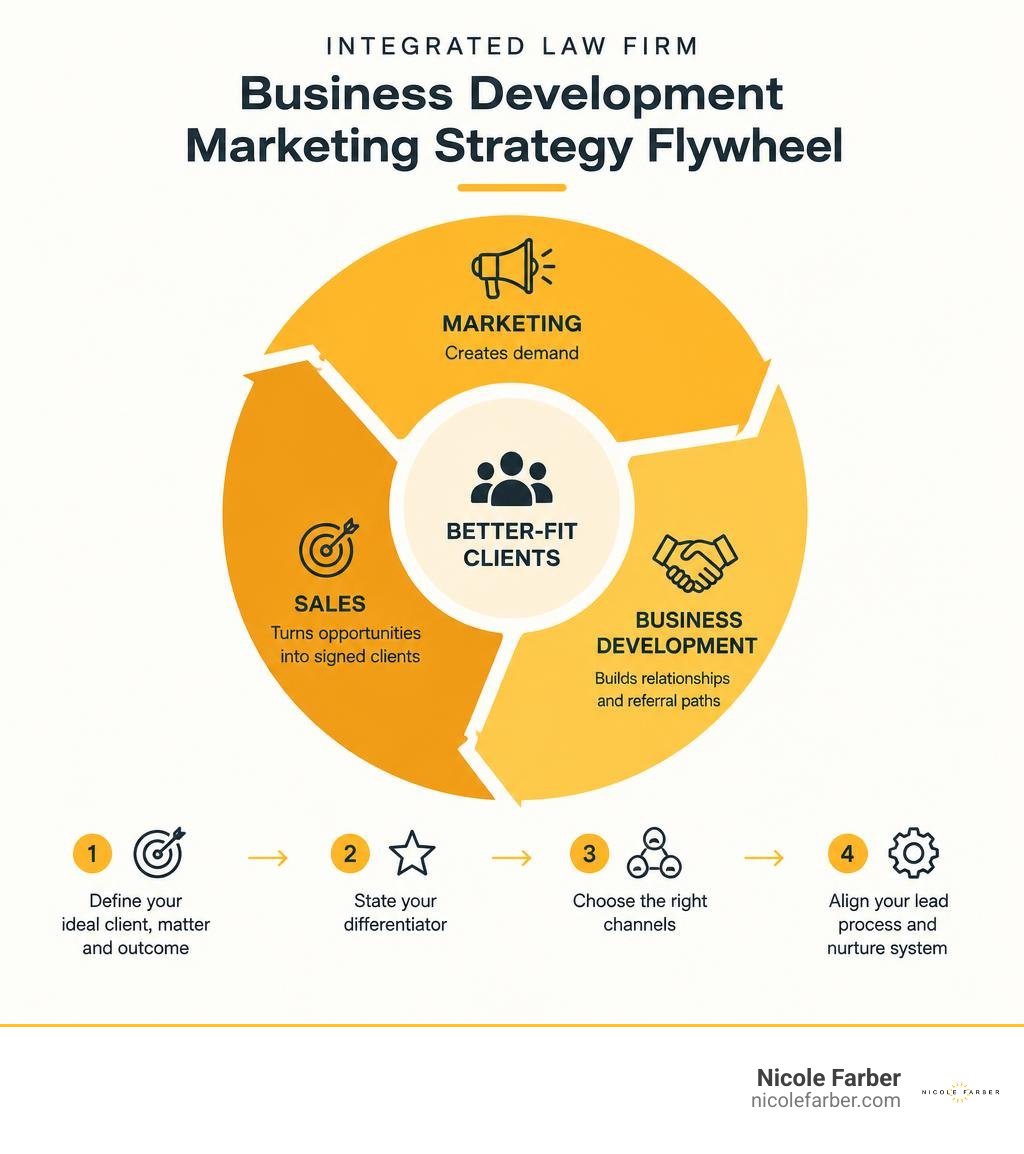
A strong business development marketing strategy connects three jobs that are too often separate: marketing creates demand, business development builds high-value relationships and referral paths, and sales turns qualified opportunities into signed clients. For a law firm, start by:
- Define the client, legal matter, and outcome you want to be known for.
- State a clear reason that client should choose your firm over alternatives.
- Pick a small number of channels where those clients and referral partners already spend time.
- Agree on how leads are qualified, followed up, tracked, and nurtured after the first matter.
This alignment matters because attention alone does not create a healthy pipeline. Your content, outreach, referral relationships, intake process, and client experience must reinforce the same promise. When they do, your firm can spend less time chasing every inquiry and more time earning trust with matters that fit your practice.
Poor go-to-market execution contributes to nearly 40% of startup failures, even where product-market fit is strong. The same lesson applies to firms: expertise is essential, but it must be paired with a repeatable way to reach, convert, and retain the right clients.
I am Nicole Farber, CEO of ENX2 Legal Marketing, with more than 15 years of experience helping law firms and businesses improve visibility, client acquisition, and sustainable growth. In this guide, I will show you how to turn a business development marketing strategy into a practical system your team can use.
Basic business development marketing strategy glossary:
Aligning Business Development, Sales, and Marketing Engines
To build scalable revenue, we must first stop treating our revenue departments like isolated islands. When marketing produces downloads that sales never calls, or when business development opens enterprise relationships that marketing never supports with collateral, growth stalls.
As outlined in The GTM Strategy Playbook, market leaders unify these disciplines into an interconnected ecosystem.
| Function | Primary Objective | Time Horizon | Key Deliverables | Core Success Metric |
|---|---|---|---|---|
| Marketing | Build brand awareness, capture intent, and generate qualified demand at scale | Short-to-Medium Term (0–6 Months) | Content, campaigns, SEO, webinars, lead magnets | Marketing Qualified Leads (MQLs), Cost Per Acquisition (CPA) |
| Sales | Convert qualified active demand into signed contracts and immediate revenue | Short Term (Immediate / 30–90 Days) | Pitches, demos, objection handling, closing | Win Rate, Average Deal Size, Quota Attainment |
| Business Development | Create new market access, strategic alliances, distribution moats, and high-value pipelines | Long Term (6–24 Months) | Strategic partnerships, co-selling agreements, channel integrations | Pipeline Value Generated, Partner-Sourced Revenue, Lifetime Value (LTV) |
The Distinct Roles in Revenue Generation
Marketing initiates demand by educating the broader market about the problems our business solves. Sales executes transactionally on active opportunities by guiding prospects through the final decision stages. Business development creates the structural conditions that make sustained sales possible.
Through winning business development strategies every growing company needs, organizations establish long-term equity. Rather than chasing one deal at a time, business development identifies non-linear expansion avenues—such as an accounting firm referring high-net-worth commercial litigation files to a boutique law practice in Philadelphia or New Orleans.
Establishing a Cross-Functional Go-To-Market Alignment
True growth requires clear rules of engagement between teams. Without explicit operational standards, friction replaces momentum. We advocate establishing strict process before promotion to maintain operational clarity across all client acquisition touchpoints.

A unified strategy relies on three concrete operational alignment mechanisms:
- Service Level Agreements (SLAs): Marketing commits to delivering a specific volume of leads meeting distinct intent criteria, while sales commits to contacting those leads within a defined timeframe.
- Predictive Lead and Account Scoring: Combining behavioral data (content engagement, webinar attendance) with firmographic fit to prioritize high-value targets.
- Closed-Loop Feedback Rhythms: Bi-weekly synchronization meetings where business development and sales report on account sentiment, allowing marketing to refine messaging in real time.
Core Pillars of a Unified Business Development Marketing Strategy
Building an engine that reliably captures market share requires strong operational foundations. By following 7 Steps to Build a Marketing Strategy That Actually Works in 2026, organizations can move past uncoordinated promotional tactics toward sustainable value creation.

Pinpointing the Value Proposition and Ideal Customer Profile
Before launching outbound outreach in competitive hubs like Wilkes-Barre or Luzerne County, we must establish our defensible market difference. If your value proposition sounds identical to five competitors, price becomes your only differentiator.
To break out of the commodity trap, we help organizations stop chasing and start attracting with a client acquisition system. We determine:
- The Core Pain Point: What operational, financial, or legal risk keeps the buyer awake at night?
- The Defensible Difference: What proprietary process, niche specialization, or technological advantage do we offer that cannot be easily copied?
- Unit Economic Viability: Does this target segment possess sufficient deal size and lifetime value to justify our acquisition investment?
Building Distribution Moats Through Strategic Channel Partnerships
Products and baseline services are increasingly easy to replicate. Because of this, distribution access is often a far stronger competitive moat than core product features. Being easily accessible and trusted across existing channels frequently outperforms simply being better.
By actively building a referral network, we secure recurring pipeline without proportional increases in advertising spend. Strategic channel alliances include:
- Co-Selling Agreements: Teaming up with non-competing service providers targeting the same buyer.
- Integrations and Value-Add Bundles: Embedding our services into broader operational packages.
- Cross-Border Expansion Networks: Expanding professional reach between markets such as USA commercial centers and international hubs like Antigua Guatemala.
Step-by-Step Execution: Building a Repeatable BizDev and Marketing Flywheel
Translating conceptual strategy into day-to-day execution requires structure. Companies can follow proven methodologies, such as those in HubSpot’s guide on How to Build a Market Development Strategy, to scale into new segments without operational drag.
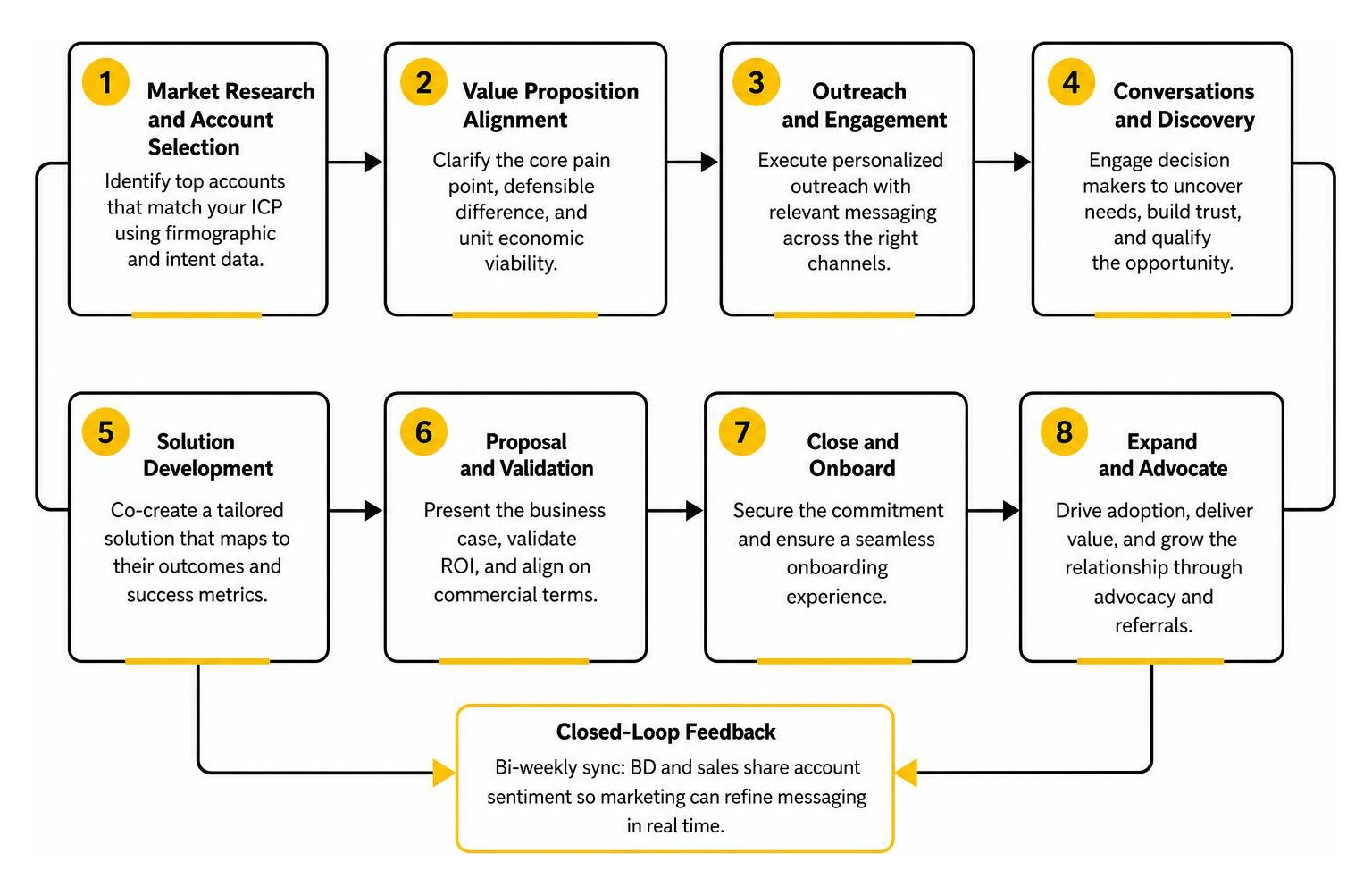
Designing a Step-by-Step Business Development Marketing Strategy Framework
To avoid disorganization, teams must stop winging it and use a business development plan template that maps out clear execution phases:
- Market Research and Account Selection: Identify top accounts that match your Ideal Customer Profile (ICP) using firmographic and intent data.
- Content and Asset Orchestration: Develop persona-specific assets, case studies, and diagnostic tools to address key pain points.
- Multi-Touch Integrated Outreach: Coordinate marketing touches (targeted digital ads, organic content) with direct business development outreach (personalized video, executive networking).
- Relationship Cultivation and Discovery: Conduct structured discovery sessions focused entirely on client challenges rather than premature capability presentations.
- Collaborative Solution Design: Structure proposals that clearly quantify expected return on investment and risk reduction.
Balancing Customer Acquisition, Retention, and Expansion
Sustainable growth protects unit economics as it compounds. If a business loses clients as quickly as it acquires them, acquisition spend becomes a financial drain.
Applying customer acquisition management 101 from first hello to long-term retention ensures our focus remains balanced across three growth levers:
- Acquisition: Generating new logos through direct inbound, account-based outreach, and channel referrals.
- Retention: Maintaining high service standards and proactive account governance to preserve Net Revenue Retention (NRR).
- Expansion: Systematically identifying cross-sell and upsell opportunities within existing accounts.
Leveraging Technology and Metrics for Scalable Growth
Modern revenue engines run on data. As detailed in the B2B Business Development Strategy Framework, adopting modern business systems allows organizations to scale sustainably while maintaining high conversion rates across every stage of the pipeline.

How AI Tools Accelerate Your Business Development Marketing Strategy
Artificial intelligence has shifted from an experimental tactic to a core operational standard for revenue teams. When implemented thoughtfully, AI eliminates hours of administrative research, giving professionals more time to build authentic human connections.
In our resource, the lawyers guide to ai and roi, we explore how leading practices utilize tools like Claude and Salesforce Einstein to:
- Synthesize Account Intelligence: Analyze extensive filings, market news, and company reports in minutes to pinpoint business drivers before an introductory call.
- Draft Hyper-Personalized Messaging: Create tailored value propositions for specific industry verticals while maintaining brand standards.
- Predict Deal Slippage: Use machine learning models to identify accounts exhibiting stalled communication patterns, enabling proactive intervention.
Critical Metrics for Measuring Growth Performance
To evaluate the health of our growth engine, we track clear indicators that balance immediate pipeline activity with long-term financial sustainability, as detailed in our guide on key strategies for growing a business.
- Customer Acquisition Cost (CAC): Total sales and marketing investment required to win a single new client.
- Customer Lifetime Value (LTV): Total gross margin generated over the entire lifespan of the client relationship.
- LTV to CAC Ratio: A target ratio of 3:1 or higher indicates a healthy, sustainable growth engine.
- Pipeline Velocity: The speed at which opportunities move from initial qualification to closed revenue.
- Repeat Order / Matter Rate: The percentage of clients who re-engage for subsequent services or introduce direct peer referrals.
Common Growth Pitfalls and How to Overcome Them
When growth stalls, the issue rarely stems from lack of effort; more often, it comes from uncoordinated execution. Here are four common traps to avoid:
- Premature Team Expansion: Hiring business development managers before the founder or core leadership has established a repeatable outreach and conversion model.
- Confusing Activity With Progress: Measuring logged calls, sent emails, and networking lunches instead of qualified pipeline value and signed engagements.
- Channel Over-Reliance: Placing your entire acquisition model on a single channel, leaving the firm vulnerable to algorithm shifts or platform price hikes.
- Siloed Departmental Goals: Allowing marketing to celebrate lead volume while sales misses revenue targets due to poor lead quality.
When unexpected market disruptions happen, teams can bounce back better essential business resilience strategies by auditing their unit economics, pausing unproven marketing experiments, and re-engaging their existing referral core.
Frequently Asked Questions About Business Development Marketing
What is the difference between business development and marketing?
Marketing focuses on building brand awareness and capturing demand across broader market segments through scalable digital and traditional channels. Business development establishes direct relationships, strategic distribution alliances, and customized partnership models that open access to new customer groups.
How long does an integrated business development strategy take to show ROI?
Leading indicators—such as target account engagement, qualified discovery calls, and early pipeline opportunities—typically surface within 60 to 90 days. Meaningful, compounding financial returns from major channel partnerships and high-value accounts generally mature over a 6 to 18-month horizon.
How should small teams balance acquisition versus partnership development?
We recommend the 70-20-10 portfolio model:
- 70% of resources allocated to proven acquisition channels (such as high-intent SEO, direct referral networks, and targeted outreach).
- 20% dedicated to emerging strategic partnerships and co-marketing channels.
- 10% invested in experimental campaigns and emerging marketing platforms.
Conclusion
Winning high-value accounts does not require chasing every new trend or adding complex tools to your stack. Real growth comes from aligning your message, relationships, and conversion paths into a clear, repeatable engine.
By uniting marketing demand, business development partnerships, and structured sales processes, your firm can build a lasting competitive advantage. As leaders, our role is to guide this execution with clarity, purpose, and steady focus.
Take the next step in establishing your growth foundation by building a business development plan that aligns your team, strengthens your market presence, and attracts the high-value clients your firm is built to serve.