Winning Business Development Strategies Every Growing Company Needs
- Marketing
- Word of the Day
- September 4, 2026
Winning Business Development Strategies Every Growing Company Needs
Business Development Strategies That Create Sustainable Growth

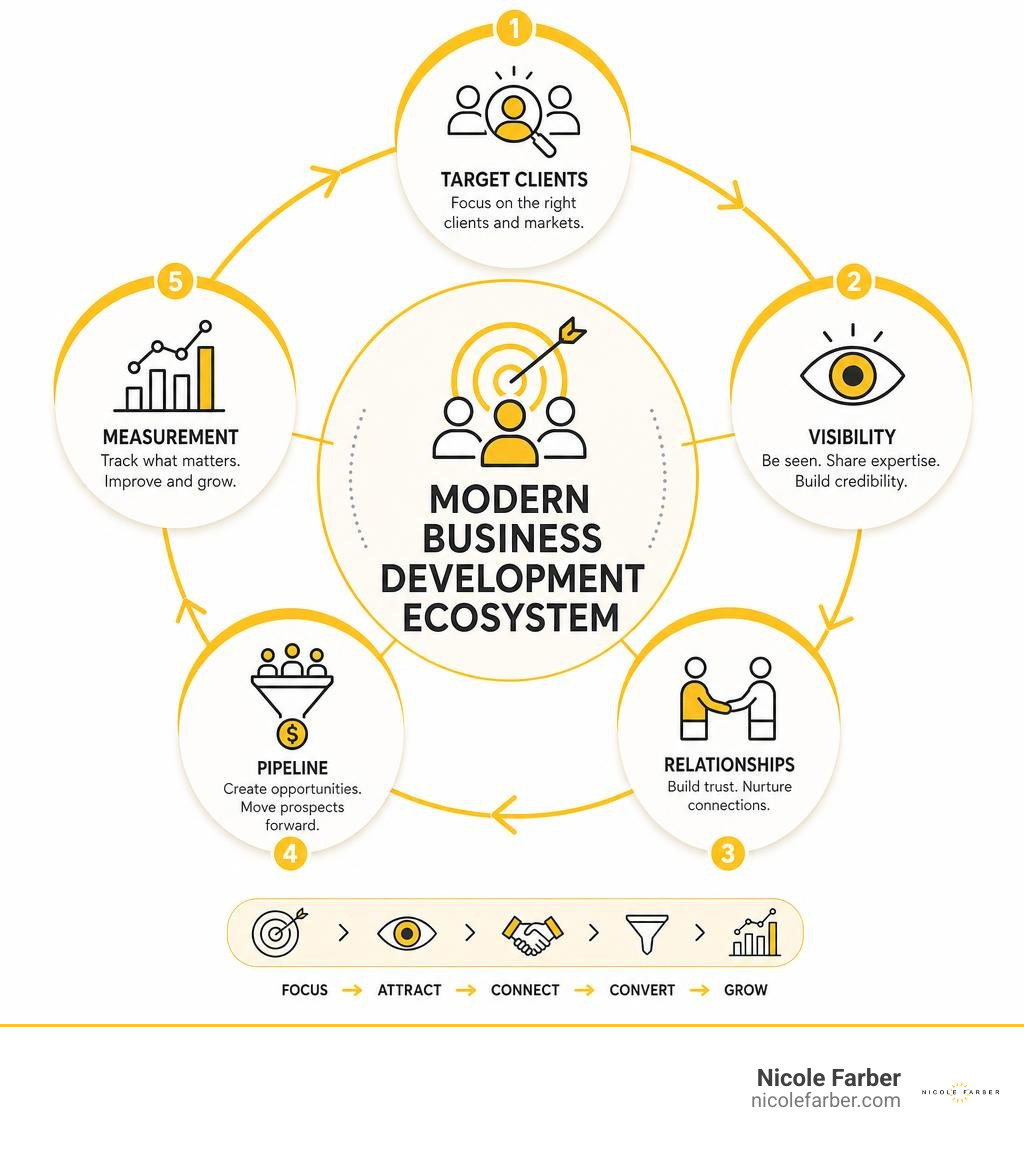
The best business development strategies turn growth from a series of random deals into a repeatable system. Start by:
- Choosing a narrow group of ideal clients or markets.
- Researching their needs, buying process, and alternatives.
- Defining a clear reason they should choose you.
- Building a focused mix of visibility, relationships, referrals, and outreach.
- Tracking qualified opportunities, conversion rates, cost, retention, and revenue – then improving what works.
For growing law firms and professional services businesses, this work matters long before a prospect calls. Research on professional services firms found that more than half of potential clients rule out a firm before speaking with anyone. Your digital presence, reputation, expertise, and referral network must therefore make the right impression early.
Business development is broader than sales. Sales closes opportunities; marketing creates awareness and demand; business development finds new markets, builds partnerships, strengthens relationships, and creates the conditions for long-term growth. The strongest plans connect all three functions without chasing every possible channel.
I am Nicole Farber, CEO of ENX2 Legal Marketing, with more than 15 years of experience helping law firms and businesses improve visibility, client acquisition, and sustainable growth. In this guide, I will break down practical business development strategies that help you focus your effort and build momentum with purpose.
Related content about business development strategies:
Business Development Foundations: Aligning Growth Functions
When companies set out to grow, they often stumble into a common trap: treating every growth function as an isolated department. Marketing works in its creative silo, sales runs after monthly quotas, and executive leadership scrambles after opportunistic deals. True business development acts as the connective tissue across all these operational engines.
Sustainable growth requires intentional cross-functional alignment. Business development is not merely a fancy synonym for high-pressure sales calls; it is the structured process of identifying untapped market opportunities, cultivating long-term strategic relationships, and laying down the pipelines that feed your conversion machinery. When we take a structured approach to growth, we unlock business potential by turning unpredictable bursts of client interest into a steady, reliable expansion engine.
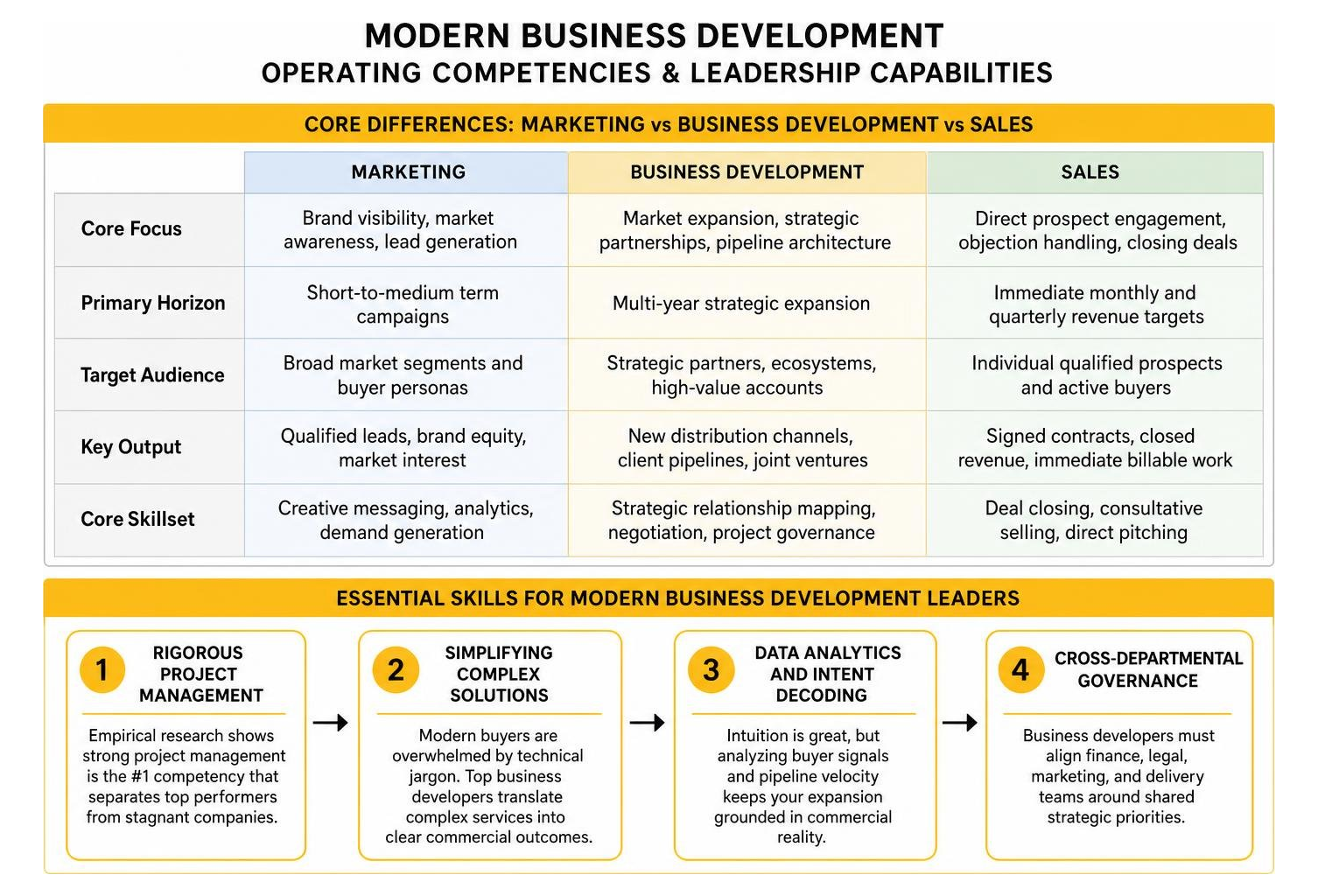
| Dimension | Marketing | Business Development | Sales |
|---|---|---|---|
| Core Focus | Brand visibility, market awareness, lead generation | Market expansion, strategic partnerships, pipeline architecture | Direct prospect engagement, objection handling, closing deals |
| Primary Horizon | Short-to-medium term campaigns | Multi-year strategic expansion | Immediate monthly and quarterly revenue targets |
| Target Audience | Broad market segments and buyer personas | Strategic partners, ecosystems, high-value accounts | Individual qualified prospects and active buyers |
| Key Output | Qualified leads, brand equity, market interest | New distribution channels, client pipelines, joint ventures | Signed contracts, closed revenue, immediate billable work |
| Core Skillset | Creative messaging, analytics, demand generation | Strategic relationship mapping, negotiation, project governance | Deal closing, consultative selling, direct pitching |
Core Differences Between Sales, Marketing, and Business Development
To build an organization that thrives across different economic cycles, we have to clarify where one function stops and another begins.
- Marketing designs the message, captures initial demand, and ensures that when potential buyers seek answers, our name comes up first.
- Sales steps in once an opportunity exists inside a known pipeline, working consultative magic to convert active prospects into paying clients.
- Business Development operates above and ahead of direct sales. It designs the bridges that make selling possible in the first place—forging alliances, opening untouched geographic territories, expanding referral networks, and architecting unvalidated revenue channels.
Many organizations find that stepping back to receive structured business strategy coaching helps them untangle these roles so their team isn’t stepping on each other’s toes while chasing growth.
Essential Skills for Modern Business Development Leaders
Running high-performing business development initiatives demands a specialized set of executive capabilities:
- Rigorous Project Management: Empirical research examining high-growth professional services firms shows that the number-one competency separating top performers from stagnant companies is strong project management rather than aggressive sales tactics.
- Simplifying Complex Solutions: Modern buyers are overwhelmed by technical jargon. Top business developers translate complex services into clear commercial outcomes.
- Data Analytics and Intent Decoding: Intuition is great, but analyzing buyer signals and pipeline velocity keeps your expansion grounded in commercial reality.
- Cross-Departmental Governance: Business developers must align finance, legal, marketing, and delivery teams around shared strategic priorities using proven business leadership strategies.
Proven Business Development Strategies for Sustainable Market Expansion

Long-term commercial success does not happen by accident. It relies on executing clear, defensible key strategies for growing a business that build a lasting moat around your services.
Designing Data-Driven Business Development Strategies
A modern growth strategy starts with defining an uncompromising Ideal Customer Profile (ICP). Rather than attempting to serve every business in the region, high-performing firms zero in on high-margin, low-friction clients where their expertise delivers undeniable results.
According to growth planning insights from the U.S. Chamber of Commerce, organizations that codify a clear growth roadmap and measure leading indicators cut decision-making time in half and allocate up to 15% more budget directly to their highest-ROI activities.
To maintain momentum without overextending your operational bandwidth, we recommend adopting the 70-20-10 channel allocation model:
- 70% of resources stay dedicated to proven, core growth channels (such as high-intent organic search and established referral networks).
- 20% of resources go toward emerging channels with high upside (such as targeted industry co-marketing webinars and account-based digital outreach).
- 10% of resources are reserved for experimental bets (such as testing novel international partner channels or piloting new software integrations).
Pairing this discipline with structured pitch collateral helps teams craft winning business development proposals and how to write them effectively to close deals faster.
Leveraging Strategic Alliances and Referral Ecosystems
Relying exclusively on cold outbound sales is expensive and exhausting. Data shows that cold calling success rates have dropped dramatically, with direct response rates falling below 2%. Conversely, strategic alliances and formalized partner ecosystems generate roughly 30% of revenue growth for top-performing B2B organizations.
By building a referral network with non-competing businesses that serve your exact target audience—such as corporate accounting firms partnering with commercial litigation attorneys—you create a reciprocal flow of pre-qualified, high-trust client opportunities.
Unlocking Growth with Municipal Incentives and Economic Tax Credits
An overlooked lever within broad business development planning is tapping into local and state economic incentives. When businesses plan geographic expansions, open new facilities, or commit to hiring benchmarks, municipalities often provide substantial tax credits, infrastructure grants, and Tax Increment Financing (TIF) packages.
In Pennsylvania, state and local programs actively assist expanding organizations that commit to regional economic development. Exploring Luzerne County business expansion programs demonstrates how local companies can leverage state support to lower operational overhead while scaling their workforce. This community-focused momentum is a major reason why luzerne county residents are leveling up their lives and launching durable enterprises.
Crucial Rule: Timing is everything with municipal tax credits. Companies must initiate applications and negotiate with local economic boards before signing commercial leases or finalizing property acquisitions; committing beforehand typically forfeits program eligibility.
Tailoring High-Growth Tactics for Professional Services and Legal Firms

Professional services firms operate under a distinct dynamic: clients hire individual experts, not faceless corporations. This dynamic creates the “seller-doer” model, where senior practitioners must balance billable work with relationship building.
Research benchmarking high-growth firms (growing at >20% CAGR over three years) against no-growth firms reveals that high-growth organizations rely heavily on structured thought leadership and strategic speaking rather than standalone traditional advertising. In fact, traditional advertising in professional services correlates with slower growth unless directly coupled with thought leadership activities.
Firms in Eastern Pennsylvania frequently leverage local resources like the Wilkes University Small Business Development Center to establish these operational growth frameworks. Mastering modern attorney business development allows practitioners to showcase their legal acumen without sacrificing hours of billable client time.
Blending Thought Leadership with Inbound Digital Channels
Over 50% of potential clients eliminate a professional services firm from consideration before ever picking up the phone. They evaluate your website, read your case summaries, review your thought leadership articles, and inspect your digital footprint in private.
To win in this buyer-led environment, firms must combine high-visibility speaking engagements with problem-focused digital content:
- Keynote Presentations and Panel Discussions: Establish immediate authority with targeted executive audiences.
- Problem-Aware Search Engine Optimization: Ensure your solutions rank when potential clients research specific operational, regulatory, or legal hurdles.
- Educational Webinars and Executive Briefings: Provide actionable value that demonstrates your firm’s problem-solving depth.
Working alongside an experienced law firm marketing coach ensures your thought leadership translates directly into qualified client inquiries rather than vanity metrics.
Client Retention and Account Expansion Systems
Acquiring a new client costs significantly more than expanding an existing engagement. Elite firms design proactive post-sale relationship systems that protect net revenue retention.
By delivering an exceptional onboarding experience, scheduling quarterly advisory reviews, and maintaining deep institutional knowledge of your client’s evolving challenges, you uncover natural opportunities to cross-sell complementary services. Mastering customer acquisition management 101 from first hello to long term retention ensures your firm builds durable, compounding revenue year after year.
Step-by-Step Blueprint: Building an Actionable Business Development Plan
A business development strategy should never be left to memory or impromptu brainstorming sessions. It must live as an actionable operating plan. Rather than winging your growth initiatives, smart leaders stop winging it and use a business development plan template to establish clear timelines, budget allocations, and execution roadmaps.
Five-Stage Operating Process: Define, Design, Build, Measure, Refine
To build a sustainable growth engine across markets like Philadelphia, Wilkes-Barre, New Orleans, or even international hubs like Antigua Guatemala, execute this five-stage operating cycle:
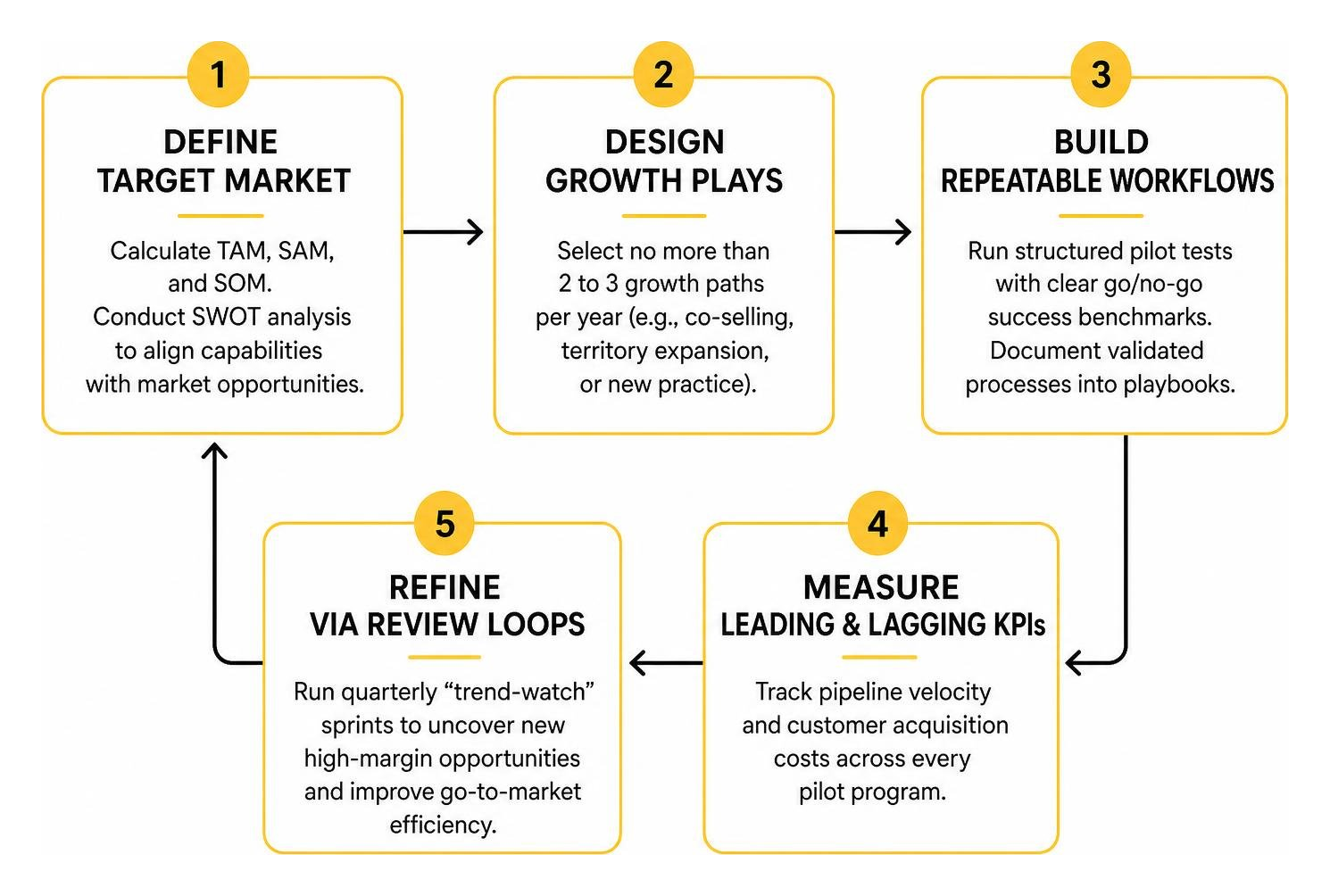
- Define: Calculate your Total Addressable Market (TAM), Serviceable Addressable Market (SAM), and Serviceable Obtainable Market (SOM). Conduct a thorough SWOT analysis to match internal capabilities against external market openings.
- Design: Select no more than 2 to 3 growth paths per year (such as strategic B2B co-selling, geographic territory expansion, or launching an enterprise practice group).
- Build: Run structured pilot tests with clear go/no-go success benchmarks. Document validated processes into standard operating playbooks.
- Measure: Track pipeline velocity and customer acquisition costs across every pilot program using a comprehensive business growth strategies ultimate guide.
- Refine: Run quarterly “trend-watch” sprints. Data indicates that leaders who conduct quarterly trend reviews uncover at least one additional high-margin market opportunity each year while reducing go-to-market research time by 20%.
Establishing Leading and Lagging Key Performance Indicators
Managing growth requires balancing future-looking activity with historical financial performance through disciplined strategic goal setting:
- Leading Indicators (Activity & Pipeline Health):
- Number of qualified partner meetings conducted monthly
- Pipeline conversion velocity across active opportunities
- Inbound executive content downloads and webinar attendance
- New referral channel introductions initiated
- Lagging Indicators (Financial Outcomes):
- Customer Lifetime Value to Customer Acquisition Cost ratio (LTV:CAC)
- Net Revenue Retention (NRR) and repeat engagement rates
- Percentage of total firm revenue driven by strategic alliances
- Total annual billings generated from newly entered target markets
Common Pitfalls in Business Development Strategies and How to Avoid Them
Even well-funded organizations run into roadblocks when scaling their business development operations. Recognizing these risks early allows teams to build necessary safeguards using bounce back better essential business resilience strategies:
- Channel Concentration: Relying exclusively on a single source of clients (such as one networking group or a single referral partner) leaves your business vulnerable to sudden market shifts.
- Tracking Vanity Metrics: Measuring social media impressions instead of qualified buyer conversations wastes energy on superficial results.
- Premature Team Scaling: Hiring dedicated sales and business development personnel before validating your core offer and unit economics bakes inefficiency into your overhead.
- Unmonitored Development Costs: Failing to track travel, event sponsorships, and entertaining expenses against actual closed contract values leads to unprofitable growth.
Frequently Asked Questions About Business Development Strategies
How does business development differ from standard sales activity?
Sales concentrates on converting prospects who are already actively evaluating a solution within an established pipeline. Business development works upstream to identify new market sectors, establish strategic partnerships, build referral channels, and create the foundational relationships that generate qualified pipelines over multi-year horizons.
What are the core components of an effective business development plan?
An actionable business development plan includes a clearly defined target audience (ICP), market research detailing customer pain points and competitor positioning, measurable SMART goals, an explicit multi-channel outreach strategy, allocated budgets, and a dashboard tracking both leading activity metrics and lagging financial performance indicators.
When should expanding businesses explore government tax incentives?
Businesses should explore local and state tax incentives, such as municipal Tax Increment Financing (TIF) and job creation credits, during the earliest stages of site selection—well before executing property leases or real estate purchases. Engaging municipal development authorities early ensures your expansion project remains eligible for state and local economic funding programs.
Conclusion
Building an enduring, high-growth enterprise is not about chasing every shiny opportunity that crosses your desk. True market expansion demands operational discipline, clear alignment between your growth functions, and a relentless focus on creating mutual value with clients and strategic partners.
Whether your organization is expanding across Philadelphia, scaling services in Wilkes-Barre, activating clients in New Orleans, or coordinating ventures across the USA and Antigua Guatemala, sustainable momentum comes from executing proven systems with clarity and purpose. By establishing strong governance, tracking honest metrics, and staying rooted in authentic relationship-building, you transform business growth into a dependable, compounding asset.
Take control of your company’s expansion roadmap today by building a business development plan that positions your firm for long-term industry leadership.