The Growth Game: Master Key Strategies to Scale Your Business
- Entrepreneurship
- In the News
- October 20, 2025
Why Growing Your Business Requires More Than Hope and Hard Work

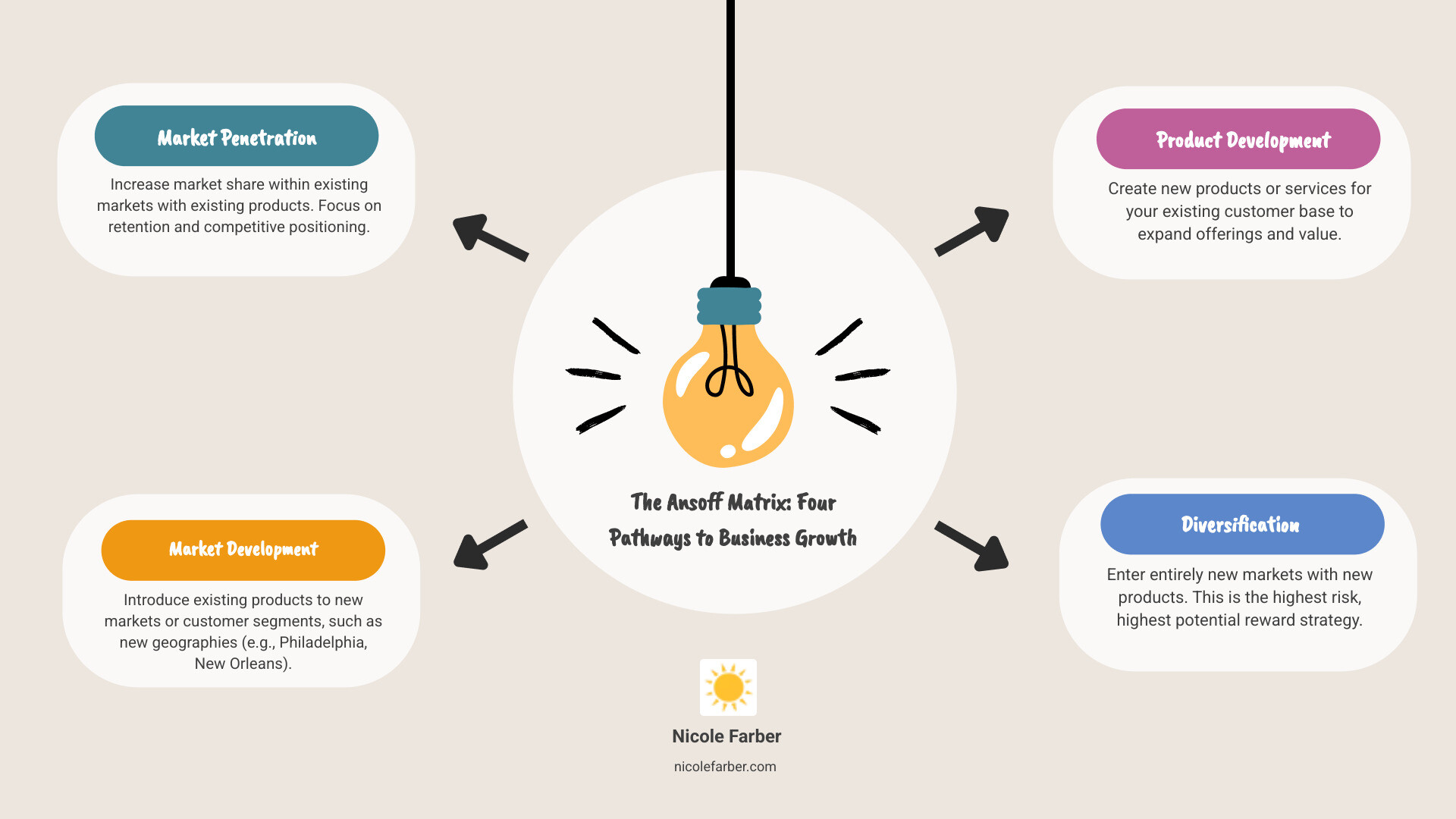
Successful entrepreneurs use four key strategies for growing a business to scale sustainably:
- Market Penetration: Increase share in existing markets.
- Market Development: Expand to new geographic areas or customer segments.
- Product Development: Create new products for your existing customer base.
- Diversification: Enter new markets with new products (highest risk, highest reward).
The statistics are sobering. According to the U.S. Bureau of Labor Statistics, only 25% of new businesses make it to 15 years or beyond. Furthermore, only a quarter of companies achieve sustainable growth, but those that do generate seven percentage points more annual total shareholder returns than their peers.
Whether you’re running a law firm in Philadelphia, a consulting practice in Wilkes-Barre, or exploring opportunities in New Orleans, the fundamentals are the same. Growth requires strategic planning, calculated risks, and consistent execution.
Companies that grow in multiple directions over a decade have double the chance of outperforming their peers, proving the value of a multi-pronged approach.
As Nicole Farber, CEO of ENX2 Legal Marketing, I’ve spent over 15 years changing struggling businesses into thriving enterprises. My experience across diverse markets shows that success comes from choosing the right key strategies for growing a business for your specific situation and executing them with precision.
Laying the Groundwork: Pre-Growth Essentials
Think of business growth like building a house; you need a solid foundation before putting up walls. Without these essential groundwork steps, even the best key strategies for growing a business can fail under pressure.
I’ve seen many entrepreneurs rush into expansion without doing their homework. The businesses that last are those that build rock-solid foundations first.
Conduct Rigorous Market Research
Market research is your business GPS, showing you where opportunities are and helping you avoid potholes. Real market research means using data to understand your ideal customers. What are their problems? What would they pay to solve? How are they currently trying to fix these issues?
This work also involves analyzing your competition. Go beyond their social media to understand their strengths, weaknesses, and where they’re leaving money on the table. Understanding customer needs in your specific market separates businesses that thrive from those that merely survive.
Each market has its own personality, from Philadelphia’s competitive legal scene to the unique dynamics of New Orleans or Luzerne County. What works in Wilkes-Barre might need tweaking for Antigua Guatemala’s cultural nuances. Resources like the Small Business Development Center | Wilkes University offer local insights that help you make data-driven decisions instead of expensive guesses.
Build an Audience Before You Launch
A powerful strategy is to build your audience first, then create what they want to buy. This creates a room full of people excited for your next move before you make it.
As Joe Pulizzi notes in Build an Audience, Not a Product, consistently creating valuable content builds trust before people even need your services. Instead of developing a service nobody wants, you’re building relationships with people who will tell you what to create. Your audience becomes your product development team.
This audience-first approach creates a “pre-customer database” of people who know, like, and trust you. When you launch, you’re not starting from zero but with a waiting community. This dramatically reduces marketing costs and speeds up your business evolution. It’s about Empowering Business Owners by building genuine connections.
Differentiate Yourself from the Competition
In today’s crowded market, being “just as good” leads to invisibility. Your Unique Selling Proposition (USP) is your business lifeline.
Differentiation can come from exceptional customer service, a resonant brand identity, or innovative solutions. The key is finding what makes you unique and delivering on that promise every time.
Authenticity beats perfection. My differentiation comes from my real-life experience as a single mother who built a business while navigating its challenges. That’s not just my story; it’s my competitive advantage.
Your differentiation might be your deep understanding of Philadelphia’s legal community or your commitment to the values of Luzerne County. Whatever it is, own it completely and weave it into everything you do. Sustainable businesses are remarkable at something specific, creating customer loyalty that can’t be copied.
The Ansoff Matrix: Four Core Pathways and Key Strategies for Growing a Business
With the groundwork laid, we can choose our path. The Ansoff Matrix, developed by H. Igor Ansoff in 1957, is a powerful framework for evaluating growth opportunities based on products and markets, helping us understand the risks and rewards of different choices.

This matrix outlines four distinct growth strategies. For a deeper dive, refer to Ansoff’s original work, Strategies for Diversification. Let’s explore each quadrant.
1. Market Penetration: Dominate Your Current Market
Market penetration is the least risky key strategy for growing a business because it focuses on familiar products and markets. The goal is to increase market share by selling more of our current offerings to our current customers.
This involves improving sales funnels and robust customer retention tactics. It costs five times more to get a new customer than to keep a current one, so retention builds loyalty and is highly cost-effective. We can use loyalty programs, targeted email campaigns, and CRM systems to manage these relationships. Starbucks excels at this with its mobile app and rewards program, encouraging repeat business.
Fulfilling customer promises and providing exceptional service is the cornerstone of Building a Successful Business.
2. Market Development: Expand into New Territories
Market development involves taking existing products to new markets or customer segments. This could mean targeting a new demographic or expanding geographically. A business in Luzerne County might open an office in Philadelphia or even expand to New Orleans or Antigua Guatemala.
When entering new geographic markets, the U.S. is a collection of local markets with unique laws and cultures. Thorough market research is paramount. A “beachhead strategy”—a focused entry to establish a foothold before expanding—can be effective for testing the waters. Resources like the Trade Commissioner Service offer crucial data for navigating international markets. Netflix’s global expansion, localizing content in over 190 countries, is a prime example of this strategy.
3. Product Development: Innovate for Your Existing Customers
Product development is another powerful key strategy for growing a business, focusing on creating new products for your existing customer base. It leverages your deep customer understanding to offer fresh value.
This can involve modifying existing products, developing different quality levels, or offering related services. For example, Moment expanded from smartphone lenses to apps and accessories. Success requires a deep understanding of customer data and preferences. Tesla exemplifies this by constantly upgrading its vehicles and software, keeping existing customers engaged. This strategy requires R&D and a culture of innovation, which is key to Overcoming Business Challenges and meeting evolving demands.
4. Diversification: The High-Risk, High-Reward Path
Diversification is the riskiest strategy, as it involves introducing new products into new markets simultaneously. While the risk is high, so is the potential reward, as it can open entirely new revenue streams.
Diversification can be “related” (synergistic with the existing business) or “unrelated” (a complete departure). Amazon’s evolution from an online bookseller to an e-commerce and cloud computing (AWS) giant is a prime example of successful diversification. They leveraged their operational expertise to create entirely new business units.
Managing strategic risk is critical. This strategy demands robust market research, a clear understanding of your capabilities, and significant investment. It’s not for the faint of heart, but it can be a game-changer for businesses with the right resources and vision.
Accelerating Growth: Beyond Organic Expansion
While the Ansoff Matrix covers organic growth, other avenues can accelerate your journey, often by leveraging external relationships or acquisitions.
Strategic Partnerships and Alliances
Strategic partnerships unite businesses to achieve more together than they could alone. These collaborations can expand reach, share resources, and foster innovation.

Forms of strategic partnerships include:
- Co-marketing efforts: Promoting each other’s products.
- Joint ventures: Creating a new entity for a specific project.
- Distribution channels: Selling products through a partner’s established channels.
- Vendor relationships: Collaborating with suppliers to optimize the supply chain.
Think of Starbucks partnering with Barnes & Noble, or Amazon’s countless alliances. These partnerships provide access to new customer bases and complementary strengths. For businesses in Philadelphia or New Orleans, strategic alliances can quickly expand market presence. Managing these relationships requires strong Business Leadership Strategies and shared goals.
Scaling Your Business: Organic Growth and Strategic Expansion
Scaling means handling increased demand and expanding operations. The two primary paths are organic growth (internal) and strategic expansion (often through mergers and acquisitions, or M&A).
Organic growth is achieved through a business’s own resources, like increasing sales or developing new products. It’s typically slower and less risky.
Strategic expansion via M&A involves acquiring other companies for immediate access to new markets, tech, or customers. Microsoft’s purchases of LinkedIn and Activision Blizzard are prime examples.
Here’s a quick comparison:
| Feature | Organic Growth | Strategic Expansion (M&A) |
|---|---|---|
| Speed | Slower, incremental | Faster, immediate market access |
| Cost | Lower initial investment, ongoing operational costs | High upfront cost (acquisition price), integration costs |
| Risk | Generally lower, more controllable | Higher (integration failures, cultural clashes, overvaluation) |
| Integration Challenges | Minimal, internal adjustments | Significant (melding cultures, systems, processes) |
| Control | High, full control over direction | Varies (depends on deal structure), potential loss of autonomy |
| Market Impact | Gradual increase in market share | Rapid increase in market share, new capabilities |
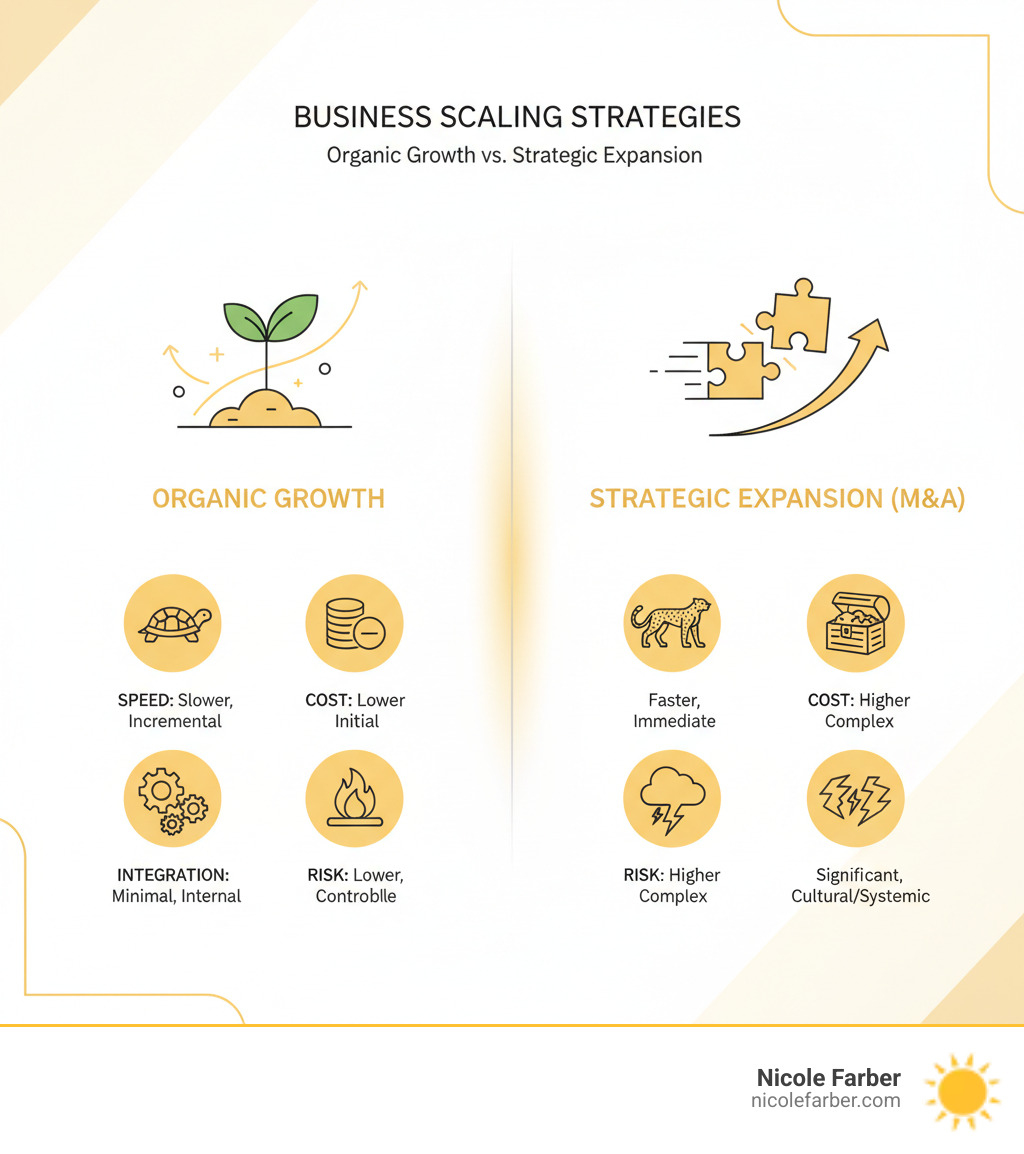
While M&A offers speed, the biggest challenge is often melding organizational cultures. Companies that align their entire organization during changes are eight times more likely to succeed.
Franchising Your Business
For some businesses, franchising is a powerful key strategy for growing a business. It allows for rapid expansion with less capital by granting others (franchisees) the right to operate under your brand and system in exchange for fees and royalties.
Think of McDonald’s or Marriott. This model leverages the entrepreneurial drive of local franchisees. However, franchising is best for businesses with a proven, repeatable model, strong brand recognition, and comprehensive operational procedures. It involves significant legal work and a commitment to maintaining brand standards. If your Luzerne County business has a robust system, franchising could be a path to national expansion.
Implementation and Measurement: Turning Strategy into Success
A brilliant growth strategy is useless without execution and measurement. It requires a methodical approach to turn your vision into reality.
Essential steps for implementing an effective business growth strategy

First, set crystal-clear, measurable goals. Use the SMART framework. Instead of “grow our business,” a better goal is “increase client revenue by 20% in our Philadelphia office by December 31st.”
Next is tactical planning, breaking big goals into actionable steps. Who does what, by when, and with what resources? If you’re expanding from Wilkes-Barre to New Orleans, your plan must cover everything from market research to hiring.
Resource allocation is about more than money; it’s about putting your best people on your most promising opportunities. This may mean stopping projects that aren’t working.
Clear communication ensures everyone is aligned. Whether your team is in Luzerne County or you’re managing partnerships in Antigua Guatemala, everyone must understand the ‘why’ behind their work.
Most importantly, your growth strategies must align with your mission and values. Growth for its own sake can be damaging. As I emphasize in my CEO Coaching Services, staying true to your core values during expansion accelerates success.
Measuring Success and Adapting to Change
Measure what matters. Your Key Performance Indicators (KPIs) should directly connect to your goals. For market penetration, track customer retention. For product development, monitor adoption rates.
Return on Investment (ROI) calculations keep you honest. Every growth initiative should be profitable. If a marketing campaign in Philadelphia isn’t working, fix it or stop it.
Market feedback loops are your early warning system. Stay close to your customers through surveys and conversations. The market will tell you if you’re on the right track.
Business agility means being ready to pivot when data demands it. The businesses that thrive are those that can adapt quickly to disruptions.
The role of innovation and technology in your key strategies for growing a business
Technology is essential for sustainable growth. Digital tools and automation, like CRM and marketing automation platforms, improve efficiency. AI for market analysis can uncover growth opportunities by scanning massive amounts of data.
Innovation as a growth driver is about fostering a culture where new ideas are welcomed and tested. Furthermore, Corporate Social Responsibility (CSR) has become a competitive advantage. Aligning your business with customer values like sustainability or community involvement can be a powerful growth driver.
Frequently Asked Questions about Business Growth
When I work with entrepreneurs from Philadelphia to New Orleans, these common questions about growth arise. Here are some insights from my years of experience.
What is the difference between organic growth and growth through strategic expansion?
Organic growth is like tending a garden—nurturing what you have until it naturally expands. It means increasing sales to current customers, developing new services for your existing client base, or gradually expanding into nearby markets with your own resources. For a law firm in Wilkes-Barre, offering a new service to existing clients is organic growth. It’s slower but less risky.
Strategic expansion, often through mergers and acquisitions, is like adding fully grown trees to your garden. You acquire an established entity for immediate scale. If that same Wilkes-Barre firm bought another practice in Luzerne County, they’d instantly gain clients and market presence. The trade-off is control and lower risk (organic) versus speed and immediate scale (strategic), which comes with higher costs and integration challenges.
What is the riskiest growth strategy?
Diversification is unquestionably the riskiest of all key strategies for growing a business. It involves betting on two unknowns at once: creating entirely new products for completely new markets. You have no existing customer relationships or proven product expertise to guide you.
Imagine a Philadelphia-based law firm starting a tech business for restaurants in Antigua Guatemala—everything is unfamiliar. This “double newness” is where the risk lies. While the potential rewards can be enormous, the failure rate is significantly higher. For most entrepreneurs, it’s better to master what you’re already good at before venturing into completely uncharted territory.
How do I know which growth strategy is right for my business?
There’s no universal answer; the right strategy depends on your unique business, from a consulting firm in New Orleans to a law practice in Philadelphia. The decision starts with honest self-assessment. What are your core strengths and competitive advantages?
Your financial situation and risk tolerance are also critical. If cash flow is tight, you likely can’t afford a major acquisition. Your long-term vision also matters. Are you building a legacy or planning to sell in five years? Your passion for serving current clients versus reaching new audiences will guide your choice.
Finally, consider market conditions. If there’s still room to grow in Luzerne County, why complicate things? But if your local market is saturated, geographic expansion might be the logical next step.
I usually recommend starting with the strategy that builds on your existing strengths, like market penetration. As you gain resources, you can explore market or product development. The key is making strategic choices that align with your capabilities and values.
Conclusion: Playing to Win the Growth Game
Business growth isn’t a game of chance; it’s a strategic endeavor rewarding thoughtful planning and consistent execution. We’ve covered the essential building blocks that separate thriving businesses from those that merely survive.
We started with the foundation: rigorous market research, building an audience, and creating crucial differentiation. These are the bedrock of successful growth.
The key strategies for growing a business within the Ansoff Matrix provide a clear roadmap. Whether it’s market penetration, market development into places like Philadelphia or New Orleans, product development, or bold diversification, each path has unique rewards and challenges.
After 15 years of helping businesses transform, I’ve learned that strategy without heart and vision falls flat. Growth must align with your core values and mission. Businesses in Wilkes-Barre or Luzerne County that grow with purpose and integrity don’t just succeed financially; they create lasting impact.
The role of leadership is paramount. As leaders, we take calculated risks while staying true to our principles. For me, faith-driven leadership has been a guiding light, reminding me that business is about serving others and creating value, whether you’re expanding to Antigua Guatemala or strengthening your local presence.
Companies that achieve sustainable growth don’t rely on luck. They implement strategies with discipline, measure their progress, and adapt. Your growth journey is unique. The key strategies for growing a business we’ve explored are your toolkit. Start where you are, use what you have, and take action. Imperfect action beats analysis paralysis every time.
If you’re ready to turn wishful thinking into strategic action, I invite you to dive deeper into our comprehensive Business Growth Strategies Ultimate Guide. It’s time to stop playing small and start playing to win.