Winning Business Development Proposals and How to Write Them
- Entrepreneurship
- In the News
- July 3, 2026
Winning Business Development Proposals and How to Write Them
Why Your Business Development Proposal Is the Key to Winning More Clients

A business development proposal is a formal written document that presents your solution to a potential client’s problem — and asks them to say yes. It is not a business plan (which maps your internal strategy) or an estimate (which is just a price quote). A proposal is a persuasion document. Its only job is to move a qualified prospect from interested to signed.
Here is a quick-reference breakdown of what a business development proposal is and how it works:
What it is:
- A written offer sent to a prospective client, partner, or investor
- Tailored to a specific problem the recipient is trying to solve
- Structured to show why you are the best choice to solve it
How it differs from similar documents:
| Document | Purpose | Audience |
|---|---|---|
| Business Proposal | Win a specific client or deal | External — prospects, partners |
| Business Plan | Map company strategy and goals | Internal or investors |
| Business Estimate | Quote a price | External — price comparison |
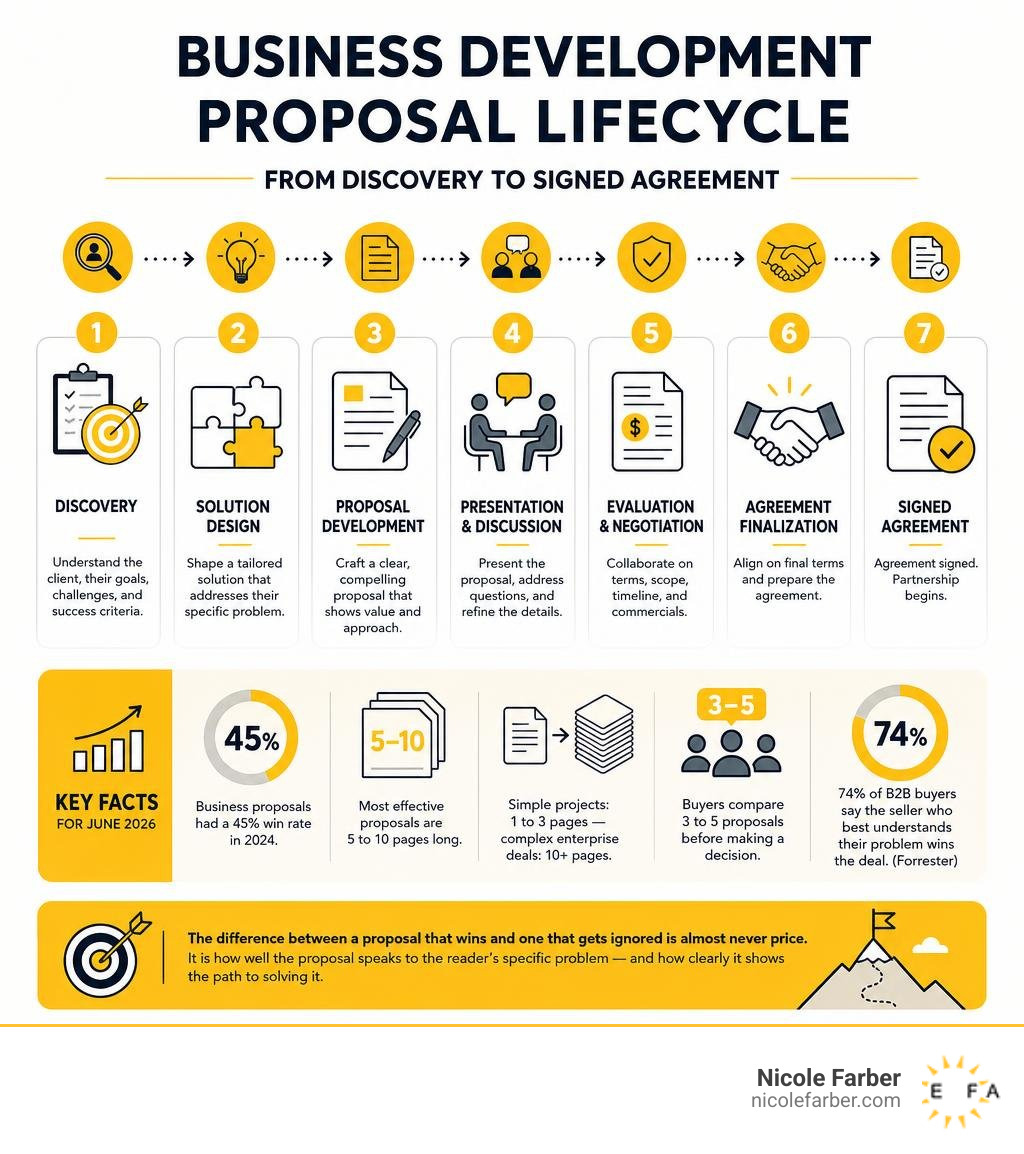
Key facts for June 2026:
- Business proposals had a 45% win rate in 2024
- Most effective proposals are 5 to 10 pages long
- Simple projects: 1 to 3 pages — complex enterprise deals: 10+ pages
- Buyers compare 3 to 5 proposals before making a decision
- 74% of B2B buyers say the seller who best understands their problem wins the deal (Forrester)
The difference between a proposal that wins and one that gets ignored is almost never price. It is how well the proposal speaks to the reader’s specific problem — and how clearly it shows the path to solving it.
For law firms especially, this matters enormously. Client acquisition is competitive. A well-crafted proposal sets you apart before you ever get on a call.
I’m Nicole Farber, CEO of ENX2 Legal Marketing, and with over 15 years of experience helping law firms grow their practices, I have seen how a strong business development proposal can be the turning point between a stalled pipeline and a signed client. In the sections below, I will walk you through exactly how to write one that works.
Business development proposal word list:
Understanding the Basics of Business Growth
When we think about scaling an organization, we must look at it through the lens of strategic growth. True strategic growth is not about chasing every single lead that crosses our path. Instead, it is about building a sustainable framework that attracts high-value clients naturally. To dive deeper into this mindset, check out An Essential Guide to Strategic Business Growth.
For many local business owners, the journey starts with structured business planning. Whether you are launching a startup or expanding an established firm, utilizing regional resources can make a massive difference. For instance, if you are looking into Starting a Business | Wilkes University offers incredible support for entrepreneurs throughout Wilkes-Barre and the broader Luzerne County region.
Furthermore, local funding programs like the [PDF] LUZERNE COUNTY’S BUSINESS DEVELOPMENT LOAN PROGRAM provide the financial foundation required to turn a strategic vision into reality. Once that foundation is set, we can transition from internal business planning to external client acquisition using a highly targeted proposal.
What is a Business Development Proposal?
At its core, a business development proposal is a sales document designed to secure a specific business opportunity. While an internal business plan acts as a roadmap for your operations, and an estimate simply outlines costs, a proposal is built entirely around the buyer’s needs. As highlighted in How to Write a Business Proposal in 2026 (+ Template) – Shopify, a successful proposal leverages competitive intelligence and market demand to prove that your company is the absolute best fit for the job.
In our legal marketing practice, we emphasize that a proposal should never exist in a vacuum. It must be part of a larger, automated approach to bringing in new clients. To understand how to make this transition, read about how to Stop Chasing and Start Attracting with a Client Acquisition System. When your proposal aligns perfectly with your acquisition system, you stop pitching blindly and start closing deals with ease.
Types of Business Proposals
Not all proposals are created equal. Depending on the scenario, we will use different formats to present our solutions. Understanding these distinctions ensures we do not waste time sending the wrong document to a prospect. According to the resource on Business Proposals, proposals generally fall into three main categories:
- Formally Solicited: These are written in direct response to an official request, such as a Request for Proposal (RFP). The client has defined requirements, and we must follow their guidelines precisely.
- Informally Solicited: These occur after a casual conversation or discovery call where a prospect says, “This sounds great, can you send over a proposal?” These have the highest conversion rates because the relationship is already established.
- Unsolicited: These are sent without a prior request, similar to a cold pitch. While they can work, they run the risk of being viewed as spam if they are not deeply personalized.
| Proposal Type | Trigger | Key Focus | Win Rate |
|---|---|---|---|
| Formally Solicited | RFP or RFQ | Compliance & precise requirements | Moderate |
| Informally Solicited | Discovery conversation | Tailored solutions & outcomes | High |
| Unsolicited | Cold outreach | Immediate value & hook | Low |
The Anatomy of a Winning Business Development Proposal
To write a proposal that converts, we must follow a logical, persuasive structure. Most proposals fail before the prospect ever reaches the pricing page because the content is too seller-centric. By structuring your document backward from the buyer’s decision criteria, you keep them engaged from the very first page.

A winning structure usually includes a cover page, table of contents, executive summary, problem statement, proposed solution, timeline, credentials, pricing, terms, and a clear call to action. To see how these sections flow together, read 10+ Steps on How to Write a Business Proposal in 2026 | Vtiger.
Using a structured framework prevents us from making mistakes. You can easily streamline this process by learning to Stop Winging It and Use a Business Development Plan Template.
The Executive Summary
The executive summary is the most critical part of your entire business development proposal. It is the hook that captures the attention of busy decision-makers who may only scan your document. A great executive summary should outline the client’s problem, introduce your high-level solution, and state exactly why your team is uniquely qualified to deliver it.
According to Business proposal template: How to write a business proposal | Adobe Acrobat, we should write this section last. This ensures we have a complete grasp of the project scope, allowing us to summarize the entire value proposition in a few tight, compelling paragraphs.
Problem Identification and Solution Mapping
To build trust, we must prove that we understand the client’s pain points better than anyone else. We can use tools like a “Problem Tree” to analyze the root causes of their challenges and convert them into an “Objective Tree” that maps directly to our solutions.
For example, when working with community organizations in Philadelphia, we might look at the Business Development Organization Network | LISC Philadelphia to align our proposals with localized economic development goals. Similarly, if we are working internationally, we can study initiatives like the Action plan – Antigua Guatemala, Guatemala, 2025 – 2027 to tailor our solutions to specific civic and regional priorities.
To see how we bridge these geographical strategies, explore our guide on the Business Development Plan 101 Philly to Antigua Guatemala.
Pricing, Timelines, and Deliverables
When presenting pricing, transparency is key. We should avoid hiding costs or bundling fees in a way that triggers sticker shock. Instead, we recommend offering tiered pricing options—such as three packages where the middle option is your recommended choice. This shifts the client’s decision from a “yes or no” on your services to a “which option works best for us.”
Additionally, every proposal must include clear milestones and a realistic timeline, often displayed as a Gantt chart. This demonstrates operational readiness. For instance, when pitching public sector or infrastructure projects, aligning your timeline with local guidelines—such as those set by the Economic Development – Home – City of New Orleans—shows that you understand the regulatory landscape and can deliver on time.
Crafting Your Proposal: Step-by-Step
Writing a proposal is a step-by-step journey that requires careful research before you ever type a single word. We must start with a deep discovery phase, asking the prospect about their timeline, budget, decision-makers, and definition of success.

Once discovery is complete, we outline the document, draft the content using the client’s exact terminology, and refine the tone. For a deeper look at professional writing standards, the guide on Writing Business Proposals | Texas A&M University provides excellent advice on maintaining clarity and conciseness. To see how this fits into your overall growth roadmap, refer to our Business Growth Strategies Ultimate Guide.
Best Practices for Designing Your Business Development Proposal
A poorly formatted document can kill a great solution. To ensure our proposals leave a lasting impression, we must focus on clean design, clear visual hierarchy, consistent brand colors, and mobile-friendly layouts. Many decision-makers review proposals on their phones, so testing your layout on smaller screens is essential.
You can save time and maintain a highly professional look by starting with a Free Business Development Proposal Template That Wins Clients. For professional service providers, particularly in the legal space, clean design paired with strong social proof builds immediate credibility. Discover more about this specialized approach in our guide on Client Acquisition for Lawyers.
The Follow-Up Strategy
Your proposal process does not end when you hit “send.” In fact, the follow-up is where most deals are won or lost. We recommend a structured follow-up cadence:
- Day 0: Send the proposal with a personalized cover letter.
- Day 2-3: A brief check-in to confirm receipt and ask if they have any initial questions.
- Day 6-7: A value-add touchpoint, sharing a relevant case study or industry insight.
- Day 10-12: A direct, polite attempt to close or establish next steps.
During this process, we can also leverage our professional connections to maintain momentum. Learn how to cultivate these relationships by Building a Referral Network. Additionally, to ensure your introductory email gets opened, you can adapt a professional Letter for Business Proposal Template (Free Word) to make a stellar first impression.
Frequently Asked Questions About Business Proposals
How long should a professional business proposal be?
For simple projects or existing client relationships, a short proposal of one to three pages is often sufficient. However, most professional and highly effective business proposals are between five to ten pages long. Complex enterprise or government proposals may require ten or more pages to cover all regulatory and technical specifications.
What is the difference between a business proposal and a business plan?
A business plan is an internal roadmap used to outline a company’s long-term strategy, operations, and financial projections, often to secure funding from banks or investors. A business development proposal is an external sales document sent directly to a prospect to persuade them to buy a specific product or service.
How many times should you follow up on a submitted proposal?
We recommend following up three to five times over a two-week period. If you do not receive a response after three to four polite, value-focused attempts, it is best to pause. Professional persistence is key, but knowing when to stop prevents you from damaging the relationship for future opportunities.
Conclusion
At the end of the day, writing a winning business development proposal comes down to empathy, clarity, and preparation. When you stop focusing on what your business does and start focusing on what your client needs, your win rates will soar.
At ENX2 Legal Marketing, we believe in faith-driven leadership and real-world experience to empower law firms and businesses to reach their highest potential. If you are ready to take your business growth to the next level, we invite you to start Building a Business Development Plan with us today. For law firms looking to scale their practices, we also offer specialized strategies in Attorney Business Development and comprehensive Law Firm Development. Let’s build something incredible together!