Leading High Performance Teams: The Modern Playbook for Breakthrough Results
- Leadership
- Word of the Day
- September 25, 2026
Leading High Performance Teams: The Modern Playbook for Breakthrough Results
How to Lead a High Performance Team for Breakthrough Results

To lead a high performance team, give people a clear shared goal, define who owns each decision, build trust so they can speak honestly, and create a steady rhythm of feedback, coaching, and review. Then protect their time and autonomy: measure outcomes, remove obstacles, and avoid managing every task.
High performance is not about asking people to work longer hours or hiring a room full of star players. It is about creating the conditions where capable people can work well together, adapt quickly, and stay accountable to meaningful results.
This matters for law firm leaders. A team that understands the firm’s growth goals, client standards, and role in the client experience can respond faster, collaborate across practice areas, and deliver more consistent service. Research consistently shows that managers have an outsized effect on engagement, while top-performing teams see stronger profitability, sales productivity, retention, and attendance.
The modern challenge is not simply getting more work done. Teams already lose significant time to unnecessary meetings, unclear priorities, and searching for information. Strong leaders reduce that friction. They create clarity, encourage constructive disagreement, and help people learn from missed deadlines or changing conditions without blame.
I am Nicole Farber, a business owner and leadership speaker with more than 15 years of experience helping firms and businesses grow through change, strengthen teams, and pursue ambitious goals. From Philadelphia and Wilkes-Barre to New Orleans, Luzerne County, and Antigua Guatemala, I have seen how the same leadership habits produce breakthrough results across different markets and cultures. In this guide, I will share practical lessons on how to lead a high performance team while keeping people focused, supported, and accountable.
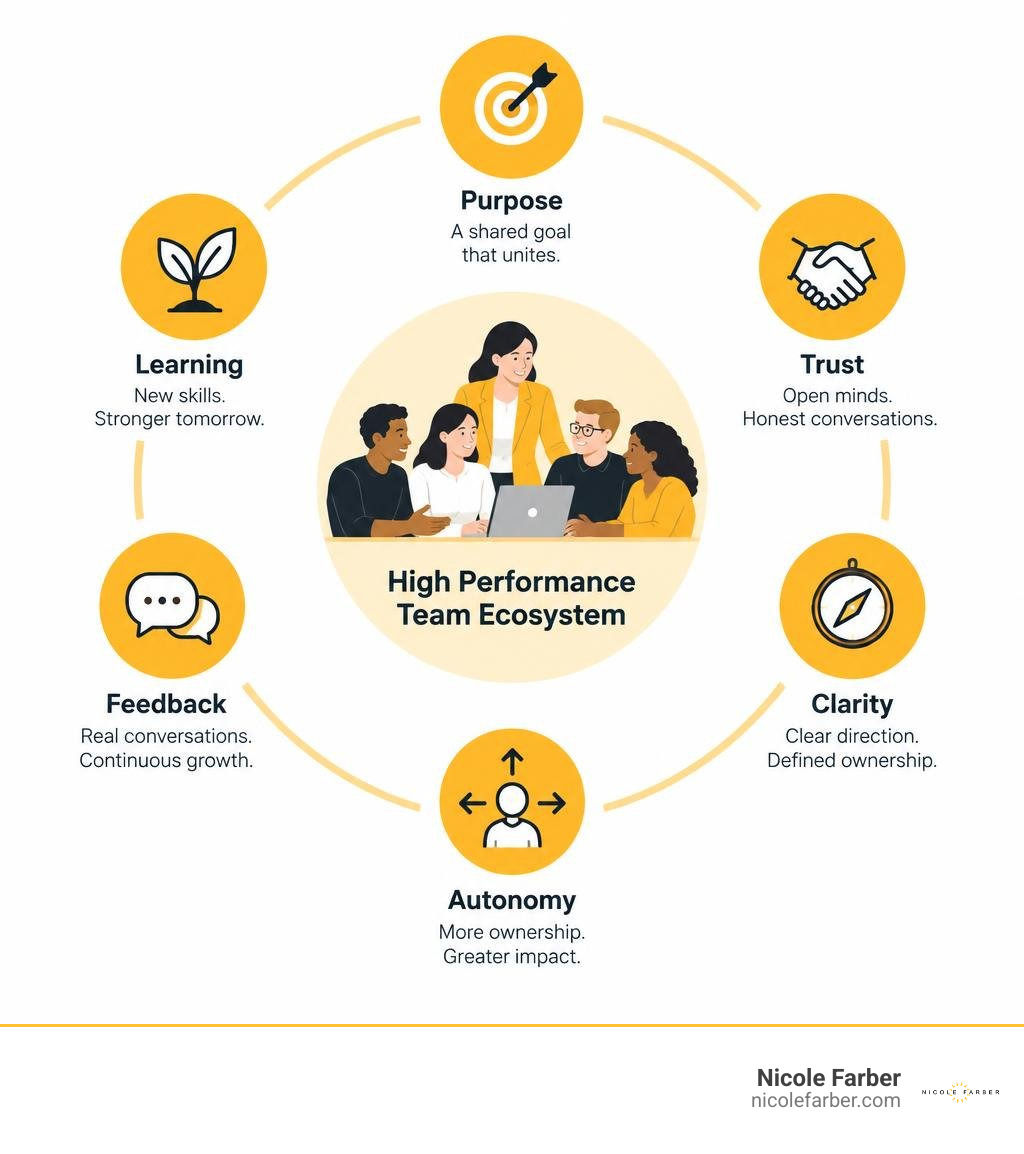
Know your how to lead a high performance team terms:
What Defines a High-Performing Team in 2026?
A high-performing team is a group of aligned individuals who collaborate with deep trust, clear accountability, and shared purpose to deliver exceptional, repeatable outcomes. In 2026, the definition extends far beyond output volume; it centers on adaptability, collective intelligence, and enduring human capabilities.
Gallup’s 2026 research reveals that global employee engagement sits at just 20%, costing the global economy roughly $10 trillion in lost productivity. Furthermore, manager engagement dropped to 22%. Yet, top-quartile teams deliver 23% higher profitability, 18% higher sales productivity, 51% lower turnover, and 78% less absenteeism compared to their disengaged peers.
When organizations empower your team to build and share collective knowledge, they are 5.4 times more likely to produce high-quality work. According to research on building high performing teams | Deloitte Insights, thriving groups distinguish themselves by combining technology with critical human strengths like curiosity, resilience, and divergent thinking. While 78% of top-tier teams leverage AI tools in their daily workflows (compared to 54% of other teams), technology alone is not the differentiator—the collaborative culture behind the tools makes the difference.
This pattern holds across the regions where I work. Law firm teams in Philadelphia and Wilkes-Barre face different market pressures than those in New Orleans or Antigua Guatemala, but the highest performers consistently share the same habits: they protect focused time, clarify decision rights, and treat feedback as a continuous improvement loop rather than an annual event.
| Dimension | Average Teams | High-Performing Teams |
|---|---|---|
| Information Flow | Waste ~25% of time searching across silos | Centralized systems with seamless knowledge access |
| Goal Alignment | Top-down mandates with unclear ownership | Co-created goals with explicit decision rights |
| Feedback Rhythm | Annual, backward-looking reviews | Continuous, forward-looking coaching loops |
| Psychological Safety | Blame culture; mistakes are hidden | Open problem-solving; calculated risk-taking |
| Meeting Culture | Calendar fragmentation; focus deficit | Structured cadences protecting deep focus blocks |
The Core Principles of How to Lead a High Performance Team
Achieving extraordinary results requires mastering the human and operational levers that drive daily performance. Research shows that 70% of the variance in team engagement is directly tied to the manager.
Academic insights from leading high-performance teams: pillars and characteristics highlight that high impact relies on humanistic, values-driven leadership. When we apply practical leadership skills across our operations in Philadelphia, Wilkes-Barre, New Orleans, Luzerne County, and Antigua Guatemala, we focus on three foundational principles:

- Relational Trust Over Raw Technical Talent: Brilliant individual contributors cannot rescue a team characterized by toxic communication or misaligned egos. High performance is rooted in mutual respect, clear expectations, and social sensitivity.
- Absolute Clarity of Shared Purpose: When team members understand exactly how their daily tasks drive the mission, engagement surges. Involving team members in goal-setting can increase overall productivity by 12%.
- Strategic Energy Management: Protecting team energy across physical, emotional, and mental dimensions prevents burnout. Sustainable high performance is an endurance race, not a sprint. Leaders who manage energy well help their teams maintain consistent quality without the boom-and-bust cycles that erode trust and retention.
A Step-by-Step Execution Framework for Modern Leaders
Transforming these principles into consistent results demands a structured approach. Using insights from the complete guide to leadership development, leaders can follow this execution roadmap:
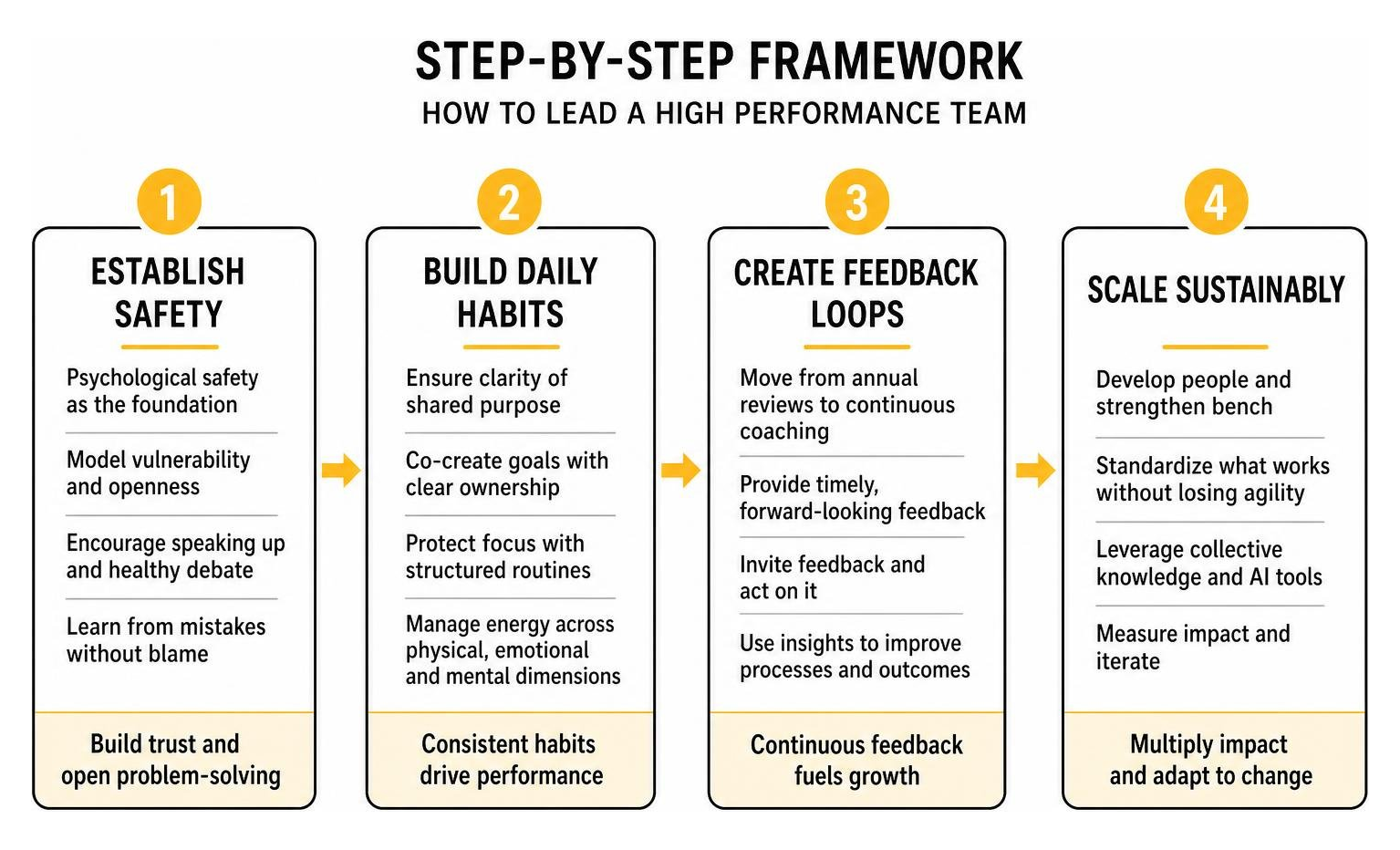
Establishing Psychological Safety: How to Lead a High Performance Team
Psychological safety—the shared belief that team members will not be embarrassed, rejected, or punished for speaking up—is the foundation of any high-achieving group. To implement how to become an effective leader in this area:
- Model Vulnerability: Acknowledge your own knowledge gaps and mistakes openly. When leaders normalize learning from errors, teams stop hiding problems.
- Invite Constructive Dissent: Actively solicit alternative viewpoints during strategy discussions by asking, “What risks are we not seeing?”
- Establish Non-Punitive Post-Mortems: Treat project setbacks as institutional data rather than individual failures.
Developing Daily Habits for How to Lead a High Performance Team
The average knowledge worker spends 15.4 hours per week in meetings but manages only 12.1 hours of uninterrupted focus. High-performing leaders deliberately rebalance this ratio.

- Audit and Protect Deep Work: Block dedicated multi-hour focus zones across company calendars to reduce context switching.
- Adopt Intentional Meeting Formats: Require agendas 24 hours in advance, invite only essential decision-makers, and ensure every session finishes with named owners and clear next steps.
- Coach Instead of Fixing: Shift from giving answers to asking guiding questions that develop critical thinking skills across the roster.
Designing Feedback Loops and Accountability Structures
Only 12% of managers are highly effective at coaching, yet 72% of employees state their output would improve with more frequent corrective guidance.
Building modern accountability involves:
- Using the SBI Framework: Deliver feedback by identifying the exact Situation, describing the observable Behavior, and explaining the resulting Impact.
- Maintaining Consistent 1-on-1 Touchpoints: Dedicate bi-weekly sessions to progress, obstacles, and professional growth rather than status reporting.
- Encouraging Peer-to-Peer Accountability: Cultivate open communication where colleagues review work collaboratively, supporting virtual leadership 101: how to lead teams remotely and build trust across distributed environments.
Scaling High-Performance Systems Across the Organization
True organizational excellence happens when high-performance team habits scale beyond single departments into the entire enterprise. Companies with advanced performance frameworks are 4.2 times more likely to financially outperform competitors.
To scale these dynamics effectively:
- Develop Managers into Multipliers: Equip frontline leaders with coaching toolkits and spaced learning opportunities over 6 to 12 months rather than isolated, one-time seminars.
- Standardize Behavioral Expectations: Define explicit cultural norms for communication, decision-making, and transparency across all regional branches, from corporate centers in Philadelphia and New Orleans to operations in Luzerne County and Antigua Guatemala.
- Align Systems with Business Growth Strategies: Measure operational health using clear leading indicators, recognizing teams that hit milestones through collaborative excellence rather than individual heroics.
Scaling also requires local adaptation. A leadership cadence that works for a Philadelphia practice may need adjustment for a distributed team spanning Wilkes-Barre and Antigua Guatemala. The core principles remain constant, but the implementation should respect time zones, client rhythms, and regional communication styles.
Frequently Asked Questions About Team Leadership
How long does it take to build a high-performing team?
Building a high-performing team typically requires 6 to 12 months of consistent execution. While initial off-sites or workshops create early enthusiasm, lasting behavioral change requires spaced practice, weekly reinforcement, and continuous supervisor coaching. Leaders who commit to this timeline see compounding gains in trust, decision quality, and retention.
What is the single most important factor for high team performance?
Psychological safety is the most critical factor. Without a secure environment where team members can take calculated risks, voice concerns, and share creative ideas without fear of retribution, advanced operational systems cannot perform at their peak.
How do leaders prevent burnout while sustaining peak performance?
Leaders prevent burnout by managing team energy rather than just tracking hours worked. This means eliminating unnecessary meetings, setting clear boundaries around off-hours communication, prioritizing top-level initiatives, and balancing challenging deadlines with adequate recovery periods.
Conclusion: Sustaining Breakthrough Results
Leading a high-performing team is an intentional discipline built on trust, operational clarity, and human-centered leadership. When leaders remove operational friction, provide psychological safety, and foster continuous learning, breakthrough outcomes become standard practice.
To explore tailored executive coaching, keynote programs, and training resources that elevate your organization, visit our complete collection of leadership resources.