The Executive Voice: Bridging the Gap Between Management and Oratory
- Leadership
- Word of the Day
- October 26, 2026
The Executive Voice: Bridging the Gap Between Management and Oratory
How Public Speaking Strengthens Leadership

Public speaking is related to leadership because leaders must turn decisions into shared understanding and action. A clear message helps a team see what matters, why it matters, and what to do next. For a law firm partner, that could mean explaining a new direction to colleagues or earning trust when a plan needs to change.
Speaking well is not about sounding perfect. It is about being clear, honest, and ready to listen.
I’m Nicole Farber, a motivational speaker and CEO in legal marketing with over 15 years of experience leading teams and helping law firms grow. When people ask, “how is public speaking related to leadership?” I draw on that work and my experience speaking about leadership through change.

Easy how is public speaking related to leadership glossary:
Understanding How Public Speaking Is Related to Leadership in Modern Business
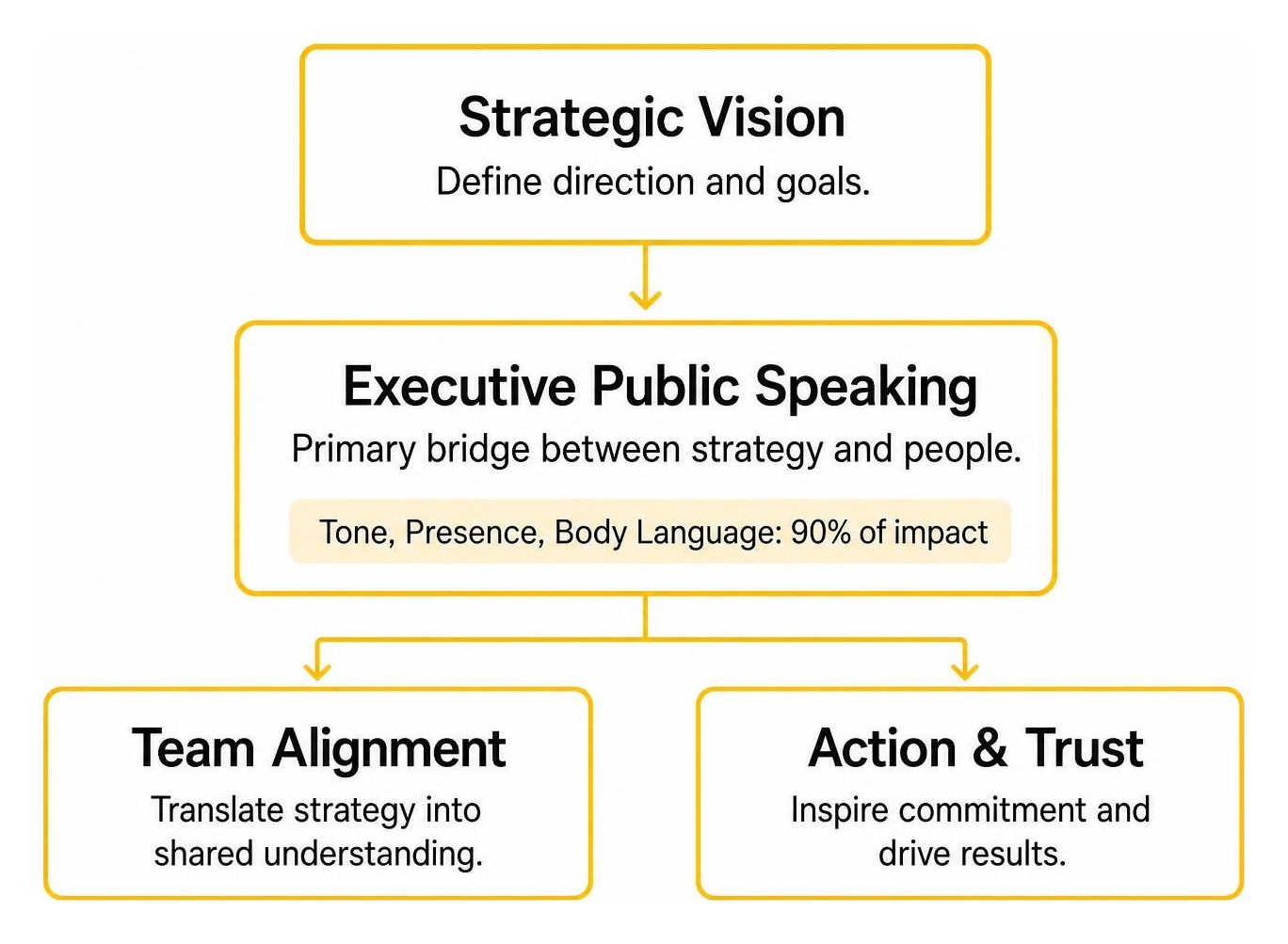
When we step into leadership, we quickly realize that management authority is not enough to move people. You can assign tasks through emails or operational dashboards, but you cannot inspire dedication through a memo. In the modern workplace, public speaking serves as the primary bridge between administrative strategy and human execution.
Public speaking acts as a true force multiplier for leadership. Consider the reality of human communication: research shows that listeners take only half a minute—a mere 30 seconds—to decide whether a speaker is trustworthy and whether their message warrants attention. Furthermore, studies reveal that only 10% of information is conveyed through spoken words alone, while the remaining 90% is communicated through non-verbal cues, presence, and vocal tone. When an executive stands up to address a room, their physical posture, vocal timbre, and emotional resonance carry nine times more weight than their slide deck.
A comprehensive academic study on public speaking confidence and leadership effectiveness confirms that confident public speaking is a foundational asset for leadership development (Españo, 2025). It directly builds credibility, fosters institutional trust, and enhances an executive’s capacity to articulate strategic visions across diverse audiences. Surveys conducted by the Harvard Business Review reinforce this finding, showing that presentation and communication abilities consistently rank among the most prized competencies for C-suite executives across corporate America.
Whether you are addressing a boardroom in Philadelphia, rallying a regional operations team across Luzerne County, or delivering a keynote in New Orleans, the ability to articulate ideas with conviction defines your leadership footprint.
Why Public Speaking Acts as a Force Multiplier for Executives
A force multiplier is a tool or skill that dramatically amplifies your existing output. In leadership, public speaking takes your core business strategy and multiplies its reach across entire departments, client rosters, and industry networks.
When executives master the podium, they achieve three distinct advantages:
- Strategic Alignment: Instead of diluting messages through multiple organizational layers, a leader can align hundreds of employees simultaneously behind a singular vision.
- Elevated Visibility: Speaking at conferences or internal town halls establishes authority, positioning the leader as a respected voice in their field.
- Heightened Engagement: When leaders share authentic narratives rather than dry figures, employee commitment and morale increase substantially.
Core Competencies: How Is Public Speaking Related to Leadership Growth?
Leadership growth requires moving from individual execution to collective influence. The skills developed through public speaking—such as structured argumentation, active audience reading, and verbal eloquence—directly mirror the core traits of elite executive management.
Groundbreaking research on debate training and leadership advancement from the University of Maryland’s Robert H. Smith School of Business demonstrates this relationship with hard data. In a study of 471 employees at a Fortune 100 enterprise, researchers found that participants who completed a structured debate training program were significantly more likely to advance into higher leadership roles 18 months later. A companion experiment involving 975 participants confirmed that individuals who underwent speaking and debate practice naturally emerged as leaders during collaborative tasks. The critical link was assertiveness—the ability to articulate points clearly and disagree diplomatically without aggression.
| Skill Dimension | Conventional Management Communication | Influential Leadership Speaking |
|---|---|---|
| Primary Goal | Disseminating data and assigning tasks | Inspiring action and building shared conviction |
| Delivery Medium | Email updates, status reports, static memos | Dynamic presentations, town halls, keynotes |
| Handling Disagreement | Top-down directives or avoidance | Diplomatic assertiveness and collaborative framing |
| Audience Engagement | Passive information consumption | Active listening, two-way emotional resonance |
| Executive Presence | Authority derived solely from job title | Credibility earned through transparency and presence |
Building Trust, Influence, and Psychological Safety from the Podium

Trust is the currency of effective leadership. When a leader steps onto a stage, the audience unconsciously evaluates psychological safety: Is this person authentic? Do they have our best interests at heart? Can they guide us through uncertainty?
To build genuine influence, leaders rely on the classical rhetorical framework formulated by Aristotle, which remains the cornerstone of modern oratory:
- Ethos (Credibility & Character): Establishing your moral authority, industry track record, and authentic values.
- Pathos (Emotional Connection): Tapping into the shared hopes, fears, and aspirations of your audience through vulnerability and empathy.
- Logos (Logic & Reason): Providing clear data, coherent structure, and practical reasoning.
Balancing these three pillars helps leaders cultivate robust executive presence for corporate leaders. When an executive pairs logical clarity with genuine vulnerability, they break down hierarchical barriers and foster high levels of psychological safety across their organization.
Winning Hearts and Minds: How Is Public Speaking Related to Leadership Trust?
People do not follow titles; they follow people who make them feel seen, valued, and understood. When we examine techniques used by elite leadership speakers, we find that stage authority is never about dominance. Instead, it relies on open body language, warm vocal pacing, and intentional eye contact.
When speaking to your team—whether in a law office in Wilkes-Barre or an international seminar in Antigua Guatemala—matching your tone of voice to the gravity of your message creates immediate authenticity. If an executive announces organizational changes while hiding behind a podium with crossed arms and a monotone delivery, the team senses a disconnect. Conversely, an open posture, calm breathing, and an empathetic vocal inflection reassure stakeholders that the leadership team is grounded, honest, and approachable.
Storytelling as an Executive Tool for Emotional Connection
Data informs, but stories transform. Leaders who rely solely on spreadsheets and quarterly metrics often struggle to ignite genuine enthusiasm. The human brain is inherently wired for narrative; cognitive science shows that 65% of the population are visual learners, and our brains process visual stories and metaphors up to 60,000 times faster than text alone.
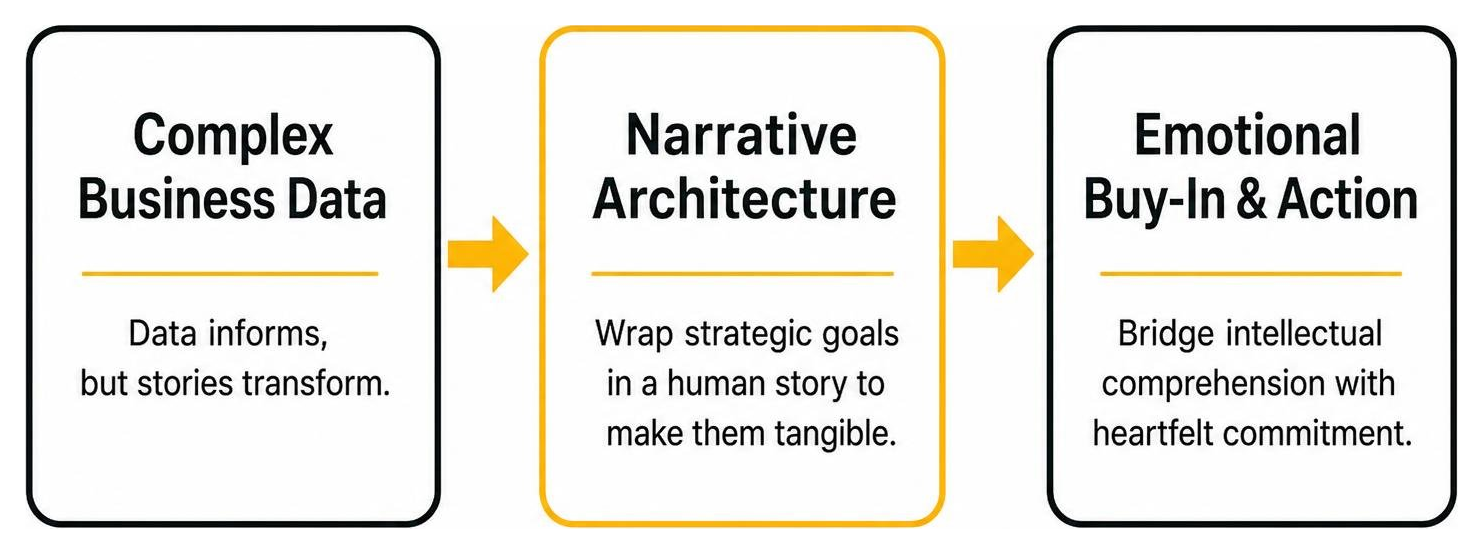
When an executive wraps strategic goals in a human story—such as recounting the early struggles of building a firm, or spotlighting a single client whose life was changed by the team’s work—abstract goals become tangible. Storytelling bridges the gap between intellectual comprehension and heartfelt commitment.
Navigating Crisis, Resistance, and Organizational Change Through Speech

The true test of leadership communication occurs during periods of disruption, economic volatility, or corporate restructuring. In moments of crisis, team members look to their leaders for stability, direction, and truth.
Framing Strategic Pivots to Overcome Resistance
Resistance to change is a natural human reaction rooted in fear of the unknown. Leaders who excel at public speaking do not dismiss these fears; they lean into them with clarity and empathy. By utilizing transformative presentation programs for leadership, managers learn how to restructure organizational narratives to frame change not as a threat, but as an opportunity for collective growth.
When announcing a strategic pivot:
- Acknowledge the Current Reality: Validate the hard work that brought the company to its current point.
- Clarify the Catalyst: Explain transparently why the status quo is no longer viable.
- Paint the Future Vision: Detail what success looks like for every team member in the new environment.
- Outline Concrete Steps: Give the audience actionable priorities for the immediate 30, 60, and 90 days.
High-Stakes Crisis Communication and Morale Stabilization
During an organizational crisis, silence breeds anxiety and misinformation. An effective leader takes the stage immediately, adopting a calm, assertive demeanor that steadies the organization.
Mastering pressure speaking involves maintaining a measured vocal pace, refusing to deflect difficult realities, and handling impromptu Q&A sessions with grace. When leaders communicate with transparent resolve, they dismantle rumors, boost employee morale, and restore stakeholder confidence even amid intense market volatility.
Practical Techniques to Master Public Speaking and Eliminate Anxiety
Public speaking anxiety is exceptionally common: research indicates that 77% of the general population experiences some degree of speech anxiety, often ranking the fear of public speaking higher than the fear of death. For executives, this anxiety is often compounded by imposter syndrome—the nagging fear that one slip-up will undermine their professional reputation.
Fortunately, public speaking is a craft that can be honed through structured technique and immersive training, such as intensive speaking bootcamps for commanding the room.

The Six-Question Preparation Framework for Leaders
Before stepping onto any stage or addressing an executive meeting, run your presentation through this six-part strategic framework to ensure maximum clarity and impact:
- What am I really trying to say? Define the single core thesis of your talk in one concise sentence.
- Why should this audience care? Explicitly identify the tangible benefit, problem solved, or value delivered to your listeners.
- What is the most critical takeaway? Isolate the primary insight that must stick with the audience long after the presentation ends.
- What is the simplest way to explain this takeaway? Deconstruct complex concepts into accessible metaphors, real-world examples, or plain language.
- How do I want the listener to feel? Determine the targeted emotional response—whether reassured, energized, or motivated to act.
- What concrete action should the listener take next? Provide a clear, actionable directive that leaves no ambiguity regarding the next step.
Overcoming Stage Anxiety and Imposter Syndrome
To conquer stage fright and project genuine executive authority, incorporate these physical and cognitive habits into your daily leadership routine:
- Cognitive Reframing: Shift your mindset from “performing for judgment” to “delivering valuable service to the audience.”
- Physical Intelligence: Stand with your feet shoulder-width apart, relax your shoulders, and consciously manage micro-expressions. Take slow, diaphragmatic breaths before speaking to regulate your heart rate.
- Low-Stakes Practice: Rehearse presentations in supportive environments, such as informal team lunches or peer mastermind groups, before delivering high-stakes keynotes.
- Seek Structured Feedback Loops: Record your practice sessions on video and seek honest assessments from mentors to identify filler words, pacing issues, or distracting mannerisms.
Frequently Asked Questions About Public Speaking and Leadership
Is public speaking an innate leadership trait or a learnable skill?
Public speaking is unequivocally a learnable competency. While some individuals possess natural extroversion, effective executive oratory relies on structured frameworks, vocal control, active listening, and message clarity—all of which can be developed through consistent practice, behavioral coaching, and deliberate study.
How does public speaking accelerate career advancement to the C-suite?
Public speaking dramatically elevates executive visibility. Leaders who communicate persuasively can align large departments, win high-stakes client pitches, and represent their firms in public forums. Research confirms that employees trained in structured oratory and debate advance into leadership ranks significantly faster than their less vocal peers.
How can organizations build structured speaking programs for emerging leaders?
Organizations can cultivate leadership pipelines by integrating debate training, presentation workshops, and peer-reviewed speaking sessions into their standard professional development tracks. Providing low-stakes speaking opportunities and executive coaching helps emerging talent refine their voices long before they assume C-suite responsibilities.
Conclusion
The connection between public speaking and leadership is undeniable. Leadership cannot occur in a vacuum; it requires a voice that can clarify complex objectives, inspire shared purpose, and steady organizations through turbulent waters. When you bridge the gap between day-to-day management tasks and purposeful oratory, you unlock your true potential as an executive.
Whether guiding a regional enterprise in Pennsylvania or leading international ventures across North and Central America, your voice is your greatest leadership asset. Take the step to elevate your impact, inspire your teams, and drive transformative growth with professional executive leadership speaking.
References
Analyn C. Españo. “Public speaking confidence as a crucial asset for leadership development in academic setting.” Environment and Social Psychology, 2025. DOI 10.59429/esp.v10i4.3193.