Stop Chasing and Start Attracting with a Client Acquisition System
- Marketing
- In the News
- April 20, 2026
Stop Chasing and Start Attracting with a Client Acquisition System
Why the Acquisition of New Customers Is the Engine Behind Every Growing Law Firm

The acquisition of new customers is the process of attracting, engaging, and converting strangers into paying clients — and it’s the single most important driver of sustainable business growth.
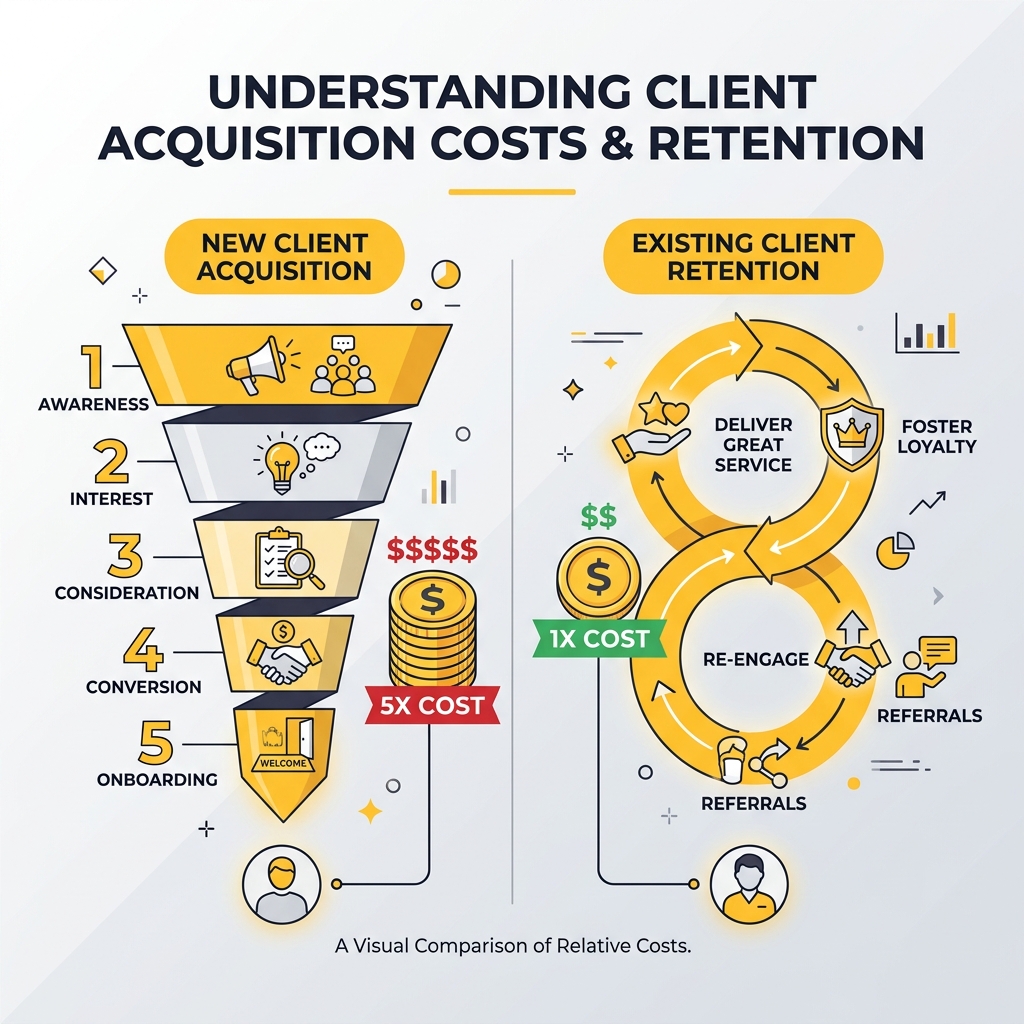
Here’s a quick breakdown of what it involves:
| Stage | What Happens |
|---|---|
| Awareness | Prospects discover your firm |
| Interest | They engage with your content or brand |
| Consideration | They evaluate your services |
| Conversion | They become a paying client |
| Onboarding | You deliver a great first experience |
For law firms — whether you’re based in Philadelphia, Wilkes-Barre, or anywhere across the country — this process rarely happens by accident. It takes a system.
Most attorneys are exceptional at practicing law. But attracting clients consistently? That’s a different skill entirely. Without a repeatable acquisition process, growth feels random. Some months are great. Others are painfully slow.
Here’s the hard truth: acquiring a new client costs five times more than keeping an existing one. That means every dollar wasted on the wrong acquisition approach hits harder than most firm owners realize.
The good news is that with the right strategy, client acquisition becomes predictable — not a guessing game.
I’m Nicole Farber, CEO of ENX2 Legal Marketing, and with over 15 years of experience helping law firms build smarter systems for the acquisition of new customers, I’ve seen what separates firms that grow from those that stall. Let’s walk through exactly how to build a system that works.
What is the Acquisition of New Customers?
At its core, acquisition of new customers refers to the strategic methodologies and repeatable processes we use to gain new clients. It isn’t just a “one-and-done” sale; it is the lifeblood of business sustainability. If we aren’t bringing in new blood, the business eventually stagnates.
In the legal world, this means more than just a billboard on the side of a Philadelphia highway. It involves a digital-first customer experience that meets people where they are. Today’s clients are researchers. They spend time vetting us before they ever pick up the phone. By focusing on a strategic acquisition process, we don’t just find “any” client; we find the right clients who will eventually become loyal advocates for our brand. To dive deeper into how this applies specifically to the legal field, check out our insights on client acquisition for lawyers.
The Purpose of a Systematic Approach
Why do we need a “system”? Why not just wing it? Because hope is not a marketing strategy. A systematic approach to the acquisition of new customers provides:
- Predictable Income: When we know that $X$ amount of marketing spend results in $Y$ number of new cases, we can plan for the future without losing sleep.
- Investor and Partner Confidence: Whether you’re looking for a bank loan in Wilkes-Barre or bringing on a new partner in New Orleans, showing a proven acquisition engine builds massive trust.
- Risk Mitigation: Relying on a single referral source is dangerous. A system diversifies your lead flow.
- Scalability: You can’t grow a firm if you are the only person who knows how to “get” clients. A system can be taught, measured, and scaled.
Why Acquisition is Essential for Growth
Without a steady stream of new clients, your firm is essentially on a countdown clock. Even the best firms lose clients to natural “churn”—cases end, people move, or needs change. Research shows that the acquisition of new customers is essential for maintaining market share and building brand strength.
According to Gartner research on B2B buyer independence, buyers (including legal clients) now spend only about 17% of their total buying journey actually meeting with potential suppliers. The rest of the time? They are doing their own homework. If we don’t have a system to capture their attention during that independent research phase, we lose them before we even know they exist.
The Modern Customer Acquisition Funnel
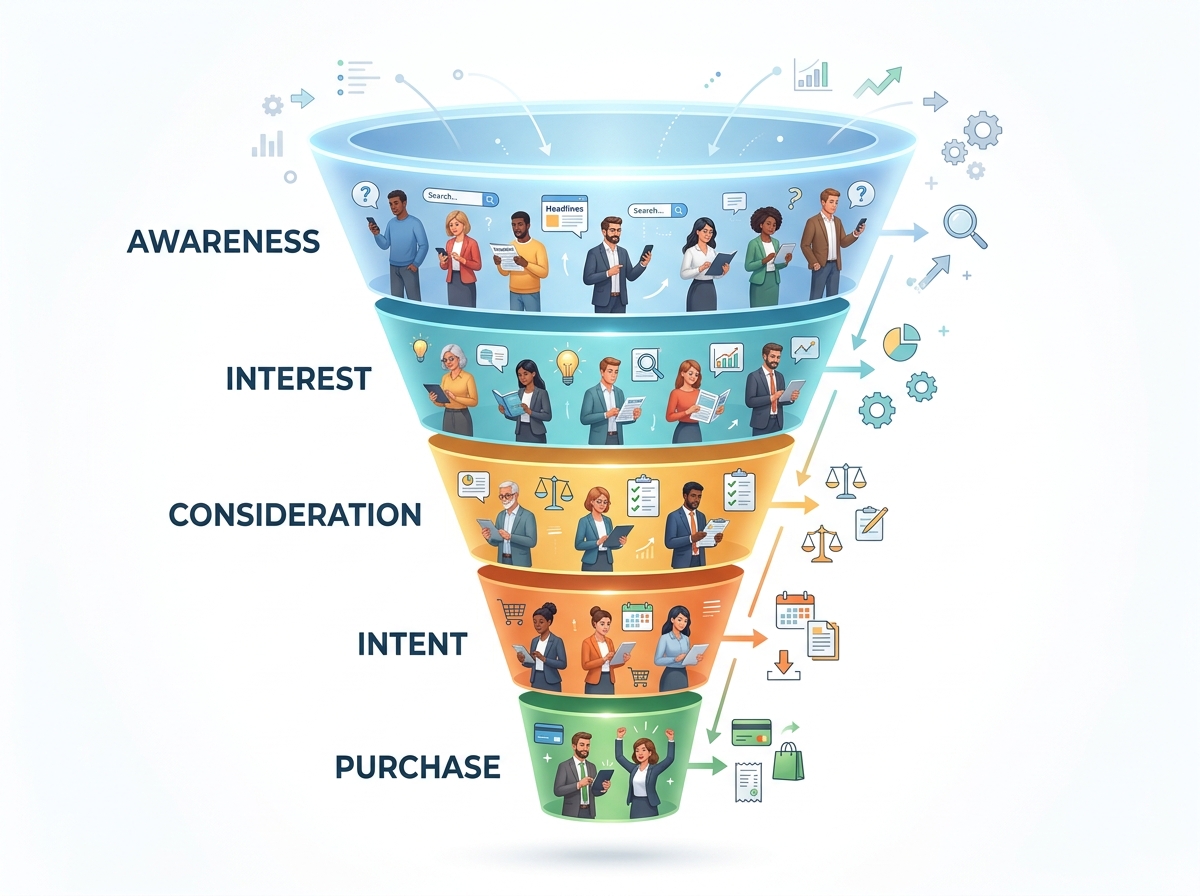
Visualizing the journey of a new client helps us understand where we might be “leaking” potential revenue. The funnel isn’t just a slide; it’s a series of checkpoints.
Awareness and Interest Stages
This is the “top of the funnel.” In Philadelphia or Wilkes-Barre, this might look like a community event or a highly-ranked SEO article.
- Awareness: The prospect realizes they have a problem (e.g., “I just got into a car accident”) and discovers your firm exists.
- Interest: They start engaging. Maybe they read your blog or follow you on social media.
Public perception is everything here. If your firm’s “vibe” doesn’t match the quality of your work, people will bounce. We’ve found that local networking in places like Wilkes-Barre is still a powerhouse for top-of-funnel awareness. It’s about being a human first and a lawyer second.
Conversion and the Onboarding Experience
This is where the magic happens—or where the ball gets dropped. Conversion is the moment they sign the retainer. But we can’t stop there. The Onboarding stage is often overlooked in the acquisition of new customers, but it is vital.
If a client experiences “high friction” during sign-up—like confusing paperwork or slow callbacks—96% of them are likely to jump ship or never recommend you. We must focus on reducing customer effort to ensure that first impression is flawless. For those in the estate planning or elder law niche, understanding the delicate timing of this is crucial; learn how to find clients before they meet their maker to better serve them in their time of need.
Calculating and Optimizing Your Customer Acquisition Cost (CAC)
If you don’t know what it costs to get a client, you don’t know if you’re actually making money. This is where we look at the Customer Acquisition Cost (CAC).
To calculate your CAC, take your total marketing and sales spend over a specific period and divide it by the number of new clients acquired.
Total Marketing Spend / New Clients = CAC
Strategies to Reduce Your CAC
Let’s be honest: marketing is getting expensive. One report suggests that CAC has increased by a staggering 222% over the last eight years. To keep your firm profitable, we need to lower that cost.
- Referral Programs: This is the “holy grail” of low-cost acquisition. Nielsen research shows that 92% of consumers trust recommendations from people they know. By building a referral network, you let your happy clients do the heavy lifting for you.
- Retargeting: Ever visited a website and then saw their ads everywhere? That’s retargeting. It’s much cheaper to show an ad to someone who already knows you than to a total stranger.
- Organic Search (SEO): While it takes time, organic traffic doesn’t cost you “per click.” It’s a long-term investment that pays off by lowering your average CAC over time.
Measuring Success Beyond the Sale
A high CAC isn’t always bad if your Customer Lifetime Value (CLV) is even higher. If it costs you $500 to get a client but that client brings in $50,000 in fees, you’d make that trade all day!
We also need to track the payback period—how long it takes for the revenue from a new client to cover the cost of acquiring them. Ideally, you want to see a return on investment (ROI) that justifies the risk. By understanding these numbers, we can move away from the old “always be closing” mentality and toward an “always be growing” strategy.
High-Impact Strategies for the Acquisition of New Customers
To win in competitive markets like New Orleans or Philadelphia, we can’t rely on just one channel. We need an omnichannel approach. This means your message is consistent whether the client finds you on Google, Facebook, or at a local charity gala.
One of our favorite strategies is hyperpersonalization. Gone are the days of generic “Did you get hurt?” ads. Today, we use data to speak directly to the client’s specific pain points. If you’re looking to refine your firm’s growth trajectory, our guide on attorney business development is a great place to start.
Leveraging AI and Technology for Acquisition of New Customers
We are currently in an AI-led sales era. By 2027, it’s predicted that 95% of seller tasks will involve AI in some way. For law firms, this doesn’t mean a robot replaces the lawyer; it means technology handles the “grunt work.”
- Automation: Use AI chatbots to answer basic questions on your website 24/7. This reduces friction for that 82% of customers who want answers in under 10 minutes.
- Predictive Analytics: Modern CRM (Customer Relationship Management) tools can help us predict which leads are most likely to convert, allowing us to focus our energy where it matters most.
- CRM Integration: If you aren’t using a CRM to track every touchpoint, you’re leaving money on the table. You can find more on this in the Gartner report on AI-led revenue growth.
Content and SEO for Acquisition of New Customers
Content is still king, but “helpful” content is the emperor. We focus on educational blogging that answers the questions people are actually asking.
- Luzerne County Focus: If we’re targeting clients in Luzerne County, we write about local laws, local courts, and local community issues.
- Antigua Guatemala Visibility: For international business or investment, showing visibility in growing markets like Antigua Guatemala positions your firm as a forward-thinking global player.
- Video Marketing: People want to see your face and hear your voice before they trust you with their legal problems. A simple 60-second video can do more for the acquisition of new customers than a 2,000-word white paper ever could.
Best Practices for Sustainable Client Attraction
Sustainable attraction is about building a bridge of trust. Research shows that people often make purchase decisions based on emotion, not just logic. If your firm feels cold and corporate, you’ll lose out to the firm that feels empathetic and human.
We advocate for a customer-centric design in everything you do. Every touchpoint—from your website’s “Contact Us” page to the way your receptionist answers the phone—should be designed to reduce stress for the client. This is a core pillar of our business coaching for lawyers.
The Role of Customer Service in Acquisition
Did you know that 62% of B2B customers purchased more after a good customer service experience? On the flip side, 66% stopped buying after a bad one.
Your current customer service is your best marketing for the acquisition of new customers. Why? Because of social proof. Online reviews and word-of-mouth are the “digital backyard fence” where people talk about your firm. If you provide a “wow” experience, your clients become your unpaid sales force. As noted in the HBR on post-pandemic customer journeys, the journey doesn’t end at the sale; it’s a continuous loop of engagement.
Balancing Acquisition with Retention
While we’re talking about getting new clients, we can’t forget the ones we already have. It costs 5x more to get a new one, so why would we let the old ones slip away?
- Loyalty Programs: Even in law, staying in touch with past clients via a newsletter keeps you “top of mind.”
- Re-engaging Dormant Clients: Sometimes a past client just needs a reminder that you’re there for their next legal need.
- Cross-selling: If you handled a client’s divorce, they might eventually need a will or help with a business contract.
Balanced growth requires both a “bucket” that doesn’t leak and a “faucet” that stays on. For a deeper dive into how coaching can help you find this balance, see our benefits of business coaching guide.
Frequently Asked Questions about Acquisition
How do you calculate Customer Acquisition Cost (CAC)?
You take the total amount spent on marketing and sales (including salaries, ad spend, and software) over a specific timeframe and divide it by the number of new clients you gained during that same period. For example, if you spent $5,000 in a month and got 10 clients, your CAC is $500.
Why is it more expensive to acquire a new customer than retain one?
Acquiring a new client requires building trust from scratch. You have to pay for their attention, educate them on your services, and overcome their skepticism. With an existing client, the trust is already there, so the “cost” of the next sale is significantly lower.
What are the most effective channels for B2B acquisition?
For law firms and B2B services, SEO, content marketing, and LinkedIn are powerhouses. However, don’t sleep on referral marketing and high-quality networking. The “best” channel is always the one where your ideal client spends their time.
Conclusion
Building a system for the acquisition of new customers isn’t just about spreadsheets and algorithms; it’s about people. It’s about showing up for your community in Philadelphia, Wilkes-Barre, or New Orleans with a heart of service and a mind for strategy.
As a single mother who built a business from the ground up, I know that the road to success is paved with faith, resilience, and the courage to try new things. Whether you are a solo practitioner or leading a large firm, you don’t have to chase clients. You can build a system that attracts them.
If you’re ready to stop the “feast or famine” cycle and start building a legacy, it’s time to start your journey with a client acquisition system. Let’s grow together, one soul at a time.