Stop Wasting Ad Dollars and Create a Clear Marketing Roadmap
- Marketing
- Word of the Day
- October 21, 2026
Stop Wasting Ad Dollars and Create a Clear Marketing Roadmap
Developing a Marketing Plan That Stops Wasted Ad Spend

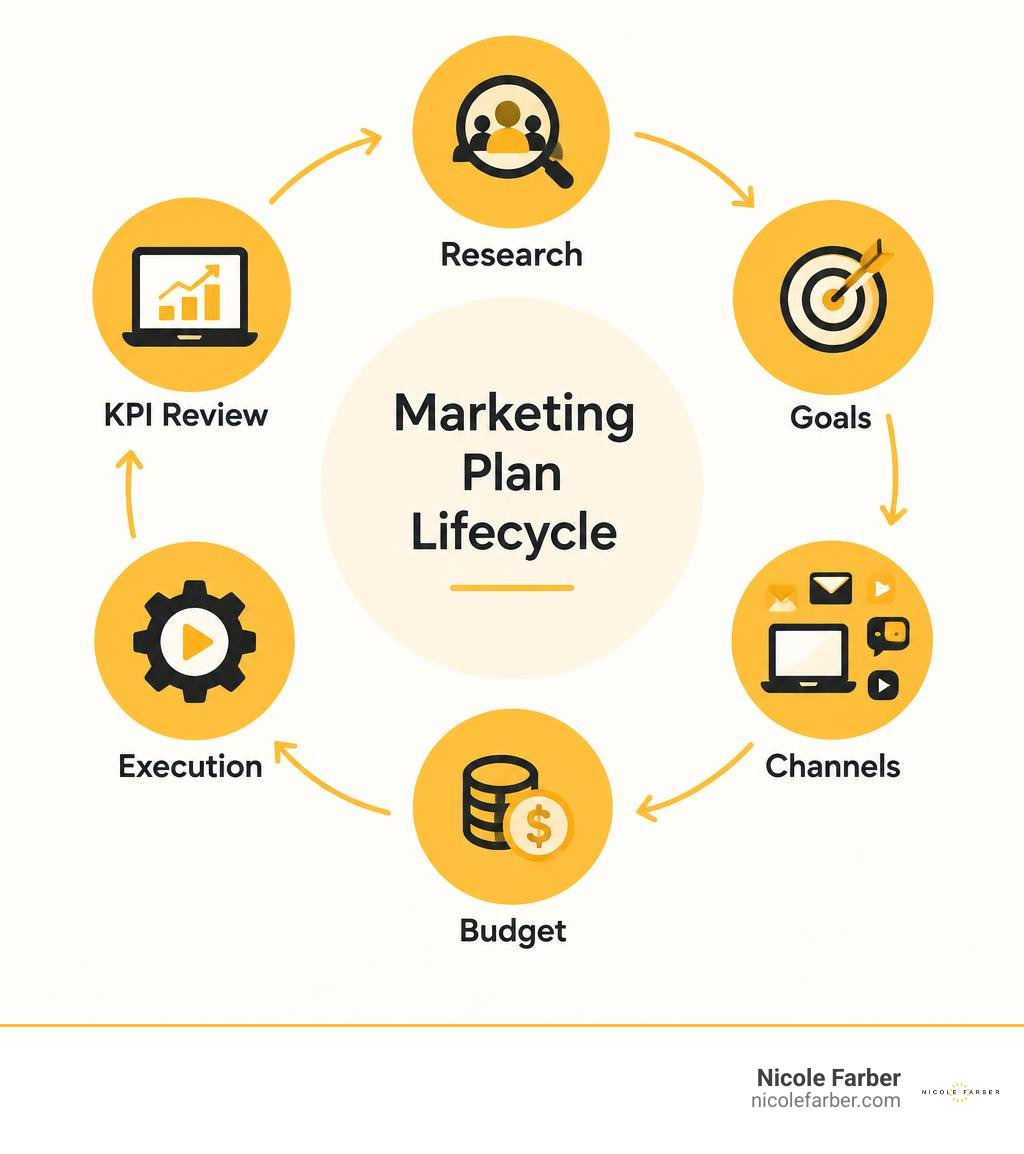
To build a marketing plan, start with the clients you want to reach, not the ads you want to buy. Research their needs and your competitors. Set a measurable goal, choose channels those clients use, and give each activity a budget, owner, and deadline. Then track which efforts bring in qualified inquiries and adjust your spending.
For a law firm, that turns marketing from a list of ideas into a roadmap you can act on and measure.
I’m Nicole Farber, CEO of ENX2 Legal Marketing. For more than 15 years, I’ve helped law firms and other businesses grow, and I’ve learned that developing a marketing plan works best when every dollar has a clear purpose.
Developing a marketing plan vocabulary:
- developing a digital marketing strategy
- developing a communications strategy
- developing a strategic business plan
Understanding the Core Framework of an Actionable Marketing Plan
Too many businesses treat marketing like a trip to the casino. They throw thousands of dollars at paid ads, launch a flashy website redesign, and cross their fingers, hoping for high-value leads to roll in. When the results fall flat, frustration sets in. In reality, random acts of marketing almost never deliver consistent revenue.
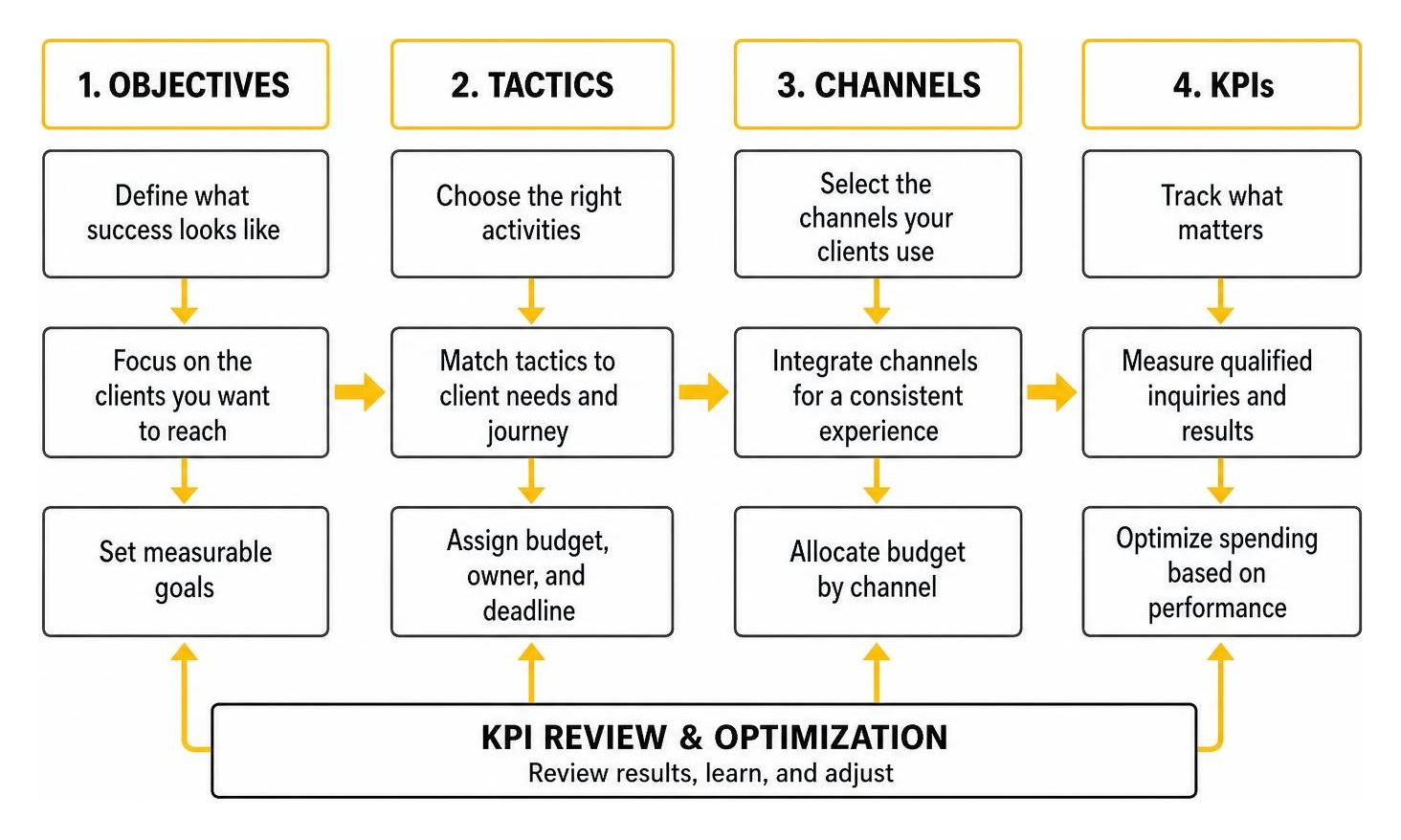
An effective marketing plan is an operational blueprint. It bridges the gap between high-level ambition and day-to-day execution. By establishing a solid practical roadmap for developing a modern digital marketing strategy, you align your executive summary, value proposition, and SWOT analysis into a structured approach that reliably produces qualified inquiries.
Many leading organizations rely on structured frameworks like SOSTAC (Situation, Objectives, Strategy, Tactics, Action, Control) to keep every campaign grounded in real-world data rather than gut instinct.
Marketing Strategy vs. Marketing Plan
It is easy to use the terms strategy and plan interchangeably, but understanding the difference keeps your team focused:
- Marketing Strategy: The overarching vision and “why.” It defines your market positioning, unique value proposition, and long-term business goals.
- Marketing Plan: The tactical roadmap and “how.” It details the exact channels, timelines, team owners, budgets, and milestones required to achieve the strategy.
Strategy sets the destination; the marketing plan is the turn-by-turn navigation system. When you work to transform brand clarity by developing a communications strategy, your tactical plan ensures that your core messaging reaches the right desks at the right time.
Essential Components of a Modern Marketing Plan
A comprehensive marketing plan covers several vital elements:
- Executive Summary: A concise overview of your targets and strategic direction.
- Mission & Value Proposition: What your firm stands for and why clients should choose you over alternatives.
- Situation & Market Analysis: A clear-eyed SWOT (Strengths, Weaknesses, Opportunities, Threats) and competitive landscape review.
- Buyer Personas & ICP: Detailed demographic and behavioral profiles of your highest-value clients.
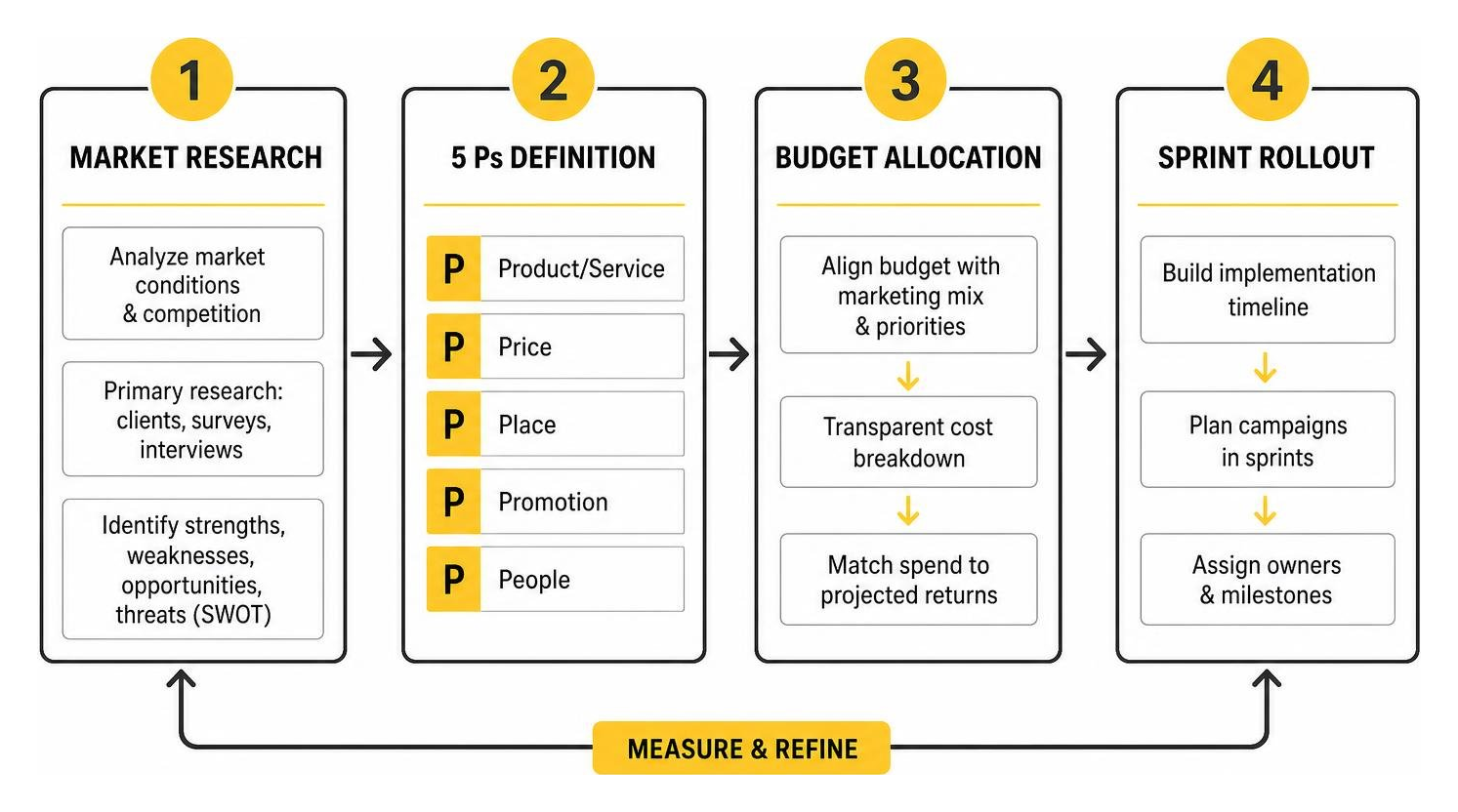
- The Marketing Mix (5 Ps): Product/Service, Price, Place, Promotion, and People.
- Implementation Timeline: A calendar of campaigns, sprint milestones, and designated owners.
- Budget & Financial Controls: Transparent cost breakdowns matched against projected returns.
As highlighted in the academic research on Eight Steps to Developing a Simple Marketing Plan, defining distribution, promotion, and pricing upfront prevents costly mid-campaign pivots.
The Step-by-Step Blueprint for Developing a Marketing Plan That Drives Revenue
Creating a reliable growth engine requires order. Before running ads, you need a solid foundation—a philosophy we call process before promotion. When your intake workflows, tracking systems, and messaging are locked in place, marketing spend translates directly into measurable returns.
Conducting In-Depth Market Research When Developing a Marketing Plan
Market research turns assumptions into actionable intelligence. Begin by examining your local market conditions—whether you are serving corporate clients in Philadelphia, expanding practice areas in Wilkes-Barre, navigating the vibrant commercial sector in New Orleans, or managing international business across Luzerne County and Antigua Guatemala.
- Primary Research: Speak directly with past clients, conduct intake surveys, and interview your frontline staff to uncover genuine pain points.
- Secondary Research: Analyze regional economic data, industry benchmarks, and competitor positioning matrices.
- Competitor Benchmarking: Identify 3 to 4 direct competitors. Where do they advertise? What is their primary claim? Where are their gaps in service?
Use this data to establish an Ideal Customer Profile (ICP) and define clear targets through structured strategic goal setting. Make sure every objective meets SMART criteria: Specific, Measurable, Achievable, Relevant, and Time-bound. Research shows that only 16% of employees feel their company communicates goals effectively, so clarity here is a genuine competitive advantage.
Defining the 5 Ps and Omnichannel Promotional Strategy
Structure your promotional strategy around the classic 5 Ps framework:
- Product / Service: Clarify your specialized offerings, practice niches, and core deliverables.
- Price: Establish clear fee structures, retainer arrangements, or value-based pricing that reflect your expertise.
- Place (Distribution): Map how clients find and engage with you, whether through digital portals, localized offices, or direct consultations.
- Promotion: Select an integrated mix of content marketing, search engine optimization, referral outreach, and targeted advertising.
- People: Train and empower your frontline team. Customer service and intake responsiveness often make or break your marketing return.
Guides on How to write a marketing plan and official resources like Develop your marketing plan emphasize that your promotional mix must match where your target audience naturally spends their attention.
Allocating Budgets and Resources While Developing a Marketing Plan
Budgeting is often where business owners get stuck. While a minimum spend of 1% of topline revenue is typical across general commerce to maintain baseline visibility, growing professional service firms and legal practices regularly invest between 7% and 10% of revenue to capture market share.
Combine two budgeting approaches:
- Top-Down: Establish an overall cap based on your annual revenue targets.
- Bottom-Up: Price out the specific tools, media spend, creative assets, and agency retainers required to hit your lead volume goals.
This dual-layer structure ensures you stop wasting your ad budget and start winning cases, keeping every dollar accountable to revenue milestones.
Tailoring Your Strategy: Common Types of Marketing Plans
Different business initiatives require different planning scopes. A single broad document rarely serves every operational need.
Annual Strategic Plans vs. Campaign-Specific Sprints
| Marketing Plan Type | Primary Focus | Typical Timeframe | Key Deliverables |
|---|---|---|---|
| Annual Strategic Plan | Broad business growth, brand positioning, total budget allocation | 12 Months (reviewed quarterly) | Comprehensive roadmap, master budget, annual KPI benchmarks |
| Product / Service Launch | Introducing a new service line or entering a niche sector | 3 to 6 Months | Go-to-market positioning, launch collateral, PR schedule |
| Digital Marketing Plan | Online visibility, lead gen funnels, organic & paid search | Continuous 90-Day Sprints | Content calendar, SEO roadmap, paid ad testing framework |
| Market Entry Plan | Geographic expansion into new regions or territories | 6 to 12 Months | Regional competitor audit, localized messaging, community partnerships |
Specialized Tactical Plans for Digital and Service-Based Firms
For legal practices and specialized B2B firms, generic advertising rarely produces premium clients. Service-based marketing plans must focus on authority, thought leadership, and trust-building touchpoints. Developing a dedicated pipeline for client acquisition for lawyers ensures your digital campaigns attract pre-qualified matters rather than price-sensitive tire kickers.
Performance Tracking, Metrics, and Continuous Plan Maintenance
A marketing plan should never sit untouched in a drawer. It is a living document that requires continuous evaluation against key performance indicators.

When your leadership team learns to merge bizdev and marketing to win high-value accounts faster, you build a closed-loop reporting system where real-time campaign performance directly informs your business development outreach.
Establishing Modern KPIs and Conversion Metrics
Track metrics across each stage of your pipeline:
- Customer Acquisition Cost (CAC): Total sales and marketing spend divided by new clients acquired.
- Customer Lifetime Value (LTV): The total gross profit generated over an average client relationship. Aim for an LTV to CAC ratio of at least 3 to 1.
- Visitor-to-Lead Conversion Rate: The percentage of website visitors who reach out via phone, form, or chat.
- MQL-to-SQL Conversion Rate: How effectively marketing-qualified inquiries advance to serious sales conversations.
- AI Share of Voice & Digital Mentions: Tracking your firm’s visibility across modern AI search engines and answer engines.
The Agile Review Cadence and Dynamic Plan Optimization
Implement a three-tiered review cadence:
- Monthly Operational Reviews: Review campaign-level analytics, ad spend pacing, and intake response rates.
- Quarterly Deep-Dives: Evaluate channel ROI, adjust resource distribution, and update persona messaging based on recent wins and losses.
- Annual Overhauls: Refresh your competitive analysis, reset annual revenue targets, and build the upcoming year’s tactical roadmap.
Set clear off-cycle triggers: if a major competitor enters your market, regulatory changes impact your service line, or a primary channel’s acquisition cost shifts by more than 20%, revise the plan immediately.
Frequently Asked Questions About Marketing Planning
How often should a marketing plan be updated?
Your overall strategic plan should receive a formal overhaul once a year, but operational tactics and channel budgets should be evaluated in 90-day sprints. Monthly check-ins ensure your ad spend remains aligned with performance data.
What is the minimum recommended marketing budget for small businesses?
While a minimum marketing spend of 1% of topline revenue is typical across most industries to maintain basic awareness, service firms looking to accelerate growth typically invest between 5% and 10% of gross revenue into integrated marketing channels.
How do marketing plans align with business development goals?
Marketing builds brand awareness and generates qualified inquiries, while business development closes engagements and fosters long-term relationships. Uniting these two functions through winning business development strategies every growing company needs creates a shared Service Level Agreement (SLA) that prevents valuable leads from slipping through the cracks.
Conclusion
A well-crafted marketing plan removes the guesswork from your business growth. By taking the time to conduct thorough market research, set measurable SMART goals, establish the 5 Ps, and track your return on investment with disciplined KPIs, you turn marketing from an unpredictable expense into a reliable revenue driver.
Whether you are scaling a practice in Pennsylvania, expanding across Louisiana, or leading an international venture, strategic clarity is the cornerstone of sustainable growth. Take control of your trajectory by building a business development plan that empowers your team, focuses your investments, and delivers lasting results.