Transform Brand Clarity by Developing a Communications Strategy
- Marketing
- Word of the Day
- October 7, 2026
Transform Brand Clarity by Developing a Communications Strategy
Developing a Communications Strategy Starts With Clarity

To develop a communications strategy, start with a business goal, then audit what you say now and who hears it. Choose the audiences that matter most, set a measurable goal for each, and write clear messages that address their needs. Pick channels they use, assign an owner, and decide how you will measure results.
For a law firm, this gives partners and staff a shared way to explain the firm’s value. It also helps you spot mixed messages before they reach prospective clients.
I’m Nicole Farber, CEO of ENX2 Legal Marketing, and I’ve spent more than 15 years helping law firms and other businesses grow. When developing a communications strategy, I focus on making the firm’s goals clear enough for the whole team to act on.
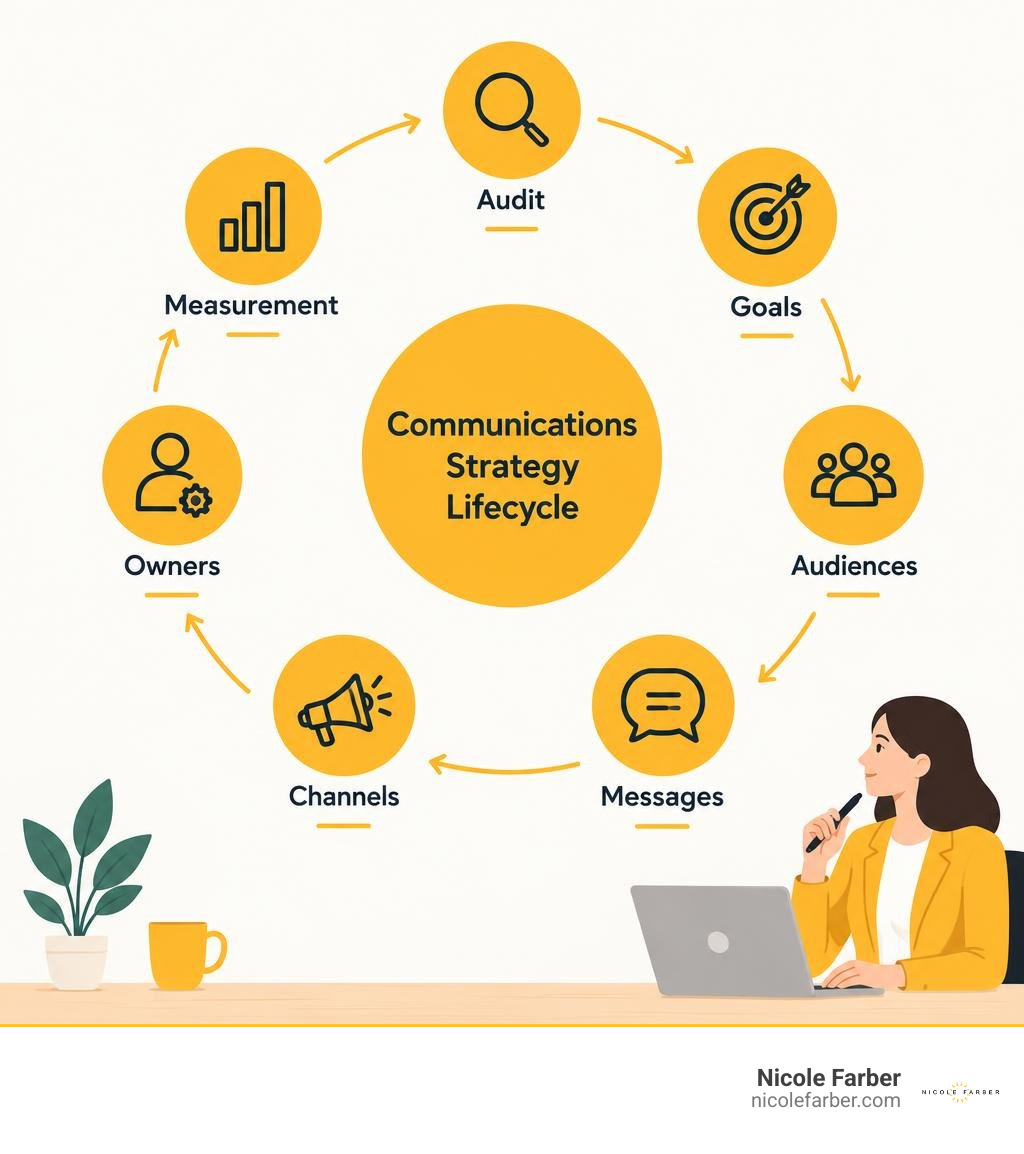
Discover more about developing a communications strategy:
- developing a digital marketing strategy
- business development strategies
- steps in developing a business plan
Understanding Strategy vs. Plan: The Strategic Foundation
Before drafting a single announcement or scheduling social posts, we must draw a clear line between our overarching strategy and the operational plan. Many leadership teams conflate the two, treating a list of tactical tasks as a strategic roadmap. A true communications strategy defines the why, who, and what outcomes of our narrative, whereas a communications plan outlines the tactical how, where, and when.
Without a guiding strategy, teams fall into reactive broadcasting. A cohesive strategy aligns executive leadership, marketing specialists, and client-facing staff around shared business objectives. Organizations with documented communications roadmaps achieve 58% higher message consistency and 42% stronger audience recall than those operating on instinct.
| Strategic Dimension | Communications Strategy | Communications Plan |
|---|---|---|
| Primary Purpose | Defines overarching narrative, business alignment, and reputation goals | Outlines tactical schedules, content deliverables, and execution steps |
| Operational Scope | High-level organizational vision and stakeholder perception mapping | Channel-specific output, asset creation, and campaign timelines |
| Time Horizon | Long-term (1 to 3 years with quarterly recalibration) | Short-to-medium term (campaign-specific, quarterly, or annual) |
| Core Deliverables | Audience personas, core value narratives, governance principles | Editorial calendars, distribution schedules, channel asset sheets |
To structure these foundational documents, leaders often turn to proven frameworks like the Wallace Foundation Communications Plan Workbook to ensure tactical plans stem directly from strategic priorities.
Strategic Differentiation and the Eight Core Elements
A comprehensive communications framework requires eight core pillars:
- Situation Analysis: A diagnostic baseline of organizational reputation and market posture.
- Strategic Objectives: Concrete business outcomes tied to measurable organizational targets.
- Audience Segmentation: Granular breakdown of key stakeholder groups based on decision-making roles.
- Message Architecture: Tiered narrative structures with proof points tailored to audience needs.
- Channel Strategy: An integrated mix across paid, earned, shared, and owned platforms.
- Implementation Roadmap: Phased milestones, execution dependencies, and editorial workflows.
- Resource Allocation: Line-item budgeting, talent deployment, and tool management.
- Measurement Framework: Continuous evaluation of leading indicators and lagging outcomes.
Adopting all eight elements is critical. Research shows that communications plans featuring every core component outperform partial efforts by 65% on audience recall and 48% on measurable behavior change. Mastering these pillars requires robust leadership communication strategies that guide internal teams through organizational change with confidence.
Business Impact and Alignment Economics
Communication breakdowns carry tangible financial consequences. Poor internal communication costs businesses an estimated $12,506 per employee annually in lost productivity, misaligned priorities, and operational friction. When messaging fragments, 52% of employees experience heightened workplace stress, and 44% report project delays.
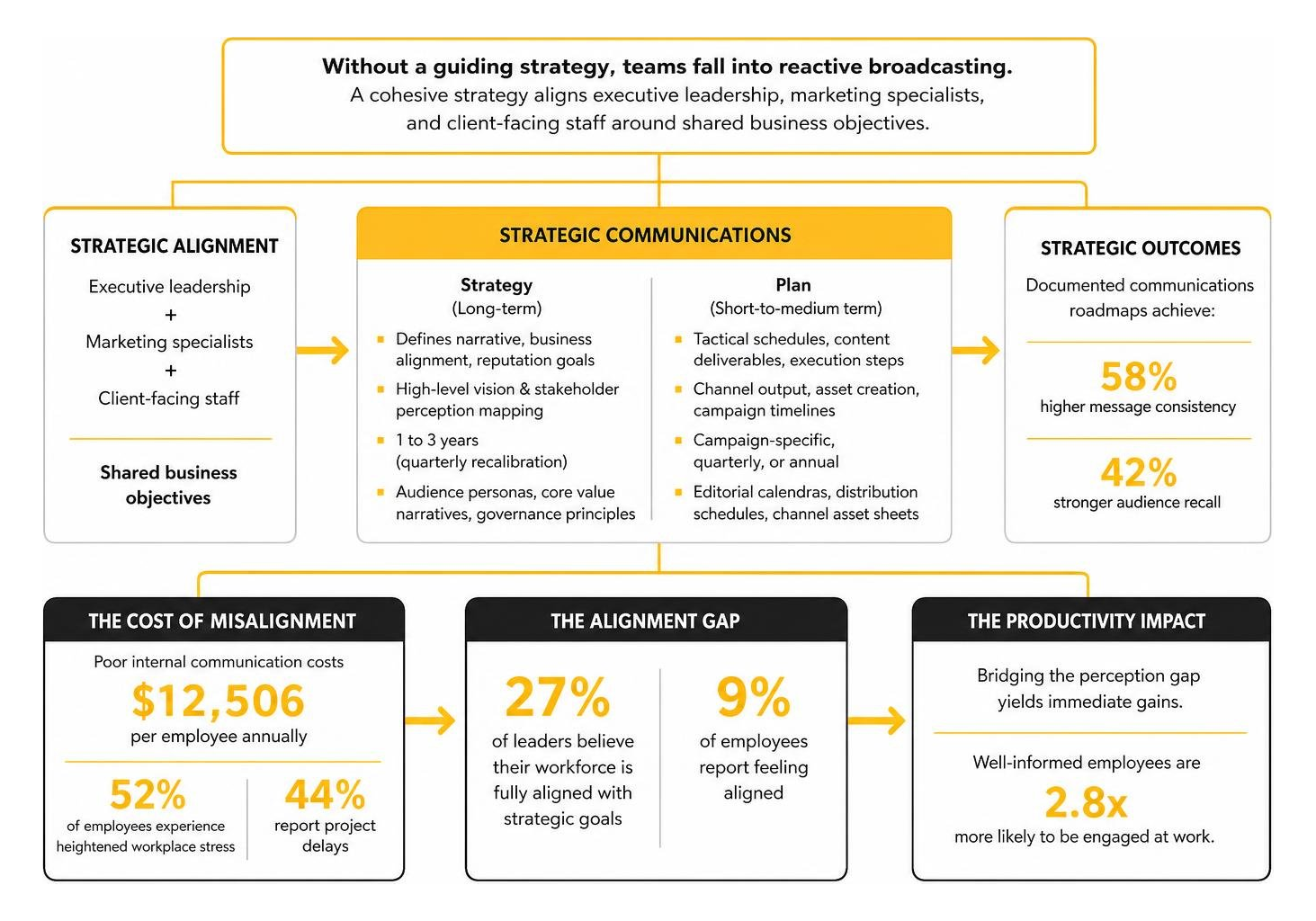
Executive perception often diverges from front-line reality: only 27% of organizational leaders believe their workforce is fully aligned with strategic goals, while a mere 9% of employees report feeling aligned. Bridging this perception gap yields immediate operational gains. Well-informed employees are 2.8 times more likely to be engaged at work. Clear communications build organizational resilience whether you operate in major commerce hubs like Philadelphia and New Orleans, regional legal centers like Wilkes-Barre and Luzerne County, or international hubs like Antigua Guatemala.
Step-by-Step Blueprint for Developing a Communications Strategy

Building a structured communication architecture requires a disciplined, repeatable process. We systematically transition from diagnostic discovery to narrative design and tactical execution.
Conducting a Diagnostic Audit Before Developing a Communications Strategy
Every sound strategy starts with an honest diagnostic audit. Rather than assuming what audiences think, we evaluate historical messaging performance across all media formats from the prior three to six months.
When executing a diagnostic audit:
- Catalog existing content assets, news releases, email newsletters, and client touchpoints.
- Review analytics to identify engagement drop-offs, low-converting topics, and channel blind spots.
- Conduct qualitative stakeholder interviews to uncover internal information bottlenecks.
- Gather feedback from client-facing staff to identify recurring objections and points of confusion.
Starting with a diagnostic situation analysis leads to a 30% improvement in overall campaign performance by eliminating guesswork.
Establishing SMART Objectives When Developing a Communications Strategy
Strategic goals must translate high-level ambition into measurable operational targets using the SMART framework (Specific, Measurable, Achievable, Relevant, and Time-bound). Communications programs with documented objectives demonstrate three times clearer ROI attribution than programs relying on vague aspirations.
Each objective must connect directly to broader business key results, such as customer acquisition, talent retention, or market expansion.
Audience Identification and Perception Mapping
Treating your entire market as a single audience dilutes your core value proposition. High-performing strategies segment audiences by decision-making authority, values, and perception barriers. Communications plans that segment stakeholders by their decision-making roles achieve 55% higher conversion rates than those targeting generic demographic groups.
Map target audiences across three tiers:
- Primary Audiences: Ultimate decision-makers (e.g., general counsel, business owners, retained clients).
- Secondary Audiences: Key influencers and advisors (e.g., department heads, referral networks).
- Tertiary Audiences: Broader community stakeholders, media gatekeepers, and industry peers.
Understanding client journeys and behavioral triggers integrates seamlessly with structured customer acquisition management, ensuring external messaging nurtures relationships from initial contact to long-term loyalty.
Core Narrative and Message Architecture
Your message architecture establishes the factual and emotional pillars of your brand. Messages designed around documented audience perception gaps outperform generic corporate messaging by 2.8 times on persuasion metrics.
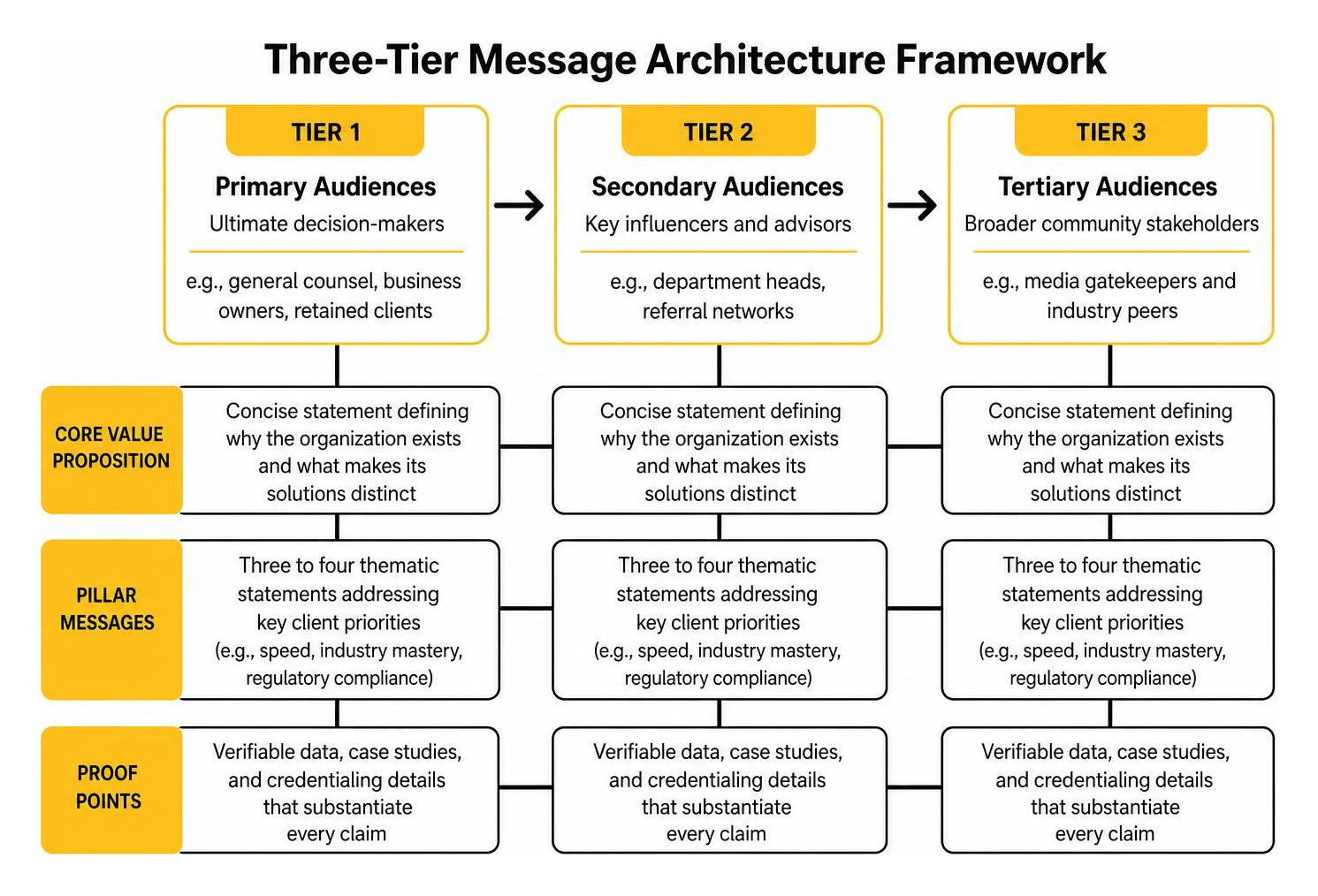
A resilient message architecture includes:
- The Core Value Proposition: A concise statement defining why your organization exists and what makes your solutions distinct.
- Pillar Messages: Three to four thematic statements addressing key client priorities (e.g., speed, industry mastery, regulatory compliance).
- Proof Points: Verifiable data, case studies, and credentialing details that substantiate every claim.
Delivering these narratives persuasively requires leaders to project authentic executive presence across every public speaking engagement, media interview, and board presentation.
Multi-Channel Strategy and the PESO Model
Reaching modern audiences requires an integrated channel ecosystem. Using three or more coordinated channels achieves 287% higher reach than single-channel outreach for the same target group.
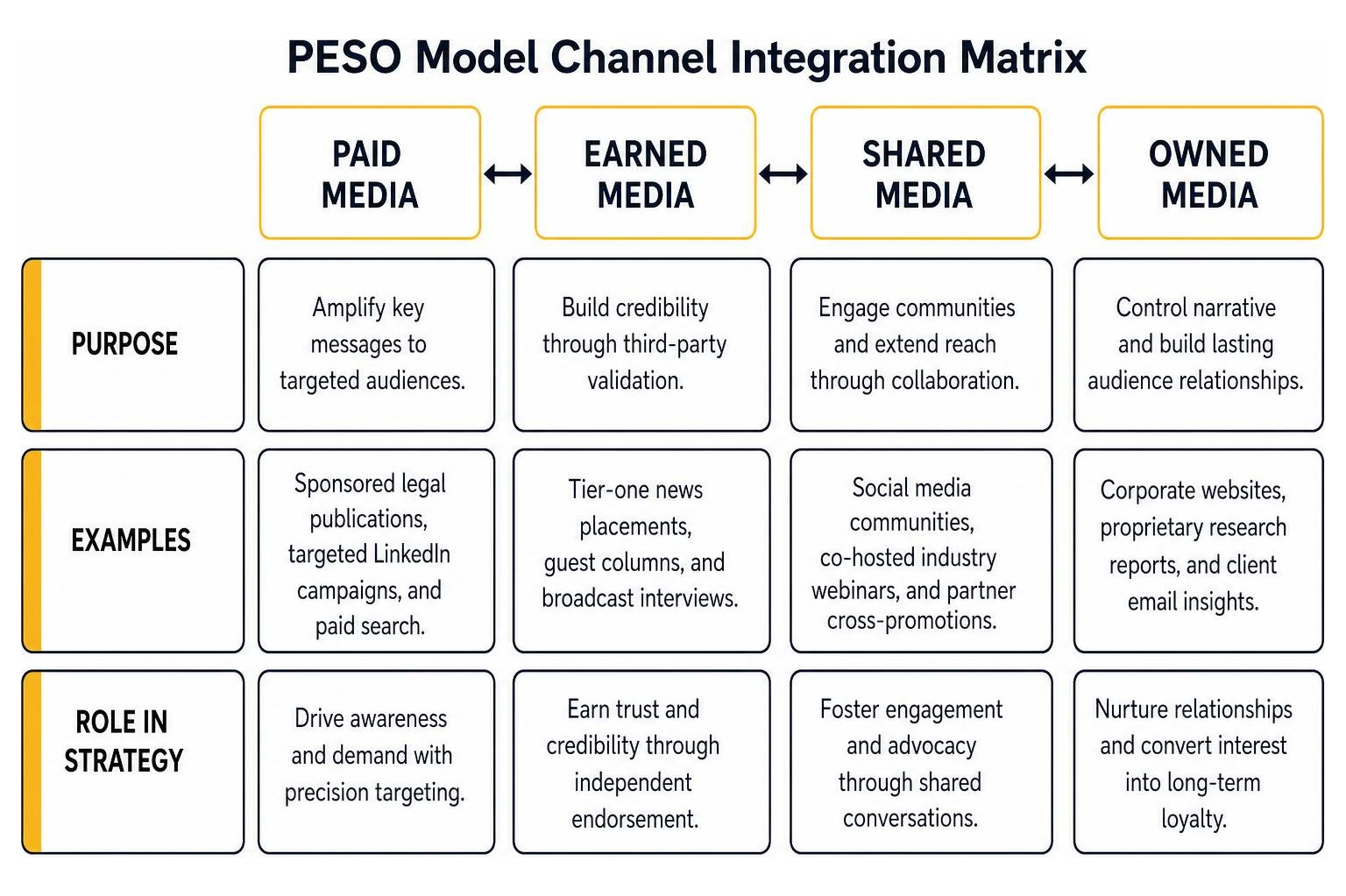
We categorize distribution channels using the PESO model:
- Paid Media: Sponsored legal publications, targeted LinkedIn campaigns, and paid search.
- Earned Media: Tier-one news placements, guest columns, and broadcast interviews.
- Shared Media: Social media communities, co-hosted industry webinars, and partner cross-promotions.
- Owned Media: Corporate websites, proprietary research reports, and client email insights.
Aligning multi-channel publishing with a modern digital marketing strategy ensures your brand maintains high visibility across both traditional search and emerging AI discovery engines. Global institutions emphasize similar multi-channel balances in their UN ESCAP Communications Strategy Guidelines.
Operationalizing Governance, Resource Allocation, and Execution

A strategy without operational governance remains theoretical. We turn strategic ideas into daily execution by establishing clear accountability, funding structures, and delivery schedules.
RACI Matrix and Team Accountability
Ambiguity around editorial approvals creates costly bottlenecks and brand inconsistencies. Implementing a RACI framework clarifies every team member’s role across content creation and release cycles:
- Responsible (R): The marketing lead or copywriter drafting the communication.
- Accountable (A): The communications director or practice lead who approves publication.
- Consulted (C): Subject matter experts, legal counsel, and compliance officers providing input.
- Informed (I): Internal client-facing staff, partners, and sales reps who need to know the message before it goes public.
Establishing clear governance structures allows leadership to focus on essential leadership topics rather than micromanaging individual social media posts.
Budgeting, Phased Timelines, and Cross-Team Integration
Effective budget allocation prevents resource shortfalls during critical campaigns. Communication investments should account for content production, software subscriptions, media distribution, and performance analytics.
Execute initiatives across four sequential phases:
- Preparation Phase: Asset creation, stakeholder sign-off, internal briefing sessions, and technical setup.
- Execution Phase: Primary announcement distribution, press release syndication, and digital campaigns.
- Amplification Phase: Social sharing, executive commentary, email sequencing, and community engagement.
- Sustained Activity: Thought leadership articles, customer success stories, and ongoing media relations.
Harmonizing outbound messaging with client development efforts allows organizations to merge bizdev and marketing to close high-value accounts faster.
Evaluating Impact: Metrics, KPIs, and Performance Governance
Evaluating communication performance requires looking beyond vanity vanity metrics like raw impressions. Under the international Barcelona Principles, modern communications measurement focuses on outcome-based behavior change and commercial impact.
| Metric Type | Focus Area | Example Indicators | Business Significance |
|---|---|---|---|
| Output Metrics | Operational activity | Press releases distributed, social posts published, blog articles produced | Measures team productivity and tactical completion |
| Outgrowth Metrics | Audience reception | Social engagement rate, unique page views, newsletter click-through rates | Confirms message visibility and content relevance |
| Outcome Metrics | Perception & behavior | Unaided brand recall, sentiment lift, qualified consultation requests | Demonstrates shift in audience mindset and commercial intent |
| Impact Metrics | Organizational bottom-line | Client acquisition revenue, talent retention rates, cycle time reduction | Proves direct return on communication investment |
Establish quarterly review cycles to evaluate leading indicators (website conversions, content downloads) against lagging business results (retained client revenue, market share growth). Quarterly reviews improve annual objective completion by 35% compared to static annual plans.
Pitfalls to Avoid in Strategic Organizational Communication
Even experienced teams encounter stumbling blocks when rolling out a communication strategy. Watch out for these common traps:
- Falling into the Tactic-First Trap: Committing to specific tactics (like launching a podcast or TikTok channel) before identifying target audiences and messaging objectives.
- Treating Communication as One-Way Broadcasting: Pushing announcements without establishing feedback loops, surveys, or listening channels to hear back from stakeholders.
- Relying on Generic, Jargon-Heavy Language: Using dense corporate terminology that confuses external clients and alienates employees.
- Neglecting Internal Stakeholders: Launching external campaigns before briefing internal teams creates disconnects between what a brand promises and what it delivers.
- Skipping Baseline Measurement: Launching initiatives without baseline data makes it impossible to prove value or justify future budgets.
Frequently Asked Questions About Strategic Communications
What is the primary difference between a communications strategy and a PR plan?
A communications strategy covers all internal and external touchpoints across the entire organization, including employee communications, client retention narratives, executive messaging, and digital marketing. A PR plan is a specialized subset that focuses primarily on earned media, journalist outreach, and public reputation management.
How often should an organization review and update its communications strategy?
We recommend conducting formal quarterly reviews to assess metric trajectories, address market shifts, and refine channel allocations. A comprehensive diagnostic audit and messaging overhaul should take place annually to ensure ongoing alignment with enterprise business plans.
Can small organizations or startups create an effective strategy with limited resources?
Yes. Lean organizations can build highly effective two-to-three-page strategies by focusing on one primary audience, three core messaging pillars, and two high-impact distribution channels. Prioritizing disciplined consistency over broad, diluted reach delivers outsized market impact.
Conclusion
Developing a communications strategy provides the operational clarity, brand consistency, and leadership alignment needed to stand out in competitive markets. By grounding our messages in diagnostic data, setting clear SMART objectives, tailoring narratives to priority audiences, and holding teams accountable to meaningful outcome metrics, we turn everyday communications into a true growth driver.
Whether guiding enterprise organizations across Luzerne County, Philadelphia, and New Orleans, or expanding international ventures in Antigua Guatemala, clear communication remains the foundation of organizational resilience. Take the next step in transforming your market positioning by building a business development plan that turns brand clarity into sustainable revenue.