Talk the Talk: The Ultimate Guide to Executive Presence
- Leadership
- In the News
- July 8, 2026
Talk the Talk: The Ultimate Guide to Executive Presence
Why Learning to Speak Like a Leader Is a Career Game-Changer

Want to speak like a leader starting today? Here’s a quick overview of what that actually means in practice:
- Use “we” instead of “I” — share credit and signal collaboration
- Replace blame with questions — ask “What’s the best way to solve this?” instead of “Who’s responsible?”
- Speak declaratively — drop hedging phrases like “I think maybe we should consider…”
- Control your pace — slow down, pause deliberately, and eliminate filler words
- Listen actively — how you listen is as important as how you talk
- Own your perspective — share opinions with conviction and disagree assertively when needed
- Project calm — steadiness communicates authority more than charisma ever will
Most professionals assume that getting promoted comes down to doing great work. And yes, your skills matter. But here’s the uncomfortable truth: how you communicate often determines how far you go.
Research consistently shows that 70% of leaders credit communication skills as the single most important factor in their success. Yet many high-performers — attorneys, partners, and executives included — still rely on entry-level communication habits long after they’ve outgrown entry-level roles.
The gap between expertise and influence is almost never a knowledge problem. It’s a language problem.
You can know your material cold and still lose the room. You can be the smartest person in a meeting and still walk out without the outcome you needed. That disconnect — between what you know and how you’re perceived — is exactly what learning to speak like a leader is designed to close.
This guide breaks down the specific habits, phrases, and mindset shifts that separate leaders who command rooms from those who get talked over. Whether you’re a law firm partner in Philadelphia trying to inspire your team, a rising executive in Wilkes-Barre preparing for a bigger stage, or a professional anywhere who wants their voice to carry more weight — these techniques apply directly to you.
I’m Nicole Farber, CEO of ENX2 Legal Marketing, with over 15 years of experience helping law firms grow through stronger communication, sharper positioning, and authentic leadership presence — and I’ve spoken on stages from Luzerne County to national conferences on exactly how to speak like a leader in ways that drive real results. The strategies in this guide are the same ones I’ve seen transform careers and practices across the country.
What It Means to Speak Like a Leader
To speak like a leader does not mean giving grand, theatrical speeches from a podium. It is not about adopting an artificial, booming voice or trying to force a magnetic charisma that does not feel natural to you.
Instead, leadership communication is a highly intentional, strategic, and empathetic way of sharing information. It is about making others feel certain, establishing psychological safety, and aligning your team around a shared vision. When we speak like a leader, we bridge the gap between our internal expertise and our external influence.
Everyday workplace communication is often transactional, reactive, and focused on individual tasks. In contrast, leadership communication is relational, proactive, and focused on the bigger picture. To help visualize this distinction, let us look at how everyday workplace talk compares directly to leadership communication:
| Everyday Workplace Talk | Leadership Communication |
|---|---|
| Focuses on the “I”: “I finished my part of the project.” | Focuses on the “We”: “We made incredible progress on this project.” |
| Reactive & Defensive: “That wasn’t my fault; the data was late.” | Solution-Oriented & Accountable: “Let’s figure out how we can adjust our timeline to resolve this.” |
| Asks closed, task-based questions: “Did you finish that report?” | Asks open, empowering questions: “What do you think we should do next?” |
| Softens statements with qualifiers: “I think maybe we could try this…” | Speaks with declarative conviction: “Based on our data, this is the best path forward.” |
| Rushes to fill silence: Over-explaining and speaking rapidly under pressure. | Embraces the strategic pause: Using deliberate pauses to let key ideas land. |
Understanding these differences is the first step toward mastering what is leadership in our daily interactions. It is about shifting our focus from simply conveying data to actively building trust and driving engagement.
The Shift from Individual Contributor to Visionary
When we first start our careers in places like Philadelphia or Wilkes-Barre, we are judged primarily on our technical output. We are individual contributors. We talk about our tasks, our hours, and our personal deliverables.
However, as we step into leadership roles, our value is no longer measured by what we can do individually. It is measured by what we can inspire others to achieve. This requires a profound identity shift.
To make this transition successfully, we must learn how to become an effective leader by changing how we frame our thoughts. A visionary leader does not show up to a meeting to prove they are the smartest person in the room. They show up to bring out the intelligence of everyone else.
This means moving away from entry-level communication styles — which often focus on self-preservation and highlighting personal achievements — and moving toward a style that champions the collective effort. We must stop talking like we are trying to get an “A” on a school project, and start talking like we are steering a ship.
Why Your Words Matter for Career Advancement
Have you ever noticed that the people who get promoted are not always the ones who work the longest hours? Instead, they are the ones who can command a room, connect with stakeholders, and close deals.
Professionals who speak with authority, clarity, and confidence are far more likely to be promoted into key leadership roles. If we want to advance, we must first discover how to become a good leader at work by demonstrating executive presence long before we receive the official title.
When you speak with authority, you build immediate trust. Your clients, your peers, and your board of directors feel secure in your hands. On the flip side, if your verbal and nonverbal habits project uncertainty, people will hesitate to trust your recommendations — even if your technical work is flawless.
The Verbal Shift: Replacing Weak Phrases with Authoritative Language
The words we choose are the building blocks of our professional reputation. Many highly qualified professionals unconsciously use language that undermines their own authority. They soften their opinions, apologize for taking up space, and use passive phrasing to avoid sounding “bossy.”
To speak like a leader, we must audit our vocabulary and replace collaborative-killing, defensive, or weak phrases with inclusive, solution-oriented language.

As highlighted in The Language of Leaders: How the Top 1% Speak, Command, and Inspire, the top tier of communicators understand that their verbal craft must signal ownership and strategic alignment. Let us look at how we can make these verbal shifts in our daily workplace conversations.
How to Speak Like a Leader by Swapping “I” for “We”
One of the simplest yet most powerful linguistic changes we can make is shifting from “I” to “We.”
When a leader says, “I managed to secure this new client,” it sounds like they are working in a vacuum. But when they say, “We secured this new client,” it instantly builds a culture of shared success. Leaders who use inclusive language like “we” instead of “I” see significantly higher team engagement and collaboration.
To practice this, read our guide on being a good leader in the workplace. You will find that replacing individualistic phrasing with collective language reinforces shared responsibility.
Instead of saying:
- “I want you to fix this.” -> Try: “Let’s figure out how we can resolve this together.”
- “What are you going to do about this?” -> Try: “What do you think our best next step is?”
- “I don’t think you should do that.” -> Try: “Why don’t we try this approach instead?”
Moving from Blame to Solution-Oriented Phrasing
When things go wrong — whether it is a missed deadline in a Philadelphia law office or a miscommunication on a project in Wilkes-Barre — a weak communicator immediately looks for someone to blame. They ask questions like, “Who was responsible for this mistake?” or state, “You did this wrong.”
This defensive language triggers a threat response in the listener’s brain, causing them to shut down, withhold their best ideas, and stop contributing.
A true leader shifts the focus from blame to solutions. They protect psychological safety by framing errors as opportunities to learn and improve. To see how this works in action, explore leadership topics that matter to your team.
Instead of pointing fingers, use phrases that invite collaborative problem-solving:
- Instead of: “This isn’t good enough.” -> Say: “We need to elevate this to meet our standards. How can we get it there?”
- Instead of: “Why did you do it this way?” -> Say: “Help me understand your thinking behind this approach.”
- Instead of: “Do you need help?” (which can feel patronizing) -> Say: “How can I best support you on this?”
The Vocal and Physical Dimensions of Executive Presence
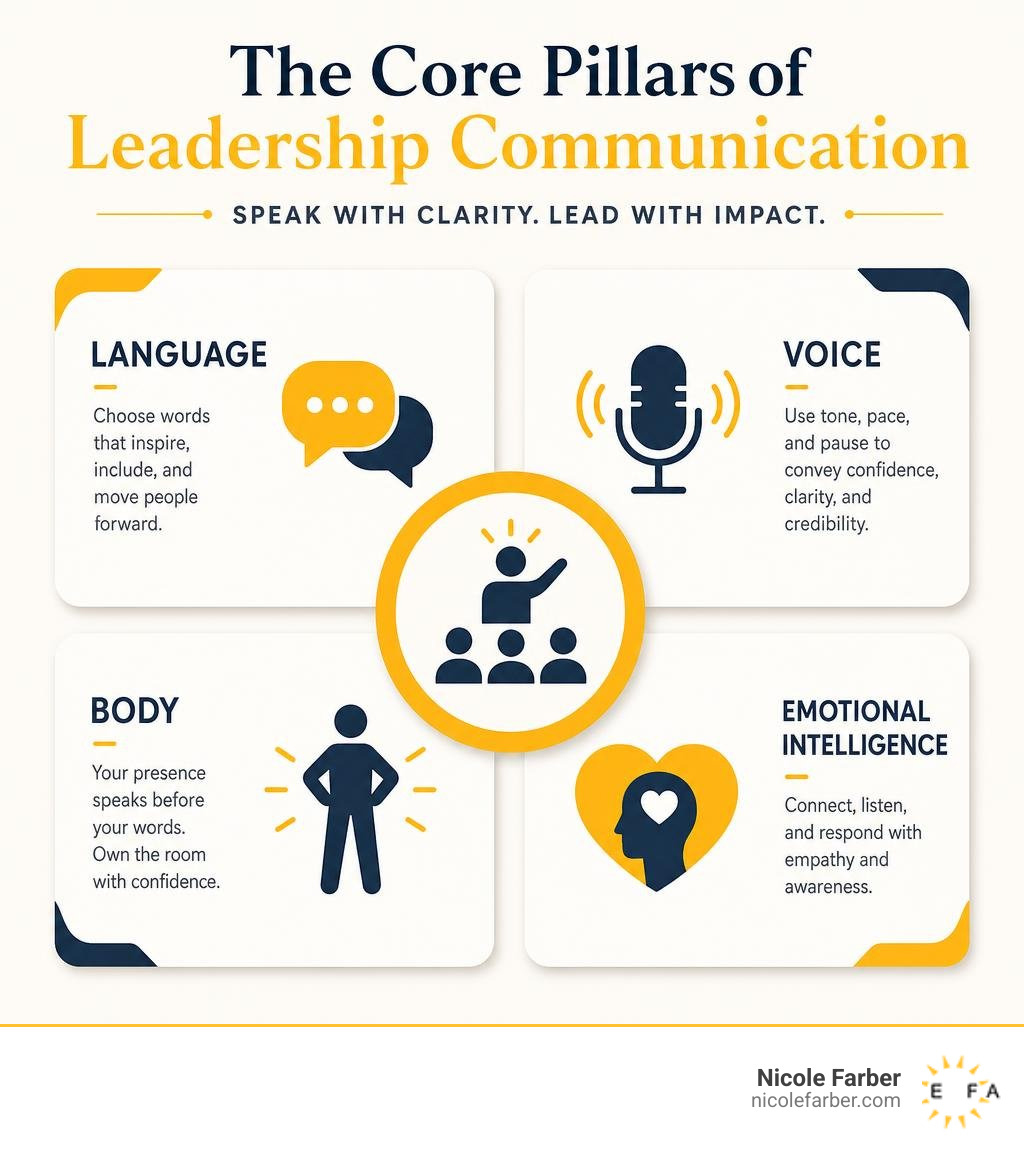
Communication is a three-channel system: it relies on our words, our voice, and our body language. You can have the most brilliant strategy on paper, but if your voice is trembling or your posture is closed, your message will not land with the authority it deserves.

To command a room in places like New Orleans or Philadelphia, we must pay close attention to our physical and vocal delivery.
Mastering Tone, Pacing, and the Power of the Pause
When we are nervous, our natural instinct is to speak as quickly as possible to “get it over with.” We fill every silent pocket with verbal viruses like “um,” “like,” “uh,” or “you know.” This rapid, cluttered delivery signals anxiety and a lack of control.
To counteract this, we must learn to project from our diaphragm and slow down our pacing. Speaking slowly and utilizing deliberate, two-to-three-second pauses before key points creates anticipation and signals that what you are saying is highly valuable.
For excellent tips on vocal control, you can Listen to the Talk Like a Leader Podcast. You will learn that managing your cadence and ending your sentences with a confident, downward inflection — rather than the rising pitch of “upspeak” — makes you sound grounded and certain.
Nonverbal Cues That Command the Room
Our physical presence speaks long before our mouths do. To project executive presence, practice these core body language habits:
- Maintain an Expansive Posture: Keep your shoulders back, your chest open, and your feet planted hip-width apart. This grounded stance signals confidence and calm.
- Distribute Eye Contact Deliberately: In group settings, do not just look at the decision-maker. Distribute your eye contact across the room to make everyone feel included and addressed.
- Use Open Gestures: Avoid crossing your arms or fidgeting. Use open-palm gestures to signal honesty and transparency. When analyzing complex data or making a highly analytical point, try using “steepled fingers” (touching the fingertips of both hands together) to convey quiet authority.
Balancing Assertiveness with Emotional Intelligence
A common misconception about leadership is that you must choose between being respected and being liked. Some believe that to speak like a leader, they must be aggressive, loud, and unyielding.
But authority without empathy is not leadership; it is theater, and it eventually breeds resentment. True executive presence requires us to balance assertive conviction with deep emotional intelligence (EQ).
We saw this balance play out beautifully during local community forums, such as the public discussions surrounding the Luzerne County anti-discrimination ordinance. You can Read about the Luzerne County anti-discrimination ordinance discussions to see how leaders must navigate complex, emotionally charged spaces by giving everyone a voice while keeping the conversation constructive.
How to Speak Like a Leader While Remaining Collaborative
Collaborative leadership means moving from a “command-and-control” style to a “leading with” model. We must leverage our team’s diverse strengths and invite their input before making final decisions.
To build this skill set, Check out our complete guide to leadership development. You will discover that the most influential leaders do not pretend to have all the answers. Instead, they ask powerful, open-ended questions that spark innovation.
Instead of commanding: “We are going to go with Option A.”
Try collaborating: “The data points us toward Option A, but I want to hear your perspectives. What potential roadblocks do you see?”
Navigating Difficult Conversations and Delivering Bad News
Whether you are delivering bad news to a client, resolving a conflict between partners, or addressing a performance issue, difficult conversations are inevitable.
To handle these moments with grace, we can look to cognitive linguistics — the study of how the brain processes language. When people feel challenged, their nervous system triggers a defensive threat response. To de-escalate this, we must pause, breathe, and lead with curiosity rather than defensiveness.
In the podcast episode How to Command the Room, Connect the Dots, Close the Deal, communication experts emphasize the value of using neutral “labeling” to defuse tension.
If a team member or client becomes defensive, do not argue back. Instead, label their emotion calmly: “It seems like this transition is causing a lot of frustration. Let’s talk about how we can make this process smoother for you.” This validates their experience, lowers their defense mechanisms, and shifts the conversation back to collaborative problem-solving.
Overcoming Obstacles: Introversion, Anxiety, and the Authenticity Paradox
What if you are naturally quiet? What if the very thought of speaking up in a high-stakes board meeting in Philadelphia makes your heart race and your palms sweat?
Many professionals believe they cannot speak like a leader because they are introverted or lack a naturally boisterous personality. But leadership is not an extrovert-only club. In fact, some of the world’s most successful leaders are introverts who lead with a quiet, steady presence.
The key is realizing that leadership communication is not about putting on an act. It is about aligning your external delivery with your internal values and safety.
Why You Don’t Need to Be Loud to Have Authority
If you try to force a loud, high-energy persona that does not match who you are, your audience will instantly sense the lack of authenticity. This is known as the “Authenticity Paradox” — the tension we feel when trying to adopt new leadership behaviors that feel unnatural to us.
As outlined in How to Speak Like a Leader Without Forcing Executive Presence, we do not need to perform. People do not follow loud energy; they follow steadiness, clarity, and safety.
If you are an introvert, you can leverage your natural strengths, such as deep listening and thoughtful preparation. Instead of trying to dominate a meeting by talking the most, go on a “listening tour” during the first half of the session. Gather the room’s perspectives, synthesize the main points, and then speak with calm, deliberate authority: “I’ve listened to everyone’s points, and it seems our main bottleneck is resource allocation. Here is how we can address that.”
Managing Speech Anxiety Under Pressure
When we are placed in high-visibility situations, our brains can mistake evaluation for physical danger. Our nervous system triggers a “fight-or-flight” response: our heart rate spikes, our breathing becomes shallow, and we feel an overwhelming urge to rush through our words or over-explain to protect ourselves.
To overcome this, we must build internal safety. Here are a few practical ways to manage speech anxiety:
- Use Video Practice: Record yourself practicing your presentations or meeting talking points on your phone. Watch the recordings back to spot filler words, pacing issues, or physical fidgeting. Repeat this process until you feel comfortable with how you look and sound.
- Focus on the Audience: Shift your focus away from “How do I look?” and toward “How can I help my audience understand this concept?” When you make the transition from self-monitoring to audience-serving, your anxiety naturally decreases.
- Lead with Faith and Real-World Experience: True confidence is not built by faking it. It is built over time through consistent, real-world action, learning from our setbacks, and leaning on a strong foundation of faith-driven leadership. When you trust your preparation and your purpose, the pressure of the room begins to fade.
Frequently Asked Questions about Leadership Communication
How do I stop over-explaining in high-stakes meetings?
Over-explaining is almost always a nervous-system threat response. When we feel evaluated, we keep talking to justify our position or prevent criticism.
To stop this habit, practice brevity. Make it a rule to state your core message in two sentences or less, and then stop speaking. Tolerate the silence that follows. Let your ideas land without softening them with qualifiers like, “Does that make sense?” Trust that your audience will ask questions if they need more details.
What is the best way to handle conflict over email?
Email lacks tone, facial expressions, and vocal inflection, making it incredibly easy for messages to be misconstrued. If you notice a conflict starting to brew over email, the best leadership move is to change the communication channel immediately.
Pick up the phone or schedule a quick virtual meeting. A simple, two-minute conversation can resolve what would have taken a frustrating, multi-day email chain to untangle.
How can I build speaking confidence if I am an introvert?
Start by preparing thoroughly. Anticipate the tough questions you might receive in a meeting and write down your answers in advance.
Additionally, focus on storytelling. Instead of trying to command the spotlight, tell stories that highlight the achievements of your peers and team members. This allows you to inspire and connect with your audience without feeling like you are forcing an inauthentic, attention-seeking persona.
Conclusion
Learning to speak like a leader is a continuous journey of self-discovery, practice, and refinement. It is about aligning your words, your voice, and your physical presence to project the calm, steady authority that your team and your clients need.
Whether you are navigating high-stakes litigation in Wilkes-Barre, leading a expanding business in Philadelphia, or managing a remote team from Antigua Guatemala, your communication is your most powerful tool for creating trust, alignment, and high-performance cultures.
You do not need to be the loudest voice in the room to lead. You simply need to be the clearest, most grounded, and most empathetic.
At ENX2 Legal Marketing, we are dedicated to helping entrepreneurs, law firms, and executives unlock their full potential through authentic communication and faith-driven leadership. If you are ready to take your communication skills and executive presence to the next level, we invite you to take the next step.
Elevate your presence with Leadership Speaking and let us help you find your voice, command your room, and build the legacy you were meant to create.