The Big List of Leadership Topics That Actually Matter to Your Team
- Leadership
- Word of the Day
- May 13, 2026
The Big List of Leadership Topics That Actually Matter to Your Team
Why Leadership Training Topics Matter More Than Ever in 2026

Leadership training topics are the specific skills and themes organizations teach their managers and executives to help them lead more effectively. Here are the most important ones to know:
- Emotional Intelligence (EQ) – self-awareness, empathy, reading the room
- Communication and Feedback – active listening, radical candor, receiving feedback first
- Psychological Safety – creating environments where teams speak up
- Decision-Making and Problem-Solving – frameworks, critical thinking, ethical choices
- Change Management – guiding teams through uncertainty
- Coaching and Mentoring – developing people, building the next generation of leaders
- Strategic Thinking – vision, planning, aligning goals
- Conflict Resolution – mediation, neutrality, difficult conversations
- Digital Leadership and AI – leading hybrid teams, using new tools responsibly
- Inclusive Leadership and DEI – belonging, equity, collaboration
Here’s something that should concern every organization right now: 63% of millennials feel they aren’t getting the leadership training they need to step into future roles. That’s not a small gap. That’s a pipeline problem waiting to become a crisis.
And it’s not just about filling seats. Research shows that leadership development initiatives can boost employee engagement by 15%. Meanwhile, a poor-performing manager can cost an organization up to 27% in lost revenue per employee.
The stakes are real — whether you’re running a law firm in Philadelphia, a growing business in Wilkes-Barre, or managing teams across multiple locations.
The good news? The right training topics, delivered the right way, make a measurable difference.
I’m Nicole Farber, CEO of ENX2 Legal Marketing, with over 15 years of experience helping law firms and businesses grow — including speaking on leadership training topics at Merakey’s Annual Leadership Conference in 2025. In this list, I’m breaking down the leadership topics that actually move the needle for your team.
Core Leadership Training Topics for Modern Success
In the business environments of Philadelphia and the growing industrial hubs of Luzerne County, leadership is no longer about “command and control.” Modern success relies on a leader’s ability to foster a culture of high performance and mutual respect. When we look at Scientific research on leadership development impact, the data is clear: companies with strong leadership programs are 1.5 times more likely to outperform their competitors.
However, many leaders are struggling. Gartner research highlights that 78% of leaders experience “collaboration drag,” characterized by too many meetings, excessive peer feedback, and unclear decision-making authority. To combat this, we must focus on leadership training topics that streamline operations while boosting morale. This starts with creating an environment of psychological safety—where team members feel safe to take risks and be vulnerable—and a robust feedback culture.

Mastering Emotional Intelligence and Soft Skills as Leadership Training Topics
If there is one “superpower” in the modern workplace, it is Emotional Intelligence (EQ). Research from TalentSmart shows that EQ accounts for 58% of job performance across various roles. In our professional events in Wilkes-Barre, we often discuss how EQ is the foundation of developing executive presence.
Mastering EQ involves four key pillars:
- Self-Awareness: Recognizing your own emotional triggers and how they affect your team.
- Self-Regulation: Managing impulses and staying calm under the pressure of a high-stakes trial or a tight business deadline.
- Empathy: Truly understanding the perspectives of your employees and clients.
- Social Skills: Reading the room and navigating complex interpersonal dynamics with grace.
When leaders prioritize these soft skills, they don’t just become “nicer” bosses; they become more effective ones. You learn how to become an effective leader by connecting with the human beings behind the spreadsheets.
Communication and Feedback as Essential Leadership Training Topics
Communication is the cornerstone of collaboration. In fact, 75% of employees view effective communication as the top leadership attribute, yet less than one-third feel their leaders communicate efficiently. Whether we are networking in New Orleans or holding a strategy session in our home offices, we must move beyond basic “talking” and toward active listening and radical candor.
One of the most impactful business leadership strategies we teach is the concept of “receiving feedback first.” Instead of focusing on how to give critiques, leaders should be trained on how to model openness. When a leader asks for feedback and acts on it without defensiveness, it removes fear from the organization. This creates a foundation where “silent meetings” or “two-way feedback loops” can actually thrive, ensuring that every voice is heard and every process is optimized.
Navigating the Future: AI, Hybrid Work, and DEI
As we navigate April 2026, the landscape of work has been permanently altered by technology and social shifts. We can no longer ignore the role of Artificial Intelligence. According to Accenture, more than 40% of all U.S. work activity can be augmented, automated, or reinvented with generative AI. This makes “Digital Leadership” one of the most critical leadership training topics today.
Leaders must develop “fusion skills”—the ability to combine human judgment with machine efficiency. This is especially relevant for our business women leadership experts who are navigating these new tools to scale their impact.
In addition to AI, hybrid work remains a permanent fixture. Managing a team that is split between Philadelphia and Antigua Guatemala requires a different set of skills than managing everyone in a single room. We need to focus on:
- Inclusive Leadership: Ensuring that remote workers feel just as included as those in the office.
- Belonging and DEI: Moving beyond “check-the-box” diversity to create a culture where everyone feels they truly belong.
- Collaboration Tools: Utilizing technology to reduce “collaboration drag” and increase high-performance output.
Organizations that promote collaborative working are 5 times as likely to be high-performing. By integrating these future-focused topics into your curriculum, you ensure your team remains agile and competitive.
Tailoring Topics for New Managers vs. Experienced Executives
A one-size-fits-all approach to training is a recipe for failure. The needs of a new supervisor in Luzerne County are vastly different from a seasoned CEO in New Orleans. We must tailor our leadership training topics to the specific stage of a leader’s journey.
| Training Focus | New Managers | Experienced Executives |
|---|---|---|
| Primary Goal | Transitioning from doer to leader | Scaling impact and legacy |
| Key Skills | Delegation, Time Management, Feedback | Strategic Planning, Succession, ROI |
| Common Pitfall | Micromanagement | Siloed thinking / Disconnect from front line |
| Coaching Need | Tactical guidance and confidence | CEO Coaching Services |
New managers often struggle with the “shift” in mindset. They need practical training on how to delegate effectively and build high-performing teams. Meanwhile, executives need to focus on the long-term health of the organization. This includes Succession Planning, as more than half of employees say they would be significantly more engaged if their company had a clear plan for the future.
Poor management is expensive. Gallup found that engagement scores were 30% better under talented managers, while poor managers can drain a firm’s revenue. By utilizing resources like Leadership Training Topics from CCL, organizations can create custom learning journeys that meet leaders exactly where they are.
Proven Methods to Deliver Impactful Training and Measure ROI
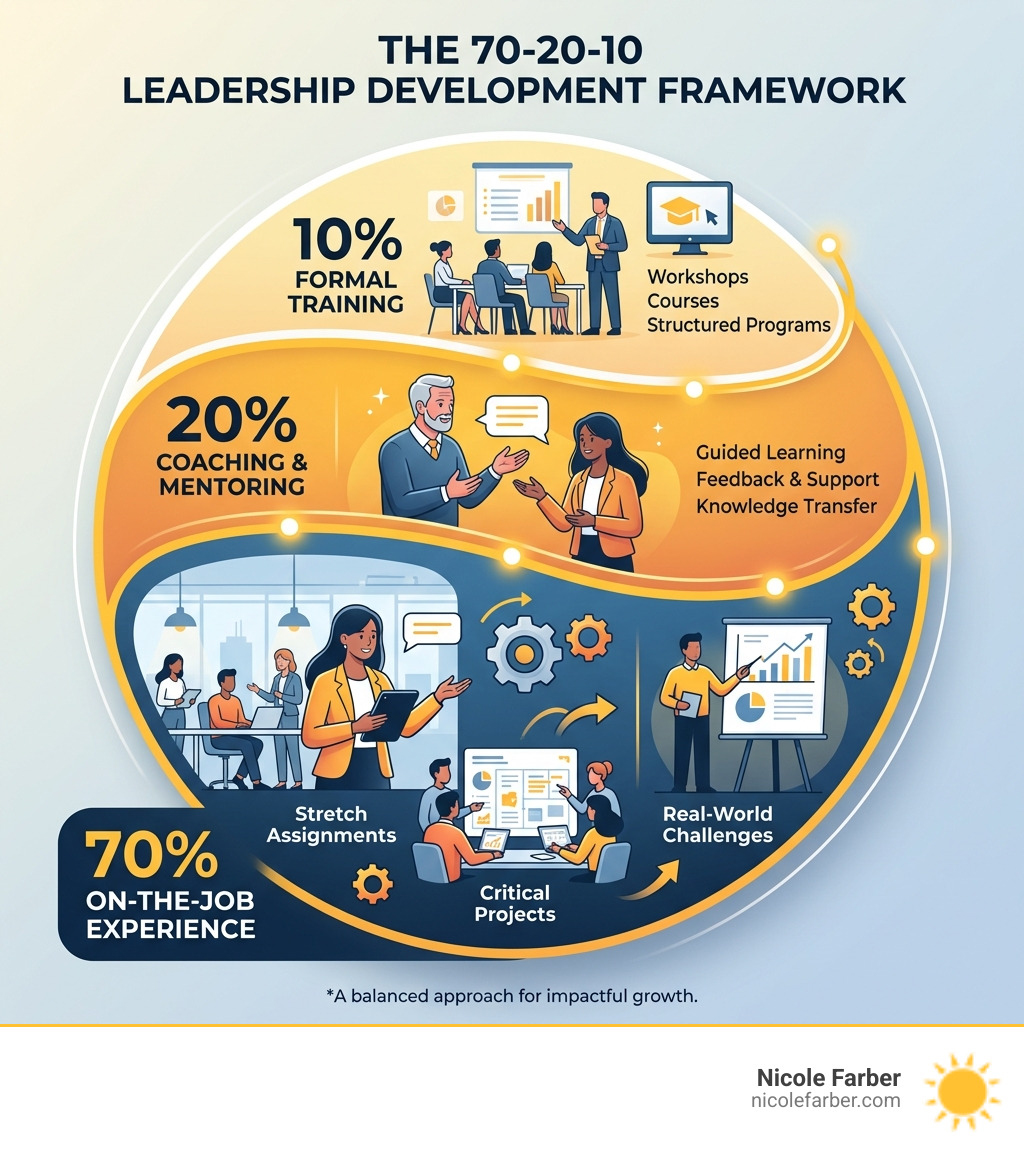
How do we ensure that leadership training actually sticks? It’s not enough to host a one-day seminar and hope for the best. High-impact programs use “blended learning”—a mix of formal instruction, peer learning, and real-world application.
The 70-20-10 framework is our gold standard:
- 70% of learning comes from difficult on-the-job experiences.
- 20% comes from coaching and mentoring.
- 10% comes from formal education.
Mentoring is particularly powerful. Unlike traditional training, mentoring provides ongoing, personalized support. When we engage in business strategy coaching, we see how customized guidance helps leaders navigate their specific business goals.
To measure the success of these programs, we look at Key Performance Indicators (KPIs) such as:
- Employee Retention Rates: Are people staying longer?
- Engagement Scores: Are teams more motivated?
- Productivity Metrics: Is the work getting done more efficiently?
- Leadership Pipelines: Do we have internal candidates ready for promotion?
Companies that invest in these leadership development seminars are 1.5 times more likely to outperform their competitors. The ROI is undeniable.
Frequently Asked Questions about Leadership Development
Why is leadership development critical for organizational success?
Leadership development is critical because it directly impacts the bottom line. Talented managers improve employee engagement by 30%, which leads to higher productivity and lower turnover. In a competitive market like Philadelphia or Wilkes-Barre, having a strong leadership pipeline is a strategic advantage that allows you to outpace competitors and adapt to market changes.
How can organizations prioritize leadership topics based on business goals?
Organizations should start with a “Training Needs Analysis.” If your goal is rapid expansion, prioritize leadership training topics like strategic planning and hiring. If you are struggling with high turnover, focus on emotional intelligence and feedback culture. Aligning training with your specific business gaps ensures that your investment yields a tangible return.
What are the most common pitfalls in leadership training and how to avoid them?
The most common pitfall is the “one-and-done” approach—providing a single workshop with no follow-up. To avoid this, integrate coaching and mentoring into the curriculum. Another pitfall is failing to tailor the content to the audience; new managers shouldn’t be trained on the same topics as C-suite executives. Finally, ensure the training is practical and not just theoretical—leaders need to be able to apply what they learn the very next day.
Conclusion
At the end of the day, leadership is a journey, not a destination. My own journey as a single mother and a business leader has taught me that the most effective leadership is rooted in real-life experience and faith. We don’t just lead with our heads; we lead with our hearts and our values.
Whether you are looking to develop your leadership or you want to empower your entire management team, the topics we’ve discussed today are the keys to unlocking your organization’s potential. From the historic streets of Philadelphia to the vibrant culture of Antigua Guatemala, the need for compassionate, capable, and tech-savvy leaders has never been greater.
Don’t let your team be part of the 63% who feel underserved. Take the first step toward building a stronger, more resilient organization. You can stop managing and start leading with these professional seminars and watch your team flourish.
Let’s build the future of leadership together. Start leading today with professional seminars and make 2026 the year your team truly thrives.