The Practical Roadmap for Developing a Modern Digital Marketing Strategy
- Marketing
- Word of the Day
- October 2, 2026
The Practical Roadmap for Developing a Modern Digital Marketing Strategy
Build a Digital Marketing Strategy That Drives the Right Clients

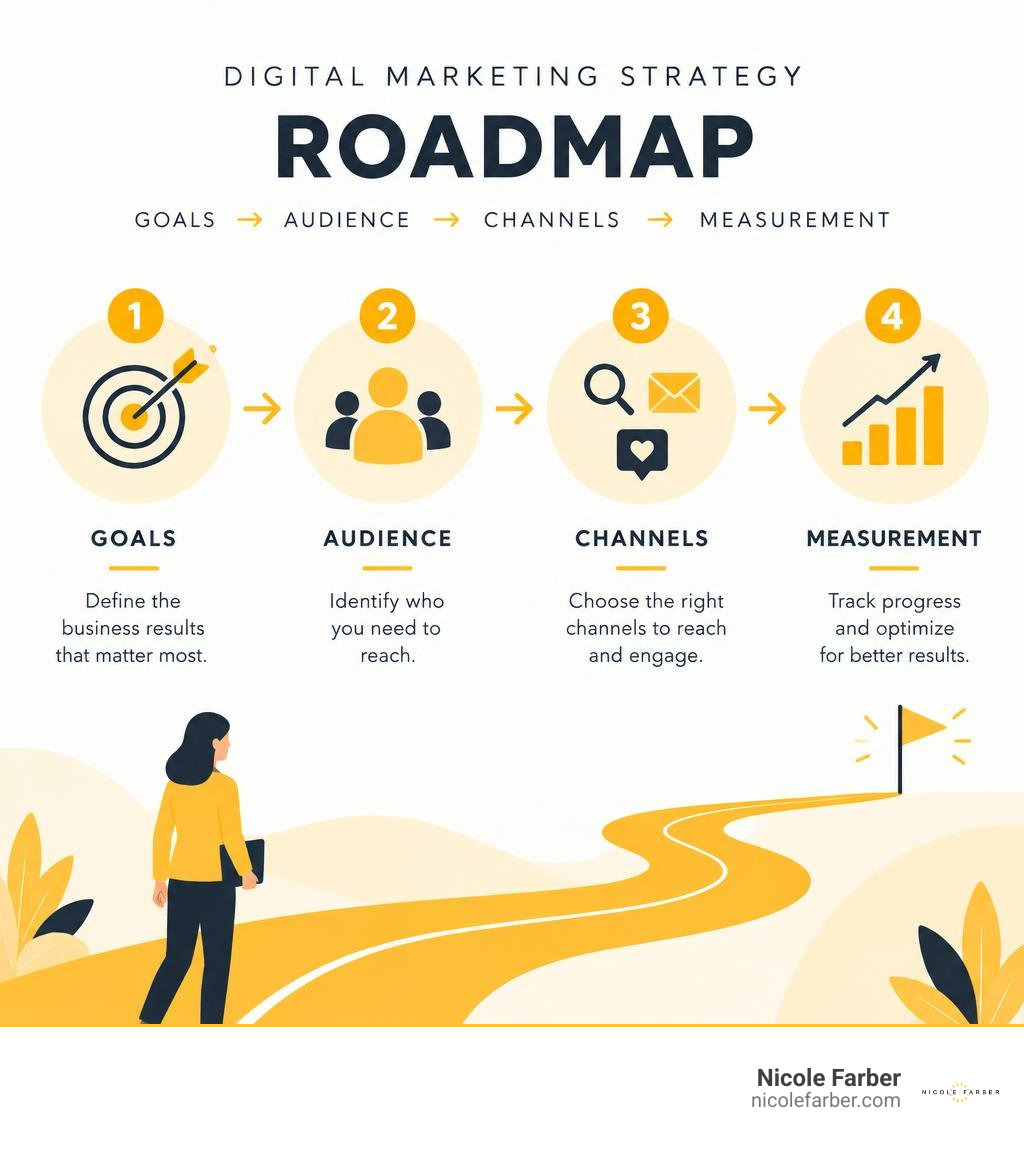
Developing a digital marketing strategy starts with four decisions: who you need to reach, what business result matters most, which channels can influence that audience, and how you will measure progress. For a law firm, that often means defining your ideal matters and referral sources, choosing a small set of channels such as search, email, and social, and creating a clear path from first visit to consultation.
A strategy is not a list of platforms or a calendar of posts. It is the decision-making framework that keeps your website, content, ads, email, and client intake efforts working toward the same goal. This matters because nearly half of organizations still lack a documented digital strategy, leaving many teams to react to the latest platform or competitor move instead of building durable growth.
In 2026, firms also need to plan for changing search behavior. AI Overviews and other answer tools can reduce clicks to traditional search results, so visibility alone is not enough. Your firm needs useful, trustworthy content, strong local and practice-area pages, and conversion paths that turn attention into qualified conversations.
I am Nicole Farber, CEO of ENX2 Legal Marketing, with more than 15 years of experience helping law firms and businesses build sustainable growth systems. I approach developing a digital marketing strategy as I would my own business: with clear priorities, hard work, and a focus on results that help the people behind the firm succeed.
Quick developing a digital marketing strategy terms:
- Philadelphia small business marketing
- business development marketing strategy
- business development strategies
Fundamental Architecture: Strategy vs. Tactics vs. Campaigns
One of the most common reasons businesses fail to gain traction online is confusing activity with achievement. It is easy to look busy managing social media pages, bidding on search ads, and sending newsletters, yet still see zero movement in revenue. To build a system that works, we must distinguish between strategic direction, campaign planning, and tactical execution.
- Strategy: The overarching, long-term blueprint. It defines your core audience, value proposition, competitive positioning, and primary business objectives.
- Campaigns: Time-bound initiatives designed to achieve specific milestones within that strategy (for instance, a 60-day push targeting estate planning leads in Wilkes-Barre).
- Tactics: The concrete tasks, tools, and daily actions deployed to execute a campaign (such as running Google Local Services Ads, optimizing title tags, or testing email subject lines).
| Dimension | Strategy | Campaigns | Tactics |
|---|---|---|---|
| Time Horizon | Long-term (1 to 3 years) | Medium-term (30 to 90 days) | Short-term (daily / weekly) |
| Primary Scope | Whole organization or practice | Specific target audience or offer | Channel-level execution |
| Core Objective | Market positioning & sustainable ROI | Defined milestone (e.g., leads generated) | Task completion & metric optimization |
| Key Question | Where will we play and how will we win? | What message drives this specific goal? | How do we produce and distribute this asset? |
Why Strategy Precedes Tactics in Business Growth
When we jump straight into buying ads or publishing social videos without a strategy, we burn capital and exhaust our teams. Research shows that 49% of organizations operate without a clearly defined digital strategy, while only 17% explicitly document their approach. This lack of direction leads directly to channel sprawl—spreading resources across eight different platforms while mastering none.
Sustainable scale demands operational readiness. We must follow a philosophy of process before promotion, ensuring our intake funnels, tracking systems, and operational capacity can handle inbound demand before turning up the volume. Aligning operations with proven business growth strategies ensures that every dollar spent creates compounding value.
Key Considerations for Developing a Digital Marketing Strategy from Scratch
Building your digital marketing roadmap requires grounding every decision in market reality. We look at the “3 Cs” model to shape our strategic angle:
- Consumer: What pain points, urgent questions, and decision triggers define your ideal client?
- Competitor: Where are competitors in your region falling short in search visibility, content quality, or customer service?
- Company: What unique strengths, track records, and resources allow you to deliver a superior outcome?
According to the Forbes Advisor guide to digital strategy, treating marketing as a living, integrated ecosystem rather than disconnected tasks allows businesses to protect their margins while scaling customer acquisition.
The Step-by-Step Roadmap for Developing a Digital Marketing Strategy

Transforming high-level vision into everyday execution requires a structured, repeatable sequence.
Step 1: Market Diagnostics, Audience Segmentation, and Positioning
We begin with an honest audit of your current presence alongside a structured SWOT analysis (Strengths, Weaknesses, Opportunities, Threats). We evaluate historic website traffic, lead conversion rates, and competitor search rankings across target markets like Philadelphia, Luzerne County, and New Orleans.
Next, segment your target market beyond simple demographic brackets. Modern segmentation looks at:
- Demographics and Firmographics: Age, income, industry, company size, or geographic jurisdiction.
- Psychographics: Core values, risk tolerance, trust barriers, and priorities.
- Behavioral Intent: How users interact with your website, review profiles, or initial intake forms.
- Jobs-to-Be-Done: The exact functional and emotional outcome the customer hires your business to solve.
Integrating these insights with comprehensive customer acquisition management creates buyer personas that guide every piece of copy you publish.
Step 2: Channel Selection and the SES Framework
Avoid the temptation to be on every platform. A disciplined strategy relies on the SES framework principles, which organize digital initiatives into three foundational pillars:
- Search (Discovery): Capturing active intent. Organic search drives 53% of all trackable web traffic. Whether someone is searching for a commercial litigator in New Orleans or a boutique consultancy in Antigua Guatemala, showing up at the exact moment of search intent delivers qualified inbound leads.
- Email (Owned Asset): Unlike social algorithms that change overnight, your email list is an asset you own. With an average return of $36 for every $1 spent, consistent email sequences nurture consideration-phase prospects into signed clients.
- Social (Relationship & Advocacy): With over 5.7 billion active social media users globally, platforms like LinkedIn or Meta serve as trust-building engines where thought leadership and community engagement validate your authority.
Combining these pillars builds an automated client acquisition system that consistently feeds high-intent prospects into your pipeline.
Step 3: Funnel Content Mapping and Operational Foundations
Content must serve a clear purpose at every stage of the client journey:
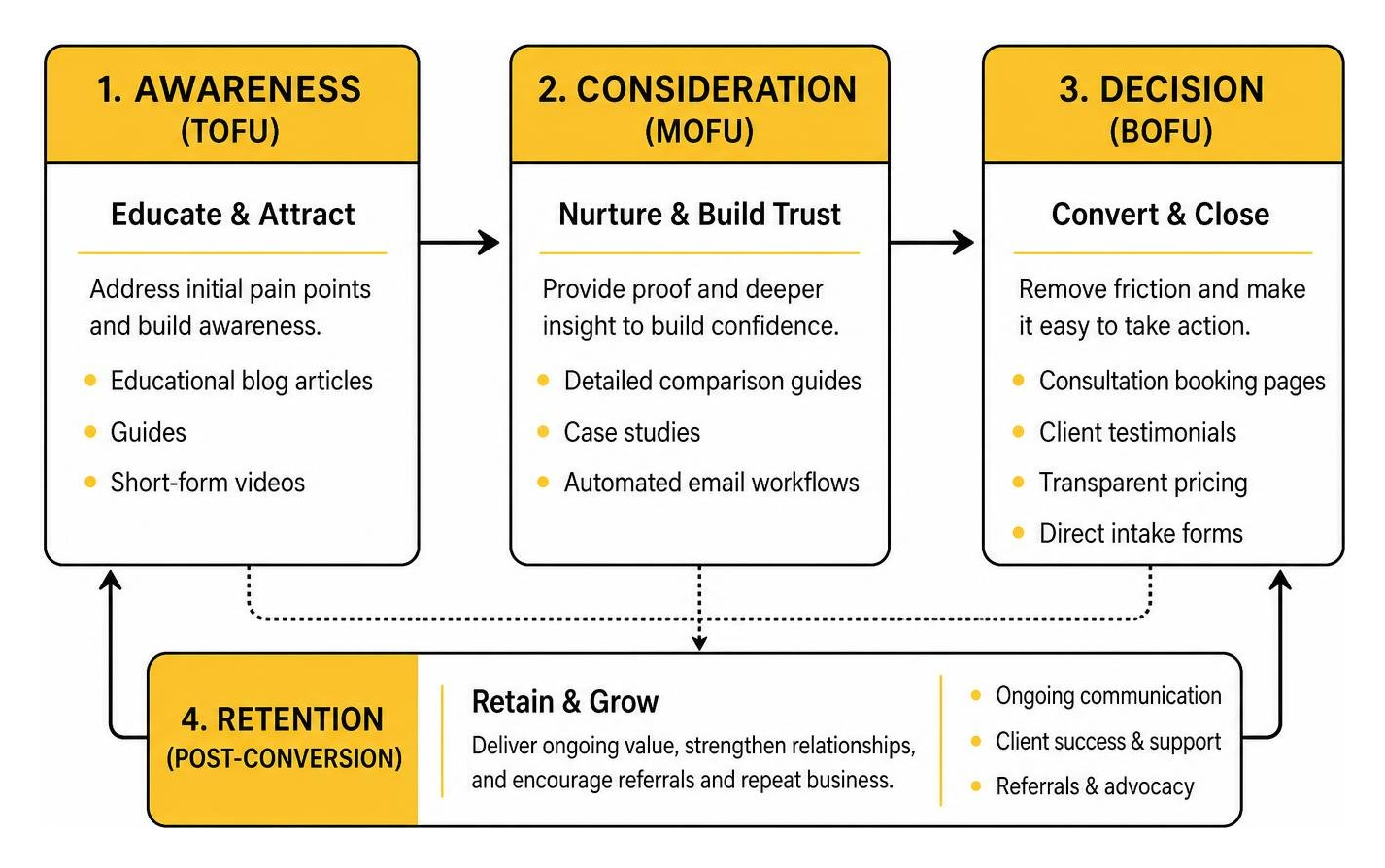
- Top of Funnel (TOFU – Awareness): Educational blog articles, guides, and short-form videos addressing initial pain points.
- Middle of Funnel (MOFU – Consideration): Detailed comparison guides, case studies, and automated email workflows proving your specific capability.
- Bottom of Funnel (BOFU – Decision): Consultation booking pages, client testimonials, transparent pricing details, and direct intake forms.
To prevent leads from slipping through the cracks, your digital assets must feed directly into CRM infrastructure. When you merge business development with marketing, intake teams follow up instantly on qualified inquiries, boosting lead-to-client conversion rates.
Step 4: Budget Allocation and Agile Implementation
Setting a budget is about capital efficiency. Enterprise benchmarks from Gartner indicate that marketing budgets average roughly 7.7% of total company revenue. However, early-stage and aggressive growth firms often invest 10% to 15% to capture regional market share.
When marketing budget planning for a 90-day cycle, allocate resources across four primary buckets:
- Paid Media (35-45%): High-intent search ads, local service ads, and retargeting.
- Content & Creative (25-30%): Professional copywriting, video production, and case study development.
- Technology & Data (15-20%): CRM licenses, analytics platforms, website hosting, and call tracking.
- Strategy & Management (15-20%): Specialized agency support and internal team coordination.
Step 5: Developing a Digital Marketing Strategy for AI-Era Search Engines
Search behavior has shifted dramatically. When AI Overviews and answer summaries appear in Google results, clicks to standard organic links drop from 15% down to 8%—nearly cutting traditional organic click-through rates in half.
To maintain visibility, our digital marketing strategy must incorporate Generative Engine Optimization (GEO):
- Publish Proprietary Data and Case Studies: AI engines cite original research, statistics, and verifiable client success stories.
- Optimize for Direct Answers: Structure content with clear subheadings, concise definitions, and structured schema markup.
- Strengthen Topical and Entity Authority: Build deep topical clusters around your core service areas rather than surface-level keyword articles.
- Protect Brand Search Demand: Cultivate strong brand recognition across email and social media so users search for your firm by name.
Measuring Success, Attribution, and the 90-Day Iteration Cycle
A digital marketing strategy is not a static binder on a shelf; it is an active operating model.
Core Performance Metrics and North Star KPIs
To evaluate performance without getting overwhelmed by vanity metrics (like impressions or raw page views), focus on indicators tied to revenue:
- Customer Acquisition Cost (CAC): Total sales and marketing spend divided by new clients acquired.
- Customer Lifetime Value (LTV): Total revenue generated across the entire client relationship. Target an LTV-to-CAC ratio of at least 3:1.
- Pipeline Velocity: The speed at which an inbound inquiry transitions through intake to become a retained matter.
- Return on Marketing Investment (ROMI): Net revenue generated directly attributable to digital campaigns divided by total marketing expenditure.
Establishing Quarterly Reviews and Strategy Governance
We recommend a quarterly review cadence using the Create, Fix, or Scale framework:
- Create: Launch new assets where clear market gaps exist (e.g., introducing an email nurture track for referral partners).
- Fix: Optimize underperforming touchpoints (e.g., resolving page speed issues, updating broken landing pages, or retraining intake staff).
- Scale: Allocate additional budget to proven, high-ROI channels (e.g., increasing budget on top-performing local search campaigns).
Quarterly Strategy Governance Milestones:
- Audit lead intake response times and form-fill conversion rates.
- Evaluate channel attribution data inside GA4 and your CRM.
- Update buyer persona assumptions against recent client interview data.
- Rebalance channel budget allocations based on verified cost-per-acquisition metrics.
Common Pitfalls to Avoid in Modern Marketing Execution
Even well-funded organizations run into execution traps. Watch out for these common missteps:
- Channel Hopping: Abandoning an organic strategy after 60 days to chase the newest platform trend before SEO gains momentum.
- Prioritizing Vanity Metrics Over Pipeline Value: Celebrating viral social video views while phone lines and intake forms remain silent.
- Broken Conversion Architecture: Driving expensive paid traffic to slow-loading websites lacking clear calls to action or secure mobile forms.
- Neglecting Mobile Performance: Over 58% of global web traffic comes from mobile devices; a clunky mobile experience destroys conversion rates.
- Over-Reliance on AI Content Without Editorial Review: Flooding your website with generic AI copy dilutes brand authority and repels discerning prospects.
Frequently Asked Questions About Digital Marketing Strategy
How long does it take to see results from a new digital strategy?
Paid search and social ad campaigns generate measurable lead flow within 2 to 4 weeks. In contrast, organic search engine optimization, content marketing, and brand positioning take 3 to 9 months to compound into steady, cost-effective organic acquisition. Plan for a 6 to 12-month horizon for your complete strategy to stabilize and produce predictable returns.
What percentage of revenue should be allocated to digital marketing?
Established companies generally allocate between 6% and 9% of gross revenue to marketing. Growth-stage firms or practices expanding into competitive markets (like Philadelphia or New Orleans) typically invest 10% to 15% of projected revenue to establish market share and build strong digital authority.
How do AI Overviews and zero-click searches impact traffic?
AI Overviews answer basic queries directly on the search engine results page, reducing traditional website click-through rates on broad informational searches. Digital marketing strategies must counter this by focusing on high-intent conversion terms, publishing unique proprietary insights that AI tools must cite, and building direct audience relationships through email lists and brand searches.
Conclusion
Developing a modern digital marketing strategy is about creating focus. By deciding who you serve, identifying the few channels that genuinely influence their decisions, and establishing disciplined measurement loops, you protect your firm from market volatility.
Success does not come from doing everything; it comes from executing the right fundamentals with consistency, purpose, and perseverance. Whether you are leading a firm in Wilkes-Barre or scaling an enterprise across the country, clear strategic alignment turns marketing from an unpredictable expense into a reliable driver of growth. Take control of your market positioning today by building a comprehensive business development plan that positions your brand for long-term leadership.