Step-by-Step Blueprint for Developing a Small Business Plan
- Entrepreneurship
- In the News
- September 16, 2026
Step-by-Step Blueprint for Developing a Small Business Plan
Start With a Business Plan That Turns Strategy Into Action

The essential steps in developing a business plan are to define the problem you solve, research customers and competitors, choose a business model, map out marketing and operations, calculate costs and revenue, and set measurable goals. Then turn those findings into a clear plan you can use to make decisions, track progress, and explain your opportunity to lenders, investors, or partners.
For a small business or growing law firm, a business plan is not busywork. It is a practical roadmap for turning a goal, such as attracting better-fit clients in your local market, into specific actions, budgets, and results. A 2025 review of published research found that business planning can support stronger startup decision-making, sustainability, and profitability.
You do not need a 100-page document to begin. A lean, one-page plan can help validate an idea quickly, while a detailed traditional plan is often better when you need financing or must show exactly how the business will use funds.
I am Nicole Farber, CEO of ENX2 Legal Marketing, and I have spent more than 15 years helping law firms and small businesses build stronger paths to sustainable growth. In the next sections, I will walk you through the steps in developing a business plan in plain language, with a focus on strategy you can put to work.
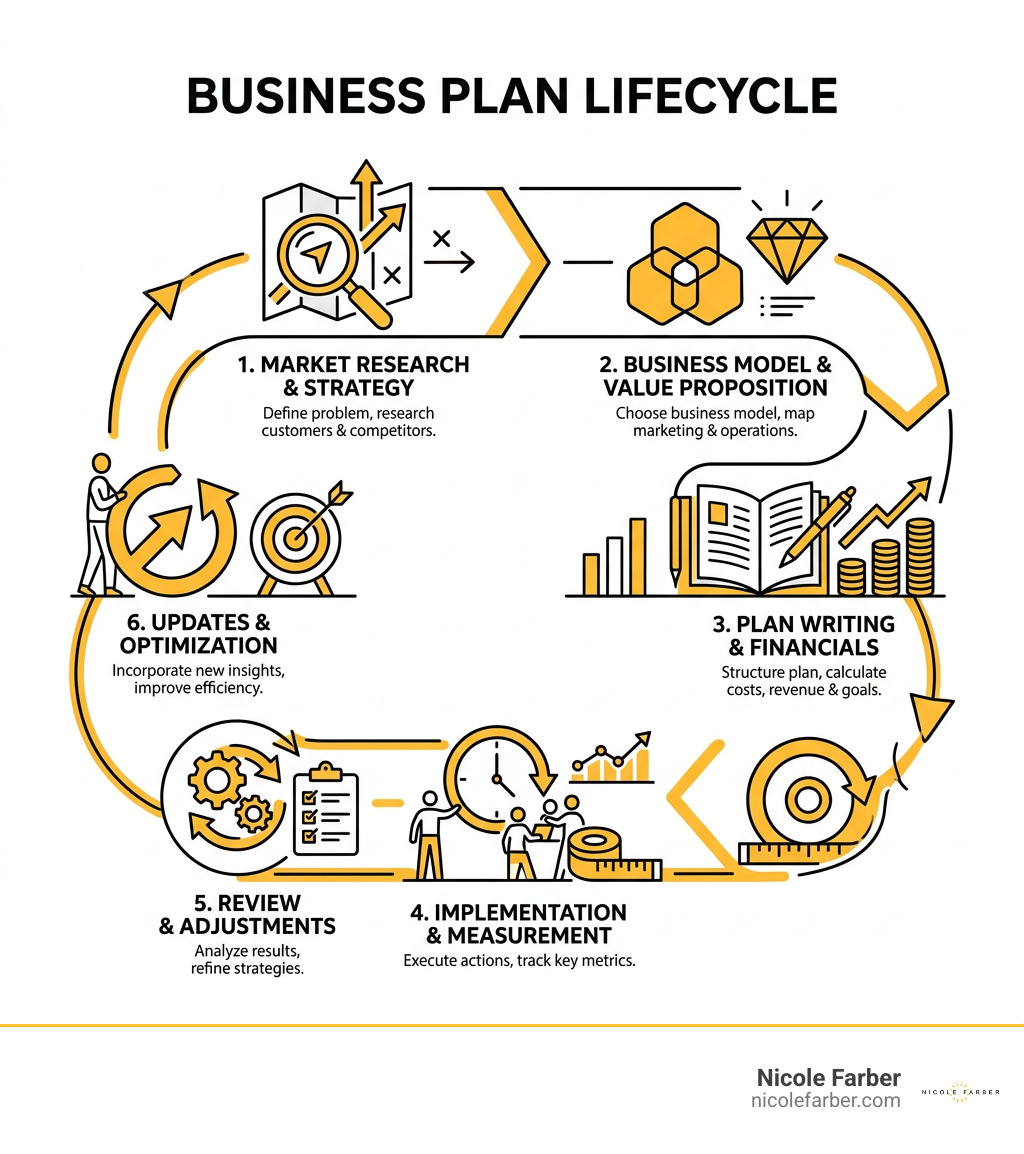
Steps in developing a business plan glossary:
Understanding Business Plan Formats: Traditional vs. Lean Startup
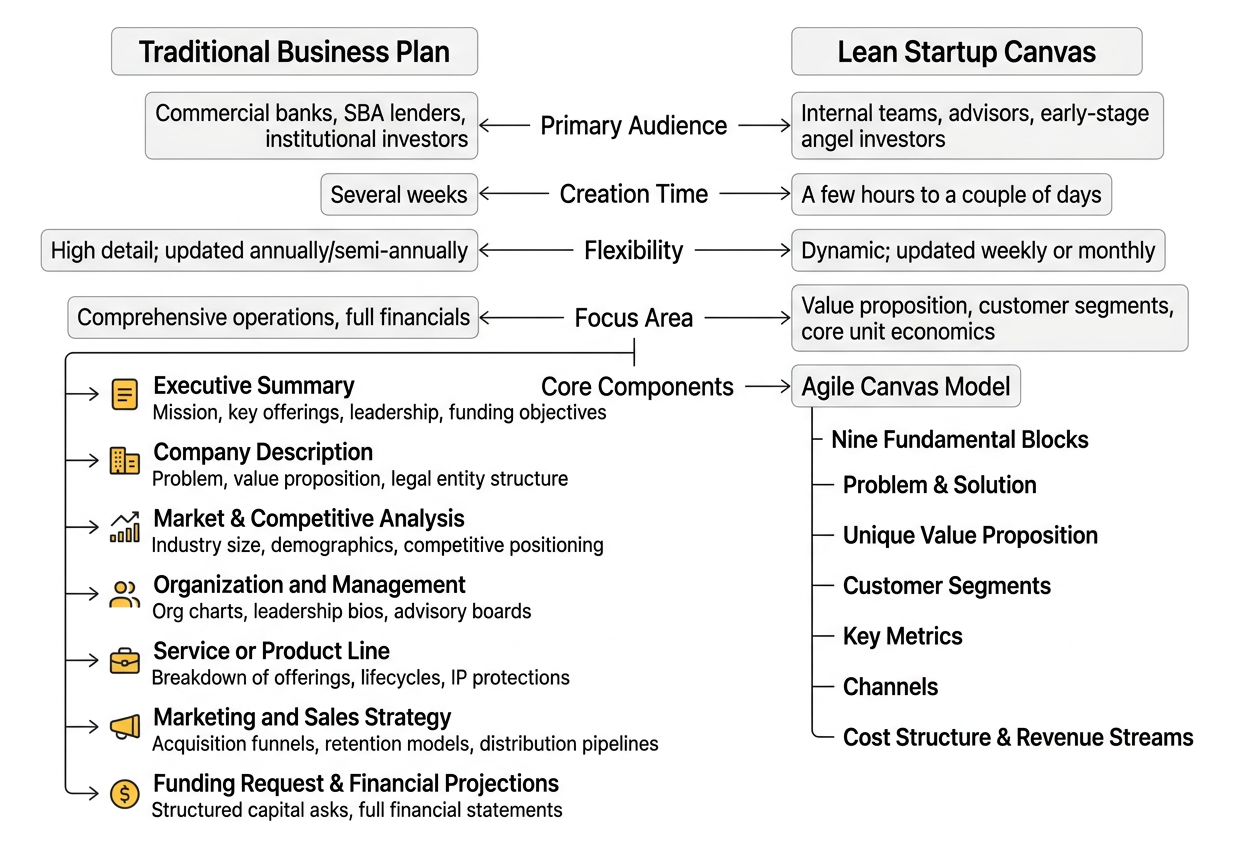
When embarking on the planning journey, one of the first decisions you face is selecting the right format. Business plans generally fall into two broad categories: comprehensive traditional plans and agile lean startup canvases. Choosing between them depends heavily on your immediate objectives, audience, and operational speed. Rather than getting stuck in analysis paralysis, build a business plan and stop winging your startup with the model that best matches your immediate goals.
As outlined by the U.S. Small Business Administration, traditional plans provide deep, structured narratives designed to satisfy institutional lenders and equity investors. Conversely, lean formats distill your business thesis down to fundamental drivers, allowing you to test assumptions rapidly before committing capital.
| Feature | Traditional Business Plan | Lean Startup Canvas |
|---|---|---|
| Typical Length | 15–30 pages | 1–2 pages |
| Primary Audience | Commercial banks, SBA lenders, institutional investors | Internal teams, advisors, early-stage angel investors |
| Creation Time | Several weeks of detailed research and forecasting | A few hours to a couple of days |
| Flexibility | High detail; updated annually or semi-annually | Dynamic; updated weekly or monthly during iteration |
| Focus Area | Comprehensive operations, formal governance, full financials | Value proposition, customer segments, core unit economics |
The Core Components of a Traditional Business Plan
A standard traditional plan offers an exhaustive blueprint of your enterprise. It leaves no stone unturned, providing third-party reviewers with an in-depth view of how your business operates, defends its market position, and manages legal compliance.
Key sections include:
- Executive Summary: A concise snapshot outlining your mission, key offerings, leadership, and funding objectives.
- Company Description: The specific problem your business solves, your unique value proposition, and the legal entity structure (such as an LLC, S-Corp, or C-Corp).
- Market & Competitive Analysis: Rigorous data showing industry size, demographics, and competitive positioning.
- Organization and Management: Organizational charts, leadership bios, advisory boards, and governance structures.
- Service or Product Line: Detailed breakdown of offerings, product lifecycles, and intellectual property protections.
- Marketing and Sales Strategy: Acquisition funnels, retention models, and distribution pipelines.
- Funding Request & Financial Projections: Structured capital asks paired with balance sheets, cash flow statements, and income projections.
The Agile Lean Canvas Model
For founders testing a new market or launching an agile initiative, the lean startup canvas removes administrative overhead. It strips away long-winded paragraphs in favor of bulleted, actionable insights.
A lean canvas centers on nine fundamental blocks:
- Problem & Solution: Top three problems your customers face and your explicit solutions.
- Unique Value Proposition: A clear, compelling message stating why you are different and worth buying from.
- Customer Segments: Defined target profiles and early adopters.
- Key Metrics: Core activities that drive revenue and retention.
- Channels: Direct paths to reach your customer base.
- Cost Structure & Revenue Streams: Fixed and variable costs matched against your primary pricing model.
Essential Steps in Developing a Business Plan for Sustainable Growth

Developing a viable business plan is a systematic process. Whether you are scaling an existing enterprise or consulting a practical guide to starting a successful business, executing these steps sequentially ensures that your operational strategy is anchored by empirical market demand rather than wishful thinking.
Foundational Steps in Developing a Business Plan: Research and Positioning
Every strong plan begins with exhaustive market validation. You must understand the competitive forces shaping your specific geographic territory—whether establishing a boutique service firm in Philadelphia, expanding across Luzerne County, or operating in historic Wilkes-Barre.
State and local agencies provide vital economic data. Utilizing resources like the PA Business One-Stop Shop allows you to examine labor statistics, licensing mandates, and local economic benchmarks.
To build a robust foundation, work through these positioning steps:
- Define the Target Audience: Segment your market by demographic, psychographic, and behavioral criteria. Identify their primary pain points and purchasing power.
- Execute a Comprehensive Competitor Matrix: Evaluate both direct competitors and indirect substitutes. Examine their pricing strategies, delivery models, strengths, and vulnerabilities.
- Conduct a Rigorous SWOT Analysis: Catalog your internal Strengths and Weaknesses alongside external Opportunities and Threats. Look honestly at operational gaps before committing resources.
- Clarify Your Distinct Differentiator: Document why a client in New Orleans or an international market like Antigua Guatemala would choose your solution over an established alternative.
Execution Steps in Developing a Business Plan: Operations and Marketing
Once research confirms market viability, transition toward execution. A brilliant idea without an operational engine is merely a daydream.
- Design the Customer Journey: Map how a prospect moves from initial awareness to signed contract. Avoid unpredictable outreach—stop chasing and start attracting with a client acquisition system that establishes predictable lead generation.
- Build the Technology Stack: Integrate modern customer relationship management (CRM) platforms, automated project workflows, and accounting software. Today, small-to-medium businesses (SMBs) leveraging AI report significant performance improvements—91% of SMBs using AI note an observable boost in revenue.
- Detail Logistics and Human Capital: Specify staffing requirements, production pipelines, vendor relationships, and key performance indicators (KPIs) to track output.
Financial Projections and Securing Funding

Your financial section bridges the gap between conceptual strategy and commercial reality. Experienced bankers and investors review numbers first; they want to see logical assumptions backed by verified data. Guidance from institutions like Bank of America emphasizes that clear, defensible projections are the ultimate test of an entrepreneur’s strategic readiness. If you are building a professional practice, pair your projections with specialized coaching such as the rainmaker blueprint business development coaching for lawyers to ensure your revenue targets align with realistic billing models.
Calculating Startup Costs and Break-Even Point
Accurately forecasting your launch requires separating one-time capital expenditures from recurring operational costs.
Categorize your expenses methodically:
- One-Time Startup Costs: Entity registration, initial inventory, office buildouts, branding, and equipment purchases.
- Fixed Monthly Costs: Commercial rent, base salaries, insurance policies, software subscriptions, and retainer fees.
- Variable Costs: Direct material costs, sales commissions, packaging, and merchant processing fees.
Once costs are established, calculate your break-even point to determine the exact sales volume needed to cover overhead:
$$\text{Break-Even Point (Units)} = \frac{\text{Total Fixed Costs}}{\text{Price Per Unit} – \text{Variable Cost Per Unit}}$$
Always include a 10% to 15% contingency reserve in your initial working capital calculations to safeguard against early collection delays or supply chain variations.
Pitching Lenders and Attracting Investors
When seeking debt financing or private equity, tailor your business plan to address the specific criteria of your capital source:
- For Commercial Lenders: Focus heavily on cash flow statements, collateral security, debt-service coverage ratios (DSCR), and personal credit history.
- For Angel Investors & Venture Capital: Highlight market size, scalability, intellectual property, and a clear exit strategy (such as an acquisition or management buyout).
This foresight is increasingly critical: approximately six million small businesses are expected to face ownership transitions by 2035 due to baby boomer retirements, placing up to $5 trillion in enterprise value at stake. Demonstrating structured succession or acquisition planning makes your business significantly more attractive to long-term capital partners.
Common Business Planning Pitfalls and Maintenance
A business plan must be a dynamic tool, not a static relic left on a bookshelf. Markets fluctuate, consumer behaviors shift, and technological advancements disrupt traditional workflows. When unexpected hurdles arise, apply bounce back better essential business resilience strategies to adapt your operational roadmap without losing momentum.
Critical Mistakes That Derail Small Business Plans
Avoid these common traps when drafting your plan:
- Excessive Financial Optimism: Presenting hockey-stick revenue growth without clear marketing math damages founder credibility instantly.
- Underestimating Cash Burn: Failing to budget for customer acquisition delays and working capital shortfalls.
- Ignoring Direct and Indirect Competition: Claiming you have “no competition” signals incomplete market research to investors.
- Vague Target Demographics: Defining an audience as “everyone” instead of focusing on a distinct, high-converting customer profile.
- Omitting Team Deficiencies: Hiding skill gaps rather than showing how strategic hires or advisors will resolve them.
When and How Often to Update Your Plan
Think of your business plan like a GPS navigation system. The destination remains constant, but the route recalibrates as you encounter road closures or heavy traffic.
- Quarterly Reviews: Conduct rapid audits comparing actual revenue, expenses, and customer acquisition metrics against your forecasts.
- Annual Overhauls: Re-evaluate market positioning, analyze competitor movements, adjust pricing structures, and refresh three-year financial projections.
- Trigger-Based Updates: Immediately revise the plan when introducing new core services, entering new geographic markets, or navigating broader macroeconomic changes.
Frequently Asked Questions About Developing a Business Plan
How long does it take to write a comprehensive business plan?
A lean startup canvas can be drafted within a few hours to validate a concept. A comprehensive, investor-ready traditional plan typically requires two to four weeks of focused effort, allowing adequate time for market research, pricing validation, and financial modeling.
Can I write an effective business plan without a finance background?
Yes. Modern financial planning tools, guided templates, and standard spreadsheets make building financial statements straightforward. You can develop initial sales forecasts and cost budgets independently, then have a qualified CPA or business advisor validate your underlying formulas and assumptions.
How does a business development plan differ from a standard business plan?
While a standard business plan defines your entire corporate structure, legal entity, product line, and overarching financial model, a business development plan focuses specifically on growth execution. It zeroes in on client acquisition pipelines, partnership channels, and commercial outreach. Review our business growth strategies ultimate guide to explore specific tactical expansion methods.
Conclusion
Developing a business plan provides the clarity, focus, and discipline needed to turn ambitious goals into commercial success. By following structured steps—validating your target market, architecting a resilient operational model, and establishing honest financial metrics—you position your company for sustained growth and investor confidence.
Whether leading a growing practice in Pennsylvania or expanding an enterprise across international borders, long-term success requires deliberate planning. Take the next step in mastering commercial growth by building a business development plan that keeps your team aligned and executing at peak performance.