The Ultimate Guide to Leadership Communication Strategies
- Leadership
- In the News
- July 24, 2026
The Ultimate Guide to Leadership Communication Strategies
Why Leadership Communication Strategies Define Organizational Success

Mastering leadership communication strategies is one of the highest-leverage things any leader can do — and the data backs that up. Here’s a quick summary of what works and why it matters:
Core Leadership Communication Strategies at a Glance:
- Know your audience — Tailor your message by role, experience, and context
- Lead with clarity — State what changed, why it matters, and what happens next
- Listen first — Do 80% of the listening and 20% of the talking
- Be consistent — Repeat core messages until your team truly absorbs them
- Use stories, not just data — Narrative drives emotional engagement and memory
- Match the channel to the message — Video for empathy, email for detail, in-person for trust
- Follow through — Actions must match words or trust erodes fast
- Embrace two-way dialogue — Create space for feedback, not just top-down messaging
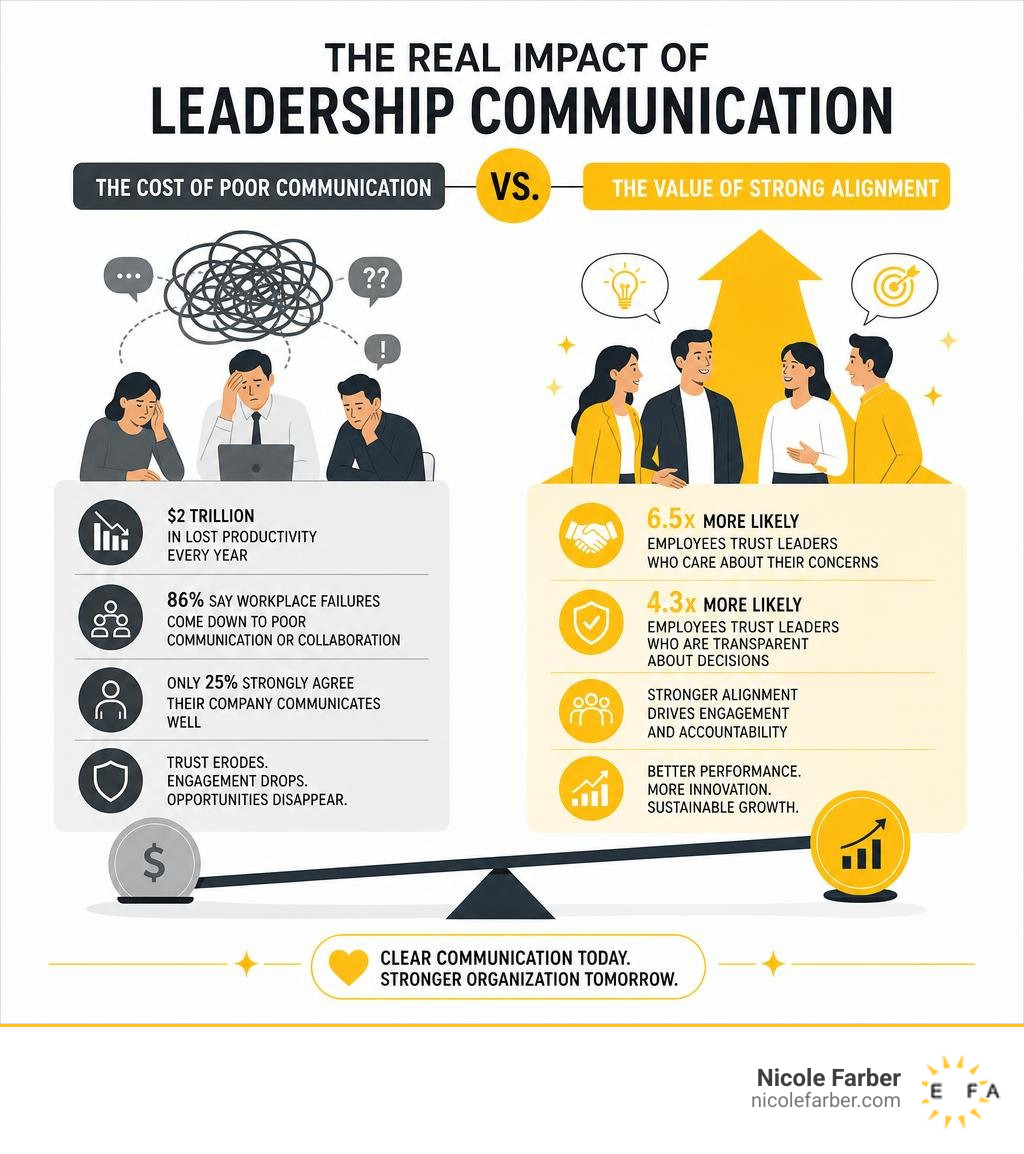
Think about this: 86% of employees and executives say workplace failures come down to poor communication or collaboration. Yet only 25% of individual contributors strongly agree their company communicates well. That gap is exactly where leadership either builds momentum — or loses it.
The cost isn’t just cultural. Employee disengagement tied to poor communication costs an estimated $2 trillion in lost productivity every year. Meanwhile, employees are 6.5 times more likely to trust leaders who genuinely care about their concerns, and 4.3 times more likely to trust those who are transparent about decisions.
Great communication isn’t a personality trait. It’s a skill — and it’s learnable.
I’m Nicole Farber, CEO of ENX2 Legal Marketing, with over 15 years of experience helping law firms grow through clearer positioning, stronger messaging, and smarter strategy — all grounded in the same leadership communication strategies covered in this guide. Whether you’re leading a team in Philadelphia, managing a practice across Luzerne County, or growing your presence in a competitive market, the principles here apply directly to you.
What is Leadership Communication and Why Does It Matter?

At its core, leadership communication is the vital connective tissue that binds an organization’s high-level strategy to everyday execution. It is not merely the act of sending emails or delivering speeches; it is a purpose-driven, two-way dialogue designed to shape perception, build trust, and drive meaningful action. While general business communication focuses on transferring information, leadership communication focuses on alignment, motivation, and inspiration.
When we look at high-performing teams, we see that communication is the primary lever of success. According to research, only 9% of employees feel fully aligned with their organization’s goals. However, among that highly aligned 9%, a staggering 60% report that the leadership communication they receive is highly effective. This demonstrates that we cannot achieve true alignment without intentional, structured messaging.
When leadership communication fails, the financial and cultural costs are massive. Employee disengagement is a silent killer of momentum, directly linked to trillions in lost productivity globally. If our teams do not understand the “why” behind their daily tasks, they operate in a vacuum, leading to mistakes, duplicated efforts, and high turnover. For those looking to transition from basic management to true influence, learning How to Become an Effective Leader starts with mastering how we speak, write, and listen.
Academic insights, such as those found in this Scientific review of leadership communication and employee engagement, confirm that modern workplaces have shifted away from old-school, command-and-control styles. Today, leadership is about co-creating shared understanding. In a knowledge-based economy, employees want to know where the ship is headed and how their individual contributions help steer it.
Core Traits That Define Leadership Communication Strategies
To build communication strategies that actually move people, we must focus on five core human traits:
- Authenticity: People do not follow corporate-speak or robotic scripts; they follow real human beings. Authenticity means letting your personal values show through, admitting when you do not have all the answers, and speaking with a sincere voice.
- Empathy: Empathy is acknowledging the emotional realities of your team. Whether they are dealing with change fatigue, market pressures, or personal challenges, an empathetic leader validates these feelings before pushing for results.
- Transparency: Trust is built on clarity. Transparent leaders share what they know, what they don’t know yet, and when they will have more answers. This prevents the rumor mill from filling the silence.
- Active Listening: True communication is a two-way street. Active listening requires us to pause, absorb what others are saying, observe nonverbal cues, and ask clarifying questions instead of simply waiting for our turn to speak.
- Emotional Intelligence (EQ): Our EQ dictates how we manage our own emotions and read the emotions of those in the room. A massive 90% of top workplace performers demonstrate high emotional intelligence, and 81% of IT leaders link EQ directly to successful technology adoption.
By grounding our approach in these traits, we define What is Leadership in the modern era. We move away from simply managing tasks and toward inspiring people. To dive deeper into these core principles, we can look to The Power of Leadership Communication: Strategies for Success , which highlights how these behavioral traits translate into organizational trust.
12 Proven Leadership Communication Strategies for High Performance

To build a truly high-performing culture, we must move past abstract ideas and implement concrete, repeatable actions. Whether we are presenting to a boardroom in Wilkes-Barre or aligning a remote team across the United States, these twelve strategies form the foundation of world-class communication:
1. Know Your Audience (and Communicate by Segment)
We cannot treat our team as a single, monolithic block. A message that inspires your sales team might confuse your engineering department or overwhelm your support staff. Segment your internal communications by role, function, and the level of impact a change will have on their day-to-day work.
2. Practice the Think-Feel-Do Discipline
Before sending any major communication or opening PowerPoint, ask yourself three questions:
- What do I want them to think? (What is the core understanding or belief?)
- How do I want them to feel? (Do they need to feel reassured, energized, or focused?)
- What do I want them to do next? (What is the immediate, clear call to action?)
This discipline, detailed in Upping Your Communication Game for 2026 – thoughtLEADERS, LLC: Leadership Training for the Real World , ensures that no message is delivered without clear intent.
3. Simplify and Be Direct
Avoid corporate jargon, unnecessary acronyms, and overly complex explanations. Lead with the headline: what changed, why it matters, and what happens next. Keeping things simple is not about dumbing down your message; it is about respecting your team’s time and cognitive bandwidth.
4. Illustrate Through Storytelling (Narrative Fluency)
Data points inform, but stories inspire. Instead of presenting dry statistics about quarterly goals, share a story about a client whose business was transformed by your team’s hard work. Narrative fluency helps employees visualize the future and see their own roles in making it a reality.
5. Utilize Compelling Visual Content
Our brains are wired for visual processing. Creative visual content sparks memory encoding 74% faster and generates significantly more emotional engagement than text-heavy alternatives. Over 95% of content leaders consider visual assets critical for key business communications. Use clean infographics, short videos, and structured diagrams to reinforce your verbal messages.
6. Deliver Difficult Truths with Compassionate Directness
Exceptional leaders do not hide bad news. They deliver tough realities with honesty and care simultaneously. Compassionate directness means stating the facts clearly without sugarcoating, while actively offering support and outlining the path forward.
7. Establish Consistent Feedback Loops
Do not wait for annual performance reviews to share and receive feedback. Implement real-time feedback channels, quick pulse surveys, and open Q&A sessions. When employees see that their input directly shapes company decisions, their commitment skyrockets.
8. Master the Art of Active Listening
Active listening means listening to understand, not to reply. Pay close attention to verbal input, but also read the room. Notice nonverbal cues like posture, eye contact, and tone of voice. Sometimes what your team isn’t saying is more important than what they are.
9. Repeat Core Messages Relentlessly
Leaders often tire of their own messages long before their teams have fully internalized them. Repetition is not a sign of lazy communication; it is how alignment is built. Repeat your core mission, values, and strategic priorities across different channels until they become part of the organizational DNA.
10. Model Collaborative Behavior
If we want our teams to collaborate openly, we must show them what that looks like. Participate actively in cross-departmental projects, ask for help publicly, and celebrate collaborative wins. Your actions will always speak louder than your words.
11. Share Both Successes and Failures
Transparency builds credibility. When a project succeeds, share the credit generously. When a strategy fails, own it publicly, explain what went wrong, and share the lessons learned. This normalizes smart risk-taking and frames failure as a learning opportunity.
12. Follow Through on Every Promise
The fastest way to destroy trust is to say one thing and do another. If you promise to look into an issue, set a calendar reminder and follow up. Consistent follow-through demonstrates integrity and proves to your team that your words have real weight.
Implementing these strategies requires structured training and development, as explored in the Leadership Communication Strategies: From Advocacy to Impact programs. Additionally, we can see how these practices directly foster a high-performing workplace culture by reviewing the latest Leadership Communication Skills for High Performance | BDO insights.
Adapting Leadership Communication Strategies Across Channels
As leaders, we must develop a sophisticated, adaptive communication repertoire rather than relying on a single default style. Different messages require different channels to land effectively.
For high-stakes organizational shifts, face-to-face meetings or live town halls remain unparalleled because they allow for real-time connection, immediate feedback, and the human warmth necessary to build trust. When we need to personalize our message at scale, high-quality video updates can convey sincerity and tone far better than a standard memo. Meanwhile, collaborative digital platforms and instant messaging are excellent for quick, tactical alignment, but they should never replace deep human conversations.
To learn more about how to navigate these dynamics in daily operations, check out our guide on Being a Good Leader in the Workplace. Furthermore, we must stay ahead of how digital mediums alter our impact, which is beautifully outlined in the research on Communication strategies on digital platforms for … – ACE2-EU .
Navigating Crisis, Change, and Uncertainty
When crisis strikes — whether it’s an operational bottleneck in New Orleans or a sudden market shift affecting your entire industry — communication becomes the primary leadership act. In moments of high volatility, your team is not looking for perfection; they are looking for presence, clarity, and stability.
The most common mistake leaders make during a crisis is delaying communication until they have all the answers. This silence creates a vacuum that is quickly filled by anxiety, rumors, and panic. Instead, proactive messaging is essential. Show up early, even if it is just to say: “Here is what we know right now, here is what we are actively working on, and here is when we will update you next.”
To lead successfully through disruption, we must provide directional clarity. This means translating a complex, chaotic situation into clear, actionable steps that individual team members can execute. When people know exactly what is expected of them today, it grounds their anxiety and gives them a sense of control.
At the same time, exceptional leaders leverage vulnerability as a strategic advantage. Admitting that a situation is difficult or that you feel the weight of the challenge does not make you look weak; it makes you human. This honesty builds psychological safety, giving your team the permission to voice their own concerns, ask for help, and surface potential issues before they become catastrophic failures.
For a deeper dive into managing these high-stakes scenarios, explore the frameworks in Strategic Communication for Leaders . When done correctly, crisis communication does more than just mitigate damage — it can actually strengthen organizational trust. As highlighted in The Leadership Communication Program Advantage: Why How You Lead Is Inseparable from How You Communicate – zenithschoolofleadership , leaders who guide their teams through crises with transparency and empathy often emerge with far higher levels of loyalty and engagement than before the disruption began.
The Role of Technology and AI in Modern Communication
In June 2026, the modern communication landscape exists at the intersection of human empathy and advanced technology. Generative AI and automated platforms have drastically increased our speed and scale, but they have also raised the stakes for authentic connection.
While AI can draft routine updates, analyze sentiment, or summarize feedback in seconds, human judgment must remain the ultimate filter. This balance is critical because human-written messages consistently score higher in credibility and emotional resonance than purely automated communications.
Technology should be used to expand our capacity, freeing us up to focus on deep, one-on-one relationships and high-stakes strategy. For instance, digital traceability protocols can record project contributions transparently, ensuring every team member’s ideas are recognized fairly. However, relying too heavily on digital tools can lead to severe digital fatigue and feelings of disconnection. As digital tools play a larger role in our workplaces, 76% of employees express a strong desire for deeper, more meaningful human connection.
As outlined in A communications playbook for 2026 – Fast Company , future-proof organizations invest heavily in emotional intelligence (EQ) training alongside new software. Technology sets the pace, but human empathy and clear leadership decide the direction.
Building a Culture of Open Dialogue and Feedback
To sustain high performance, we must actively dismantle the traditional “command-and-control” model and replace it with a dynamic, two-way feedback culture.
| Traditional Command-and-Control | Modern Two-Way Dialogue |
|---|---|
| One-way instruction delivery | Collaborative, multi-channel conversations |
| Focus on compliance and output | Focus on alignment, engagement, and innovation |
| Closed-door decision making | Transparent processes and shared “why” |
| Feedback is periodic and top-down | Feedback is continuous, real-time, and multi-directional |
| Jargon-heavy and highly formal | Simple, human, and authentic |
Building this culture requires us to develop inquiry intelligence — the habit of asking powerful, open-ended questions that challenge assumptions and invite diverse perspectives. We must also invest in manager coaching, ensuring that leaders at every level of our organization are equipped to listen, facilitate healthy debate, and handle difficult conversations constructively. When we elevate the quality of our daily interactions, we Empower Your Team to take ownership, innovate, and speak up without fear.
By prioritizing open dialogue, we turn communication from a corporate task into a true culture multiplier. To explore practical exercises and leadership frameworks that bring this table to life, read The No-Nonsense Guide to Practical Leadership Skills and Examples.
Frequently Asked Questions about Leadership Communication
What are the most common barriers to effective leadership communication?
The most common barriers include a lack of leader self-awareness, overconfidence in one’s own communication skills, time constraints, and a fear of receiving feedback. Additionally, relying too heavily on corporate jargon or hiding behind emails instead of engaging in direct, human conversations creates massive disconnects within teams.
How do you measure the impact of leadership communication?
We can measure impact through regular employee engagement surveys, tracking KPI alignment across departments, monitoring voluntary retention rates, and measuring productivity metrics before and after major communication initiatives. When communication is effective, project execution speeds up, and alignment scores rise.
How can leaders balance speed and empathy in digital communication?
Leaders can achieve this balance by using technology to handle routine logistics while reserving human judgment and emotional intelligence for high-stakes messages. Always take a moment to consider the emotional context of a digital message before hitting send, and never let speed override the need for tone check and empathy.
Conclusion
How we lead is inseparable from how we communicate. Exceptional leadership is not about having a loud voice or commanding a room; it is about building trust, clarifying vision, and empowering those around us. From the vibrant boardrooms of Philadelphia to our community initiatives in Wilkes-Barre, and all the way to our faith-driven leadership development programs in Antigua Guatemala, our mission remains the same: to inspire and equip leaders to communicate with purpose, clarity, and heart.
If you are ready to elevate your team’s performance, build a stronger organizational culture, and refine your approach, explore our comprehensive Business Leadership Strategies to start your journey toward impactful leadership today.