Stop Aiming in the Dark and Start Reaching Your Firm Milestones
- Marketing
- In the News
- September 30, 2026
Stop Aiming in the Dark and Start Reaching Your Firm Milestones
Turn Firm Ambitions Into Measurable Milestones

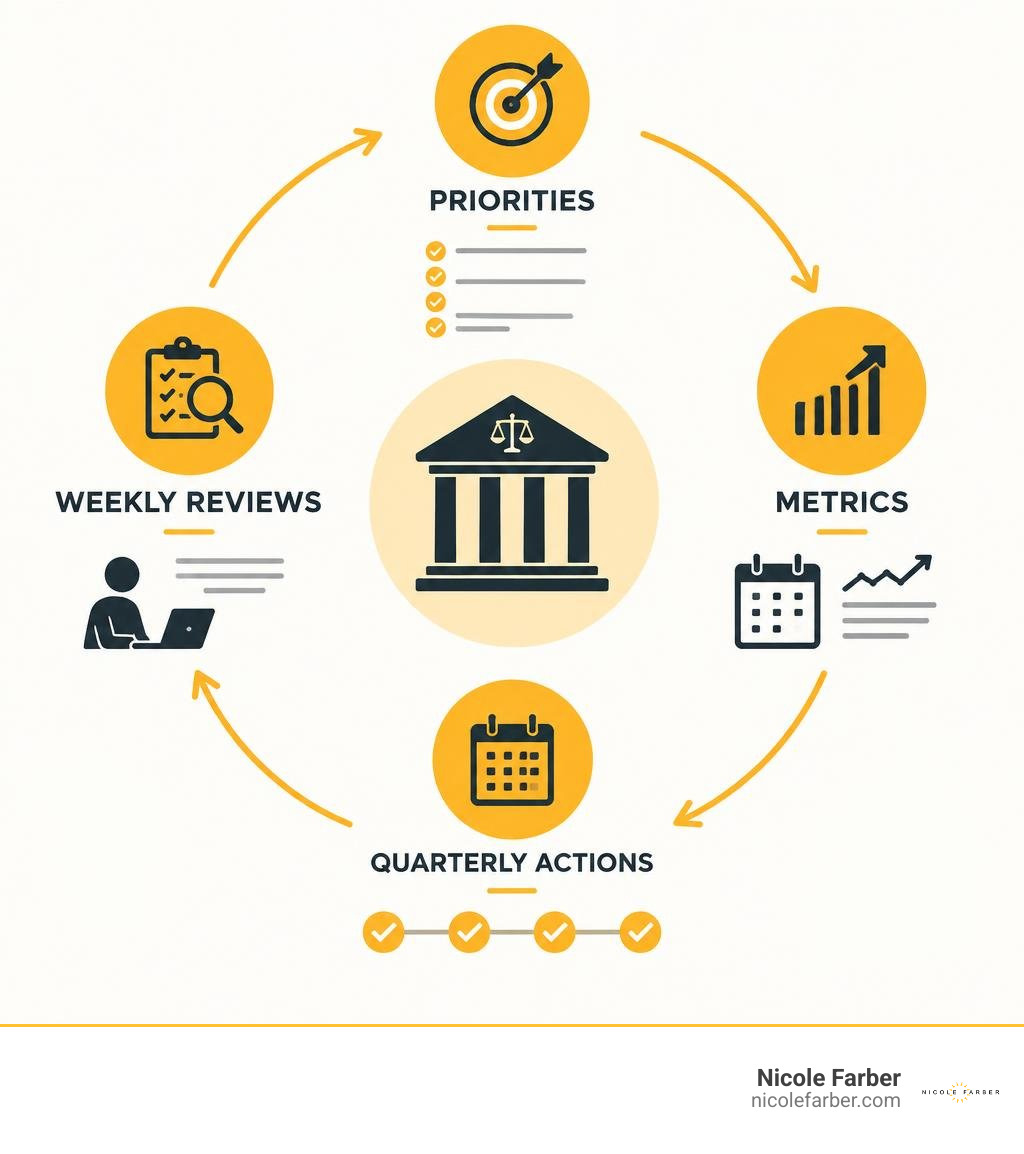
Effective goal setting for law firms starts with choosing a few priorities, giving each one a number, deadline, owner, and review date. Instead of resolving to “grow the firm,” build goals your leadership team can act on:
- Set 3-5 firm priorities tied to your strategy, such as client growth, collections, retention, or technology adoption.
- Define success with a clear metric and deadline, such as increasing qualified consultations by 15% by the end of Q2.
- Break each annual goal into quarterly milestones and weekly actions.
- Review a simple scorecard every week and recalibrate each quarter.
This matters because good intentions rarely survive a busy legal calendar. Client emergencies, billable demands, and constant decisions can push long-term work aside. Firms that monitor progress throughout the year achieve goals at roughly twice the rate of those that do not.
The strongest plans connect daily work to a larger direction. They help partners decide where to spend marketing dollars, which client relationships to develop, what to delegate, and which systems need improvement. With legal demand and market conditions able to shift quickly in 2026, measurable goals also give your firm an early warning system, not just a year-end report card.
I am Nicole Farber, CEO of ENX2 Legal Marketing, with more than 15 years of experience helping law firms clarify growth priorities, improve visibility, and build practical plans for sustainable results. In my work on goal setting for law firms, I have seen that consistent accountability turns ambitious ideas into real business progress.
Why Strategic Planning Outperforms New Year Resolutions in the Legal Sector
Every January, law firm leaders sit down with ambitious hopes. We tell ourselves that this will be the year we finally overhaul client intake, expand into high-value litigation, or hit an aggressive profitability milestone. Yet, industry data reveals a harsh truth: fewer than half of us achieve our annual targets by year’s end, with a massive drop-off occurring as early as mid-January.
Why do typical resolutions fall apart so quickly inside legal practices? The answer lies in the fundamental difference between vague aspirations and structured strategic intent. A resolution is an open-ended wish—like wanting to “bring in better cases”—without an operational framework or measurable criteria. When high-stakes casework lands on your desk, wishful thinking dissolves under intense decision fatigue.
According to the Legal Trends Report, 65% of successful law firms implement a structured strategic planning process. Clear, written targets dramatically elevate an attorney’s likelihood of career advancement and firm profitability. When building a law firm that endures shifting markets, you cannot rely on willpower alone.
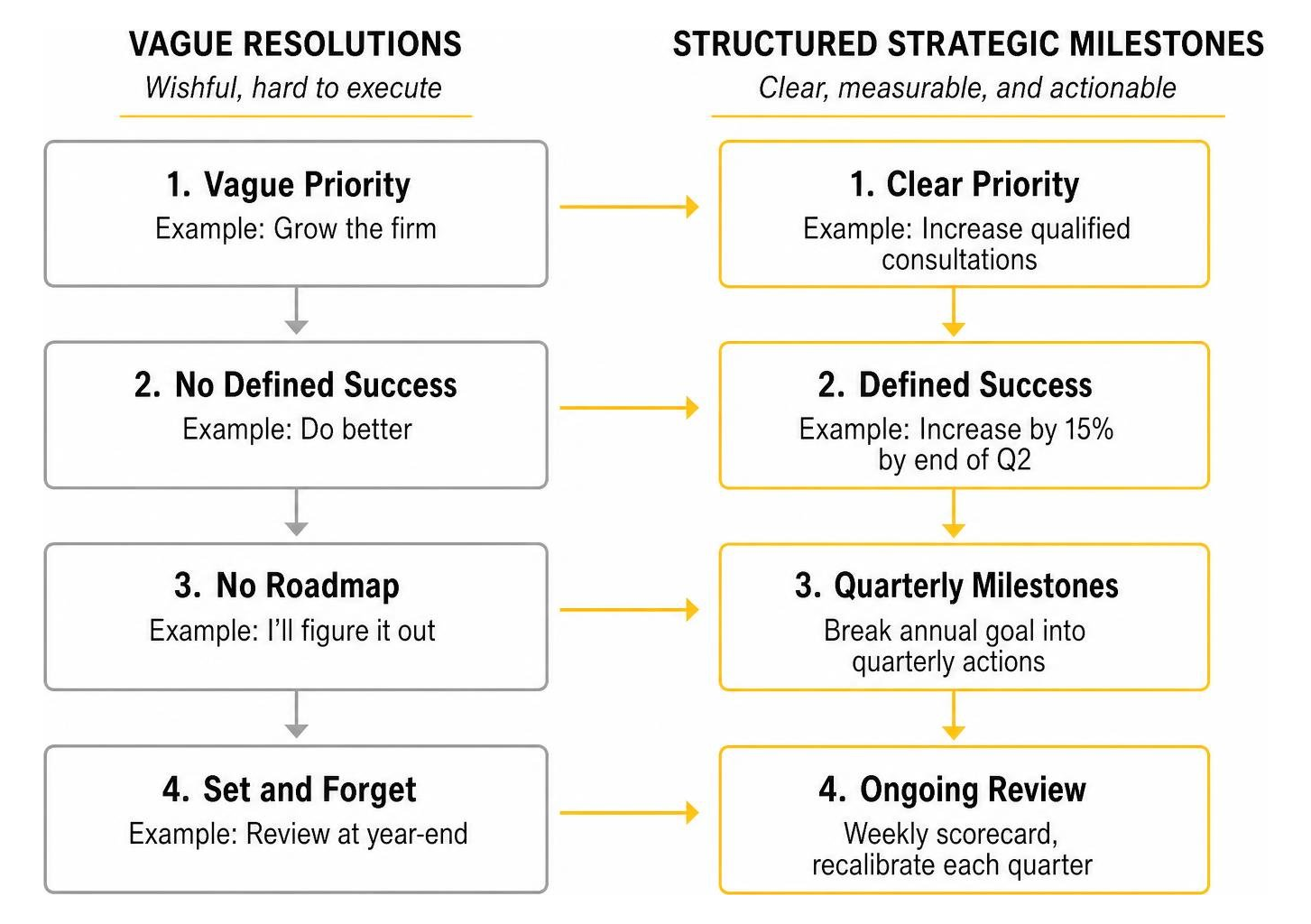
Strategic planning creates intentional habit formation. Rather than asking yourself every morning what non-billable task deserves attention, a structured plan dictates exactly which operational lever to pull. As highlighted in ABA research on structured legal goals, shifting from reactive legal work to proactive milestone execution safeguards your team against cognitive overload, providing a clear roadmap across every office location—from Philadelphia and Wilkes-Barre to New Orleans.
Overcoming Perfectionism and Billable Hour Inertia
Lawyers are trained to spot risk and eliminate errors. While perfectionism is an asset in brief writing or trial preparation, it acts as quicksand during firm growth planning. We delay rolling out new client communication workflows or launching digital outreach campaigns because they aren’t “100% flawless.”
Pair this perfectionism trap with billable hour inertia, and strategic execution screeches to a halt. When billable hours represent immediate revenue, spending two hours on operational milestones can feel like an unprofitable distraction.
To overcome this inertia, reframing is essential:
- Progress over perfection: Treat operational growth as an iterative process. A 10% gain in intake efficiency today beats an unexecuted “perfect” system next year.
- Process-oriented micro-habits: Break massive goals into non-negotiable daily or weekly routines.
- Protected non-billable blocks: Reserve dedicated time slots on your calendar for strategic initiatives just as you would for a court appearance.
The 4-Tier Blueprint: Goal Setting for Law Firms That Drive Measurable Growth
To transform lofty visions into measurable execution, high-performing legal practices rely on a multi-tiered architecture. When your team understands how daily tasks feed into long-term enterprise value, alignment follows naturally.

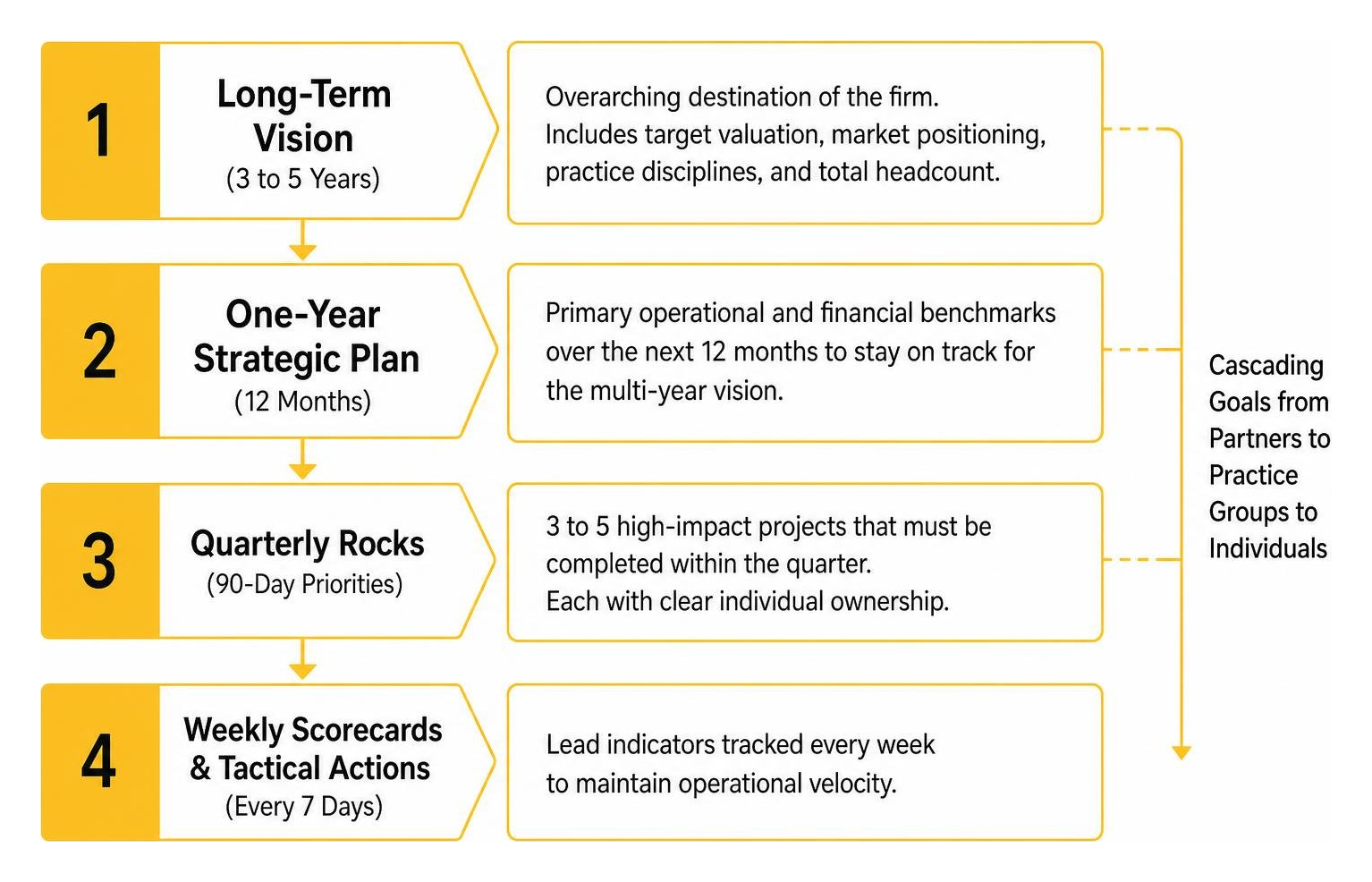
Applying practical law firm growth strategies requires organizing your firm’s ambition into four synchronized levels:
- The Long-Term Vision (3 to 5 Years): The overarching destination of your practice. This includes your target firm valuation, market positioning across key regions like Luzerne County and beyond, core practice disciplines, and total headcount.
- The One-Year Strategic Plan: The primary operational and financial benchmarks required over the next 12 months to stay on track for your multi-year vision.
- Quarterly Rocks (90-Day Priorities): Specific, high-impact projects that must be completed within the quarter. Limit these to 3 to 5 firm-wide initiatives with clear individual ownership.
- Weekly Scorecards and Tactical Actions: The vital lead indicators tracked every seven days to maintain operational velocity.
Cascading Goal Setting for Law Firms from Partners to Practice Groups
A strategic plan should never live exclusively inside the managing partner’s desk drawer. For true momentum, high-level objectives must cascade downward into practice groups and individual attorney targets.
When managing partners articulate the firm’s strategic focus, practice group leaders can establish complementary milestones. For example, if the overarching objective is to increase commercial litigation profitability by 15%, the litigation group might focus on improving realization rates and refining discovery workflows.
At the individual level, structured attorney business development metrics empower partners and associates to take ownership of specific origination numbers, referral outreach quotas, and CLE speaking engagements that directly support the firm’s bottom line.
Establishing Base, Target, and Stretch Objectives
Legal markets face continuous economic adjustments. The average firm grew profits by 13% in 2025 on record demand, but changing economic conditions highlight the need for disciplined risk calibration.
Using a three-tiered model prevents discouragement while encouraging bold performance:
- Base Objective (The Floor): The minimum acceptable operational standard. This covers baseline operational overhead, maintains standard realization rates, and ensures financial safety.
- Target Objective (The Commitment): The realistic, well-planned goal that the leadership team actively commits to achieving through standard strategic execution.
- Stretch Objective (The Breakthrough): An ambitious milestone designed to inspire innovation. Achieving a stretch goal usually requires exploring new operational systems, entering new regional markets, or deploying automated client intake.
Implementing the SMART and WOOP Frameworks for Legal Teams
Two proven frameworks provide the psychological and practical scaffolding needed for sustained law practice growth: SMART and WOOP.
While most lawyers understand the SMART acronym (Specific, Measurable, Achievable, Relevant, Time-bound), traditional goal frameworks often fall short because they fail to account for inevitable friction. This is where the WOOP model—developed by psychologist Gabriele Oettingen—proves indispensable. WOOP stands for Wish, Outcome, Obstacle, and Plan. It utilizes mental contrasting alongside implementation intentions (structured “if-then” planning) to prepare teams for real-world disruption.
| Dimension | SMART Framework | WOOP Framework |
|---|---|---|
| Core Philosophy | Metric-driven structural clarity | Psychology-based obstacle navigation |
| Primary Strength | Sets unambiguous finish lines and timelines | Anticipates real-world barriers before they occur |
| Best Application | Financial budgets, billable quotas, intake KPIs | Behavioral habit changes, delegation, business development |
| Key Output | “Increase quarterly collections by 8% by Q3” | “If trial prep runs late, then I will delegate intake calls to my associate” |
Crafting Actionable Business Development Objectives
Business development should never feel like aimless socializing. Incorporating structured methodologies, such as the rainmaker blueprint for lawyers, enables attorneys to convert vague networking into measurable client acquisition pipelines.
Consider these actionable business development milestones:
- Client Retention & Cross-Selling: Schedule structured biannual reviews with your top 20% of corporate clients to identify unmet legal needs across adjacent practice areas.
- Referral Pipeline Cultivation: Establish two dedicated touchpoints per month with complementary professionals (accountants, financial planners, or regional counsel in locations like Antigua Guatemala or Pennsylvania).
- Thought Leadership Milestones: Author two authoritative legal articles per quarter targeting specific client pain points rather than generic legal summaries.
Integrating Legal Technology and AI Milestones in 2026
Modern law firm operational plans must address technological adaptation. In 2026, competitive advantages are won by practices that strategically streamline workflows through modern legaltech and artificial intelligence.
Meaningful technology objectives might include:
- Intake Automation: Integrating an automated intake screening tool to cut initial response times from four hours down to under 15 minutes.
- Research and Drafting Efficiency: Implementing verified AI research assistants to reduce routine brief preparation time by 20%, redirecting saved hours toward strategic case positioning.
- Centralized Dashboard Analytics: Migrating billing and practice management data into real-time reporting dashboards to monitor realization and collections daily.
Tracking Metrics, Accountability, and Economic Resilience
A goal without a tracking mechanism is simply an expensive daydream. According to research from the American Psychological Association, frequent progress check-ins significantly improve the likelihood of reaching a goal. Furthermore, firms that systematically monitor progress achieve their objectives at roughly twice the rate of those that do not.

Connecting performance metrics to operational execution strengthens financial resilience. Exploring the benefits of business coaching for lawyers can help managing partners establish strict accountability rhythms, ensuring client satisfaction and profit margins remain high regardless of external economic shifts.
Key Performance Metrics in Goal Setting for Law Firms
Tracking the right blend of lead indicators (predictive behaviors you directly control) and lag metrics (ultimate financial results) is crucial for steady performance:
- Utilization Rate (Lead): Billable hours worked divided by total hours in a standard workday (industry average hovers around 38%).
- Realization Rate (Lead/Lag): Percentage of billed work actually collected from clients (benchmarking toward 88% or higher).
- Lockup Period (Lag): The total calendar days between performing legal work and depositing payment (median total lockup often stretches to 93 days; reducing this improves cash flow).
- Operating Profit Margin (Lag): Healthy operating benchmarks define 10% as respectable, 15% as strong, and 20%+ as a well-run, highly efficient firm.
- Operating Cash Reserve (Lag): Maintaining a liquid cash reserve covering three to six months of operating expenses to protect against market fluctuations.
Establishing Quarterly Reviews and External Coaching Rhythms
To prevent strategic plans from collecting dust, implement a consistent review rhythm. A quarterly business review allows partners to score their 90-day rocks on a simple binary scale (completed or not completed) and recalibrate resources for the upcoming quarter.
Pairing internal check-ins with professional business coaching for lawyers provides an objective external perspective. An experienced coach holds firm leaders accountable, pressure-tests financial assumptions, and prevents day-to-day firefighting from derailing long-term equity growth.
Frequently Asked Questions About Law Firm Milestones
What is the difference between a law firm strategic plan and a business plan?
A business plan is primarily an external-facing document often created to secure bank financing, outline broad market analyses, and detail long-term startup projections.
A strategic plan is an internal, dynamic operating blueprint. It focuses on immediate operational priorities, sets 1-year and 3-year organizational milestones, defines quarterly rocks, and assigns direct personal accountability to partners and practice group leaders.
How many active goals should a law firm focus on at once?
Law firms should limit active firm-wide goals to 3 to 5 priorities per quarter.
When everything is deemed urgent, nothing receives adequate focus. Setting too many objectives creates cognitive fatigue and fractures team execution. Focusing on a small set of high-leverage milestones ensures that each initiative receives the staffing, budget, and leadership oversight needed for completion.
How can legal leaders balance billable client work with strategic milestones?
Balancing client demands with firm-building initiatives requires structured time-blocking and aggressive delegation:
- Treat non-billable strategic sessions as mandatory calendar commitments.
- Delegate administrative, initial drafting, and routine intake tasks to paralegals, associates, or specialized legal technology.
- Focus partner energy exclusively on high-value casework, relationship building, and strategic leadership execution.
Conclusion: Transform Your Firm’s Vision into Predictable Execution
Running a thriving law firm requires moving past reactive crisis management and embracing disciplined, measurable leadership. When you replace vague annual hopes with an actionable, four-tier execution framework, hitting critical firm milestones becomes predictable rather than accidental.
At Nicole Farber, we believe that true leadership blends relentless operational discipline with purpose-driven vision. As a single mother and executive who built an enterprise from the ground up, I know that reaching exceptional milestones requires courage, faith, and structured execution.
Are you ready to stop aiming in the dark and unlock the full potential of your legal practice? Partner with us for expert strategic goal setting and turn your firm’s ambitious vision into lasting reality.