How to Inspire Confidence and Finally Silence Your Inner Critic
- Life
- Word of the Day
- September 18, 2026
How to Inspire Confidence and Finally Silence Your Inner Critic
Why Learning How to Inspire Confidence Changes Everything

How to inspire confidence starts from the inside out — and it’s more learnable than most people think. Here’s a quick overview:
- Understand the gap between how you feel inside and how others perceive you
- Build self-belief through small wins, daily habits, and honest self-talk
- Use your body — posture, eye contact, and voice are powerful signals
- Prepare and build real competence so confidence has something to stand on
- Lead by example — the way you show up teaches others how to see you
Picture this: you’re walking into a high-stakes meeting — maybe a client pitch or a courtroom — and inside, your stomach is doing backflips. But nobody in that room can see your inner chaos. What they can see is how you carry yourself.
That gap between what you feel and what you project is exactly where confidence is built.
Most people think confidence is something you either have or you don’t. Research says otherwise. Confidence is a skill — one that grows through action, preparation, and the daily choice to keep showing up, even when you’re unsure.
The inner critic is loud. But it is not in charge.
I’m Nicole Farber, CEO of ENX2 Legal Marketing and a speaker on self-leadership and professional growth, and I’ve spent over 15 years helping law firms and business owners understand how to inspire confidence — in themselves, in their teams, and in the clients they serve. Let’s walk through exactly how to do it.
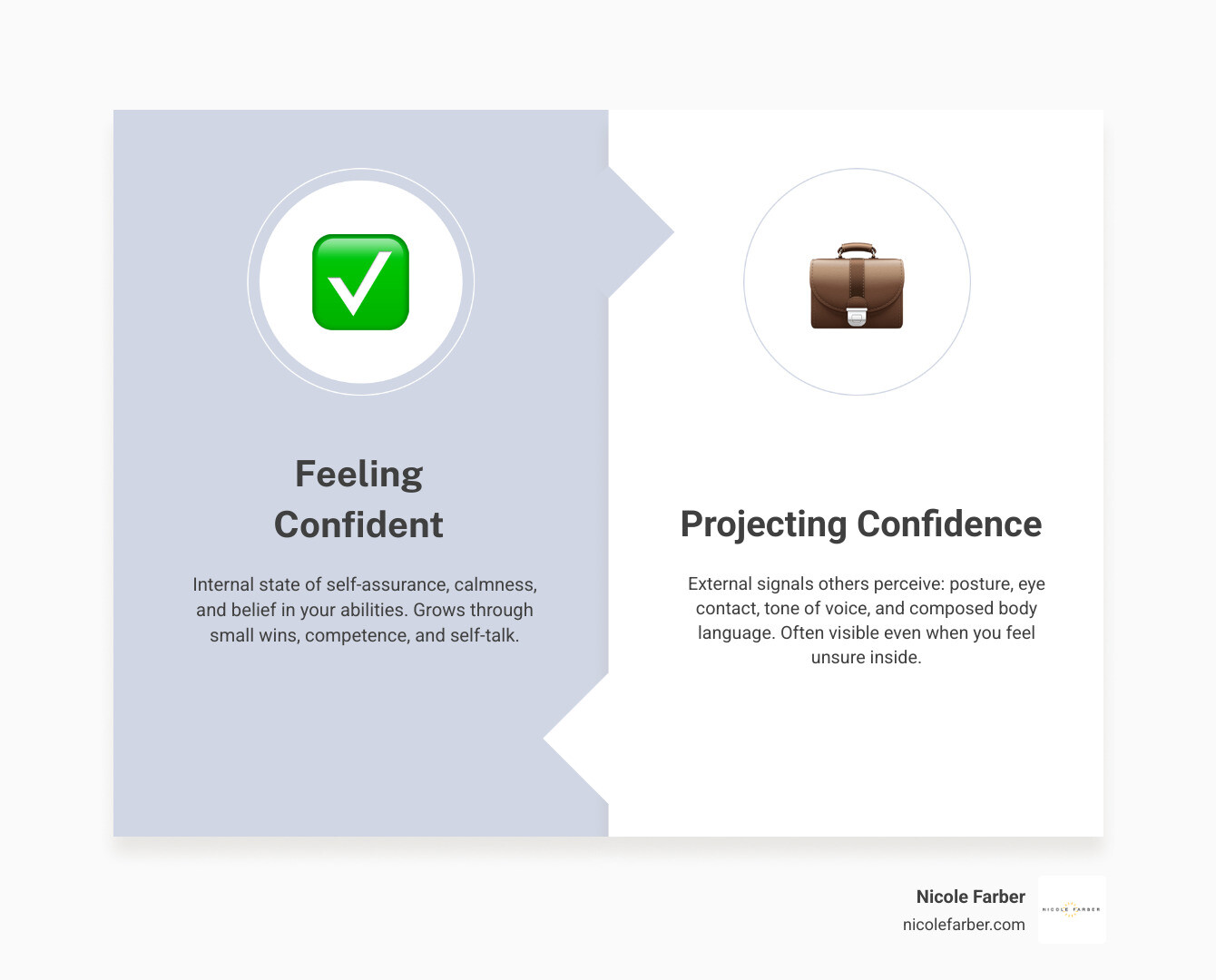
Feeling Confident vs. Projecting Confidence: The Core Distinction
We often assume that the leaders we admire are completely devoid of self-doubt. When we watch a top trial attorney command a courtroom in Philadelphia, or see a dynamic entrepreneur pitch a new venture in Wilkes-Barre, we assume their internal state perfectly matches their flawless external delivery.
In reality, there is a massive difference between feeling confident and projecting confidence.
Felt confidence is an internal emotional state—a prediction model our brain makes based on comfort, safety, and past success. Displayed confidence, on the other hand, is a set of physical and verbal behaviors that signal capability and trustworthiness to the outside world.
Psychological research shows that people form judgments of our competence and trustworthiness in about 0.1 seconds—a literal tenth of a second—based on a single glance. In those high-stakes moments, waiting to “feel” ready is a luxury we cannot afford. The classic advice of “just believe in yourself!” is completely useless when your heart is racing ninety seconds before walking through a door.
Instead, we must learn to treat projection as a vital communication skill. Adjusting how we present ourselves to match our actual competence isn’t “faking it”—it is translating our value into a language the world understands. If you want to dive deeper into this distinction, check out this guide on How to Come Across as Confident When You’re Not.
Furthermore, experiencing self-doubt does not mean you are a fraud. In fact, an estimated 70% of people experience the impostor phenomenon at some point, particularly high achievers. True frauds rarely worry about being frauds because they feel entitled to their success. If you are questioning your abilities, it is actually evidence of your conscientiousness and desire to do a good job. When we learn to Develop Executive Presence, we bridge the gap between our internal doubts and our external impact.
How to Inspire Confidence? The Inside-Out Approach to Self-Belief
While we can project authority in the short term, sustaining it over a lifetime requires us to address the relationship between self-esteem, self-worth, and self-confidence.
To understand how to inspire confidence in others, we must first build it within ourselves. This begins by understanding the difference between self-esteem and self-confidence:
| Concept | What It Means | How It Is Built |
|---|---|---|
| Self-Esteem | The deep-rooted belief that you are worthy of respect and love. | Practicing self-kindness, setting boundaries, and aligning with core values. |
| Self-Confidence | The belief in your ability to succeed at specific tasks. | Taking action, building competence, and accumulating evidence of success. |
When we run our businesses or lead teams in Luzerne County, we have to combat the negative self-talk that erodes both of these pillars. The human brain has a natural negativity bias, meaning it remembers failures and criticisms far more vividly than successes.
To silence the inner critic, we must use behavioral exposure and cognitive reframing. Instead of trying to force positive thinking (which often causes cognitive dissonance), we should focus on the “Evidence Method.” Write down your wins. Keep a success journal. When your inner critic says, “You’re going to fail,” look at your track record and reply with realistic, accurate statements: “I am prepared, and I have handled difficult situations successfully before.”
True confidence is quiet. It is comfortable with uncertainty and has no interest in constantly proving itself to others. For a deeper look at the psychological mechanics of self-trust, read How to Be More Confident: The Psychology-Backed Guide That Actually Changes Something. Once you master this internal dialogue, you can truly Empower Your Inner Boss Today.
The Physicality of Presence: Body Language, Posture, and Speech
Our physical bodies are essentially a “cheat code” for our nervous systems. When we alter our physical presence, our brain receives neurological signals that we are safe, which in turn generates the feeling of confidence.

To instantly project authority and calm your racing mind, focus on these three physical pillars:
1. Posture and Grounding
Adopt an open, upright posture. Keep your shoulders back and down, your chest open, and your arms away from your torso. Plant both feet firmly on the ground. Fidgeting like a weak Wi-Fi signal trying to connect tells the room—and your brain—that you are anxious. Grounding yourself physically provides immediate emotional stability.
2. Eye Contact and Facial Tension
Maintain steady, natural eye contact for 3 to 5 seconds at a time during conversations. Unclench your jaw and drop your shoulders to release the physical tension we naturally hold when stressed.
3. Paralanguage and Speech Patterns
Speech rate is a primary proxy for authority. When we are nervous, we tend to speed up. Practice speaking roughly 20% slower than your default pace.
- The Deliberate Pause: Replace filler words like “um,” “uh,” and “like” with a deliberate, silent two-second pause. This signals that you believe your words are worth waiting for.
- Downward Inflections: End your sentences on a downward note rather than “uptalk” (which makes statements sound like questions).
- Eliminate Over-Justification: Stop using weak, qualifying phrases like “I might be wrong, but…” or “Does that make sense?” State your recommendations clearly.
Before entering a high-stakes meeting, run a simple 20-second pre-flight routine: plant your feet, pull your shoulders back, take three slow breaths (making your exhales longer than your inhales to trigger your body’s relaxation response), and rehearse your first sentence. For more tactical advice on mastering these cues, explore The Psychology Trick That Can Make You Instantly More Confident and learn how to Talk The Talk The Ultimate Guide To Executive Presence.
Actionable Daily Habits to Build Unshakeable Self-Assurance
We cannot build mental muscle by looking in the mirror and wishing we were stronger. Real self-assurance is built through consistent, daily “reps.”

If you are looking to cultivate unshakeable confidence while growing a business in New Orleans or managing a busy household, integrate these five daily habits into your routine:
- Keep Micro-Commitments to Yourself: Self-trust is built when we make and keep tiny promises. Commit to waking up at a specific time, drinking water first thing in the morning, or clearing your desk at the end of the day. When you follow through, you prove to your brain that you are reliable.
- Execute the Hardest Task First: Tackle your most avoided, long-procrastinated task first thing in the morning. Completing it provides an immediate psychological anchor of control and accomplishment for the rest of the day.
- Limit Social Media Comparison: Social media presents a highly curated, imperfect slice of life. Reducing your daily consumption by 50% for 30 days has been shown to consistently improve self-perception and reduce anxiety.
- Take One Small Social Risk Daily: Say hello first. Ask a follow-up question. Make eye contact with the barista. Stepping slightly outside your comfort zone in low-stakes environments builds social evidence that you can handle unexpected interactions.
- Create a Success Log: Counteract your brain’s negativity bias by writing down three small wins every single evening.
Over time, these micro-actions compound. For a structured approach to building these habits, check out How to Be More Confident: 12 Proven Daily Habits That Build Unshakeable Self-Assurance and follow the step-by-step strategies in How to Be Confident in 2026: Build Real Self-Confidence Step by Step.
Leading with Authority: How Leaders Inspire Trust in Others
True leadership is not about having all the answers; it is about creating a container of safety and certainty where others feel empowered to succeed. Whether we are advising legal clients in the United States or collaborating with international partners in Antigua Guatemala, our primary job as leaders is to project a stable internal prediction that we can handle whatever comes our way.
To build a team that believes in your vision, you must first show them that you believe in your own execution. This is an inside-out process. When you work highly visibly, break down complex goals into manageable steps, and face roadblocks publicly without panic, your team naturally mirrors your composure.
To explore the coaching insights of elite performers on this topic, read How to Build Confidence: What 25,000 Elite Performers Taught Us About Real Self-Assurance. Understanding these principles is the first step when you are learning How To Become An Effective Leader.
How to inspire confidence? Through authentic connection
We often think leaders must appear flawless to be respected. In reality, warmth beats performance every single time. People need to know that you are safe and grounded before they care about your resume.
Strategic vulnerability—such as admitting when you do not know something but committing to finding the answer—actually increases trust and respect. Practice active listening, ask deep follow-up questions, and show genuine empathy. When you prioritize the growth of your people, you naturally Empower Your Team.
How to inspire confidence? By modeling competence and preparation
There is no substitute for doing the work. Competence is the foundation upon which real confidence stands.
Thorough preparation eliminates situational anxiety. If you want your team or your clients to trust your direction, you must model continuous learning, master your domain, and show up fully prepared for every challenge. To build these foundational habits, dive into The Emerging Leaders Playbook 15 Ways To Improve Your Leadership Skills.
Frequently Asked Questions about Building Confidence
How long does it take to build real confidence?
While you can experience an immediate boost in your composure within days by adjusting your posture, breathing, and speech, building deep, unshakeable self-assurance is a journey of neuroplasticity. Typically, practicing consistent daily habits and keeping micro-commitments will yield noticeable changes in your self-perception within 4 to 8 weeks, while deeper, identity-level shifts generally take 3 to 12 months of consistent behavioral evidence.
What is the difference between confidence and arrogance?
Confidence is quiet, grounded, and generous. It requires no external validation and is comfortable admitting mistakes, asking questions, and lifting others up. Arrogance, conversely, is loud, fragile, and needy. It is driven by insecurity and a constant need to prove superiority over others, often by dismissing their ideas or minimizing their worth.
How can I overcome the fear of failure?
The fastest way to overcome the fear of failure is through gradual exposure. We must stop waiting to feel “ready” before we act. Treat confidence as a consequence of action, not a prerequisite. By breaking intimidating goals into tiny, manageable steps and taking action despite our fear, we gather tangible evidence that failure is not catastrophic, but rather a valuable data point for growth.
Conclusion
At the end of the day, learning how to inspire confidence is not about creating a flawless, bulletproof persona. It is about building a deep, quiet trust in your ability to figure things out, handle setbacks, and stay true to your core values.
As a single mother, CEO, and motivational speaker in the legal marketing industry, I have faced countless moments where the path forward was uncertain. But I have learned that when you combine preparation with faith-driven leadership, and choose to take action despite the whispers of your inner critic, you unlock a level of influence that can transform your business, your team, and your life.
You don’t have to feel fearless to start. You just have to plant your feet, take a deep breath, and take the next step.
Are you ready to elevate your leadership, empower your team, and build unshakeable presence in your industry? Book Nicole Farber for Speaking Engagements today, and let’s work together to inspire unstoppable confidence in your organization.