Inspiring Playbooks from the Best Business Leaders Shaping Our Future
- Leadership
- In the News
- September 11, 2026
Inspiring Playbooks from the Best Business Leaders Shaping Our Future
Why the Best Business Leaders Matter in a Changing Market

The best business leaders pair a clear vision with strong execution. They create value for customers, build teams that can adapt, take informed risks, and treat trust, inclusion, and long-term impact as business priorities – not side projects.
This list looks beyond fame and company size. It explores leadership playbooks from figures such as Satya Nadella, Mary Barra, Jeff Bezos, Indra Nooyi, Jensen Huang, and Melanie Perkins. Their industries differ, but their lessons are similar: stay close to customers, keep learning, make hard decisions early, and help people succeed through change.
For law firm leaders, these habits matter in every market, including competitive practices across the United States. Growth requires more than better marketing tools. It requires the focus to choose a direction, the courage to test new ideas, and the empathy to build a firm clients and employees want to trust.
I am Nicole Farber, CEO of ENX2 Legal Marketing, with more than 15 years of experience helping law firms and businesses grow through change, including the global pandemic. In studying and applying lessons from the best business leaders, I have seen that sustainable growth starts with leaders who treat their clients’ success as their own.
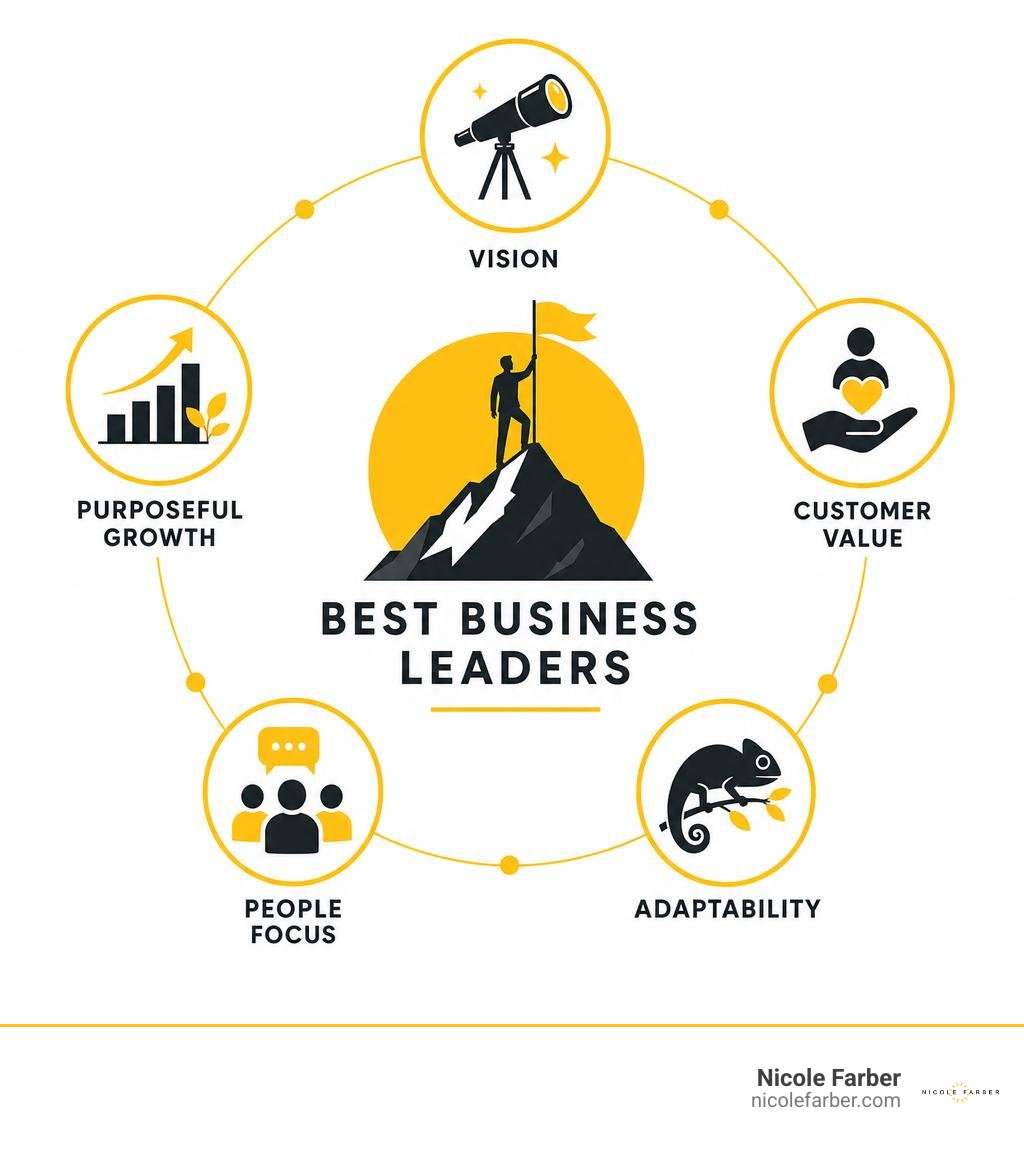
Best business leaders terminology:
Core Attributes That Define Modern Executive Excellence
Examining top corporate pioneers reveals that true excellence relies on more than financial metrics alone. While driving shareholder returns remains crucial, modern executive excellence is rooted in an organization’s public reputation for innovation, strong social connections, and decisive risk management.
Achieving sustainable impact requires developing a fundamental understanding of what is leadership. It is not about commanding teams from an isolated corner office; it is about setting a shared purpose, removing barriers, and empowering talent across all tiers of the enterprise. Leaders who cultivate trust enable their teams to execute with clarity and confidence even amidst intense market competition.
| Leadership Style | Defining Characteristic | Primary Focus | Best Used In |
|---|---|---|---|
| Transformational | Inspires change through shared vision | Cultural reinvention and morale | Legacy turnarounds and shifting markets |
| Customer-Obsessed | Works backward from customer needs | Continuous innovation and execution | Fast-moving digital and retail markets |
| Human-Centered | Prioritizes empathy and inclusion | Employee engagement and ethics | Complex organizations and diverse workforces |
| Industrial / Visionary | Pursues bold, long-term capital projects | Infrastructure and tech sovereignty | Energy, manufacturing, and global hardware |
Essential Qualities of the Best Business Leaders
The most effective executives stand apart by cultivating high self-awareness and emotional intelligence. When leaders replace rigid hierarchies with a genuine growth mindset, they create resilient organizational cultures where curiosity replaces complacency.

Empathy acts as an operational superpower. Top leaders listen actively to front-line staff and clients, identifying friction points before they become major liabilities. Incorporating proven business leadership strategies helps executives translate empathy and clear communication into repeatable, measurable organizational performance.
Embracing Disruption and Navigating Market Volatility
Market volatility is a given in business. Top executives embrace uncertainty by viewing disruption as an opportunity to innovate rather than an obstacle.
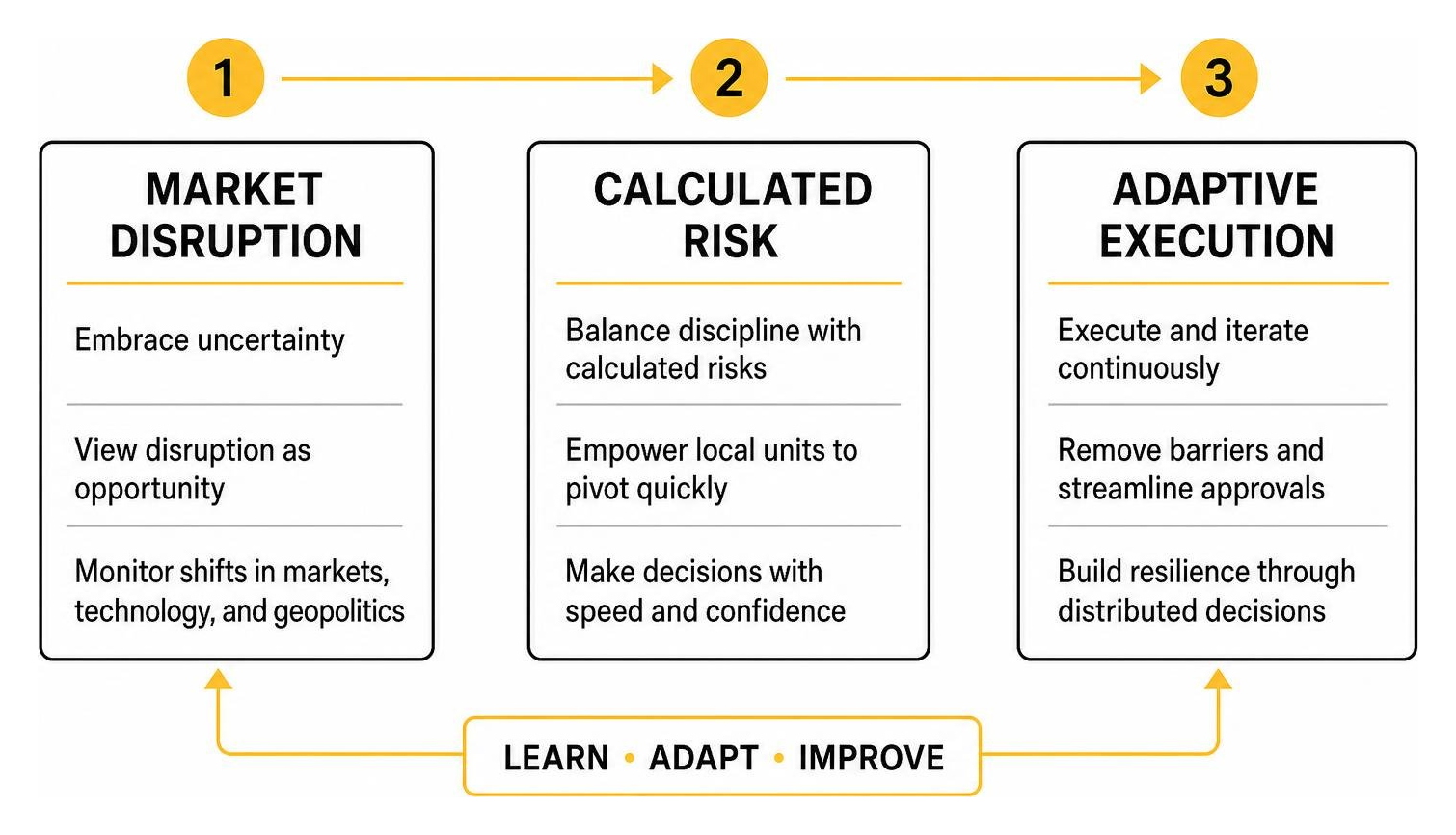
Whether navigating geopolitical shifts or sudden industry-wide technological changes, effective executives balance operational discipline with calculated risks. They build organizational resilience through distributed decision-making, allowing local business units to pivot rapidly without waiting for bureaucratic approvals. This proactive adaptability ensures companies stay ahead of industry transformations while protecting their core mission.
Iconic Strategies from the Best Business Leaders Across Industries
Studying the world’s most accomplished founders and CEOs provides practical playbooks for organizational growth. From tech corridors to manufacturing floors, these leaders show how bold strategies yield market dominance.

Organizations aiming to stay ahead of the curve must focus on discovering emerging business leaders early, bringing fresh perspectives into their core leadership pipelines.
Transforming Legacy Enterprises: Mary Barra and Satya Nadella
Reinventing a legacy enterprise requires courage and cultural focus. When Mary Barra took the helm at General Motors, she began leading an ambitious shift toward electrification, championing a corporate vision of zero crashes, zero emissions, and zero congestion. Barra’s hands-on approach—having started as an 18-year-old engineering co-op student on the factory floor—underscores the power of knowing an organization from the inside out. Reviewing the executive profile of Mary Barra shows how authentic, people-first leadership drives industrial evolution.
Similarly, Satya Nadella orchestrated a massive transformation at Microsoft. By replacing an aggressive internal culture with a collaborative growth mindset and pivoting heavily into cloud computing and AI, he expanded Microsoft’s valuation past $3 trillion, proving that culture drives performance.
Scaling Global Innovation: Jeff Bezos, Jensen Huang, and Melanie Perkins
Scaling a startup into a global powerhouse requires operational rigor and long-term thinking:
- Jeff Bezos: Founded Amazon in 1994 in his Seattle garage, scaling it from an online bookstore into a global infrastructure giant with over $230 billion in revenue by 2018 through a relentless focus on customer obsession.
- Jensen Huang: Positioned Nvidia as a central pillar of the modern global AI economy through pioneering graphics hardware architectures and sustained long-term R&D investments.
- Melanie Perkins: Democratized graphic design by co-founding Canva, scaling the platform to over 135 million users and a $40 billion valuation by 2024 with an intuitive, user-friendly interface.
Conglomerate Growth and Industrial Vision: Kumar Mangalam Birla and Gautam Adani
Building resilient, multi-sector conglomerates requires a balance of disciplined execution, strategic capital allocation, and long-term national development:
- The insights on Kumar Mangalam Birla illustrate how meritocracy, strong corporate governance, and more than 60 global acquisitions expanded the Aditya Birla Group’s turnover by 33 times over three decades.
- Meanwhile, the visionary initiatives of Gautam Adani highlight the role of modern logistics, green energy transitions, and large-scale infrastructure investments in driving economic growth.
Human-Centered Leadership: Inclusion, Purpose, and Philanthropy
Long-term value creation depends directly on how businesses treat their people, their communities, and the planet. Today’s top executives understand that ethical leadership, sustainable supply chains, and social responsibility are central to business success.
Executives like Dow’s CEO show how large industrial corporations can champion circular economies and diverse work environments. Discovering the executive insights from Jim Fitterling reveals how transparent communication and inclusion drive material science innovation.
How the Best Business Leaders Balance Purpose and Profit
Balancing financial performance with social impact creates enduring enterprise value:
- Indra Nooyi: Pioneered “Performance with Purpose” at PepsiCo, proving that sustainable, healthier product lines can go hand in hand with exceptional business performance. During her 12-year tenure, net revenue grew by over 80% and total shareholder return reached 162%. Studying the leadership playbook of Indra Nooyi provides a clear model for value-driven leadership.
- Melinda French Gates: Merges venture investing, data-backed policy, and philanthropy through Pivotal Ventures and the Gates Foundation. Reviewing the social impact initiatives by Melinda French Gates shows how targeted investments in caregiving infrastructure and women’s health generate lasting economic returns.
Championing Diversity, Inclusion, and Female Leadership
Despite clear evidence linking diverse leadership to improved profitability, women and underrepresented groups remain underrepresented in executive suites. Trailblazers like Meg Whitman—who scaled eBay from $5.7 million to $8 billion in revenue—and Oprah Winfrey—the first African-American female billionaire—have shown how authentic leadership breaks through systemic barriers.
Fostering equitable pathways requires executive sponsorship, transparent promotion systems, and direct mentorship. Seeking guidance from business women leadership experts provides actionable strategies for cultivating diverse leadership across every level of an organization.
Frequently Asked Questions About Top Business Leaders
What core traits distinguish top executives from traditional managers?
Traditional managers focus primarily on day-to-day operations, workflows, and task execution. In contrast, top executives set strategic vision, champion core values, foster cross-functional collaboration, and inspire their teams to navigate market disruptions with confidence.
How do modern CEOs adapt their organizations to rapid AI advancements?
Forward-thinking executives treat AI as an operational partner rather than a simple cost-cutting mechanism. They invest heavily in workforce upskilling, implement clear data governance policies, and create collaborative testing environments to deploy tools safely and effectively.
Why is human-centered leadership essential for long-term corporate sustainability?
Prioritizing employee well-being, psychological safety, and clear communication builds resilient, high-trust cultures. Companies led with empathy experience lower turnover rates, higher productivity, and greater brand loyalty from both clients and partners.
Conclusion
Whether you are scaling a professional services practice in Philadelphia, leading a regional firm in Wilkes-Barre and Luzerne County, or expanding across vibrant markets from New Orleans to Antigua Guatemala, the core principles of effective leadership remain consistent: set a clear vision, embrace continuous learning, lead with empathy, and take full accountability for your team’s success.
Sustainable organizational growth requires navigating adversity with grit, fostering genuine human connections, and empowering others to reach their full potential. By grounding your management style in purpose, integrity, and faith-driven resilience, you position your organization to thrive across changing markets and build a lasting legacy. To build a stronger, more adaptable organization, explore our comprehensive business leadership guide and start implementing these proven strategies today.