Everything You Need to Know About Leadership Strategies in Philadelphia, Wilkes-Barre, New Orleans & Antigua Guatemala
- Leadership
- In the News
- June 12, 2026
Everything You Need to Know About Leadership Strategies in Philadelphia, Wilkes-Barre, New Orleans & Antigua Guatemala
Why Strategies of Leadership Define Organizational Success

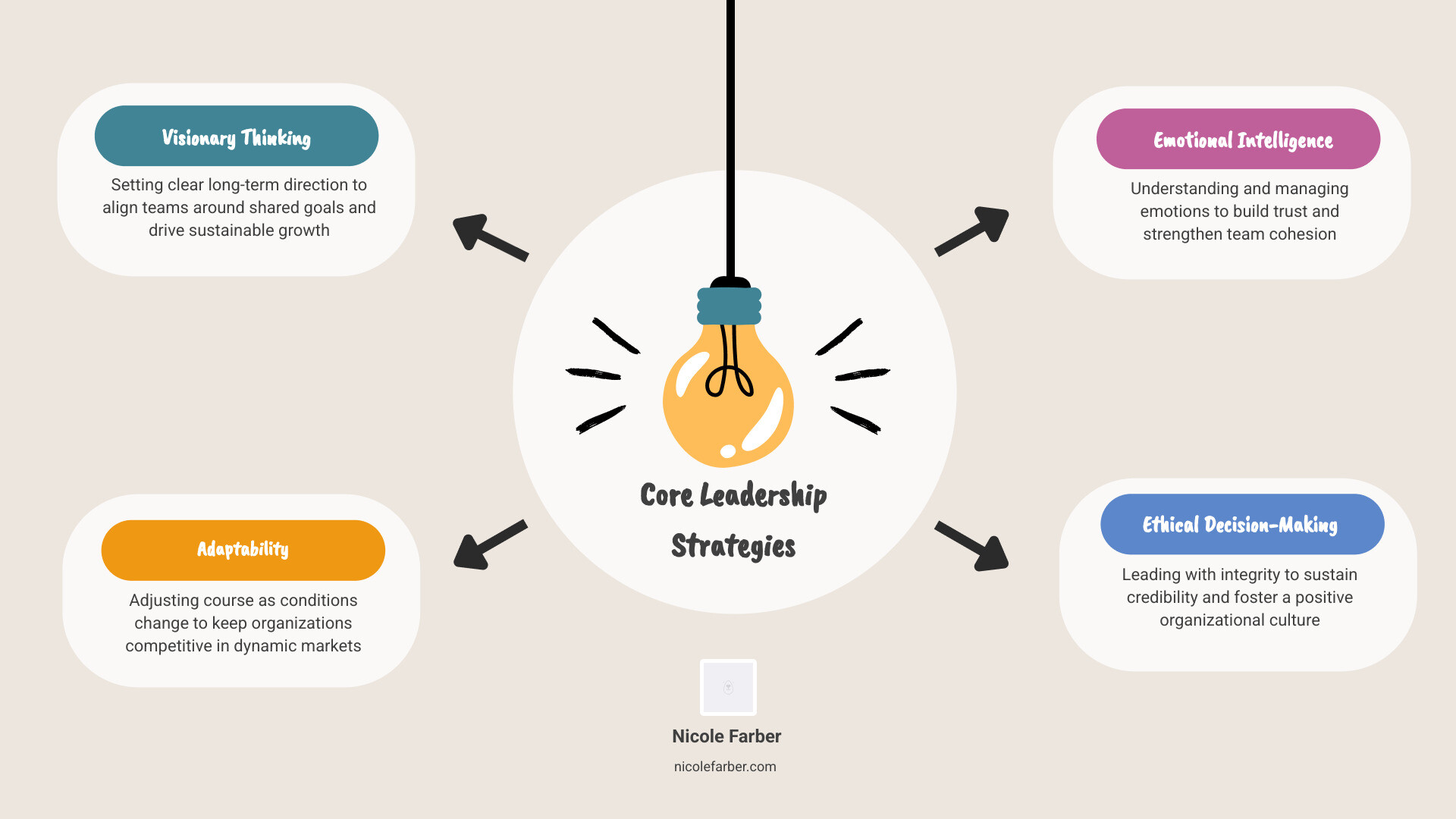
Understanding the right strategies of leadership can be the difference between a team that struggles and one that consistently delivers results. Here is a quick overview of the core leadership strategies that drive performance:
| Leadership Strategy | What It Means | Why It Matters |
|---|---|---|
| Visionary Thinking | Setting a clear long-term direction | Aligns teams around shared goals |
| Adaptability | Adjusting course as conditions change | Keeps organizations competitive |
| Emotional Intelligence | Understanding and managing emotions | Builds trust and team cohesion |
| Clear Communication | Sharing expectations openly | Reduces confusion and conflict |
| Ethical Decision-Making | Leading with integrity | Sustains credibility and culture |
| Empowering Others | Delegating and developing people | Strengthens the leadership pipeline |
Strategic leadership is not just about having a vision. It is about translating that vision into action — while keeping people motivated, aligned, and resilient through constant change.
Organizations that invest in leadership development are 3.5 times more likely to be top performers in their industry. Yet many leaders — whether running a law firm in Philadelphia, a business in Wilkes-Barre, or a growing operation in New Orleans — focus almost entirely on day-to-day operations. They never carve out the space to lead strategically.
That gap is costly.
This guide breaks down the most effective leadership strategies in plain language, with practical steps you can apply whether you lead a small team or an entire organization.
I’m Nicole Farber, CEO of ENX2 Legal Marketing, with over 15 years of experience helping law firms and businesses grow — including speaking on strategies of leadership and self-leadership at Merakey’s Annual Leadership Conference in 2025. My experience guiding teams across Philadelphia, Wilkes-Barre, New Orleans, and beyond gives me a front-row seat to what actually works when leaders commit to leading with intention.
Defining Strategic Leadership vs. Operational Management

When we talk about the strategies of leadership, we often find that people confuse “leading” with “managing.” It’s a bit like the difference between a telescope and a microscope. If you are only looking through the microscope, you can see every tiny detail of the day-to-day tasks, but you have no idea if a storm is brewing on the horizon. If you only use the telescope, you might trip over the rug in front of you.
In our work across Philadelphia and Wilkes-Barre, we’ve seen that the most successful executives are those who can switch between these two views. What Is Leadership really comes down to the act of directing and managing a group toward a shared success, but the strategic side of that coin is what keeps the lights on ten years from now.
According to the Handbook of Research on Strategic Leadership, strategic leadership is a field of research focused on how top executives influence organizational outcomes through their decisions, values, and experiences. While operational management focuses on doing things right (efficiency), strategic leadership focuses on doing the right things (effectiveness).
What are the Core Strategies of Leadership?
To be a truly strategic leader, you need a specific toolkit. It isn’t just about being the boss; it’s about being the person who can see around corners. Here are the core characteristics we emphasize:
- Visionary Thinking: You must be able to articulate a compelling future. If your team in New Orleans doesn’t know where the ship is headed, they’re just rowing in circles.
- Adaptability: In May 2026, the world moves faster than ever. A leader who can’t pivot when the market shifts is a leader who gets left behind.
- Emotional Intelligence (EQ): This is the “human side” of business. Understanding your own values and how your moods affect others is essential for How To Become An Effective Leader.
- Decision-Making Skills: Strategic leaders don’t just guess; they conduct thorough analyses of risks and opportunities before pulling the trigger.
Strategic vs. Tactical: Balancing the Horizon
We often use the “Four Ps” framework to help leaders keep their eyes on the horizon. This framework, detailed in Keeping Your Eyes on the Horizon, suggests that leadership is a “mental dashboard” consisting of:
- Perception: Understanding multiple perspectives before deciding how to proceed.
- Process: Thinking about how we include people in the work and who benefits from our choices.
- People: Engaging with the emotional reality of the team.
- Projection: Telling a story about where the organization is headed.
Whether you are navigating the legal landscape in Philadelphia or overseeing an action plan in Antigua Guatemala, balancing these four areas allows you to maintain competitive advantage. Tactical leadership handles the “now,” but strategic leadership handles the “next.”
Core Strategies of Leadership for High-Performing Teams

You’ve probably heard the adage, “Teamwork makes the dream work.” It’s a bit cliché, we know, but it’s true! However, high-performing teams don’t just happen by accident. They are built through intentional strategies of leadership.
To move From Good To Great How To Lead Your Team To Peak Performance, a leader must provide three things: clear direction, effective communication, and team chemistry. Think of it like driving in a thick fog—without a clear vision, the team slows down, gets confused, and eventually stops moving altogether. Our Beginners Guide To Leading Your Team emphasizes that the leader’s job is to clear that fog.
Building Team Synergy in New Orleans and Wilkes-Barre
In places with rich cultures like New Orleans and close-knit business communities like Wilkes-Barre, trust is the currency of leadership. We encourage leaders to get to know their team members’ stories. When you know someone’s “why,” you can lead them much more effectively.
Organizations like Leadership Northeast in Luzerne County have shown that when leaders focus on psychological safety—an environment where people feel safe to take risks and admit mistakes—innovation flourishes. When you Empower Your Team, you aren’t just giving them tasks; you are giving them ownership. This reduces turnover and boosts engagement, which is vital in our current 2026 economic climate.
The Role of Emotional Intelligence and Ethics
We cannot overstate the importance of the “human element.” In the 21st century, the best leaders are not the smartest people in the room; they are the most self-aware. They use the “Trust Equation”—Credibility times Reliability times Intimacy, divided by Self-Orientation. If your “self-orientation” (your ego) is too high, your trust score plummces.
For those in the non-profit sector, such as those working with Nonprofit Leadership & Effectiveness in New Orleans, ethical decision-making is the bedrock of your mission. People want to be part of something bigger than themselves. If they don’t trust your ethics, they won’t follow your strategy. For more on this, check out our guide on How Be A Good Leader.
Navigating Paradoxes and VUCA Environments in 2026
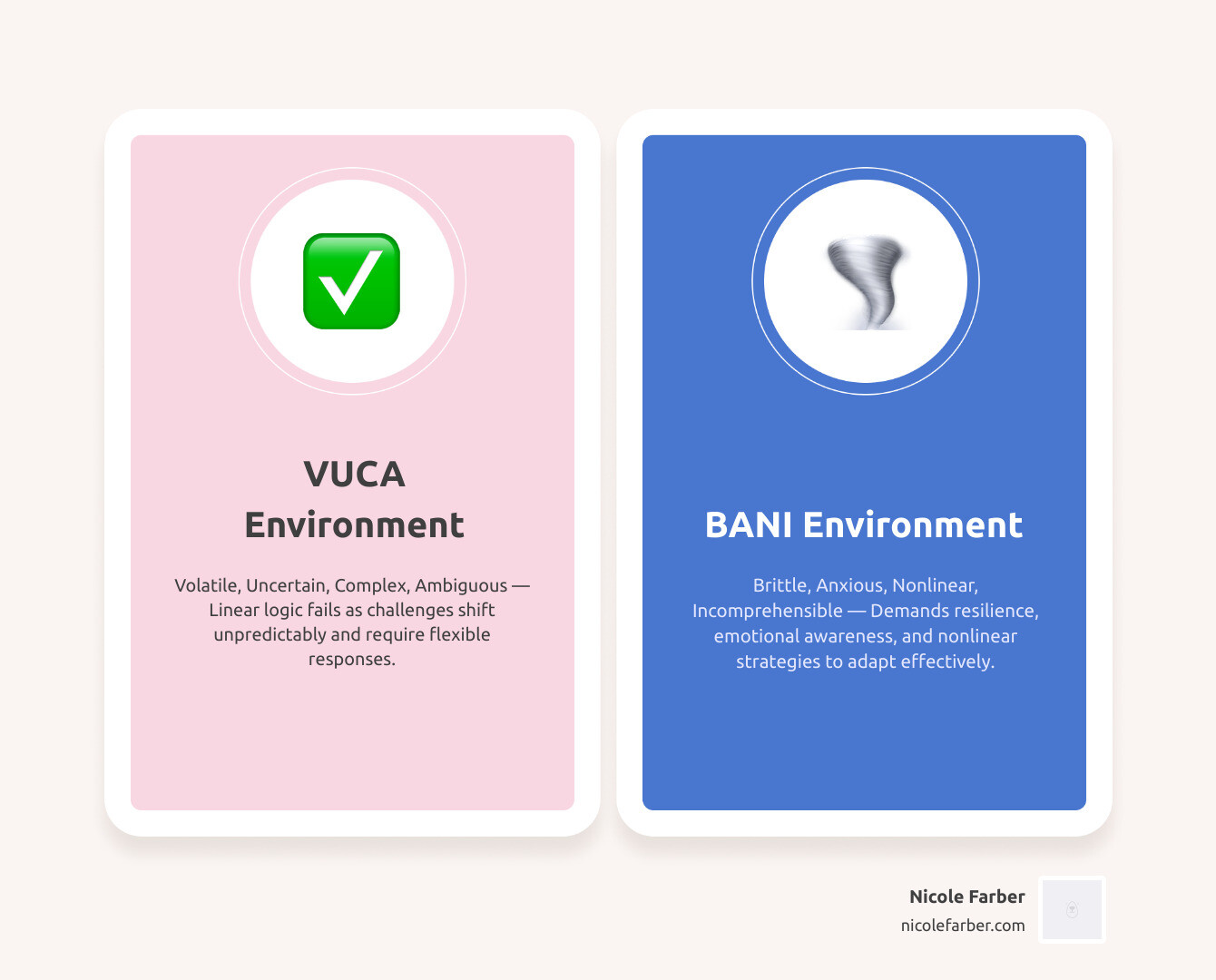
In May 2026, we are living in a world that is not just VUCA (Volatile, Uncertain, Complex, Ambiguous) but also BANI (Brittle, Anxious, Nonlinear, Incomprehensible). This requires a shift in how we think about the strategies of leadership. Linear logic just doesn’t cut it anymore.
| Environment Type | Leadership Response | Key Strategy |
|---|---|---|
| Brittle | Resilience | Build systems that can bend without breaking |
| Anxious | Empathy | Focus on mental health and psychological safety |
| Nonlinear | Contextual Thinking | Look for patterns rather than direct cause-and-effect |
| Incomprehensible | Transparency | Communicate clearly even when you don’t have all the answers |
Leaders today must be masters of “Paradoxical Leadership.” This is the ability to manage requirements that seem contradictory but are actually interdependent. Our Business Leadership Strategies Guide dives deep into how to navigate these waters.
Mastering Paradoxical Leadership Strategies
The TENSE leadership model is a fantastic framework for this. It identifies four main areas where leaders face “both/and” tensions rather than “either/or” choices:
- Task Management: Balancing day-to-day operations with long-term strategy.
- Relationship Management: Maintaining professional distance while building close team bonds.
- Change Management: Balancing the need for stability with the necessity of radical innovation.
- Micropolitical Management: Staying authentic to yourself while representing the organization’s interests.
Successful managers who can think paradoxically foster much higher levels of adaptability. They don’t choose between control and empowerment; they find ways to provide structure that enables freedom.
Health-Oriented Leadership in Luzerne County
One of the most pressing trends we are seeing in 2026 is the rise of health-oriented leadership. Statistics show that sick days due to mental health issues increased by over 56% in the decade leading up to 2023. This makes Being A Good Leader In The Workplace a task that involves caring for the “whole person.”
In Wilkes-Barre and throughout Luzerne County, we’ve seen that leaders who prioritize employee well-being see a 21% increase in productivity. It turns out that when people aren’t burnt out, they actually do better work! Who would have thought? (A little humor goes a long way in leadership, too—studies show humorous leaders are 27% more motivating).
Leadership Development and the “Leadership Factory” Model
To stay competitive, organizations need to stop thinking about leadership as a “one-and-done” training session and start thinking about it as a “Leadership Factory.” This term, coined by McKinsey, describes a culture where leaders are constantly being developed at every level.
Whether we are talking about Developing Female Leaders or grooming the next generation of executives, the most effective approach is “blended learning.” This combines formal training, 360-degree feedback, and—most importantly—real-world experience. You can’t learn to swim by reading a book, and you can’t learn strategies of leadership just by sitting in a seminar. You have to get in the water.
Investing in the Pipeline from Philadelphia to Antigua Guatemala
We believe that every employee should have access to a “learning map” that helps them Develop Your Leadership skills. In Philadelphia, organizations like Leadership Philadelphia are masters at connecting talent with community needs to build this pipeline.
Even in our international work, such as the Action plan – Antigua Guatemala, the focus is on transparency and building leadership capacity across all levels of government and business. Succession planning shouldn’t be a secret meeting held in a dark room; it should be a visible process of mentorship and coaching.
Digital Savviness and Industry 4.0
As we navigate the Fourth Industrial Revolution, “digital savviness” has become a non-negotiable leadership trait. This doesn’t mean you need to be a coder, but you do need to understand how AI and data-driven decision-making can enhance your mission.
Our Business Leadership Ultimate Guide highlights that “Quality 4.0” involves using technology to not just monitor work, but to improve the human experience of work. Leaders who embrace these tools can move faster and with more precision than those relying on “gut feeling” alone.
Frequently Asked Questions about Leadership Strategies
What is the difference between strategic and operational leadership?
Operational leadership is about the “how” and the “now”—executing tasks, monitoring efficiency, and managing day-to-day workflows. Strategic leadership is about the “why” and the “next”—setting a long-term vision, evaluating market risks, and navigating the organization through disruption. Most successful leaders in Philadelphia and New Orleans must be able to do both, but strategic leadership requires more “inner work” and foresight.
How can leaders manage paradoxical tensions like control vs. empowerment?
The key is to move away from “either/or” thinking and toward “both/and” solutions. This is often called the TENSE model. For example, instead of choosing between total control and total freedom, a leader can create clear “guardrails” (structure) within which employees have full autonomy (empowerment). This provides the safety of structure with the motivation of independence.
Why is health-oriented leadership a priority in 2026?
With the massive rise in mental health-related absences over the last decade, leaders have realized that human capital is their most fragile and valuable resource. Health-oriented leadership isn’t just “being nice”; it’s a strategic necessity to maintain productivity, reduce turnover, and foster an engaged workforce in a stressful, high-speed world.
Conclusion
The strategies of leadership we’ve discussed—from visionary thinking to navigating BANI environments—are all about one thing: people. Whether you are a single mother starting a business, a partner at a law firm in Philadelphia, or a community leader in Antigua Guatemala, your ability to lead with intention, faith, and strategy will define your success.
We believe that leadership is a journey of continuous growth. It’s about being a “learn-it-all” rather than a “know-it-all.” By investing in your own development and building a “leadership factory” within your own organization, you can create a legacy that lasts long after you’ve left the office.
If you’re looking for more inspiration or practical tips on Business Leadership Strategies, we are here to help you navigate your journey with purpose and passion. Let’s build something great together.