Leadership Development Pathways: Choose Your Own Career Adventure
- Leadership
- In the News
- June 15, 2026
Leadership Development Pathways: Choose Your Own Career Adventure
What Are Leadership Development Pathways (And Why They Matter for Your Career)

Leadership development pathways are structured programs that guide professionals through progressive stages of growth — from foundational skills to executive-level strategy.
Here is a quick breakdown of the most common types:
| Pathway Type | Who It’s For | Typical Duration | Key Focus |
|---|---|---|---|
| Emerging Leader | Early-career professionals | 6-12 months | Self-awareness, communication, foundational skills |
| Mid-Level Manager | Team leads, directors | 5-12 months | Leading from the middle, collaboration, decision-making |
| Senior/Executive | VPs, C-suite | 10-12 months | Strategic vision, organizational change, executive presence |
| Public Sector (e.g., DoD) | Government/military civilians | 10-12 months | Interagency leadership, competency frameworks |
| Industry-Specific | Philanthropy, education, legal | 9-12 months | Sector-specific equity, culture, and influence |
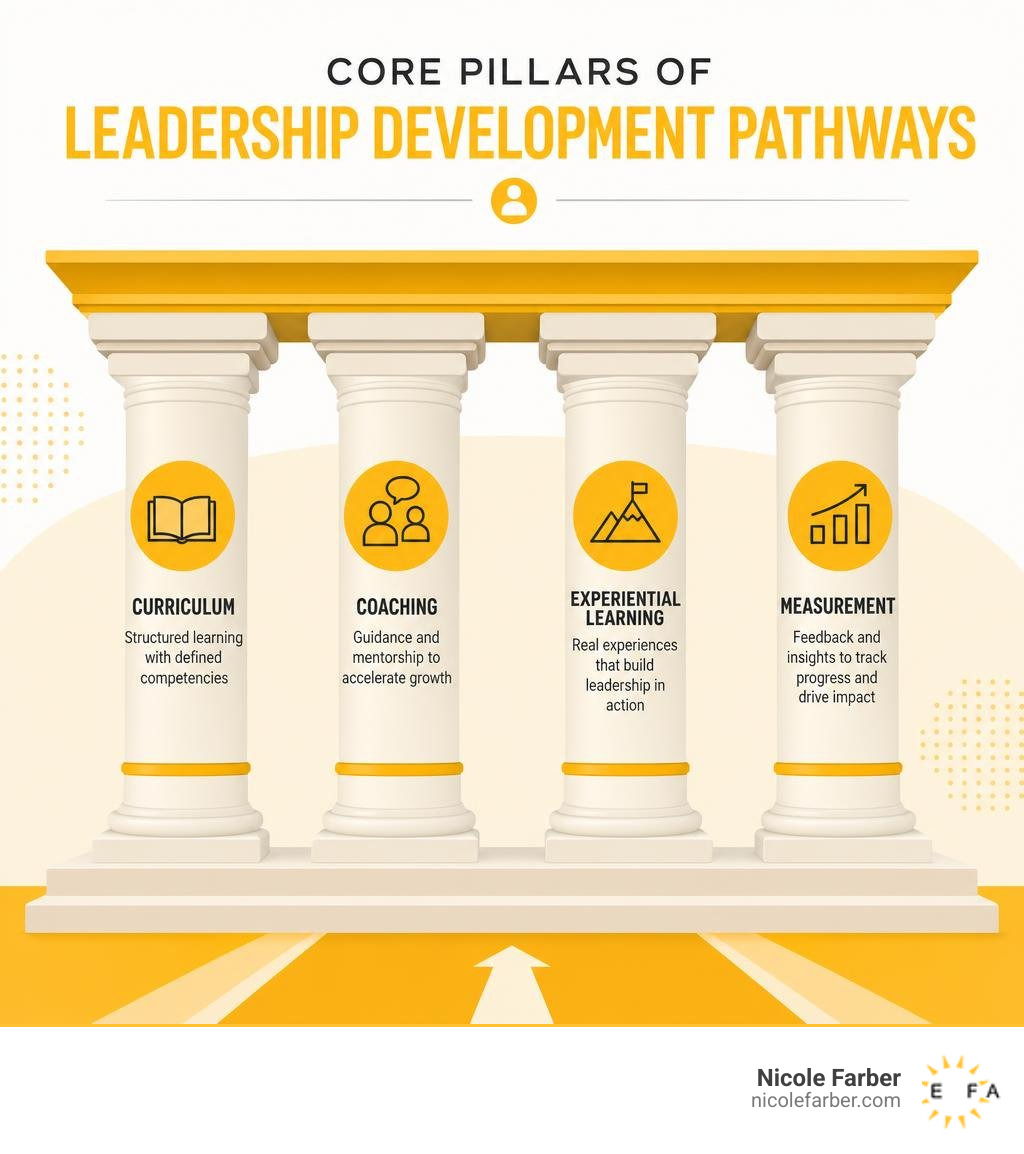
Most programs share four core pillars:
- Structured curriculum — progressive levels or phases with defined competencies
- Coaching and mentorship — peer coaching, ICF-certified coaches, or senior mentors
- Experiential learning — real projects, stretch assignments, and team leadership
- Measurement and feedback — 360-degree assessments, action plans, and performance tracking
Choosing the right pathway can feel overwhelming. There are dozens of programs — government-backed, nonprofit-led, corporate, virtual, and in-person — each designed for different goals, budgets, and career stages. And here is the uncomfortable truth: 85% of professionals already recognize the skills they need to improve, yet a third of employees say their organizations don’t give them enough support or recognition for the learning they do.
That gap — between knowing what you need and actually getting there — is exactly what leadership development pathways are designed to close.
Whether you are a law firm partner in Philadelphia trying to grow your leadership presence, a mid-level manager in Wilkes-Barre navigating a team for the first time, or an emerging professional looking for structure in your growth, the right pathway exists for you. The challenge is knowing where to start.
I’m Nicole Farber, CEO of ENX2 Legal Marketing, with over 15 years of experience helping law firms and business leaders build their brands and sharpen their leadership edge — including speaking on leadership development pathways and self-leadership at Merakey’s Annual Leadership Conference in 2025. In this guide, I’ll walk you through every major type of pathway so you can find the one that fits your career adventure.
The Architecture of Modern Leadership Development Pathways

A successful leadership development pathway is not a single, one-off seminar. It is a carefully designed blueprint. Just as we design marketing campaigns to guide clients from awareness to loyalty, organizations build structured pathways to guide professionals from raw talent to seasoned decision-makers.
The architecture of modern pathways balances a structured core curriculum with personalized development. This dual approach ensures that while every leader masters the organization’s core values and competencies, they also have the flexibility to address their unique skill gaps.
| Leadership Level | Primary Focus | Key Competencies | Core Learning Methods |
|---|---|---|---|
| Emerging Leaders | Self-leadership & foundational skills | Self-awareness, active listening, time management, basic public speaking | 360-degree assessments, peer coaching, interactive workshops |
| Mid-Level Leaders | Leading teams & bridging silos | Conflict resolution, situational awareness, delegation, collaborative planning | Executive coaching, cross-functional projects, simulation tools |
| Executive/Senior Leaders | Leading institutions & driving change | Strategic vision, executive presence, crisis management, equity-focused talent development | High-impact coaching, board sponsorship, organizational change initiatives |
Tailoring Leadership Development Pathways for Emerging Leaders
For emerging leaders, the journey begins with self-leadership. Before you can successfully guide a team through a high-stakes project in New Orleans or manage a legal campaign in Philadelphia, you must master the art of leading yourself.
At this foundational stage, pathways focus heavily on building self-awareness, mastering communication, and learning the fundamentals of project management. Emerging leaders learn to understand their personal styles and how those styles impact others. They practice giving and receiving constructive feedback, managing their time, and conquering the universal fear of public speaking.
If you are looking to build this groundwork, understanding How to Become an Effective Leader is your critical first step. It is about shifting your mindset from “individual contributor” to “team facilitator.”
Navigating Mid-Level Leadership Development Pathways
Mid-level managers face a unique, often exhausting balancing act. They operate in the middle, translating executive strategy into frontline action while advocating for their teams’ needs upward.
For these leaders, the curriculum shifts toward advanced collaboration, conflict resolution, and reading organizational dynamics. They must learn to manage complex, multi-functional priorities and build alignment across departmental silos.
A prime example of a program designed for this level is the Leadership Development Program (LDP)® | CCL. LDP focuses on helping mid-level leaders build the agility, trust, and resilience needed to lead from the middle of demanding corporate structures. At this level, development pathways are less about technical execution and much more about human connection, influence, and strategic alignment.
Executive and Senior Leadership Pathways
At the executive level, the focus expands from managing day-to-day operations to steering the entire institution. Senior leaders must cultivate a powerful executive presence, develop long-term strategic vision, and champion organizational change.
Executive pathways are highly personalized. They often incorporate confidential, one-on-one executive coaching, deep-dive 360-degree feedback, and intensive strategy sessions. The goal is to help senior leaders navigate high-stakes environments, manage systemic volatility, and build equitable talent pipelines for the future.
To explore how to transition into this space, finding the right high-level training is key. You can read more about selecting these elite experiences in our guide on The Executive Edge: Finding the Best Seminar on Leadership for Your Career.
Public vs. Private Sector Leadership Pathways: Key Differences

While the core principles of leadership—honesty, vision, and empathy—remain constant, the pathways to develop these traits look remarkably different depending on whether you operate in the public or private sector.
Public sector programs are typically characterized by highly structured, standardized, and competency-based frameworks. They are designed to manage massive, bureaucratic organizations where equity, standardized promotion metrics, and interagency cooperation are paramount. Private sector and non-profit pathways, on the other hand, prioritize corporate agility, brand alignment, rapid decision-making, and market impact.
Structured Government and Military Pathways
Government and military pathways are renowned for their rigor and highly formalized selection processes. These programs focus on preparing civilian and military personnel to lead in complex, multi-domain, and joint-agency environments.
A premier example is the Defense Civilian Personnel Advisory Service EXECUTIVE LEADERSHIP DEVELOPMENT PROGRAM (ELDP) OVERVIEW. The ELDP is a grueling 10-month program that combines intense academic study with physically demanding military readiness immersions. It is designed to give civilian leaders a front-line perspective on warfighter operations.
Similarly, the Leadership Excellence and Acquisition Development (LEAD) – USAASC is a 12-month program tailored specifically for Army acquisition professionals, preparing them to manage massive portfolios and rapid technology procurement through structured developmental assignments, including time at the Pentagon.
Dynamic Private Sector and Non-Profit Pathways
In the corporate and non-profit worlds, leadership pathways are closely tied to business agility, brand values, and strategic growth. For instance, in the legal marketing industry, leaders must learn how to build a powerful brand that differentiates their firm in a crowded market.
Non-profit and philanthropic organizations also utilize specialized pathways. The Career Pathways | Council on Foundations is a 10-month hybrid program designed to help mid-to-senior-level philanthropic professionals develop authentic, equity-focused leadership strategies. Rather than focusing on military readiness, these pathways emphasize cultural intelligence, systemic change, and community impact.
To see how these concepts translate directly into business growth, check out our Business Leadership Complete Guide.
The Power of Mentorship, Coaching, and Experiential Learning
No one ever became a great leader simply by reading a textbook. While theory is valuable, the real magic of leadership development happens through hands-on practice, peer support, and professional guidance. This is why modern pathways place a massive emphasis on experiential learning, mentoring, and coaching.
If you want to truly accelerate your growth, you must actively seek out opportunities to apply what you learn in real-time. For a deeper look at integrating these components into your career, explore our resources on Developing Your Leadership.
The Role of ICF-Certified Coaching and Peer Networks
Executive and peer coaching provide a safe space for leaders to dissect real-world challenges, receive unbiased feedback, and build actionable strategies.
Many prestigious programs build their curriculums around structured coaching. For example, the Leadership Development Experience – The Executive Leadership Council offers emerging leaders direct access to senior executives and small-group, ICF-certified peer coaching. Capped at 20 participants per cohort, these intimate sessions allow leaders to build deep, confidential professional networks while mastering organizational dynamics and building their personal leadership charters.
Action Learning and Real-World Projects
Experiential learning—often referred to as “action learning”—forces leaders to step outside their comfort zones. This can take the form of stretch assignments, temporary cross-functional roles, or planning and executing high-profile events.
By tackling a real business problem with a diverse team, leaders practice active listening, delegation, and risk management in a live environment. These practical experiences build the resilience and adaptability that define a truly Good Leader Complete Guide.
Measuring the Impact and ROI of Leadership Pathways
Organizations invest heavily in leadership development, but how do they know it is working? Generic programs yield generic results. To justify the time and financial commitment, organizations must rigorously measure program effectiveness, looking beyond simple “satisfaction surveys” to track real behavior change and business outcomes.
To learn more about how organizations leverage these educational experiences, you can read about our perspective on Leadership Development Seminars.
Key Metrics and Evaluation Frameworks
Many organizations use structured evaluation frameworks, such as the Kirkpatrick Model, to measure impact across multiple levels:
- Reaction: Did the participants find the training relevant and engaging?
- Learning: Did participants acquire the intended knowledge and skills? (Often measured via pre- and post-assessments).
- Behavior: Are leaders applying their new skills on the job? (Evaluated using 360-degree assessments and feedback loops 3 to 6 months post-program).
- Results: Did the training drive business outcomes, such as increased revenue, improved retention, or reduced operational costs?
To understand the core behaviors organizations look to measure and cultivate, it helps to start with the basics: What is Leadership?
Cost, Time Commitments, and Financial ROI
High-quality leadership pathways require a significant investment of both time and capital. For instance, the Department of Defense’s ELDP program requires approximately 67 training days over a 10-month period, with tuition costing around $14,648 and travel expenses reaching an estimated $30,000 to $40,000 per participant.
In the private sector, programs like the ELC’s Leadership Pathways offer a virtual, 9-month structure for a more modest tuition investment of $945, though it still requires a serious commitment to live, unrecorded sessions.
When calculating the return on investment (ROI), organizations must weigh these costs against the massive financial benefits of improved employee retention, smoother succession planning, and more innovative team execution. For a strategic breakdown of balancing these costs with business growth, see our Business Leadership Strategies Guide.
Evolving Pathways for Remote Work, Diversity, and Regional Growth
The landscape of work is shifting rapidly. Today’s leaders must navigate hybrid team structures, rapid technological advancements, and an increased focus on diversity, equity, and inclusion. As a result, modern leadership pathways are evolving to meet these modern challenges.
Adapting to Hybrid Environments and AI Transformation
In 2026, leading a team doesn’t always mean sitting in the same room. Leaders must become masters of digital collaboration, learning how to foster trust, alignment, and culture across distributed networks.
Furthermore, the rise of AI requires leaders to guide their organizations through massive technological transformations. Modern pathways are incorporating tools like digital simulations, virtual reality learning, and AI-impact training to prepare leaders for this high-tech frontier. If you are looking to build these forward-thinking skills locally, consider looking into targeted regional programs, such as Leadership Training New Orleans.
Regional Leadership Initiatives from Philadelphia to Antigua Guatemala
Leadership development is deeply contextual. What works in a corporate boardroom in Philadelphia might look very different in a community-focused nonprofit in Luzerne County or an entrepreneurial hub in Antigua Guatemala. Fortunately, there are exceptional local initiatives designed to address specific regional needs:
- Philadelphia: The school district has partnered with local universities to build specialized paths, preparing equity-focused educational leaders to drive academic excellence. You can read more about this local impact through the District Partners with Temple University and the University of ….
- Wilkes-Barre & Luzerne County: Local organizations like Leadership Northeast | Wilkes-Barre, PA | Nonprofit Organization focus on community-based leadership, helping professionals build local networks and drive regional civic impact.
- Supporting Working Parents: Programs like Parent Pathways of NEPA – Luzerne County Community College recognize that leadership development must be accessible, offering specialized support structures for single parents and caregivers pursuing educational and career advancement.
Eligibility Requirements and Selection Processes for Prestigious Programs
Getting into a top-tier leadership development program is highly competitive. Organizations use rigorous selection criteria to ensure they are investing their resources in individuals with the highest potential for long-term impact.
For prestigious executive programs, the nomination and application process typically requires:
- Command or Executive Endorsement: A formal nomination from senior leadership within your organization.
- Demonstrated Performance: A proven track record of excellent performance in your current role, often requiring specific certifications (such as DAWIA certification for military acquisition roles).
- Statement of Interest & Resume: A detailed essay outlining your leadership philosophy, career goals, and how the program aligns with your professional trajectory.
- Rigorous Board Review: Applications are often vetted by centralized selection boards that evaluate candidates based on their strategic potential, humility, and willingness to engage in challenging, unfamiliar environments.
To see a detailed breakdown of how these elite selection processes work in the public sector, you can review the DSLDPProgramOverview_May2025.pdf.
Frequently Asked Questions about Leadership Development Pathways
What are the most common structures of leadership development pathways?
Most pathways are structured as multi-month or multi-year journeys rather than single events. They typically progress through defined levels—such as mastering personal fundamentals, learning team dynamics, increasing strategic knowledge, and finally demonstrating executive expertise. These structures combine online coursework, intensive in-person or virtual cohorts, and real-world application projects.
How do organizations balance structured curriculum with personalized development?
Organizations achieve this balance by establishing a core set of mandatory leadership competencies (the “structured curriculum”) while offering elective projects and personalized coaching. This allows participants to tailor their learning experience to their specific career goals, choosing electives in areas like public relations, storytelling, or advanced project management.
What is the typical cost and time commitment for a prestigious leadership program?
The commitment varies widely. Intensive government and military programs can require up to 67 training days over 10 to 12 months, with total costs (tuition and travel) exceeding $50,000 per participant. Private and non-profit cohort programs typically range from 9 to 10 months, requiring several hours of live participation each month, with tuition costs ranging from $900 to $9,000 depending on the sector and organization size.
Conclusion
Your leadership journey is not a straight line. It is a career adventure filled with unique opportunities, challenges, and pivot points. Whether you are leading a legal marketing team in Philadelphia, driving community change in Wilkes-Barre, or building an entrepreneurial venture in Antigua Guatemala, choosing the right leadership development pathway is the key to unlocking your full potential.
As a single mother who built a business from the ground up, I know that leadership requires more than just technical skill. It requires resilience, a clear brand, and a foundation of faith-driven purpose. If you are ready to take the next step in your leadership adventure, I encourage you to explore our Ultimate Faith-Based Leadership Guide for inspiration and practical wisdom.
Are you ready to find your power and map out your path? Explore Nicole Farber’s Leadership Resources to discover tools, guides, and insights designed to help you lead with confidence and purpose.