Lead the Way: Practical Tips for Cultivating Your Leadership Prowess
- Leadership
- In the News
- December 31, 2025
Why Develop Your Leadership Skills Matter More Than Ever

When you develop your leadership skills, you open up the power to transform your career and the lives of those around you. Whether you’re managing a team in Philadelphia or building a practice in New Orleans, leadership isn’t an innate trait—it’s a skill built through deliberate practice and continuous growth.
Quick Answer: How to Develop Your Leadership Skills
- Start with self-awareness – Understand your strengths, weaknesses, and emotional triggers.
- Find mentors and be one – Learn from experienced leaders while guiding others.
- Practice active listening – Master communication by truly hearing your team.
- Seek feedback regularly – Use 360-degree feedback to identify blind spots.
- Take on stretch assignments – Volunteer for challenging projects outside your comfort zone.
- Study continuously – Read leadership books, attend workshops, and take courses.
- Lead by example – Demonstrate integrity, accountability, and the values you expect.
The research is clear: 70% of team engagement depends directly on leadership quality. Yet, nearly 60% of new managers receive zero formal leadership training. This gap represents both a challenge and an enormous opportunity for those willing to grow.
Great leaders aren’t born—they’re made. From Wilkes-Barre to New Orleans, successful leaders communicate clearly, make decisive choices, inspire trust, and never stop learning.
I’m Nicole Farber, CEO of ENX2 Legal Marketing. For over 15 years, I’ve helped business owners develop your leadership capabilities to transform their practices. Through my work with the American Bar Association and speaking engagements nationwide, I’ve seen how strong leadership creates ripples of success.
Develop your leadership further reading:
The Blueprint of Leadership: Core Qualities and Key Distinctions
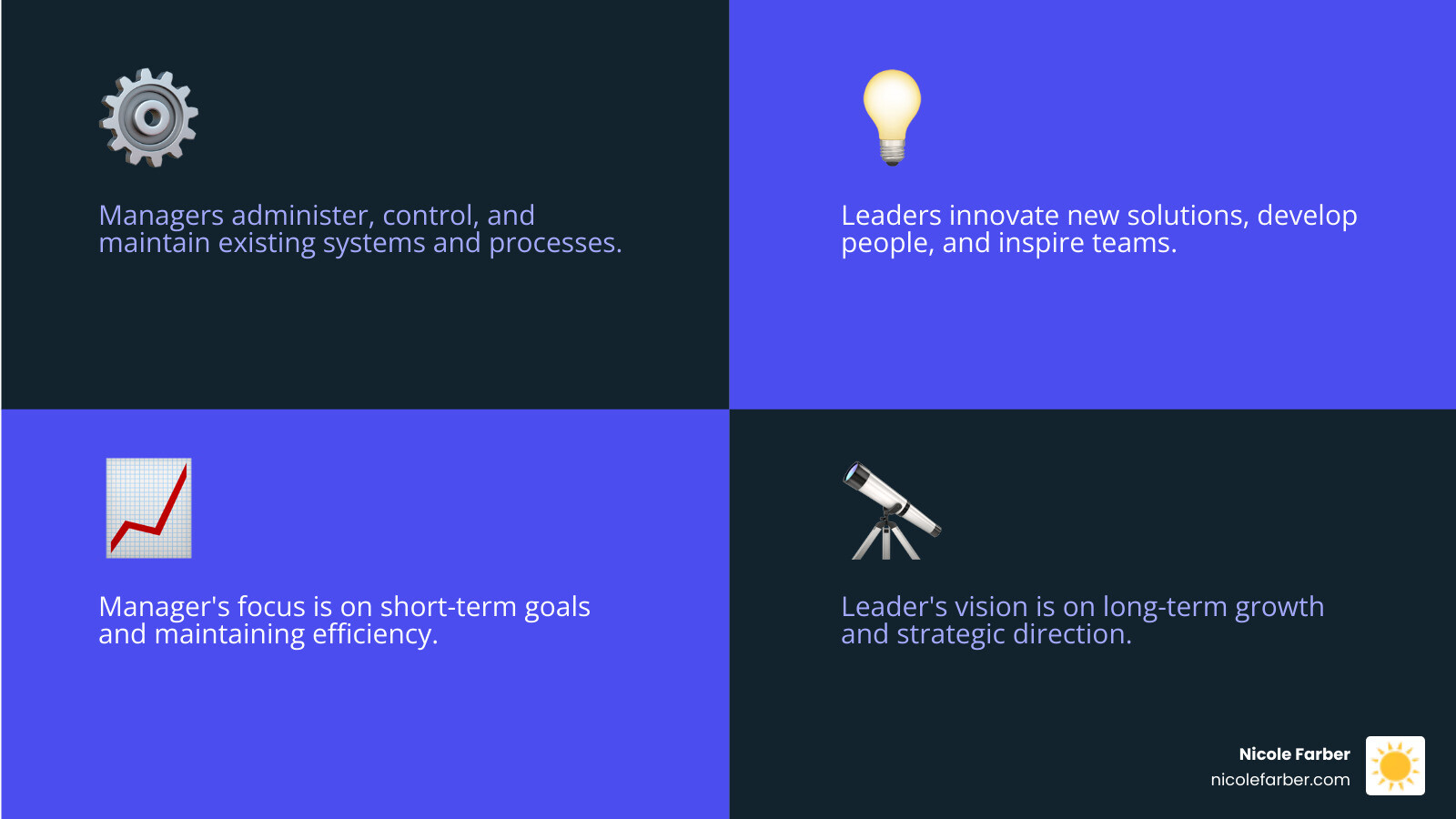
Leadership isn’t just a title; it’s a mindset that transforms how you approach challenges and inspire others. Whether you’re building a law practice in Philadelphia or managing a team in Wilkes-Barre, understanding the difference between a leader and a manager can revolutionize your career.
Effective leaders deliver measurable results. They build environments where people want to work, and engaged teams deliver 21% greater profitability than their disengaged counterparts. So what separates a leader from a manager?
| Trait | Manager | Leader |
|---|---|---|
| Focus | Administers, maintains, controls | Innovates, develops, inspires |
| View | Short-term, tasks, efficiency | Long-term, vision, effectiveness |
| Approach | Relies on authority, process-driven | Relies on trust, people-driven |
| Goal | Stability, problem-solving | Growth, opportunity-seeking |
| Impact | Directs work, ensures compliance | Shapes culture, empowers individuals |
Think of it this way: managers keep the train running on time, while leaders decide where the train should go. This distinction is critical in today’s rapidly changing world. Organizations need people who can develop your leadership vision and guide teams through uncertainty. Leaders provide clarity of purpose, helping team members understand not just what they’re doing, but why it matters. For a comprehensive look, explore our Business Leadership Ultimate Guide.
The Essential Skillset of an Effective Leader
To develop your leadership effectiveness, focus on these core competencies:
Communication is the foundation. Great leaders connect, articulate a clear vision, give constructive feedback, and create space for others to share their thoughts.
Strategic thinking means seeing the bigger picture. It’s about understanding how industry changes affect your team and clients, whether in New Orleans or Luzerne County.
Decisiveness creates momentum. Timely decisions can reduce team stress by 40% and accelerate project completion by 30%. Your team needs to see confidence, especially in uncertain times.
Delegation is about empowering people based on their strengths. It builds trust and helps team members grow. If you hired well, you know where people’s talents shine.
Problem-solving skills help turn conflicts into growth opportunities. The best leaders find innovative solutions rather than just putting out fires.
Empathy is a leadership superpower. Emotionally intelligent leaders improve team behavior and business results because people feel understood and valued.
Flexibility keeps you relevant. Adapting to new client needs or supporting work-life balance shows you care about people, not just processes.
These skills create leaders people want to follow. For practical strategies, check out our Good Leader Workplace Guide.
Why Honesty and Integrity are Non-Negotiable
Authentic leadership cannot be faked. Honesty and integrity are the bedrock of everything you build.
When you lead with integrity, you build trust with every decision. Your team watches to see if your actions match your words. This consistency creates psychological safety, where people feel comfortable taking risks and sharing ideas.
Fostering a positive culture happens naturally when integrity guides you. People mirror the behavior they see in leadership. Ethical decision-making, transparency, and accountability become organizational values.
Leading by example means your team learns more from what you do than what you say. Every choice either builds or erodes trust.
The business impact is undeniable. Organizations with strong ethical foundations attract top talent and build better client relationships. In competitive markets like Philadelphia’s legal sector, your reputation for integrity is a significant advantage.
Transparency doesn’t mean sharing every detail, but it does mean being honest about challenges and the “why” behind your choices. Without integrity, everything else falls apart. You might get short-term wins, but you’ll never build lasting success. To explore building strong ethical foundations, dive into our leadership resources.
Mastering the Inner Game: The Power of Self-Awareness and Emotional Intelligence
The most effective leaders, from law firms in Philadelphia to startups in New Orleans, know themselves deeply. To truly develop your leadership abilities, you must master the “inner game” by turning inward.

Self-awareness is the foundation of great leadership. Understanding your emotions, triggers, and motivations allows you to manage your reactions instead of being controlled by them. This transforms how you connect with others and steer challenges.
The research is powerful: employees with emotionally intelligent managers are 4x less likely to leave their jobs. This isn’t a soft skill; it has a hard impact on your bottom line through lower turnover and better decision-making. Emotional intelligence helps you read a tense meeting, notice when a team member in Wilkes-Barre is overwhelmed, and stay calm when things go wrong.
For more guidance on building these capabilities, see How to Become an Effective Leader.
The Role of Empathy in Modern Leadership
As a single mother building a business, I learned that empathy isn’t weakness—it’s a secret weapon. Understanding what your team members are experiencing open ups their potential in ways commands never could.
Empathy in leadership means understanding team perspectives, improving morale, and reducing conflict. It also helps you connect with clients on a deeper level. Whether serving professionals in Luzerne County or expanding to Antigua Guatemala, understanding their unique pressures makes you invaluable. Leaders who take time to understand their clients and employees don’t just manage—they inspire loyalty and exceptional performance.
Practical Steps for Cultivating Self-Awareness
Self-awareness can be accelerated with intentional practice. Here are methods that have proven effective:
Journaling is a private coaching session. Spend ten minutes daily writing about your reactions and decisions to reveal crucial insights about your leadership style.
Seeking feedback requires courage but is transformative. Ask your team, peers, and clients for honest input to uncover blind spots and areas for growth.
Self-assessment tools provide structured insights into your personality, communication style, and emotional intelligence, offering a practical roadmap for improvement.
Mindfulness practices, even just five minutes of quiet reflection, help you observe your thoughts without being overwhelmed. This creates the space between trigger and reaction where great leadership happens.
Understanding your triggers and strengths helps you play to your strengths while managing growth areas. Know what energizes you and what challenges you.
The goal is progress, not perfection. Every step toward greater self-awareness makes you a more effective and authentic leader. For more strategies, explore our guide on Overcoming Business Challenges.
Your Action Plan: How to Actively Develop Your Leadership
Ready to develop your leadership skills but unsure where to start? You’re not alone. Nearly 60% of new managers receive no formal leadership training. The good news is that leadership development can be intentional and manageable.

The journey to develop your leadership is a marathon, not a sprint. It requires intentional effort and a commitment to growth. Common problems like fear of failure and lack of time can be overcome. With 44% of workers’ skills expected to be disrupted in the next five years, investing in your leadership is essential, not optional. Adopting a growth mindset—shifting from “I know this” to “I’m learning this”—opens up new possibilities.
Find a Mentor and Be a Mentor
Mentorship is a powerful accelerator for leadership development. A good mentor offers more than advice; they share experiences, reveal blind spots, and open doors to new opportunities. Whether you’re in Philadelphia’s competitive legal market or New Orleans’ unique business landscape, local mentorship provides invaluable insights.
In communities like Luzerne County and Wilkes-Barre, strong professional networks offer chances to connect with seasoned leaders. Be proactive—reach out and show genuine interest in learning.
Equally important is becoming a mentor yourself. Guiding someone else forces you to articulate your knowledge and reflect on your experiences. It also builds your reputation as a leader who invests in others’ success.
How to Develop Your Leadership Through Continuous Learning
Leadership thrives on curiosity. The business world changes fast, and staying relevant requires continuous learning.
- Read books to gain decades of experience distilled into actionable insights.
- Attend workshops and seminars for interactive practice and peer learning.
- Take online courses for flexible, self-paced learning and professional certifications.
- Seek stretch assignments by volunteering for challenging projects. These real-world experiences teach lessons no classroom can replicate.
The goal is to become better than you were yesterday. Every new skill adds to your leadership toolkit.
Seek and Implement Constructive Feedback
We all have blind spots. Constructive feedback is the mirror that shows us what we can’t see on our own.
Creating a feedback loop means actively asking for input from your team, peers, and clients, not just waiting for annual reviews. 360-degree feedback provides a comprehensive view from supervisors, peers, and subordinates, revealing patterns and unrecognized strengths.
How you receive feedback is key. Practice active listening by putting aside defensiveness to truly hear what is being said. Don’t interrupt or justify; just listen.
Turning criticism into growth opportunities is what separates stagnant leaders from those who keep growing. View difficult feedback as free consulting—valuable information on how to become more effective. This commitment to growth shows your team you’re serious about improvement and creates a culture of safety and progress.
Inspiring Action: How to Motivate, Communicate, and Strategize Effectively
As leaders, our goal is to inspire action and drive results. This requires mastering motivation, communication, and strategic thinking—three pillars that create powerful change.

When we develop your leadership in these areas, the impact is measurable. Highly engaged teams deliver 21% greater profitability, and 70% of that engagement stems directly from leadership quality. Furthermore, 69% of employees say they’d work harder if their efforts were better recognized. Recognition costs nothing but delivers everything.
These strategies work universally, from the legal markets of Philadelphia to teams in Wilkes-Barre or remote workers in Antigua Guatemala. For frameworks that drive results, explore our Business Leadership Strategies.
Motivating Your Team for Peak Performance
True motivation isn’t about pushing people; it’s about creating an environment where they want to excel.
- Set a clear vision. Your team needs to know why their work matters. Connecting daily tasks to a larger purpose is a powerful motivator.
- Recognize achievements. Acknowledge good work in real-time, not just in annual reviews. A genuine “thank you” can transform someone’s week.
- Empower your team. Give people ownership over their work. Smart delegation shows trust and builds confidence.
- Foster a positive environment. Maintain optimism, even when things are tough. Whether in Philadelphia or New Orleans, positive energy is contagious.
People want to feel valued and part of something bigger than themselves, regardless of location.
Enhancing Your Decision-Making and Problem-Solving
Indecision undermines leadership. Your team looks to you for clarity, especially when things get complicated. These skills improve with practice.
Gathering data is the first step, but don’t get paralyzed by analysis. Set deadlines for information gathering to maintain momentum.
Weighing options systematically helps avoid emotional decision-making. Use a simple pros-and-cons list or a decision matrix for higher-stakes choices.
Making timely decisions is crucial. Decisive leaders reduce team stress by 40% and accelerate projects by 30%. A good decision now is often better than a perfect one too late.
Fostering creative solutions means creating space for new ideas. Tapping into your team’s collective intelligence often leads to the best breakthroughs.
Great decision-making isn’t about being right 100% of the time; it’s about making thoughtful choices and learning from the outcomes. As you develop your leadership in this area, your team’s trust in you will deepen. For specialized guidance, consider our Business Coaching for Lawyers.
Frequently Asked Questions about Leadership Development
At conferences from Philadelphia to New Orleans, I hear the same questions about leadership. Whether I’m working with law firms in Luzerne County or entrepreneurs in Antigua Guatemala, these concerns are universal. Here are the most common ones.
What is the single most important leadership skill?
If I had to choose one foundational skill, it would be effective communication. It’s the bridge that connects every other leadership skill to real results. You can have a brilliant vision, but without clear communication, your team won’t understand it. You might care about your employees, but if you can’t express that empathy, they won’t feel it. When you develop your leadership communication, you open up the ability to motivate, delegate, resolve conflict, and build trust.
How can I develop leadership skills without a formal title?
Leadership is about influence, not your title. You can build leadership credibility right where you are. Take initiative on difficult projects. Propose solutions instead of just complaining about problems. Mentor newer team members. I’ve seen paralegals and junior associates become informal leaders by demonstrating reliability, positivity, and a commitment to making things better. When formal leadership opportunities arise, you’ll already have a proven track record.
What are common challenges when developing leadership skills?
After fifteen years of coaching leaders from Philadelphia to Wilkes-Barre, I’ve seen the same obstacles repeatedly.
- Fear of failure is the biggest roadblock. Many avoid leadership opportunities because they’re afraid of making mistakes. But our failures often teach us more than our successes.
- Lack of self-awareness is another challenge. It’s hard to improve if you don’t understand your strengths and blind spots. This is why seeking feedback is crucial.
- Limited time for development is a common excuse. But leadership development doesn’t require huge time blocks. Fifteen minutes of daily reflection or one leadership book a month can create meaningful growth.
- Receiving constructive criticism can be difficult. Learning to welcome feedback is what separates leaders who grow from those who stagnate.
Overcoming these challenges requires a “learning mindset.” Shifting your perspective from “I should know this” to “I’m excited to learn this” turns obstacles into opportunities.
Conclusion: Your Journey to Authentic Leadership Starts Now
Leadership isn’t a destination; it’s a journey of becoming the best version of yourself. The most powerful leadership comes from authenticity.

Throughout this guide, we’ve explored the power of emotional intelligence, clear communication, and decisive problem-solving. But as a single mother who built a business, I learned that our struggles often become our greatest strengths. Late nights taught me empathy, impossible moments taught me resilience, and tough decisions taught me courage.
Your unique path—whether in Philadelphia, Wilkes-Barre, New Orleans, or even Antigua Guatemala—shapes the leader you are becoming. Every experience matters.
Faith-driven leadership has been my anchor. It taught me that leadership isn’t about having all the answers, but about having the courage to learn, the humility to seek feedback, and the heart to lift others.
70% of team engagement depends on leadership quality. That’s not pressure—it’s an opportunity to make someone’s work more meaningful every day.
Leaders are made, not born. You’ve already taken the first step by reading this. Now, put these insights into practice. Pick one area—seeking feedback, practicing empathy, or clarifying your vision—and focus on it this week.
Your leadership journey starts now. Trust the process and remember that every great leader was once exactly where you are today: ready to take the next step.
Take that next step in your growth by exploring our comprehensive leadership resources. Your team and your community are waiting for the leader you’re becoming.