The No-Nonsense Guide to Practical Leadership Skills and Examples
- Leadership
- In the News
- June 24, 2026
The No-Nonsense Guide to Practical Leadership Skills and Examples
Why Practical Leadership Examples Matter More Than Theory

Practical leadership examples show up every day — in how a manager handles a missed deadline, how a partner runs a team meeting, or how a firm owner responds when a key client walks out the door.
Here are the most common practical leadership examples you’ll find in real workplaces:
- Modeling behavior — A leader replies to emails within 24 hours, and the team follows without being told.
- Making decisions under pressure — A frontline supervisor uses a structured framework instead of guessing or escalating every problem.
- Turning around a broken culture — A new manager starts with people and trust before pushing for revenue or performance metrics.
- Balancing empathy and authority — A leader holds a difficult conversation with grace, not avoidance.
- Delegating with purpose — Assigning a stretch task to build a team member’s confidence, not just to clear a to-do list.
- Communicating vision clearly — Defining one non-negotiable priority each week so the team knows exactly what matters.
- Resolving conflict without confrontation — Using face-saving language to shift a powerful person’s position without triggering defensiveness.
- Measuring what’s working — Tracking outcomes like response times, team retention, or client satisfaction — not just effort.
Leadership is the number one skill employers look for, according to the National Association of Colleges and Employers. Yet most people learn it by accident, not design.
This guide skips the abstract advice. Every section gives you real scenarios, specific tactics, and honest examples you can use right now — whether you lead a law firm in Philadelphia, a small business in Wilkes-Barre, or a team anywhere in between.
I’m Nicole Farber, CEO of ENX2 Legal Marketing, with over 15 years of hands-on experience leading teams, turning around struggling organizations, and speaking on practical leadership examples at conferences including Merakey’s Annual Leadership Conference. I’ve lived these lessons — and this guide pulls together everything that actually works.
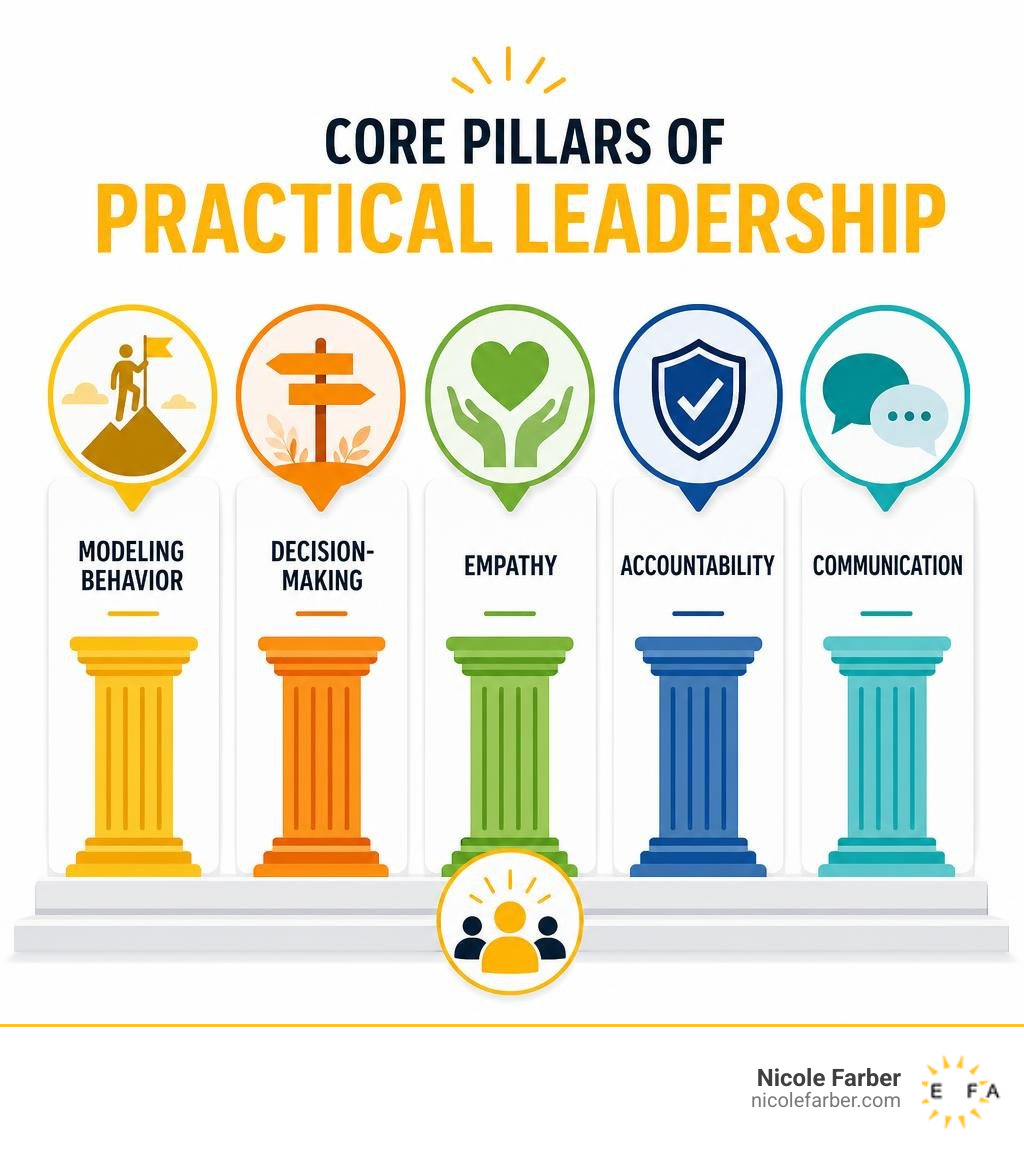
Explore more about Practical leadership examples:
Real-World Scenarios and Practical Leadership Examples

Every day, we are faced with moments that test our ability to guide others. True leadership isn’t defined by a fancy title on a door; it is defined by action. When things go wrong, do we react emotionally, or do we respond with intention?
Understanding how to navigate real-world workplace scenarios is the difference between a thriving business and a toxic, stagnant environment. High-quality leadership is the single most important factor for business success. Without it, even the most incredible products or services are dead on arrival.
To build a high-performing team, we must focus on situational leadership and behavioral modeling. This means adjusting our style based on the needs of our team members and actively showing them what success looks like. If you want to dive deeper into these foundational habits, check out our comprehensive guide on How to Be a Good Leader.
How Quiet Modeling Provides Practical Leadership Examples
Many of us assume that leading requires standing on a soapbox, delivering fiery speeches, or hosting massive town halls. But the truth is, quiet modeling is often the most sustainable way to drive change without burning yourself or your team out.
Consider this real-world experiment: A leadership team struggled with incredibly slow response times. For six weeks, they discussed the issue in meetings, but nothing changed. Instead of calling another long, exhausting meeting or hiring an expensive consultant, the leader decided to try a quiet, seven-day modeling method.
The leader committed to a simple, tiny habit: replying to every internal email within 24 hours. They didn’t make a grand announcement. They simply did the work. Within three days, three team members naturally matched the behavior without being prompted. By the end of the week, the average reply time across the entire team dropped from three days to under 24 hours.
This works because human behavior spreads through observation and social proof, not mandates. When we quietly model the changes we want to see, we create a safe environment where team habits shift naturally. It is a highly effective approach, especially for introverted leaders who prefer action over showmanship. You can read more about this specific seven-day approach in Steven Claes’s insightful piece, Leading by Example Fixed My Team’s Problem in 7 Days | Steven Claes – The A+ Introvert .
By focusing on these subtle, daily actions, we establish what it truly means to practice Being a Good Leader in the Workplace.
Practical Leadership Examples in High-Pressure Decision Making
When a crisis hits on the business floor, we often see frontline supervisors freeze or immediately run to senior management asking, “What do you want me to do?” This is the “Micromanagement Doom Loop.” It happens because supervisors are rarely trained in how to make decisions under pressure, so they default to transferring accountability upward.
To break this loop, successful organizations teach frontline leaders structured decision-making frameworks. When we provide our team with a clear process, we bypass common cognitive biases like the framing trap (getting stuck on how a problem is presented) or anchoring bias (relying too heavily on the first piece of information we hear).
One highly effective framework is the four-line recommendation structure:
- Frame: Clearly state the problem.
- Alternatives: Identify at least two realistic paths forward.
- Drivers: Highlight the key factors (cost, speed, quality) influencing the decision.
- Recommendation: State the chosen path and why.
The next time a team member comes to you with a problem, stop accepting open-ended questions. Instead, hand them this four-line structure and give them 20 minutes to prepare a recommendation. Coach their thinking process rather than simply grading their final answer. Over time, this builds their confidence and frees you from the trap of micromanagement.
For a deeper dive into training your team to handle intense situations, explore the strategies in How to Develop Frontline Leaders Who Make Better Decisions Under Pressure and use our Become Good Leader Team Guide to build a more autonomous team.
Core Strategies for Daily Operations and Team Trust

A healthy daily operation relies on trust, and trust is built through consistent, reliable habits. If our team doesn’t trust us to keep our word, they won’t feel safe enough to take risks or innovate. Building this trust requires us to master active listening, practice radical accountability, and learn how to transition our teams From Good to Great: How to Lead Your Team to Peak Performance.
Balancing Empathy and Authority in Diverse Teams
Managing a diverse team with different backgrounds, work styles, and personalities requires us to find the sweet spot between empathy and authority. This is where mindful leadership becomes essential. Mindful leaders plan and respond rather than react emotionally when things go sideways.
Most workplace stress does not come from malice; it comes from a disconnect of expectations. To bridge this gap, we must practice intentional communication. For example, in our local business communities across Philadelphia, leaders who participate in structured regional programs learn how to balance their business drive with community-minded empathy. If you want to develop these skills locally, programs like the LEADERSHIP Philadelphia Core Program offer incredible resources for aligning your leadership style with community impact.
When a team member falls short, a mindful leader doesn’t yell or threaten. Instead, they schedule a private, one-on-one meeting, listen to the employee’s perspective, and establish a joint accountability plan. This keeps standards high while ensuring the employee feels supported. For practical daily steps on maintaining this balance, refer to our Good Leader Workplace Guide.
Designing Your Time: The One-Priority Rule
As leaders, we often fall into the trap of thinking that working harder and longer is the solution to every problem. But when we over-schedule ourselves, we become the ultimate bottleneck for our teams. Systems need slack to function. If 100% of your calendar is booked, you have zero time to handle unexpected crises or support your team when they need guidance.
To protect your deep work and prevent burnout, we recommend implementing the One Priority Rule:
- Monday Morning Design: Before you open Slack, email, or any other communication tools, sit down with a blank piece of paper.
- Select One Priority: Identify the single most important outcome you must achieve this week. This outcome should directly map to business growth, profitability, or customer satisfaction.
- Block Deep Work: Dedicate a solid block of time (ideally 8 hours across the week) exclusively to this priority.
- Timebox the Rest: Leave 15 to 20 hours of unplanned “slack time” in your weekly calendar to handle reactive issues, meetings, and team check-ins.
At the end of the week, conduct a quick self-assessment. Did you protect your focus? Did you prioritize outcomes over raw hours worked? To see a fascinating example of this time-design philosophy in action, read about how a modern leader manages a massive, multi-team organization on a strict four-day schedule in Leader’s Week 2026: How I Lead a 50+ Person Org on a 4-Day Workweek . To help refine your own schedule, check out our curated Business Leadership Strategies.
Overcoming Dysfunction and Navigating Powerful Personalities
Every leader eventually inherits a dysfunctional team or has to deal with a highly opinionated, powerful decision-maker. How we handle these delicate situations determines the long-term health of our business culture.
| Reactive Leadership (The Trap) | Proactive Practical Leadership (The Solution) |
|---|---|
| Reacts emotionally to mistakes and assigns blame. | Responds with curiosity, focusing on process improvement. |
| Overcomplicates problems with endless meetings. | Applies simple, practical next steps to keep things moving. |
| Demands respect through power and authority. | Earns trust through quiet modeling and active listening. |
| Prioritizes short-term revenue over relationships. | Focuses on building trust and clear systems first. |
To master these complex dynamics, explore our Business Leadership Complete Guide.
Turning Around Broken Team Cultures
When you step into a team where systems are broken and accountability is non-existent, the resistance to change can be intense. People who have benefited from a lack of structure will often resist new boundaries, sometimes making you feel like the “villain” for simply doing your job.
In these moments, we must remember to prioritize people before process, and process before performance. You cannot build a high-performing culture on a foundation of broken trust.
A fantastic practical example of this comes from a turnaround situation at a local market. The incoming manager inherited a highly dysfunctional team where an assistant manager regularly showed up hours late while writing schedules for everyone else. Instead of hiding behind a desk, the manager got out on the floor, worked alongside the team, and implemented a clear, transparent scheduling system.
When the late behavior continued, the manager had direct, grace-filled conversations, but ultimately had to make the difficult decision to let the toxic employee go. Although there was short-term pushback, the culture quickly healed. Eventually, former employees who had left due to the old dysfunction actually returned to the business because they saw the new, healthy environment.
For those of us leading in the Wilkes-Barre and broader Luzerne County area, building these leadership skills is highly accessible. You can find excellent local growth programs through resources like the Leadership Opportunities – Penn State Wilkes-Barre . For a deeply personal reflection on turning around a broken workplace culture, read Leah McCracken’s beautiful piece, The Whiteboard Above My Desk – Leah McCracken .
Persuading Decision-Makers Without Direct Confrontation
Sometimes, the challenge isn’t our direct reports, but persuading a powerful, stubborn client or senior executive who has made a poor decision. Telling an authoritarian leader they are wrong is usually operationally useless, even if it feels morally satisfying. It triggers defensiveness and shuts down communication.
Instead, we must master the art of executive persuasion by providing “face-saving off-ramps.”
A classic example of this comes from a seasoned bureaucrat who needed to convince a powerful government official to reinstate a wrongly suspended colleague. Instead of confronting the official or arguing about who was right, the leader used passive, non-blaming language. They explained that “a mistake had occurred in the paperwork processing,” allowing the official to reverse the decision in less than a minute without having to admit they were wrong.
To apply this in your daily operations:
- Map Moods: Pay attention to the decision-maker’s daily habits. Raise sensitive topics when they are relaxed, not when they are rushed.
- Use Passive Language: Frame issues around process errors (“a misalignment happened”) rather than personal failures (“you made a mistake”).
- Offer an Off-Ramp: Provide a solution that allows them to change their mind while keeping their dignity fully intact.
To study this brilliant communication technique in detail, read the full analysis in Anil Swarup On How He Reinstated A DM In Half A Minute By Refusing To Tell A Chief Minister She Was Wrong .
Frequently Asked Questions about Practical Leadership
Developing practical leadership skills is a lifelong journey. Here are some of the most common questions we receive from emerging leaders looking to build their soft skills and expand their impact. If you are looking for a complete overview of what these skills mean for your career, check out our guide on What is Leadership.
How do you demonstrate leadership without a formal title?
You do not need a manager, director, or supervisor title to show what you’re made of. In fact, some of the best practical leadership examples come from team members who step up in everyday moments.
If you are looking to showcase your skills for a future promotion, try these actionable steps:
- Volunteer for Projects: Take the initiative to coordinate a community service project or lead a volunteer committee.
- Improve a Process: Identify a bottleneck in your daily workflow and present a clear, structured recommendation to fix it.
- Train and Mentor: Offer to onboard a new team member or help a colleague master a tool you know inside and out.
- Be the Go-To Expert: Deepen your knowledge in a specific area so your team naturally turns to you for guidance.
Whether you are working in a bustling creative agency in New Orleans or a tech startup, these actions build your reputation and show senior management that you are already operating at a higher level. Learn more about how to highlight these moments in your career with our guide on How to Be a Good Leader at Work.
What is the “rubber band trick” in mindful leadership?
The “rubber band trick” is a simple cognitive-behavioral technique designed to help driven, high-stress leaders manage their emotional reactions.
Here is how it works:
- Wear a Band: Place a simple rubber wristband on your wrist.
- Catch the Thought: The moment you notice yourself having a toxic, angry, or highly negative thought about a team member or situation, gently snap the band.
- Interrupt and Redirect: The physical sensation acts as an immediate pattern interrupter. Say to yourself (or quietly out loud), “Cancel that thought,” and consciously choose a calmer, more constructive response.
This exercise helps shift us from unconscious, reactive leaders into conscious, mindful leaders who choose their words and actions with intention.
How can leaders measure the impact of their approach?
We cannot manage what we do not measure. To know if your practical leadership style is working, you must look beyond raw financial metrics and track behavioral indicators:
- Response Times: Are team communication delays shrinking?
- Retention Rates: Are your top performers staying with the business?
- Accountability Shifts: Are supervisors bringing you recommendations instead of just questions?
- Feedback Loops: Do team members feel safe enough to share honest feedback and admit mistakes?
For those looking to expand their perspective globally, stepping out of your comfort zone can provide invaluable feedback on your leadership growth. Programs like the Guatemala Leadership & Language Exchange Program offer leaders a unique opportunity to test their adaptability, cross-cultural communication, and empathy in Antigua Guatemala, proving that true leadership transcends languages and borders.
Conclusion
Practical leadership isn’t about memorizing management textbooks; it’s about showing up for your team with clarity, empathy, and consistent action every single day. Whether you are quietly modeling a new habit, guiding a supervisor through a high-pressure decision, or navigating a complex cultural turnaround, your daily choices set the tone for your entire organization.
As a single mother, business owner, and motivational speaker, I have built my career on these exact principles of faith, resilience, and real-world experience. If you are ready to take your team to the next level and build a culture of true accountability, we are here to walk that path with you.
Explore more resources, speaking opportunities, and expert guidance at the Nicole Farber Leadership Hub. Let’s lead with purpose, together.