Beginner’s Guide to Leading Your Team
- Leadership
- Word of the Day
- April 17, 2026
Beginner’s Guide to Leading Your Team
Why Effective Team Leadership Matters More Than Ever

How to lead the team starts with understanding that leadership is fundamentally different from management. Great leaders focus on vision, empowerment, and building psychological safety, while managers execute processes and maintain order. To lead effectively:
- Develop emotional intelligence – Build self-awareness, empathy, and strong social skills
- Communicate consistently – Make expectations clear and maintain open dialogue
- Foster psychological safety – Create an environment where team members feel safe taking risks
- Lead by example – Model the behavior you expect from your team
- Delegate strategically – Empower team members by playing to their strengths
- Make decisive decisions – Don’t procrastinate on tough calls
- Set collaborative goals – Ensure team buy-in and alignment on success metrics
- Recognize and reward – Celebrate wins and address poor performance constructively
Research shows that people skills account for 80 percent of success in leadership roles. Yet many leaders are promoted based on technical capabilities rather than their ability to manage and motivate others. This creates a real challenge for law firm partners in Philadelphia, Wilkes-Barre, and beyond who must balance casework with team development.
The impact of strong leadership is undeniable. Leaders at every level influence employee productivity and engagement, client satisfaction and loyalty, innovation, and financial performance. Organizations with strong leadership talent act more decisively, steer complexity with greater efficiency, and anticipate business challenges with ease.
Here’s the truth: effective leadership isn’t about glorious crowning acts. It’s about keeping your team focused on a goal and motivated to do their best to achieve it, especially when stakes are high. It’s about laying the groundwork for others’ success, then standing back and letting them shine.
As Nicole Farber, CEO of ENX2 Legal Marketing with over 15 years of experience turning around law firms, I’ve seen how to lead the team effectively through change and growth. My approach combines strategic vision with genuine care for the people doing the work, which has helped countless firms transform their culture and results.
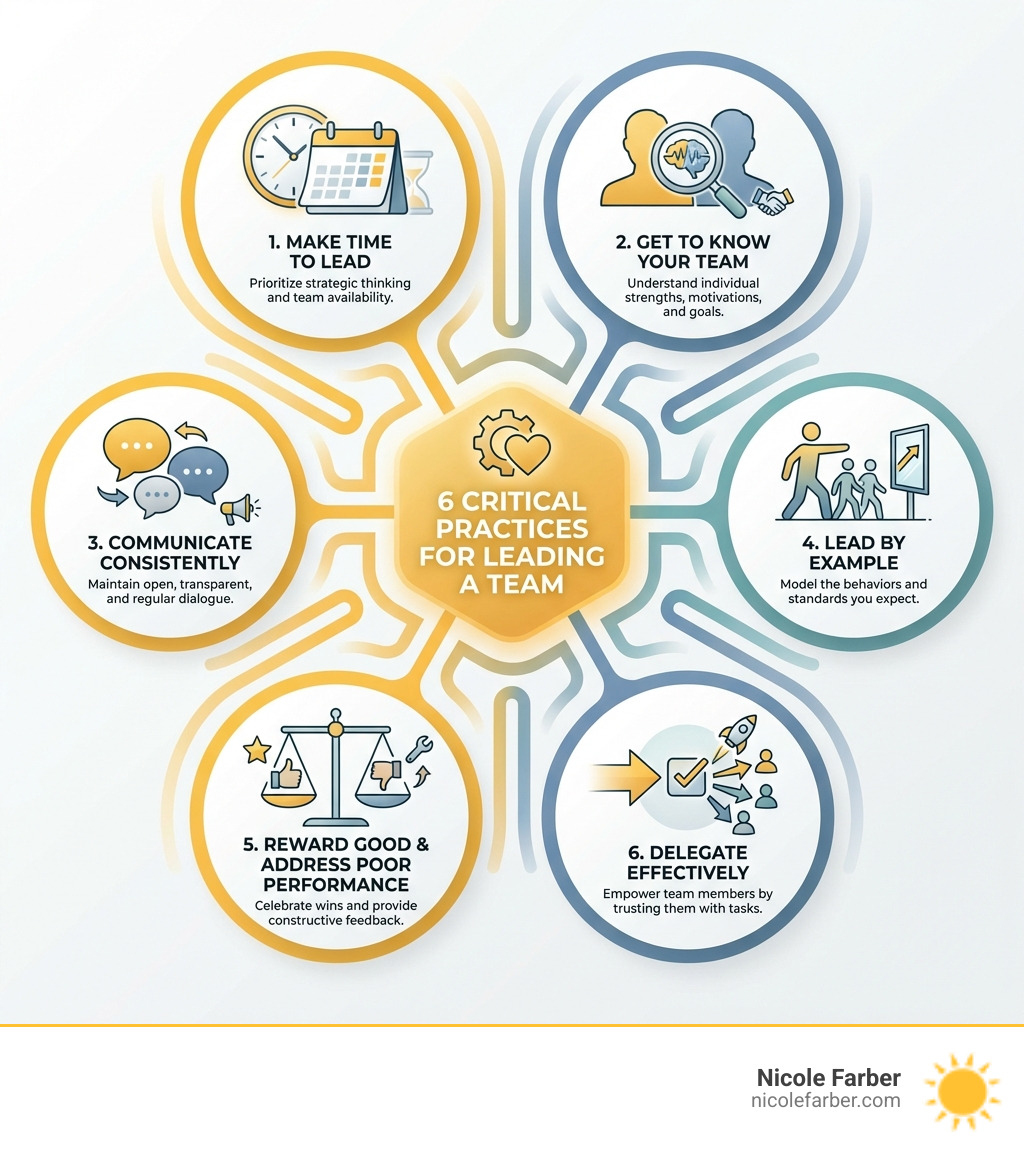
The Fundamental Shift: Leadership vs. Management
One of the most common problems we see for new leaders in places like Philadelphia or New Orleans is the confusion between being a “boss” and being a “leader.” While the terms are often used interchangeably, they represent two very different functions within an organization.
Management is about the “how” and the “now.” It focuses on tactical processes, maintaining order, and ensuring that articulated goals are executed through specific systems. Managers administer, maintain, and focus on structure.
Leadership, however, is about the “why” and the “future.” It is centered on a vision to guide change. Leaders innovate, develop, and focus on people. As scholar Warren Bennis famously put it, the manager has his eye on the bottom line; the leader has his eye on the horizon.
| Feature | Management | Leadership |
|---|---|---|
| Focus | Systems and structure | People and relationships |
| Objective | Execution and consistency | Vision and change |
| Approach | Tactical and process-driven | Strategic and inspirational |
| Goal | Maintains the status quo | Challenges the status quo |
Understanding this distinction is vital. You can be a manager by title, but you become a leader through action. In our experience, the best managers are those who also accept leadership qualities, moving beyond simply organizing people to truly aligning teams toward a shared purpose. When we learn what it means to be a great team leader, we realize it’s less about giving orders and more about what is leadership?—the act of influencing others to achieve a common goal.
Core Characteristics of an Effective Leader
If you want to master how to lead the team, you must look inward before looking outward. We often find that the most successful leaders share three core characteristics, regardless of their specific personality type or industry.

1. Emotional Intelligence (EQ)
Research shows that 90 percent of top performers are high in emotional intelligence. Emotional intelligence is the ability to understand and manage your own emotions while recognizing and influencing the emotions of others. It consists of four core competencies:
- Self-Awareness: Recognizing your triggers and blind spots.
- Self-Management: Controlling radical outbursts or impulsive decisions.
- Social Awareness: Having empathy for what your team is going through.
- Relationship Management: Using your awareness to communicate effectively and handle conflict.
2. Analytical Skills
A strong leader isn’t just a “people person”; they are also analytical. They can take stock of a complex situation—whether it’s a difficult case in Luzerne County or a marketing shift in Antigua Guatemala—consider the possible outcomes, and chart the course most likely to succeed.
3. Empathy
Empathy has been ranked as the top leadership skill needed today. According to DDI’s research, leaders who excel at listening and responding with empathy perform more than 40 percent higher in coaching, planning, and decision-making. It’s about asking, “Is everything okay?” and truly listening to the answer before jumping into “fix-it” mode.
To dive deeper into these traits, we recommend exploring the seven traits of an emotionally intelligent leader and our comprehensive guide on how to become an effective leader.
8 Essential Steps for How to Lead the Team
Transitioning into a leadership role—especially if you are now managing former peers—is one of the hardest moves you will ever make. To help you steer this, we’ve outlined eight actionable steps to establish your footing.
1. Make Time to Lead
The biggest mistake new leaders make is adding “leadership” to an already overflowing task list without re-negotiating their workload. If you are too tied up in hands-on tasks, you won’t be visible or available to support your team. You must carve out intentional time to lead.
2. Get to Know Your Team
You cannot lead people you don’t know. Schedule one-on-one meetings to understand their roles, strengths, and career aspirations. A great tool we recommend is the “User Manual”—asking each team member to write a short guide on how they prefer to work, communicate, and receive feedback.
3. Building Psychological Safety for How to Lead the Team
Psychological safety is the shared belief that the team is safe for interpersonal risk-taking. In Wilkes-Barre and beyond, teams with high psychological safety communicate more effectively and make better decisions because they aren’t afraid of being punished for a mistake.
To foster this, we encourage you to:
- Admit when you don’t have all the answers.
- Frame mistakes as learning opportunities.
- Solicit input from every team member, especially the quiet ones.
You can use our interactive team dynamics self-assessment to see where your team currently stands.
4. Effective Communication for How to Lead the Team
In our modern era of remote and hybrid work—stretching from our offices in New Orleans to our partners in Antigua Guatemala—communication is the lifeblood of the team. Poor communication leads to project delays, low morale, and lost sales.
The key is to “over-communicate to connect.” This doesn’t mean micromanaging; it means being clear about expectations and goals. We suggest holding brief 10-15 minute check-ins once or twice a week and maintaining “office hours” where your team knows they can reach you without an appointment. For more tips, check out how to over-communicate to connect and our good leader workplace guide.
5. Lead by Example
If you expect your team to be punctual, transparent, and hard-working, you must exhibit those traits yourself. If you “fake it,” you will eventually be unmasked, losing the trust and credibility you’ve worked so hard to build.
6. Empowering Others Through Delegation and Growth
Delegation is not just about offloading work; it’s about empowering your team. When you delegate, assign responsibility for results rather than a “to-do” list. This fosters independence and allows your team members to shine.
7. Be Decisive
Procrastination is the enemy of leadership. It is all too easy to defer difficult decisions, but ultimately, it’s costly for the job and your reputation. Gather the necessary information, consult your team, and then “grab the nettle” and make the call.
8. Enjoy the Journey!
Leadership is a privilege. It’s about helping others grow and seeing a collective vision come to life. If you enjoy the process, your team will feel that passion and be more likely to follow your lead. For more on this mindset, see our become a good leader team guide.
Managing Performance and Fostering Culture
A leader’s job is to cultivate an environment where people can thrive. This involves a delicate balance of rewarding the good and constructively addressing the bad.
Rewarding Success
Don’t wait for annual reviews to show appreciation. Sincere, timely recognition—whether it’s a shout-out in a meeting or a team lunch in Luzerne County—builds a culture of gratitude. Statistics show that employees who feel their ideas and suggestions matter have an 83 percent more positive work experience.
Addressing Poor Performance
Tackle performance issues promptly. Delaying these conversations only allows resentment to build within the rest of the team. Remember to:
- Hold challenging conversations in private.
- Focus on observations rather than personal impressions.
- Look for the root cause (is it a lack of skill, or is something going on at home?).
- Create a clear action plan for improvement.
Being a “nice” leader doesn’t mean avoiding conflict. In fact, avoiding tough decisions hamstrings your ability to be a good leader. True being a good leader in the workplace means having the courage to hold people accountable because you care about their growth and the team’s success.
Strategic Decision-Making and Goal Alignment
Effective leadership requires keeping your eye on the big picture while managing day-to-day tasks. This is especially true when leading highly interdependent teams where one person’s output is another person’s input.
Creating Collaborative Goals
Goals shouldn’t be handed down from on high; they should be built with the team. When team members are involved in setting Key Performance Indicators (KPIs) or Objectives and Key Results (OKRs), they have much higher buy-in. Research shows that collaborative goal-setting can improve performance by up to 10 percent.
The Role of External Expertise
Sometimes, to get to the next level, you need an outside perspective. Whether it’s a team development consultant or a specialized coach, bringing in expertise can help you synthesize team feedback and create a more robust action plan. In the legal world, we often see firms in Philadelphia and Wilkes-Barre benefit from business leadership strategies that help them refine their intake processes and brand vision.
Frequently Asked Questions about How to Lead the Team
How can new leaders make time for leadership tasks?
The most effective way is to perform a “workload audit.” Identify tasks that only you can do and tasks that can be delegated to develop others. Re-negotiate your responsibilities with your own supervisors to ensure that “leading” is recognized as a core part of your job, not an “extra” to be done after hours.
What is the best way to handle poor performance?
Address it immediately and privately. Use the “SBI” model: describe the Situation, the specific Behavior, and the Impact it had on the team or project. Then, shift to a coaching mindset by asking how you can support them in improving.
Why is empathy considered a top leadership skill?
Because empathy builds trust, and trust is the currency of leadership. When employees feel understood, they are 55 percent more engaged and 110 percent more likely to stay with the organization. Empathy allows you to steer the “storming” stages of team development with grace and keep the team focused on the goal.
Conclusion
Mastering how to lead the team is a continuous journey, not a destination. It requires a commitment to self-development, a willingness to be vulnerable, and a deep-seated belief in the potential of your people.
At the heart of my own leadership philosophy—shaped by my journey as a single mother and a business leader in the legal marketing space—is the concept of faith-driven leadership. It’s about leading with purpose, compassion, and the resilience to turn failures into lessons. Whether you are leading a small law firm in Luzerne County or a growing team in Antigua Guatemala, the principles remain the same: empower others, communicate with heart, and always keep your eye on the big picture.
Ready to take the next step in your leadership journey? Explore our category on leadership for more resources, guides, and inspiration to help you and your team thrive.