From Good to Great: How to Lead Your Team to Peak Performance
- Leadership
- In the News
- February 23, 2026
Why Effective Team Leadership Matters More Than Ever

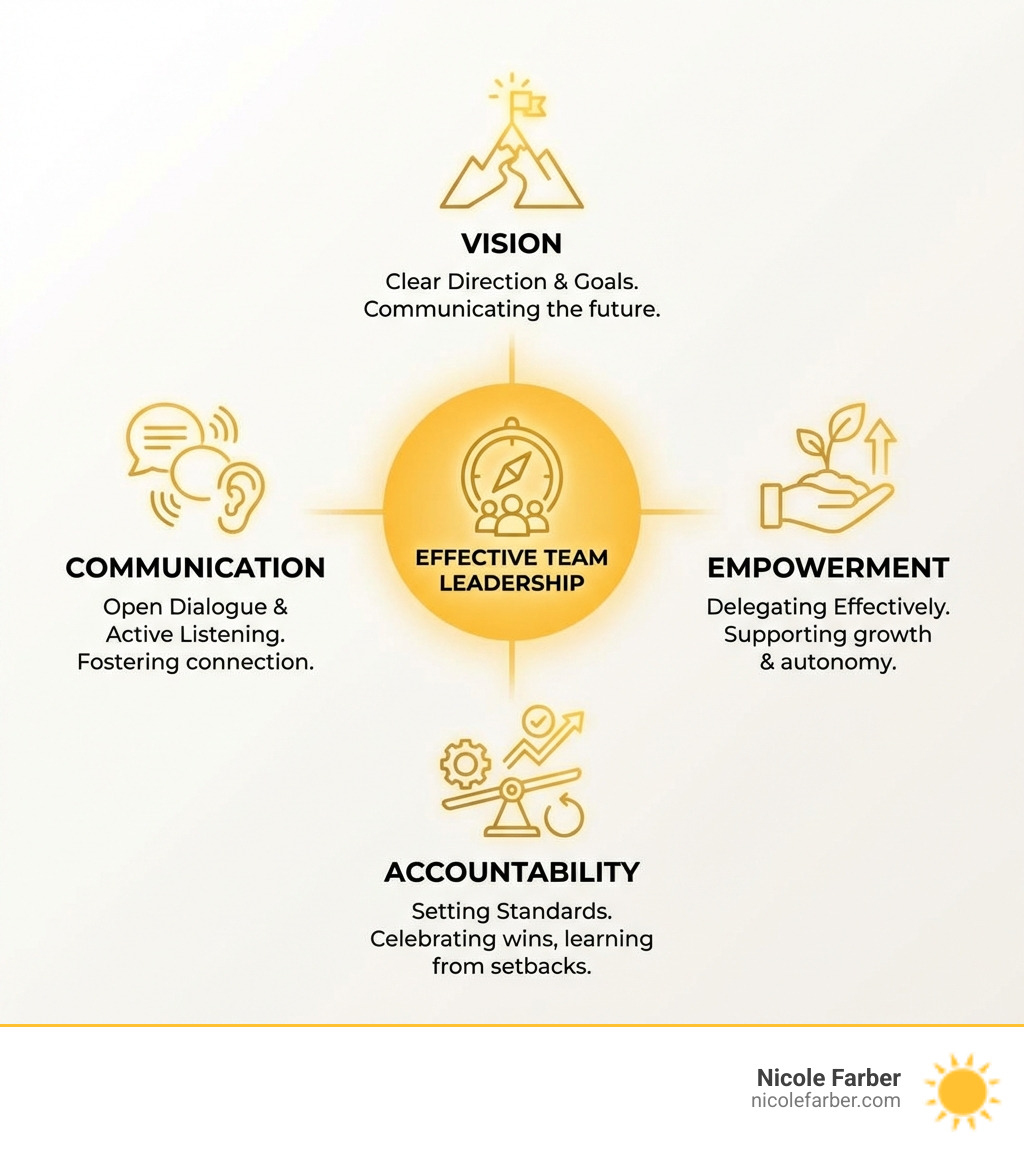
How to lead the team effectively is the defining challenge for partners and business owners who want to transform their practices from good to great. Effective leadership means fostering open communication, building trust, empowering your team to solve problems, setting a clear vision, and supporting professional growth while leading by example. When you master these core competencies, you open up peak performance in your team and create sustainable business growth.
According to Google’s extensive research, teams with highly effective managers are more likely to achieve better results, be happier, and experience lower turnover. The data is even more striking when you look at revenue: sales teams that worked together effectively exceeded their targets by an average of 17%, while teams that didn’t fell short by up to 19%. That’s a 36% swing in performance—all driven by how well leaders guide their teams.
But here’s the reality most leaders face: you know what good leadership looks like, yet you struggle to make it stick. The problem isn’t knowledge. It’s execution. As Chris Hadfield, who commanded the International Space Station, put it: “Leadership is not about glorious crowning acts. It’s about keeping your team focused on a goal and motivated to do their best to achieve it, especially when the stakes are high and the consequences really matter.”
Great leadership is about building up the people around you, trusting them, and empowering them to contribute their expertise so the team becomes more than the sum of its parts. It’s about creating an environment where innovation thrives, where psychological safety allows team members to take risks, and where everyone feels valued and heard. Whether you’re leading a law firm in Philadelphia, managing a practice in Wilkes-Barre, or building a team across multiple locations, the principles remain the same.
I’m Nicole Farber, CEO of ENX2 Legal Marketing, and over my 15+ years of experience turning around law firms and businesses, I’ve seen how to lead the team effectively by starting with self-leadership and fostering environments where teams thrive. Most recently, I spoke at Merakey’s Annual Leadership Conference on “Leading from Within: The Role of Self-Leadership Through Change,” because I believe exceptional leadership starts with understanding yourself before you can truly empower others.
The Foundation: Mastering Your Leadership Mindset

Before we can effectively lead others, we must first lead ourselves. This means cultivating a strong leadership mindset rooted in self-awareness, emotional intelligence, integrity, and the willingness to set the standard for our team. The fundamental characteristics of an effective leader aren’t just about authority; they’re about influence, inspiration, and building up the people around you. As the saying goes, great leaders aren’t born, they’re built—through continuous practice and self-development.
Develop Unshakeable Self-Awareness and Emotional Intelligence
To truly master how to lead the team effectively, we must begin with ourselves. This involves a deep dive into self-awareness, understanding our own strengths, limitations, and personal leadership style. It’s about being comfortable discussing these aspects, recognizing that seeking constructive criticism isn’t a weakness but a crucial step in our development. Leaders who are self-aware actively seek feedback and are open to learning and evolving.
Hand-in-hand with self-awareness is emotional intelligence (EQ). This isn’t just a buzzword; it’s a crucial skill for anyone who works with others, especially leaders. Emotional intelligence allows us to understand and adjust to the emotions of our team members, manage our own strong emotional responses, and guide our teams toward positive outcomes. It involves recognizing our own feelings and how they impact our decisions, as well as empathetically understanding the perspectives of others. For a leader in a busy city like Philadelphia or a tight-knit community like Wilkes-Barre, understanding the emotional landscape of our team can make all the difference in navigating daily challenges and fostering a harmonious environment.
Lead by Example: Be the Standard You Want to See
One of the most powerful ways to influence our team is by setting a good example. Our actions, more than our words, shape the habits and attitudes of our team members. This means exhibiting the professionalism, dedication, and work ethic we expect from them. If we want a team that communicates openly, we must be open communicators. If we want a team that takes responsibility, we must own our mistakes.
Admitting when we’ve made an error or are feeling pressure doesn’t diminish our authority; it builds trust and makes us more relatable. Showing vulnerability allows our team to feel more relaxed and comfortable approaching us, fostering a psychologically safe environment. There’s no space for flakiness in a leadership role; our consistency and integrity are paramount. We must be the standard we wish to see in our team, whether we’re navigating a complex legal case or launching a new marketing campaign.
Differentiate Between Management and Leadership
While often used interchangeably, management and leadership are distinct yet complementary roles. Understanding this difference is key to knowing how to lead the team effectively. Management often focuses on tasks, processes, and control, ensuring that operations run smoothly. Leadership, on the other hand, is about vision, people, and influence—inspiring action and guiding the team towards a future state.
| Aspect | Management | Leadership |
|---|---|---|
| Focus | Tasks, Processes, Systems | Vision, People, Strategy |
| Approach | Directing, Controlling, Organizing | Guiding, Inspiring, Coaching |
| Goal | Efficiency, Consistency, Problem-solving | Innovation, Growth, Empowerment |
| Power Base | Authority, Position | Influence, Trust, Respect |
| Time Frame | Short-term to Medium-term | Long-term, Future-oriented |
As managers, we handle the day-to-day operations—delegating tasks, planning projects, and ensuring deadlines are met. But as leaders, we transcend these duties to inspire, motivate, and develop our team members, helping them see the big picture and their vital role in it. The most effective managers understand how to blend strong day-to-day management practices with visionary leadership. This integration is crucial for any organization, from a growing business in New Orleans to a specialized firm in Luzerne County. For a deeper dive into this distinction, explore The Basics of Managing as a Leader.
The Blueprint: How to Lead the Team Effectively Through Action

With a solid leadership mindset in place, our next step is to translate that into actionable strategies that empower our team. This blueprint focuses on creating an environment where communication flows freely, trust is paramount, innovation is encouraged, and team dynamics are healthy and productive.
How to lead the team effectively by fostering open and honest communication
Communication is the lifeblood of any effective team. It’s how we build relationships, assess progress, identify risks, and celebrate successes. To foster open and honest communication, we need to create an environment where everyone feels safe to speak their mind and contribute.
This means actively listening—listening twice as much as we speak—to truly understand our team members’ concerns, ideas, and aspirations. Regular check-ins, whether brief 10-15 minute conversations or scheduled “office hours,” are vital for maintaining connection, especially with remote or hybrid teams. Establishing clear feedback channels, including anonymous surveys or one-on-one meetings, ensures that team members have a clear path to share their thoughts. Transparency regarding goals, challenges, and organizational changes helps build trust and keeps everyone aligned. In diverse environments, from the vibrant culture of New Orleans to the hardworking communities of Wilkes-Barre, custom communication strategies build rapport and strengthen team bonds.
Build a Culture of Trust and Psychological Safety
A team that trusts its leader and feels psychologically safe is a team that thrives. Psychological safety means team members feel comfortable taking risks, admitting mistakes, and voicing new ideas without fear of punishment or humiliation. As research shows, a manager’s intolerance of mistakes and challenges can lead to a complete drying up of ideas within a team. Publicly criticizing team members, for example, severely erodes this safety.
To cultivate trust and psychological safety, we must:
- Encourage risk-taking: Create a safe environment where experimentation is seen as a path to learning, not just a potential for failure.
- Eliminate blame culture: Focus on learning from mistakes rather than assigning blame. Address poor performance privately and constructively.
- Support new ideas: Even “underpar” ideas should be heard and discussed respectfully.
- Ensure every voice is heard: Actively solicit input from all team members, valuing diverse perspectives.
Google’s Project Aristotle famously found that the effectiveness of a team is more dependent on how they work together—including factors like psychological safety and open communication—than who is on the team. By prioritizing this, we empower our teams to perform at their best.
Encourage and Harness Team Creativity and Innovation
Innovation is often the key to competitive advantage, and it stems directly from a team’s creativity. To encourage and harness this, we need to move beyond simply assigning tasks and instead empower our team members to problem-solve.
This involves:
- Empowering problem-solving: Instead of always providing the answers, encourage team members to brainstorm and develop their own solutions. This builds confidence and ownership.
- Brainstorming sessions: Create dedicated time and space for creative thinking, allowing ideas to flow freely without immediate judgment.
- Rewarding new ideas: Acknowledge and celebrate innovative thinking, even if not every idea is implemented. This fosters a culture where creativity is valued.
- Providing autonomy: Give team members the freedom and resources to explore new approaches and take initiative.
- Creating space for out-of-the-box thinking: Sometimes, this means stepping back from day-to-day pressures and allowing for creative exploration.
As we’ve learned, it’s time to hit the reset button and get creative. This mindset shift is essential for leaders everywhere, from a dynamic startup in Philadelphia to an established firm in Antigua Guatemala.
Driving Peak Performance: Strategies for Empowerment and Growth
Once we’ve established a foundation of trust and open communication, the next step in how to lead the team effectively is to drive peak performance through strategic empowerment and continuous growth. This involves clear goal setting, effective delegation, unwavering support for professional development, and, crucially, celebrating every win along the way.
Communicate a Clear Vision and Set Collaborative Goals
A team without a clear vision is like a ship without a rudder. It might be busy, but it won’t reach its destination efficiently. Our role as leaders is to define a compelling vision for the future and communicate it effectively, ensuring every team member understands how their work contributes to the bigger picture.
This involves:
- Defining a compelling vision: Articulate where the team is headed and why it matters.
- Involving the team in strategy: When team members participate in developing the strategy, they feel greater ownership and commitment.
- Setting clear KPIs and expectations: Everyone involved needs to be aligned on what success looks like, outlining detailed KPIs right at the beginning. This ensures clarity and accountability.
- Aligning individual roles with team goals: Help each team member understand how their specific tasks contribute to the overall team and organizational objectives.
By keeping our eye on the big picture and ensuring our team understands their contribution, we stabilize the team and find synergy. This is crucial whether we’re setting goals for a marketing team in Luzerne County or a global project. For more on this, check out our insights on Strategic Goal Setting.
Delegate to Empower, Not Just to Offload
Effective delegation is an art form that empowers team members and frees up a leader’s time for more strategic initiatives. It’s not just about offloading tasks; it’s about assigning responsibility for results and fostering growth.
To delegate effectively, we must:
- Identify team member strengths: Match tasks to individual skills and development areas. This significantly impacts team productivity and engagement.
- Assign responsibility, not just tasks: Empower team members to find resolutions and own the outcome, not just follow a to-do list.
- Provide necessary resources and authority: Ensure they have what they need to succeed, including information, tools, and the authority to make decisions.
- Monitor progress without micromanaging: Check in regularly, offer support, and provide feedback, but avoid taking over. Trust your team to deliver.
Delegation demonstrates trust and provides valuable development opportunities. It’s a cornerstone of how to lead the team effectively. You can learn more about empowering your team through delegation at Empower Your Team.
How to lead the team effectively by supporting career growth
Great leaders invest in their people. Supporting the professional development and career growth of our team members is not just a nice-to-have; it’s a critical component of retention and team effectiveness.
This means:
- Conducting regular performance discussions: Beyond annual reviews, consistent conversations about performance and growth help team members understand their progress and potential.
- Identifying development opportunities: Work with individuals to pinpoint areas for skill improvement and career advancement.
- Providing training and mentorship: Offer access to courses, workshops, and mentorship opportunities that align with their goals and the team’s needs. This could be local workshops in Philadelphia or online training accessible globally.
- Advocating for team members: Champion their achievements and potential within the organization, opening doors for new responsibilities or promotions.
When team members know we are invested in their future, they become more engaged, motivated, and loyal. This commitment to developing our leadership skills and those of our team is explored further in Develop Your Leadership.
Acknowledge Success and Learn from Setbacks
Celebrating successes and learning from setbacks are two sides of the same coin when it comes to effective team leadership. Both are essential for building a resilient, high-performing team.
- Celebrating individual and team achievements: Acknowledge good work publicly and privately. Sharing successes with the company, championing them to leadership, or organizing team events (even a virtual escape room for distributed teams) fosters a positive culture. This builds confidence and encourages future involvement.
- Providing specific, positive feedback: Don’t just say “good job”; explain why it was good. This reinforces desired behaviors.
- Creating a culture of recognition: Make appreciation a regular part of team interactions.
- Analyzing failures constructively: When things go wrong, focus on what can be learned rather than who is to blame. This approach, often seen in post-operation reviews in humanitarian organizations, allows for continuous learning and adaptation.
Remember the statistic: sales teams that worked together effectively exceeded their targets by an average of 17%. A significant part of that effectiveness comes from a leader who acknowledges their team’s hard work and dedication, whether they’re closing deals in New Orleans or managing projects in Antigua Guatemala.
Navigating Challenges: The Mark of a Resilient Leader
Leading a team is rarely a smooth ride. Challenges, conflicts, and difficult decisions are inevitable. The mark of a resilient leader lies in our ability to steer these complexities with grace, decisiveness, and adaptability. This section explores how to lead the team effectively through stormy waters.
Manage Conflict and Adapt Your Leadership Style
Conflict is a natural part of working in teams, but how we manage it defines our leadership. Ignoring conflict allows it to fester and erode team morale.
- Addressing disagreements promptly and privately: Tackle issues before they escalate. Challenging conversations should always be held in private.
- Mediating for a win-win solution: Facilitate discussions focused on understanding perspectives and finding common ground, rather than assigning blame. “Not everyone is going to be easy to work with,” but effective mediation helps us move forward.
- Adapting style to different personalities and situations: A single, constant leadership style is rarely effective. We must be flexible, adjusting our approach based on the team member, the task, and the specific circumstances. This might mean being more directive in a crisis, or more supportive during a period of uncertainty. For instance, leading a diverse team in Antigua Guatemala might require a different approach than a more homogenous group in Philadelphia.
The ability to adapt our leadership style is one of the six essential leadership skills needed in today’s evolving work environment.
Cultivate Decisiveness and Avoid Common Pitfalls
Decisiveness is a hallmark of strong leadership. Our team looks to us for direction, and procrastination on difficult decisions can be costly, eroding trust and momentum.
- Making timely, informed decisions: Gather necessary information, consult with your team for input, and then make a clear choice. Even if it’s a series of smaller decisions to gain momentum, be decisive.
- Seeking team input without abdicating responsibility: Solicit ideas and perspectives, but ultimately, the decision rests with us.
- Avoiding micromanagement and favoritism: These are common pitfalls that stifle team autonomy and create resentment. Trust your team, and treat everyone fairly and with respect.
- Learning to say no: Protect your team’s time and resources by learning to decline projects or requests that don’t align with priorities.
There’s no space for flakiness in a leadership role. Your decisiveness produces results and shapes how you are viewed. The ability to anticipate solutions by recognizing patterns can also help us avoid tough decisions down the road. For more on navigating challenges, see Overcoming Business Challenges.
Frequently Asked Questions about Effective Team Leadership
Here, we address some common questions that arise when leaders strive to optimize their team’s performance.
How can I effectively manage both individual performance and team dynamics?
Managing individual performance and fostering healthy team dynamics requires a delicate balance. We achieve this by:
- Balancing individual goals with team objectives: Ensure that each team member’s personal development goals align with and contribute to the broader team and organizational vision.
- Fostering peer-to-peer accountability: Encourage team members to support and hold each other accountable, creating a stronger collective.
- Using team-building activities to improve cohesion: Whether it’s a virtual coffee break or an in-person retreat in Luzerne County, these activities strengthen bonds and improve collaboration.
- Addressing individual issues that impact the team: When an individual’s performance or behavior negatively affects the group, address it directly and constructively, focusing on solutions that benefit both the individual and the team.
What is the role of empathy in leadership, and how can it be demonstrated?
Empathy is a cornerstone of effective leadership, enabling us to connect with our team members on a deeper level. According to inspirational leadership author Simon Sinek, empathy “is the most important instrument in a leader’s toolbox.”
We can demonstrate empathy by:
- Understanding team members’ perspectives: Before jumping to conclusions, try to see a situation from their point of view. Ask questions like, “What factors might be contributing to this?”
- Showing genuine care for their well-being: A simple “Is everything okay?” can demonstrate you care about the team member and helps build relationships.
- Adjusting expectations during personal challenges: Recognize that life happens. If a team member is going through a difficult time, show flexibility and support.
- Softening our tone: When team members are distressed, our tone and approach can make a significant difference.
Empathy builds trust, strengthens relationships, and ensures our team feels valued and supported.
What are the best ways for leaders to solicit and act on feedback from their teams?
Soliciting and acting on feedback is vital for continuous improvement and demonstrating to our team that their voices matter.
- Anonymous surveys: Provide a safe space for honest feedback on leadership, team dynamics, and processes.
- One-on-one meetings: Use these dedicated times to ask specific questions about what’s working, what’s not, and how we can better support them.
- “Ask Me Anything” sessions: Create forums where team members can openly ask questions and share concerns.
- Open-door policies: Be genuinely accessible and approachable for team members to bring issues forward.
- Demonstrating change based on feedback: The most crucial step is to act on the feedback received. When team members see their input leads to positive changes, it reinforces their trust in leadership and encourages further participation.
Conclusion: Your Journey to Exceptional Leadership Starts Now
Leading a team effectively is a dynamic journey, not a destination. It requires continuous self-reflection, a commitment to developing others, and the courage to steer challenges. We’ve explored how mastering your leadership mindset, building a blueprint for action, driving peak performance, and navigating challenges are all essential steps in changing your team from good to great.
The impact of great leadership extends far beyond metrics and spreadsheets; it shapes lives, fosters growth, and creates environments where people thrive. As Nicole Farber, I’ve witnessed how faith-driven leadership, combined with practical strategies, can empower entrepreneurs and teams from Luzerne County to Antigua Guatemala to achieve extraordinary results.
Your journey to becoming an exceptional leader starts now. Accept the practice, learn from every experience, and watch as your team achieves peak performance.
Unlock your full leadership potential with our expert guidance.