A Practical Guide to Law Firm Growth Strategies
- Marketing
- In the News
- August 7, 2026
A Practical Guide to Law Firm Growth Strategies
Core Law Firm Growth Strategies: Diagnosing Bottlenecks and Phased Sequencing
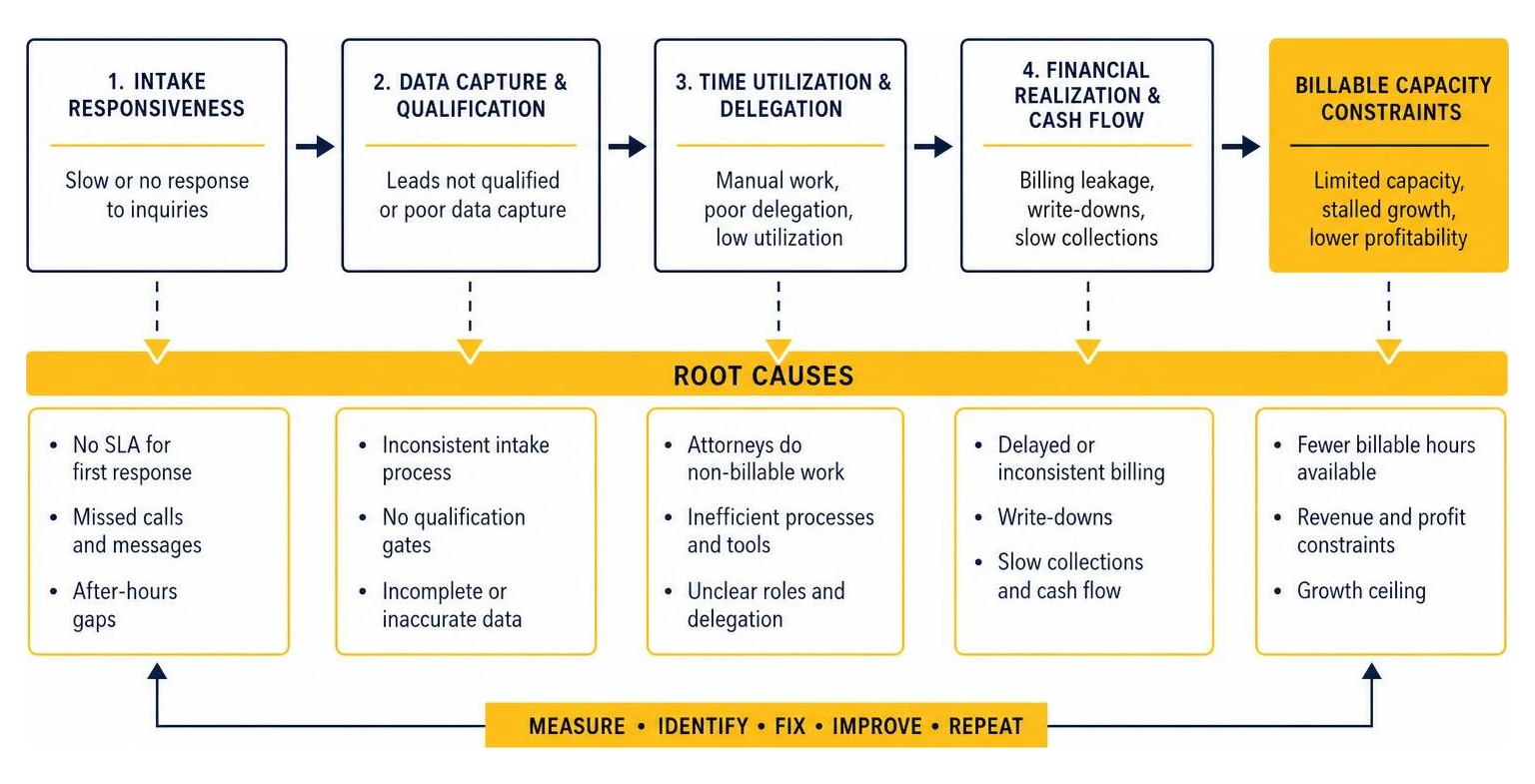
Why do high-performing law firms hit growth ceilings? In our experience working with firms across the country, growth plateaus are rarely caused by a shortage of legal talent. Instead, they stem from hidden operational friction, unaddressed intake leaks, and severe billable utilization constraints.
When the average attorney bills only 2.9 hours in an 8-hour workday (a 37% utilization rate), firm capacity is choked by manual administration, disorganized delegation, and fragmented software. Adding more marketing dollars to a leaky bucket doesn’t create growth—it creates chaos, employee burnout, and reduced profit margins.
To diagnose your specific bottlenecks, managing partners must conduct a formal audit across four core practice areas:
- Intake Responsiveness: Track your team’s exact time to first human contact. Studies reveal that 48% of law firms never respond to phone inquiries, and 27% never respond to online leads.
- Data Capture & Qualification: Audit whether leads pass through structured qualification gates (Conflict, Jurisdiction, Practice Alignment) or if attorneys waste billable hours on non-viable consultations.
- Time Utilization & Delegation: Map daily tasks across timekeeper levels to uncover administrative tasks that paralegals or practice management tools should handle.
- Financial Realization & Cash Flow: Examine write-down protocols, automated billing cadence, and billing leakage to ensure captured hours turn into collected revenue.
Fixing these baseline operational friction points before expanding your ad spend protects your margins and creates a stable foundation for growth. For insights on securing capital for expansion, explore Law firm growth strategies and how to fund them.
Phasing Growth Investments for Maximum Compounding Impact
Scaling a law firm requires careful timing. When firms invest in massive marketing campaigns or lateral hires before fixing operational systems, turnover rises and client satisfaction drops. We recommend a 4-phase sequence to maximize return on investment:
- Phase 1: Operational Foundation (Months 1–3): Audit intake, establish sub-5-minute lead response protocols, and implement automated practice management tools. High-performing firms spend 12% more on software, earning 21% higher profit margins by eliminating friction early.
- Phase 2: Maximizing Revenue Per Client (Months 3–6): Deepen existing client relationships before chasing new leads. Proactively mapping a client’s broader legal needs during intake yields 30–50% higher revenue per client through structured cross-practice engagement.
- Phase 3: Compounding Marketing & Acquisition (Months 6–12): Deploy targeted digital acquisition channels. Sequence fast-converting paid search (Google Ads) with long-term organic content (SEO) to build a multi-channel acquisition system.
- Phase 4: Structured Capacity Expansion (Months 12+): Hire non-legal operational support (such as an office manager or intake specialist) and lateral partners only into established, documented systems.
By following this sequence, firms avoid over-hiring and maintain financial health. Learn more about laying these structural foundation blocks in our guide on Building a Law Firm.
Tailoring Law Firm Growth Strategies Across Solo, Mid-Size, and Enterprise Practices
Growth strategies must adapt to a law firm’s size, practice areas, and target market dynamics:
- Solo Practitioners: Solo lawyers face acute capacity constraints. Growth depends on implementing practice management automation, outsourcing non-core billing, and hiring an intake coordinator or office manager as the first non-legal role. In local markets like Luzerne County, solo practices thrive by establishing deep community referral networks and focused Local Service Ads (LSAs).
- Mid-Size Firms: Mid-size practices scaling across regional markets—such as expanding from Wilkes-Barre into larger metro areas like Philadelphia—must move away from sole-partner dependency. Focus on formalizing departmental organizational charts, deploying non-attorney sales specialists, and building cross-practice referral protocols.
- Large & Enterprise Practices: Enterprise firms operating in major markets like New Orleans focus heavily on strategic lateral partner integration, corporate client retention frameworks, institutionalizing brand equity, and preparing formal partner succession plans.
High-Impact Client Acquisition: Modernizing Legal Intake and Sales Systems
Even robust marketing campaigns fail if your intake system lets prospects slip through the cracks. In modern legal marketing, speed to lead is a crucial driver of conversion. Research proves that lead conversion probability collapses by 80% after just 5 minutes of delay.
Because 67% of legal consumers hire the first law firm that contacts them, reducing response time from hours to minutes transforms firm profitability.
To eliminate intake leakage—which costs an average $2.5M firm upwards of $400,000 annually—firms must implement an 8-touch follow-up rule. This systematic cadence combines calls, SMS text messages, and automated emails across the first 7 days, ensuring leads are nurtured rather than prematurely retired.
To optimize conversions while protecting billable attorney time, leading practices adopt the Rainmaker/Dragon Sales Model. Operating in full compliance with ABA Formal Opinion 506, this structure utilizes trained non-attorney legal intake specialists (“Rainmakers” or “Dragons”) under attorney supervision to conduct qualification calls, explain firm value, and execute retainer agreements.
This model keeps fee-earning attorneys focused on legal strategy while driving same-day consultation close rates above 50%. For actionable playbooks on modernizing your firm’s pipeline, review our resource on Client Acquisition for Lawyers.
Balancing Paid Acquisition and Organic Content Strategies
A balanced acquisition strategy pairs fast-acting paid channels with long-term organic compounding assets.
Paid search (Google Ads and Local Service Ads) generates immediate lead volume, making it an effective tool for new practices or immediate case acquisition. However, relying solely on PPC leaves firms vulnerable to rising cost-per-click fees in competitive markets like Philadelphia and New Orleans.
Organic content marketing and SEO require a 12-to-24-month horizon, but they deliver compounding, cost-effective growth over time. While paid search leads in high-demand practice areas range from $300 to $800+ per lead, a mature content marketing program yields qualified inbound leads at $50 to $150 per lead.
By launching paid search to generate initial case flow while building organic content infrastructure, firms can systematically lower their overall cost per client acquisition over time. To deepen your team’s business development capabilities, explore Attorney Business Development.
Operational Infrastructure: Leveraging Tech, Metrics, and Culture for Scalability

Scaling a practice without team burnout requires modern technology. Generative AI and cloud-based practice management software are reshaping legal operations. According to recent industry surveys, 82% of legal professionals believe generative AI applies to legal practice, yet only 4% to 5% are actively deploying it.
Early adopters gain a significant efficiency advantage. AI-assisted transcription, document drafting automation, and intake summaries enable attorneys to reclaim billable hours, shifting time from administrative tasks to high-value client strategy.
Equally critical is aligning operational systems with firm culture. A firm’s growth trajectory is tied directly to internal cultural alignment and shared behaviors. High employee turnover—which costs between $50,000 and $100,000 per departing staff member—undermines revenue growth.
To explore how cultural clarity drives practice performance, review operational frameworks on understanding law firm culture.
Essential Data Metrics and Key Performance Indicators
Managing partners must track core operational and marketing metrics to pinpoint revenue leaks and manage firm health:
| Performance Metric | Industry Baseline Benchmark | Top-Performing Law Firm Target | Strategic Revenue Impact |
|---|---|---|---|
| Response Time to Lead | 13 minutes median | < 5 minutes | Prevents 80% drop in lead conversion probability |
| Consultation Show Rate | 60% – 65% | 80% – 95% | Adds 30–40 consultations monthly at $0 added ad cost |
| Lead Close Rate | 20% – 30% | 50%+ | Directly increases top-line revenue per lead |
| Inbound Lead Cost (Paid vs Organic) | $300 – $800 (PPC) | $50 – $150 (SEO/Content) | Reduces customer acquisition costs by up to 75% |
| Attorney Utilization Rate | 2.9 hours/day (37%) | 5.5+ hours/day (68%+) | Reclaims billable legal capacity without hiring |
| NPS Score | +30 to +40 | +70 or higher | Drives organic client referral loops |
Cultivating Firm Culture and Institutional Leadership
Sustaining long-term growth requires aligning internal values with strategic goals. Cultural friction often emerges when firms scale headcount without clear communication or structured leadership frameworks.
Holding off-site strategic planning sessions—such as executive alignment retreats in serene environments like Antigua Guatemala—allows managing partners to step away from daily case firefighting. These forums help clarify 1-, 5-, and 10-year growth plans, resolve internal operational friction, and align team goals.
For frameworks on resolving operational disputes and building strong team alignment, read Winning the Growth Case Without Trial.
Expanding Practice Capacity: Hiring, Lateral Integration, and Referral Engines

Expanding firm capacity requires structured talent planning. Many firms make the mistake of hiring lawyers into unstandardized, chaotic operations, resulting in lawyer departures within 18 months. Industry data shows that more than 40% of lateral partner hires depart within five years, representing a significant loss of capital and institutional knowledge.
To expand capacity successfully, firms should follow standard operational protocols:
- Hire Non-Legal Leadership First: Bring on an experienced office manager or Director of Operations to standardize SOPs before adding heavy fee-earning headcount.
- Validate Practice Area Expansion: Before launching a new practice area, verify demand across your existing client base. Ensure the new division has a clear path to self-sustainment within 24 months.
- Institutionalize Client Relationships: Introduce multiple attorneys and relationship managers to key client accounts. This protects client relationships and prevents business loss if a partner departs.
To build structured growth roadmaps for your legal team, review our guidance on Business Coaching for Lawyers.
Building Sustainable Practice Capacity and Practice Area Expansion
When expanding into complementary practice areas—such as an estate planning group adding elder law or a commercial litigation firm adding employment law—use a clear strategic checklist:
This disciplined approach ensures that practice area expansion adds predictable revenue without straining firm resources.
Turning Client Experience into Law Firm Growth Strategies
Word-of-mouth recommendations remain a powerful growth driver, with 84% of consumers identifying word-of-mouth as the most trustworthy form of advertising. Turning client satisfaction into a predictable referral engine requires systematic touchpoints across the client lifecycle.
Implementing a Net Promoter Score (NPS) 3-Wave Filter System helps capture client sentiment and convert positive experiences into marketing assets:
- Promoters (NPS 9–10): Automatically route these satisfied clients to leave public online reviews (Google Business Profile) and participate in recorded video case studies.
- Passives (NPS 7–8): Trigger a personal follow-up check-in from the managing partner to identify areas for service improvement.
- Detractors (NPS 0–6): Route feedback immediately to firm operations for resolution within 24 hours, preventing public negative reviews and improving client retention.
To master conversion strategies and business development coaching, explore The Rainmaker Blueprint: Business Development Coaching for Lawyers.
Frequently Asked Questions About Law Firm Scaling
Why do high-performing law firms plateau, and how can managing partners fix it?
Law firms usually plateau because of operational friction, intake inefficiency, and billable hour limits—not a lack of market demand. When lawyers spend over 60% of their day on administrative work, capacity freezes.
Managing partners can address this by auditing the intake funnel, implementing sub-5-minute lead response protocols, automating billing workflows, and delegating non-legal tasks to administrative specialists.
What is the ideal balance between paid Google Ads and organic SEO content?
The ideal approach is a phased sequence based on practice growth stage. Launch paid search (PPC and LSAs) first to generate immediate case opportunities and cash flow.
Simultaneously invest in long-term organic SEO and content marketing. As organic search authority builds over 12 to 24 months, firms can reallocate ad spend, lowering average client acquisition costs while building long-term domain authority.
How can law firms adopt AI and automation without compromising service quality?
Law firms can integrate AI tools into administrative tasks without affecting legal oversight or ethics. Use generative AI for drafting preliminary intake summaries, transcribing client calls, automating follow-up emails, and organizing task management systems.
Keep qualified human professionals in charge of client consultations, legal strategy, and document reviews to ensure high service standards and compliance with ethical guidelines.
Conclusion: Building Your Firm’s Compounding Growth Engine
Scaling a law firm is an ongoing process that combines intake responsiveness, operational discipline, smart digital acquisition, and a supportive team culture. By diagnosing operational bottlenecks, sequencing strategic investments, and tracking core performance metrics, managing partners can transition from unpredictable revenue cycles to predictable, long-term growth.
Whether you are optimizing a solo practice in Luzerne County or expanding a regional firm across Philadelphia and New Orleans, focus on fixing internal systems before expanding marketing budgets.
Ready to eliminate operational bottlenecks, optimize your client acquisition system, and build a high-performing legal practice? Learn how our team supports managing partners by exploring the Law Firm Development Guide or join legal industry leaders at the next Law Firm Growth Conference.