Empowering Tomorrow: How a Center for Leadership Shapes Future Executives
- Leadership
- In the News
- August 17, 2026
Empowering Tomorrow: How a Center for Leadership Shapes Future Executives

At its core, a center for leadership is an institution dedicated to cultivating potential, shaping strategic vision, and fostering sustainable behavior change. Whether operating within a university setting, functioning as an independent executive institute, or running as a community-focused non-profit, these centers share a common mission: converting latent individual potential into active, ethical leadership capability.
In our work across various markets—from corporate hubs in Philadelphia and New Orleans to close-knit regional business communities in Wilkes-Barre, Luzerne County, and international centers like Antigua Guatemala—we consistently see that leadership is not an innate trait reserved for a select few. Instead, it is a practice honed through structured guidance, practical application, and continuous self-reflection.
A dedicated center for leadership serves as an incubator where core competencies are tested and refined. Rather than relying on static lectures, modern centers leverage multidimensional learning frameworks that address three core dimensions:
- Leading Self: Developing deep self-awareness, personal values, emotional control, and a clear sense of purpose.
- Leading People: Mastering interpersonal communication, team motivation, trust building, and talent development.
- Leading Systems: Navigating organizational complexity, strategic decision-making, systemic ambiguity, and cultural change.
By addressing all three dimensions, a center for leadership bridges the gap between academic theory and operational reality, preparing participants to handle high-stakes environments with confidence and integrity.
Key Audiences Across Academic, Corporate, and Youth Sectors
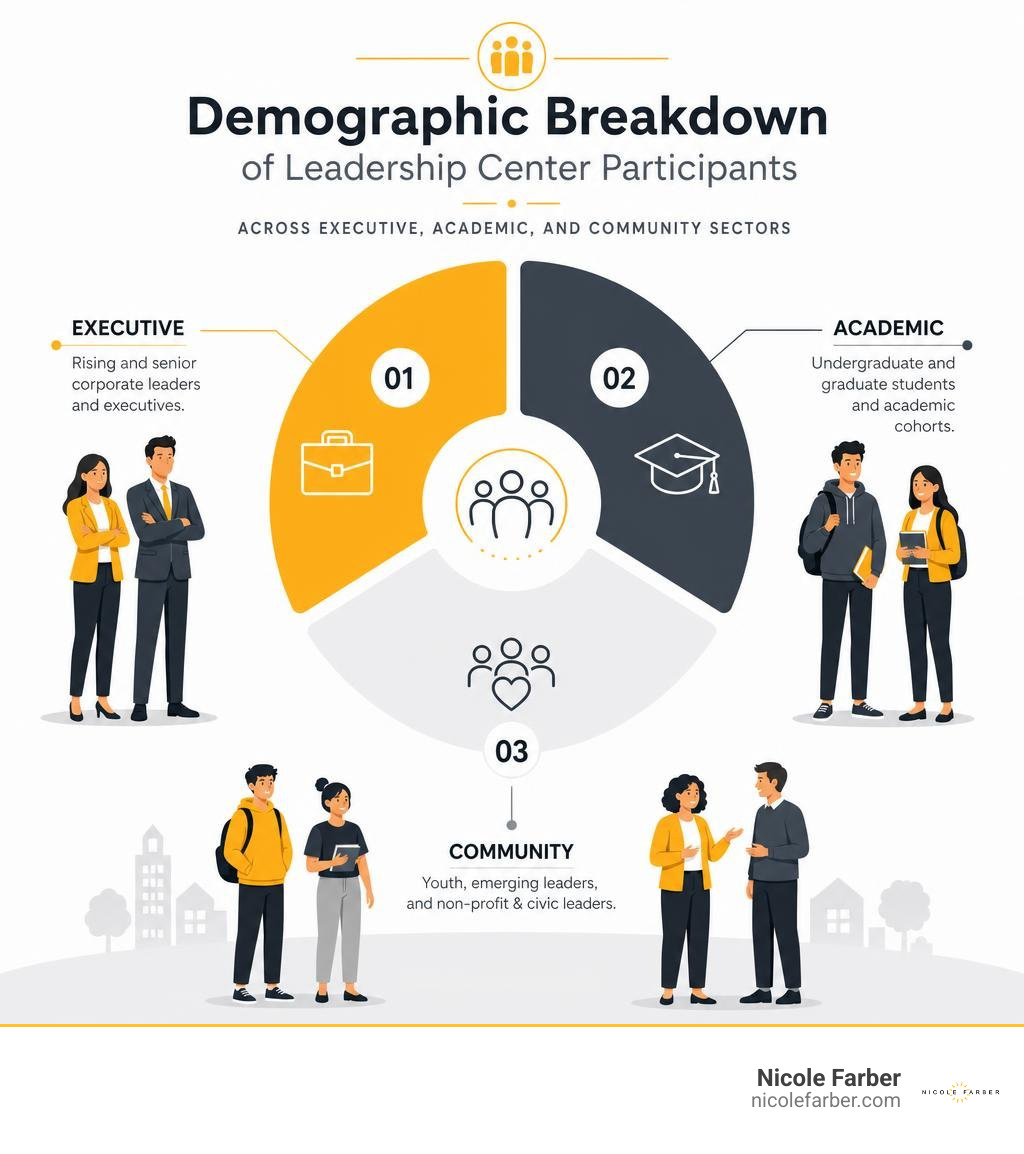
The reach of a contemporary center for leadership extends across multiple generational and professional cohorts. Each sector requires tailored methodologies to unlock specific leadership behaviors:
- Rising and Senior Corporate Executives: Programs like those highlighted by the Corporate Leadership Center focus on C-suite readiness, board transitions, and strategic alignment for high-potential directors and corporate officers. Executives learn to shift from operational management to visionary governance, gaining insights into shareholder perspectives and board dynamics.
- Academic and Post-Secondary Cohorts: Universities frequently establish centers, such as the Center for Leadership Studies at Carnegie Mellon University or regional university institutes, to help undergraduate and graduate students contextualize their academic studies through metacurricular leadership seminars, peer mentorship, and real-world project execution.
- Youth and Emerging Community Leaders: Non-profit centers focus heavily on character development, academic preparation, and career readiness for youth. For example, organizations dedicated to youth advancement—such as the Center for Leadership, Development & Advocacy in Philadelphia or community initiatives like the Youth Leadership School in New Orleans, LA—empower minority youth and student cohorts to build resilience, setting them up for long-term collegiate and professional success. Discover why early intervention matters in our guide on why every rising star needs a leadership development program.
- Non-Profit and Civic Leaders: Regional non-profits, such as Leadership Northeast serving Luzerne County and surrounding areas, focus on community engagement, social responsibility, and collaborative leadership to solve regional social challenges.
How Diverse Models Differentiate a Center for Leadership
Not all leadership centers follow the same blueprint. Different centers specialize based on their targeted audience, regional needs, and core focus areas:
- Corporate Growth and Executive Continuity: These institutions prioritize executive coaching, succession planning, and corporate strategy. By providing confidential, off-the-record access to sitting CEOs and enterprise leaders, corporate centers help rising leaders prepare for enterprise-level management.
- Social Change and Restorative Leadership: Some centers prioritize community impact, ethical governance, and peacebuilding. Programs like Circula – Centro de Liderazgo Restaurativo in Antigua Guatemala emphasize conflict resolution, restorative practices, and community resilience.
- Academic Research and Professional Certification: Academic centers leverage empirical research to ground theoretical frameworks, offering formal certificate programs, co-curricular tracks, and specialized research institutes.
To understand how these strategic frameworks apply across different geographic regions, explore our detailed resource on everything you need to know about leadership strategies in philadelphia wilkes barre new orleans antigua guatemala.
Proven Methodologies and Measurable Leadership Impact
What makes a center for leadership genuinely effective is its departure from traditional, one-dimensional training. Groundbreaking centers implement immersive methodologies that require active participation and real-world application.
A premier example is the 3D Leadership Model (Leading Self, People, and Systems), often paired with Full Immersion™ learning strategies. In these programs, participants do not simply study leadership case studies; they execute strategic initiatives within their own organizations during live operations, returning to peer consultation groups to evaluate outcomes, refine behaviors, and build lasting habits.
| Feature | Theoretical Academic Training | Experiential Leadership Center |
|---|---|---|
| Primary Format | Standard lectures & textbook readings | Immersive workshops, peer coaching & live workplace application |
| Focus Area | Conceptual understanding & broad framework knowledge | Behavioral transformation, emotional intelligence & tactical execution |
| Feedback Mechanism | Exams, term papers & grades | 360-degree feedback, executive coaching & peer review groups |
| Time Horizon | Fixed semester schedules | Flexible, modular formats (e.g., Matrix Flex™ over 1-3 years) |
| Measurable Outcome | Academic credits & degrees | Career promotion, strategic skill acquisition & board readiness |
Immersive Curricula in a Modern Center for Leadership
Modern executive programs, such as the Program for Leadership Development offered by the international Center for Leadership, utilize flexible scheduling models like Matrix Flex™. This approach allows senior managers and executives to complete core educational modules at their own pace over a 1 to 3-year timeframe while actively maintaining their professional responsibilities.
Key elements of an immersive curriculum include:
- Peer Consultation Groups: Executives present real-time organizational dilemmas to a cohort of cross-industry peers, receiving candid feedback and alternative strategic perspectives.
- Custom Corporate Workshops: Programs tailored to an organization’s specific operational hurdles, ensuring that training directly aligns with corporate growth targets.
- C-Suite and Board Readiness: Intensive preparation for high-potential directors focusing on corporate governance, shareholder engagement, and enterprise risk management. For insights on selecting executive education, read our guide on the executive edge finding the best seminar on leadership for your career.
High-Impact Statistics: Career Growth, College Prep, and C-Suite Advancement
The concrete value of a high-caliber center for leadership is validated by industry data and participant outcomes:
- Enterprise Trust: Over two-thirds of the Fortune 1000 trust specialized institutions like the Center for Creative Leadership for executive development and leadership research.
- Participant Satisfaction: 98% of all Corporate Leadership Center Fellows recommend their executive leadership programs to other senior leaders.
- C-Suite Advancement: 1 in 8 fellows in executive development programs like CEO Perspectives become CEO after entering the program, and 1 in 3 fellows go on to serve on a public company board.
- Confidence and Skill Building: 93% of fellows acquire new, strategic leadership capabilities, while 92% leverage their abilities with greater confidence in high-pressure situations.
- Youth Educational Impact: Youth-focused programs show transformative post-secondary outcomes. For instance, 77% of participants in targeted youth leadership development enroll in post-secondary institutions. Furthermore, 46% of these participants who attend college complete their degree in six years, compared to an average of just 25% among underrepresented peers in state-supported public institutions.
Navigating AI and Human-Centric Challenges Through Strategic Partnerships
As artificial intelligence and automated systems rapidly transform business operations in 2026, the traditional responsibilities of managers are shifting. Tech tools can now analyze massive datasets, automate routine decisions, and optimize operational workflows. However, technology cannot replace human judgment, empathy, or moral decision-making.

This technological shift makes the mission of a center for leadership more relevant than ever. Research highlighted by major executive leadership programs confirms that as technology takes over technical analysis, the core value of an executive shifts entirely to human capabilities: building organizational trust, transferring institutional wisdom, and creating genuine personal connections across teams.
Human Connection in an Automated Workplace
In an increasingly virtual and automated business environment, leading teams requires intentional skill development in emotional intelligence, adaptive communication, and ethical leadership.
Centers for leadership help executives navigate these modern workplace challenges through:
- Empathy and Psychological Safety: Cultivating open team environments where innovation thrives and employees feel supported when taking calculated risks.
- Adaptive Leadership Frameworks: Equipping leaders to manage systemic complexity, unexpected industry disruptions, and remote or hybrid workforce dynamics.
- Cross-Sector Networking & Mentorship: Connecting emerging talent with seasoned executives, alumni networks, and community partners to encourage multi-perspective problem-solving.
To master leading teams across digital and hybrid spaces, explore our full analysis on virtual leadership 101 how to lead teams remotely and build trust. For a holistic view of enterprise growth, consult our complete guide on business leadership complete guide.
Frequently Asked Questions About Leadership Centers
What is the primary purpose of a center for leadership?
The primary purpose of a center for leadership is to develop ethical, capable, and self-aware leaders who can drive positive change within organizations and communities. By offering structured training, executive coaching, peer consultation, and research-backed frameworks, these centers help individuals move beyond standard management to master strategic vision, team alignment, and human connection.
How do centers for leadership balance theory with practical training?
Top leadership centers balance theoretical frameworks with hands-on practice through immersive methodologies such as the 3D Leadership Model and Full Immersion™ learning. Participants learn core principles, such as adaptive leadership or situational management, and immediately apply them to real workplace projects or community challenges. They then review their results in peer coaching groups and executive feedback sessions to ensure lasting behavior change.
How are modern leadership centers adapting to artificial intelligence?
Modern centers are adapting to AI by doubling down on irreplaceable human capabilities. While AI handles data analysis and task automation, leadership centers focus heavily on emotional intelligence, ethical decision-making, trust building, and wisdom transfer. They teach leaders how to pair modern technology with deep human empathy and strategic judgment to guide organizations effectively.
Conclusion
A center for leadership plays a vital role in preparing executives, emerging managers, youth, and civic pioneers to meet the challenges of an evolving global landscape. By grounding leadership growth in self-awareness, immersive practical application, and strong human connection, these centers transform potential into actionable capability.
At Nicole Farber, our mission is built on empowering business owners, legal professionals, and rising leaders through real-life experience, strategic direction, and faith-driven leadership. Whether you are leading a firm through growth in Philadelphia or New Orleans, steering business development in Wilkes-Barre and Luzerne County, or expanding international ventures in Antigua Guatemala, investing in your leadership journey is the most powerful step you can take toward lasting success.
To explore more insights, strategies, and executive training guides, visit our complete collection of leadership development resources.