The Complete Guide to Leadership Development
- Leadership
- In the News
- June 22, 2026
The Complete Guide to Leadership Development
Why Leadership Development Determines Whether Organizations Thrive or Stagnate

Leadership development is the ongoing process of building the skills, mindset, and behaviors that help people lead others more effectively — and it is one of the most critical investments any organization can make.
Quick answer: What is leadership development?
- It is the intentional process of growing a person’s ability to lead teams, make decisions, and drive results
- It includes formal training, coaching, mentoring, feedback, and on-the-job experience
- Effective leadership development is continuous, not a one-time event
- It operates at three levels: the individual leader, the team, and the organization as a whole
- Organizations that do it well are 3.5x more likely to outperform their industry peers
Here is the problem most organizations face: they treat leadership development like an event. Send someone to a seminar. Run an annual training. Check the box.
But research tells a different story. Globally, organizations spend an estimated $60 billion per year on leadership development — and as few as 5% of participants successfully apply what they learned back on the job. Two-thirds of senior executives say leadership development is their most urgent challenge, yet fewer than 10% of senior managers believe their companies are actually developing global leaders effectively.
That gap between investment and impact is enormous. And it is not a training content problem. It is a systems problem.
This guide breaks down why traditional approaches fall short, what the research says about what actually works, and how to build a leadership development system that creates lasting change — not just short-term learning.
I’m Nicole Farber, CEO of ENX2 Legal Marketing, with over 15 years of experience helping law firms and businesses grow — including speaking on leadership development at Merakey’s Annual Leadership Conference in 2025. My work sits at the intersection of business strategy and people-first leadership, and I’ve seen how the right development approach transforms teams from the inside out.
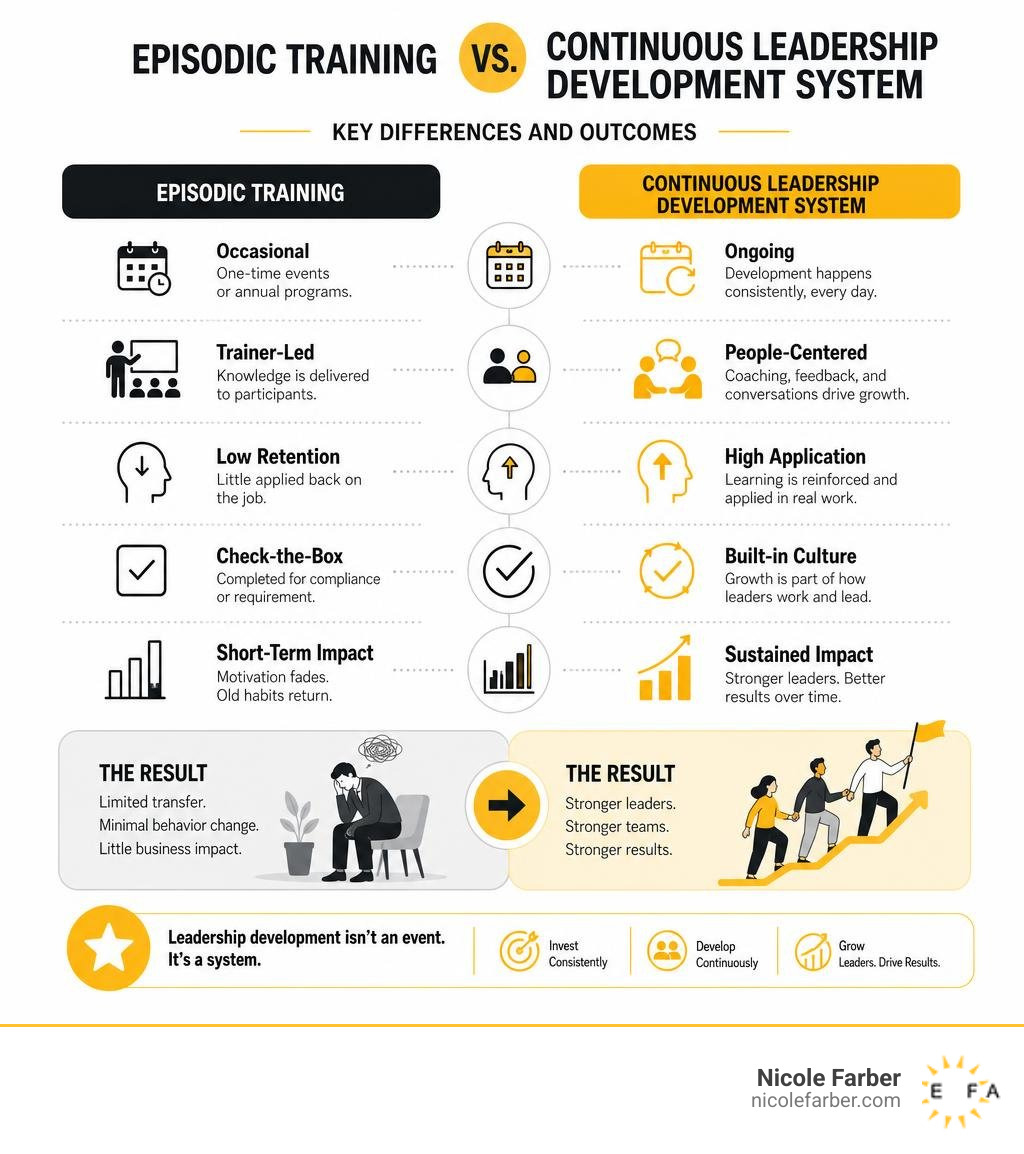
Rethinking Leadership Development: Moving Beyond Episodic Programs
We have all seen the cycle. An organization notices a gap in performance or communication, panics, and books an intensive weekend retreat or a multi-day training seminar. For a few days, everyone is energized, speaking a new corporate language, and promising to implement fresh strategies.
But within two weeks, the daily grind takes over. The binders from the seminar gather dust on office shelves, and team members slip right back into their comfortable, old habits.
This occurs because most traditional training programs operate as closed, episodic systems. They treat leadership development as something you “go do” rather than an active, integrated part of how you run your business. When we look at Longitudinal studies of leadership development, we see that genuine growth occurs over months, years, and decades—not during a single, isolated weekend. To make a lasting impact, we must understand How to Become a Good Leader at Work as a long-term commitment to self-awareness and behavioral modification.
The Pitfalls of One-Off Training Seminars
The primary reason one-off seminars fail is classroom isolation. We pull our managers out of their natural work environments, place them in a sterile conference room in Philadelphia or a hotel ballroom in Wilkes-Barre, and feed them abstract leadership theories. This creates a disconnect. Because the learning environment is completely detached from the daily pressures of the office, the “training transfer” rate remains incredibly low.
When these managers return to their desks, they face the exact same organizational systems, metrics, and cultural pressures that existed before they left. The workplace can untrain people far more efficiently than even the most expensive training department can train them. Without continuous reinforcement, real-world application, and supportive structures, skill decay sets in almost immediately.
The Low ROI of Closed-System Leadership Development
When we look at the financial side of these initiatives, the numbers are sobering. Organizations pour billions into these programs, yet 10% of interventions fail entirely, and the vast majority yield negligible behavioral change.
According to research on Maximizing the Impact and ROI of Leadership Development, the return on investment can range from massive multi-million dollar gains to substantial net losses. The deciding factor isn’t the quality of the slides or the charisma of the presenter. It is whether the organization supports the leader before, during, and after the training.
When we treat development as a closed system with a fixed endpoint, we waste precious budget and human potential. We must transition to a model that treats leadership as a living, breathing ecosystem.
Transforming Leadership Through Open Systems Theory
To build a system that actually works, we can look to open systems theory. Originally developed in the biological and organizational sciences, this theory views organizations as living systems that constantly interact with their external environments.
Instead of seeing a leader as an isolated individual who just needs a few more skills, open systems theory helps us see that a leader’s behavior is shaped by, and shapes, the entire organization.

This approach introduces three critical concepts to our development strategy:
- Dynamic Homeostasis: A healthy system maintains stability and balance even as the environment around it changes. Our developmental systems must help leaders build the emotional resilience and adaptability to keep their teams steady in times of crisis.
- Negative Entropy: Left alone, closed systems naturally decay and lose energy. Open systems import fresh energy and information from the outside world to stay vibrant. By continually bringing in new ideas, external feedback, and diverse perspectives, we prevent organizational stagnation.
- Equifinality: This is the belief that there are many different paths to the same destination. Every leader in our organization starts with a unique set of strengths, life experiences, and cultural backgrounds. An open systems approach honors this, moving away from cookie-cutter leadership models.
We can explore these concepts further in the academic review, Reconsidering Leadership Development: From Programs to Developmental Systems, which argues that true development must be continuous and cyclical rather than linear and episodic.
Applying Systems Design to Leadership Development
When we apply systems design to our companies—whether we are running a legal marketing agency in Luzerne County or managing a growing business—we start by mapping out the feedback loops that drive behavior.
Instead of waiting for an annual performance review (which is like trying to drive a car by only looking in the rearview mirror), we build real-time feedback loops. This ensures that when a leader tries a new behavior, they receive immediate, constructive data on how it impacted their team.
To successfully scale these efforts, we must actively Develop Your Leadership capabilities by designing environments where leaders can experiment, fail safely, and refine their approaches in real time.
Multi-Level Perspectives on Organizational Growth
An effective developmental system operates on three distinct levels simultaneously:
- The Individual (Leader Development): Focusing on personal growth, self-awareness, leader identity, and emotional intelligence.
- The Team (Leadership Development): Cultivating the collective capacity of a group to produce direction, alignment, and commitment.
- The Organization (Systemic Alignment): Ensuring that the company’s culture, performance metrics, and strategic goals actively reinforce the leadership behaviors we want to see.
By addressing all three levels, we create a cohesive environment where individual growth directly drives team performance and organizational success.
Core Practices of an Effective Leadership Development System
Transitioning from episodic programs to an open systems approach requires a shift in our daily practices. We must integrate development into the actual flow of work.
According to the 2025 Global Leadership Development Study, the most successful organizations in 2026 are those that prioritize scalability, continuous learning, and human-AI collaboration.
| Traditional Episodic Programs | Open Systems Developmental Systems |
|---|---|
| Bounded, one-off events | Continuous, integrated learning journeys |
| Focused solely on individual skills | Focused on individual, team, and organizational alignment |
| Closed to the daily work environment | Permeable boundaries that interact with daily workflows |
| One-size-fits-all curriculum | Tailored pathways based on equifinality |
| Delayed or non-existent feedback | Real-time, continuous feedback loops |
Embedding Learning into Daily Workflows
We cannot expect our busy managers to step away from their responsibilities for hours on end to learn how to lead. Instead, we must bring the learning to them.
In places like New Orleans, where business moves fast and client relationships are everything, we advocate for micro-learning and on-the-job application. This means providing leaders with bite-sized, highly relevant resources that they can digest in 5 to 10 minutes and apply immediately in their next team meeting.
If you are just starting out on this journey, our Beginners Guide to Leading Your Team offers highly practical, step-by-step strategies to help your new managers build trust and establish credibility from day one.
Establishing Continuous Feedback Cycles
To fuel our developmental system, we need high-quality data. This is where continuous feedback cycles come in. By combining structured 360-degree feedback with real-time coaching and AI-driven insights, we give our leaders a clear, objective picture of their performance.
Many forward-thinking organizations are now using AI assistants to provide real-time coaching tips, analyze team sentiment, and help leaders prepare for difficult conversations. This isn’t about replacing human connection; it’s about using technology to elevate our emotional and social intelligence.
Implementing and Sustaining Your Developmental System
Building a leadership development system is not a project with a start and end date. It is a long-term commitment to organizational excellence.
Whether we are supporting entrepreneurs in Wilkes-Barre or collaborating on community-focused initiatives in Antigua Guatemala, the steps to implement and sustain this system remain the same.

First, we must align our development goals with our company’s true north. Every training initiative, coaching session, and feedback loop must directly support our broader business strategies. For a comprehensive look at how to align these elements, check out our Business Leadership Strategies Guide.
Securing Executive Support and Resources
A developmental system will fail if our senior leaders do not actively champion it. Executive support goes far beyond signing off on the budget. Our executives must model the very behaviors we are trying to teach. They should participate as mentors, share their own leadership challenges, and actively foster a culture of psychological safety.
Furthermore, we must provide our people with “protected time.” If we expect our managers to grow, we must give them the breathing room to do so. Adding development tasks to an already overwhelming workload is a recipe for burnout and frustration.
Measuring Long-Term Impact and Adaptability
To ensure our system remains effective, we must measure its impact over time. Instead of relying solely on “smile sheets” (the feedback forms handed out right after a class), we look at deeper behavioral and business metrics:
- Speed to Skill: How quickly are our leaders adapting to new tools, strategies, and market changes?
- Behavioral Change: Are we seeing a measurable increase in collaboration, trust, and effective communication across teams?
- Business Outcomes: Are these leadership behaviors driving higher employee retention, increased productivity, and revenue growth?
When we prioritize these metrics, we see incredible results. Organizations that invest heavily in leadership development report 25% higher employee engagement, 21% higher productivity, and up to a 40% increase in employee retention.
Frequently Asked Questions about Leadership Development
Why do traditional leadership development programs fail to deliver long-term results?
Traditional programs fail because they are treated as isolated events. Without ongoing reinforcement, real-world application, and executive support, leaders quickly fall back into old habits once they return to their daily routines. True development requires a continuous, systems-based approach.
How does open systems theory improve leadership development?
Open systems theory views leadership as an interconnected ecosystem. By focusing on feedback loops, environmental interaction, and the unique developmental path of each leader (equifinality), it ensures that learning is continuously reinforced and aligned with the organization’s culture and goals.
What are the most critical leadership development areas to focus on in 2026?
In 2026, the most critical areas include emotional and social intelligence, AI fluency, and the ability to manage ambiguity in a rapidly changing world. To explore these topics in depth, view The Big List of Leadership Topics That Actually Matter to Your Team.
Conclusion
At its core, leadership development is about people. It is about believing in the potential of your team, investing in their growth, and creating an environment where everyone can thrive.
My own journey as a single mother, entrepreneur, and CEO has taught me that the most powerful leadership is rooted in real-life experience, resilience, and faith. We don’t build great leaders in sterile classrooms; we build them through the daily, courageous choices they make in the workplace.
If you are ready to move beyond outdated, one-off training programs and build a dynamic developmental system that drives real business results, we are here to help. Explore Nicole Farber’s Leadership Resources to find the tools, strategies, and inspiration you need to guide your team to peak performance.