Top Leadership Training Programs for Employees That Deliver Real Results
- Leadership
- In the News
- August 19, 2026
Top Leadership Training Programs for Employees That Deliver Real Results
Key Types of Leadership Training Programs for Employees Across Career Stages
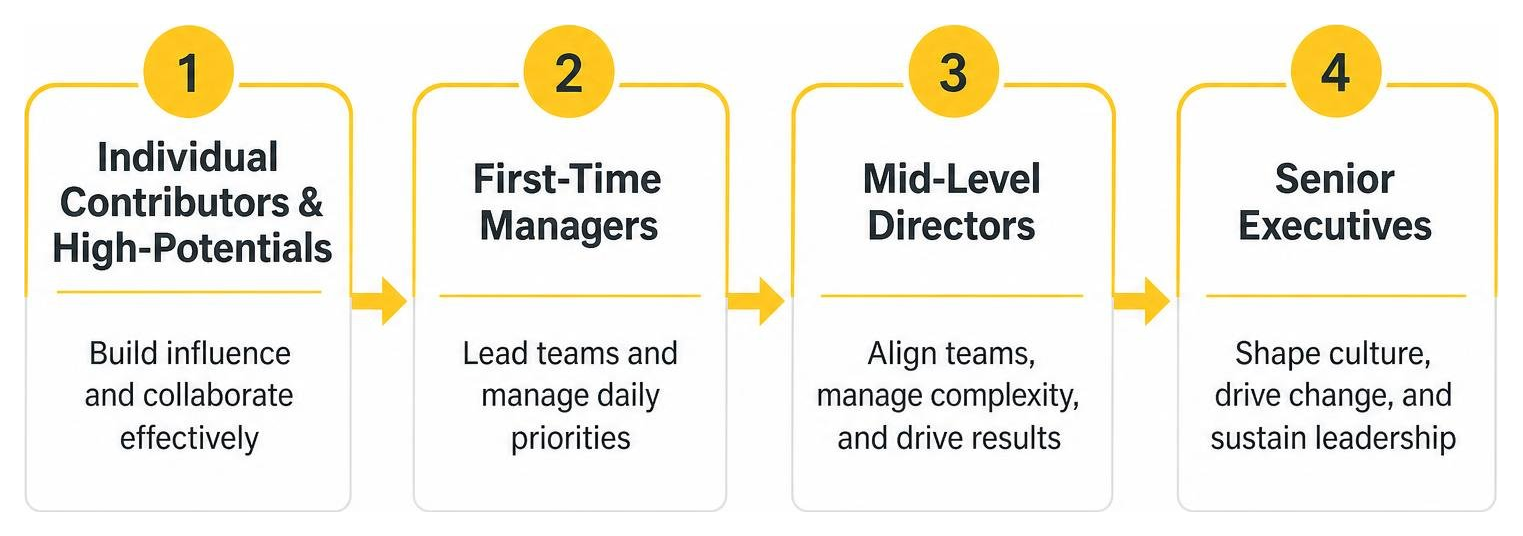
Designing effective leadership training programs for employees starts with meeting professionals right where they are in their career lifecycle. A one-size-fits-all approach simply fails because a first-time team lead faces vastly different daily challenges than a senior director steering cross-departmental operations.
When organizations evaluate training frameworks, they must map skill progression across clear career tiers:
At each stage, the core objective shifts:
- Individual Contributors & High-Potentials: Transitioning mindsets from personal achievement to collaborative influence.
- First-Time Managers: Learning task delegation, performance feedback, and time management.
- Mid-Level Directors: Navigating organizational complexity, managing cross-functional friction, and aligning team output with executive strategy.
- Senior Executives: Shaping workplace culture, driving enterprise-wide change, and preparing seamless succession plans.
Designing Leadership Training Programs for Employees in Entry and Mid-Level Roles
The step from individual contributor to first-time manager is widely recognized as one of the most difficult transitions in any professional career. Yesterday, success meant delivering on individual assignments; today, it requires achieving results through others. Without formal support, new supervisors frequently default to micro-managing or burning themselves out trying to maintain their old workloads while overseeing direct reports.
To support this transition, early-stage programs must focus heavily on core operational capabilities:
- Peer-to-Manager Dynamics: Establishing clear boundaries and authority while preserving professional trust with former peers.
- Delegation and Accountability: Matching individual strengths to specific tasks rather than keeping high-impact work on one’s own plate.
- Constructive Feedback: Shifting away from annual reviews toward ongoing, future-oriented coaching conversations.
For mid-level managers—often referred to as those “leading from the middle”—the leadership balancing act intensifies. Mid-level leaders must translate top-down executive strategy into operational realities for frontline staff, all while advocating for their teams upward. Training at this stage focuses on conflict resolution, emotional intelligence, and influence.
Whether operating out of offices in Philadelphia, Luzerne County, or supporting remote talent in Antigua Guatemala, equipping mid-level managers with tools to handle competing priorities is essential for maintaining operational momentum. Discover how structured growth pathways transform rising stars into capable leaders in Why Every Rising Star Needs a Leadership Development Program.
Executive and Rotational Leadership Pathways for Senior Leaders
For senior executives and C-suite leaders, leadership training shifts from tactical management to strategic governance and organizational stewardship. Research shows that only 2 in 10 employees strongly agree that their organizational leadership makes them feel enthusiastic about the future, and an equal proportion believe their leaders know where the organization is headed. Executive leadership initiatives must bridge this trust gap by refining high-level decision-making and authentic communication.
Rotational leadership pathways offer a proven methodology for building broad enterprise capability. By cycling high-performing senior leaders through distinct operational functions over a 12- to 24-month period, organizations build leaders with holistic business acumen. Rotational structures offer distinct strategic benefits:
- Cross-Functional Perspective: Senior managers gain experience with the operational constraints of sales, finance, operations, and human resources.
- Mitigated Pipeline Risk: Broad exposure ensures that executive succession planning is supported by candidates with deep institutional knowledge across multiple units.
- Cultural Cohesion: Leaders who have worked across diverse regional teams—from regional hubs in New Orleans and Wilkes-Barre to international offices—build unified company standards.
To explore comprehensive frameworks for developing top-tier executive talent, read The Complete Guide to Leadership Development.
Core Curriculum Components of High-Impact Leadership Training
A modern, high-impact leadership curriculum goes far beyond static PowerPoint lectures. To achieve lasting behavior modification, leadership training programs for employees must pair self-awareness tools with practical application exercises.
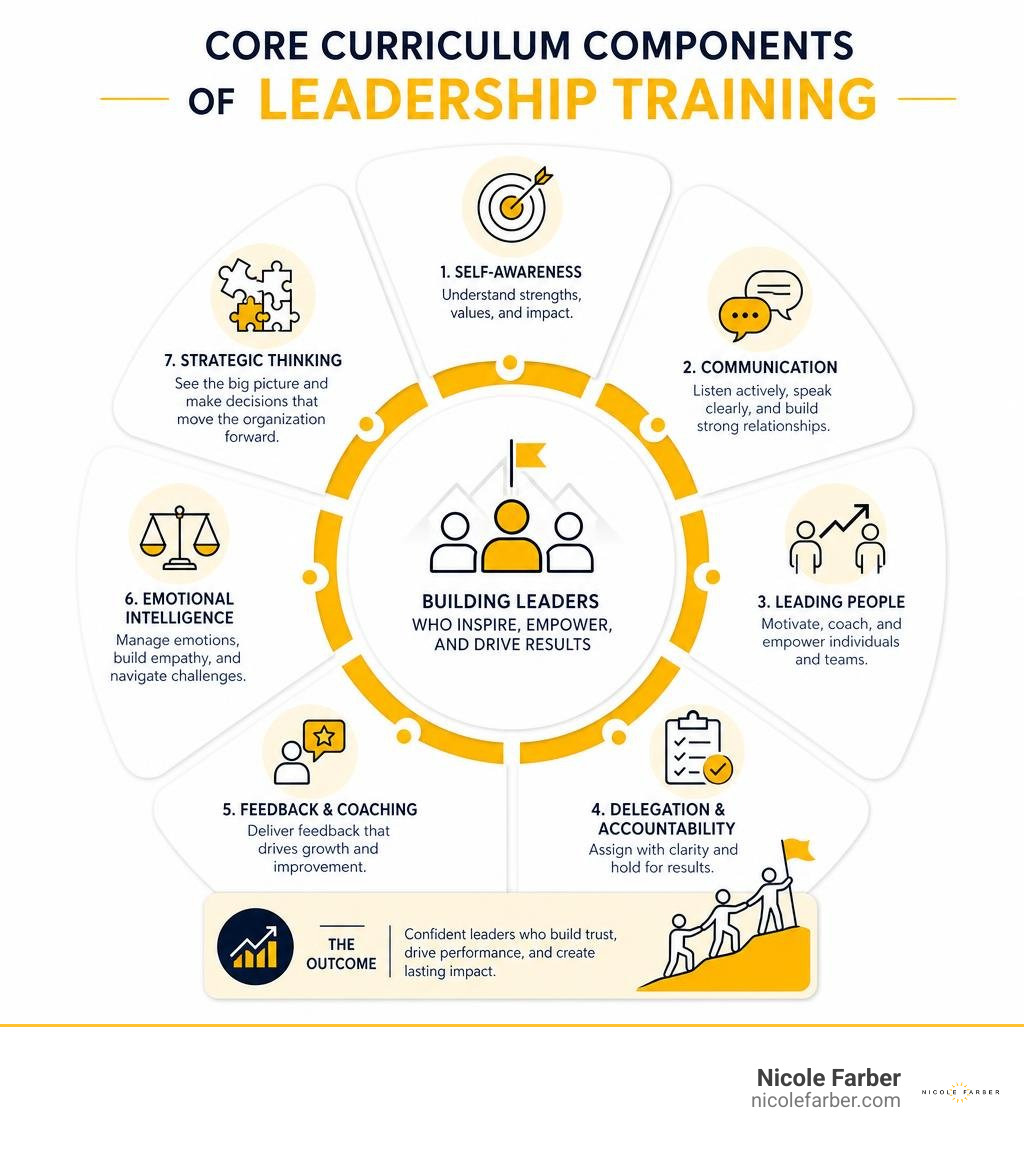
Essential Mindsets, Soft Skills, and Communication Strategies
At the heart of great leadership lies effective communication and emotional intelligence. Traditional performance management systems are fundamentally broken; Gallup research highlights that only 29% of employees strongly agree that the performance reviews they receive are fair, and just 26% consider them accurate. Modern training replaces punitive review structures with continuous coaching models built on trust and clarity.
Essential soft-skill curriculum pillars include:
- Active Listening: Learning to hear underlying concerns rather than simply waiting for a turn to speak.
- Empathy and Psychological Safety: Creating an environment where employees feel safe to admit mistakes, debate ideas, and take smart risks without fear of unfair retribution.
- Transparent Change Management: Communicating the why behind strategic shifts to combat workforce cynicism and uncertainty.
Mastering these interpersonal dynamics ensures managers motivate rather than demotivate their direct reports. For an actionable deep-dive on refining your organization’s messaging, review The Ultimate Guide to Leadership Communication Strategies.
The Role of 1-on-1 Coaching, Peer Feedback, and Microlearning

Skill acquisition requires real-time practice and reflective feedback loops. Incorporating 360-degree multi-rater assessments provides leaders with anonymous, candid input from peers, direct reports, and supervisors. This multi-angle perspective uncovers critical blind spots—such as recognizing when a manager operates as an “accidental diminisher” who unintentionally stifles team innovation.
Combining 360-degree feedback with dedicated 1-on-1 coaching helps leaders process evaluation data constructively and build personalized growth tracks. Furthermore, integrating peer coaching boards allows managers facing similar workplace friction to debrief live scenarios, test strategies, and hold each other accountable.
To accommodate demanding work schedules across environments in the USA and globally, modern programs supplement formal coaching with microlearning modules. Short, bite-sized lessons accessible on-demand allow busy leaders to refine body language, review delegation strategies, or prep for difficult conversations right when those challenges arise.
Delivery Formats: Comparing In-Person, Live Online, and Hybrid Models
Selecting the right delivery model depends heavily on workforce dispersion, budget constraints, and organizational learning goals. Below is a comparative overview of primary delivery formats:
| Format | Key Benefits | Best Used For | Primary Challenge |
|---|---|---|---|
| In-Person Immersive | Deep personal connection, zero workplace distractions, high psychological safety, networking. | Executive retreats, multi-day leadership bootcamps, cohort building. | Higher travel expenses, time away from daily operational duties. |
| Live Virtual Classrooms | Geographic flexibility, interactive real-time instruction, lower travel costs, scalable across regions. | Multi-location teams (e.g., spanning Philadelphia to Antigua Guatemala), busy mid-level managers. | Potential virtual fatigue, requiring active facilitation to maintain high engagement. |
| On-Demand Microlearning | Maximum scheduling flexibility, self-paced learning, immediate point-of-need skill retrieval. | Continuous reinforcement, high-potentials, busy individual contributors. | Requires strong self-discipline; lacks immediate live peer feedback. |
| Hybrid (“Learn Anywhere”) | Combines live peer connection with self-paced flexibility; participants seamlessly switch between formats. | Distributed enterprise workforces needing consistent multi-week development tracks. | Requires robust multi-platform learning infrastructure to track progress seamlessly. |
Evaluating Leadership Training Programs for Employees to Maximize ROI

Investing in leadership training programs for employees represents a significant financial commitment. To justify this outlay, HR directors and executive sponsors must establish transparent tracking metrics prior to program launch.
Organizations evaluating training impact measure success across four quantitative metrics:
- Employee Engagement Growth: Studies show that companies implementing structured manager development see an average 16% increase in engaged employees.
- Retention Rates: High-performing employees stay with organizations that actively invest in their personal leadership trajectory, significantly lowering costly talent turnover.
- Reclaimed Team Productivity: Advanced management courses focusing on priority management and meeting efficiency routinely help attendees reclaim up to 20% of their team’s lost operational time.
- Promotability Pipeline: Tracking the percentage of internal leadership vacancies filled by training program graduates versus external recruitment hires.
By capturing baseline survey data prior to training and evaluating behavior quarterly, decision-makers directly prove the business impact of their leadership investments.
How Organizations Choose and Customize the Right Development Program
Selecting the right training partner or curriculum begins with a rigorous skill gap analysis. Organizations must evaluate whether current manager performance aligns with strategic operational goals.
When choosing a framework, leadership development decision-makers should follow a step-by-step evaluation process:
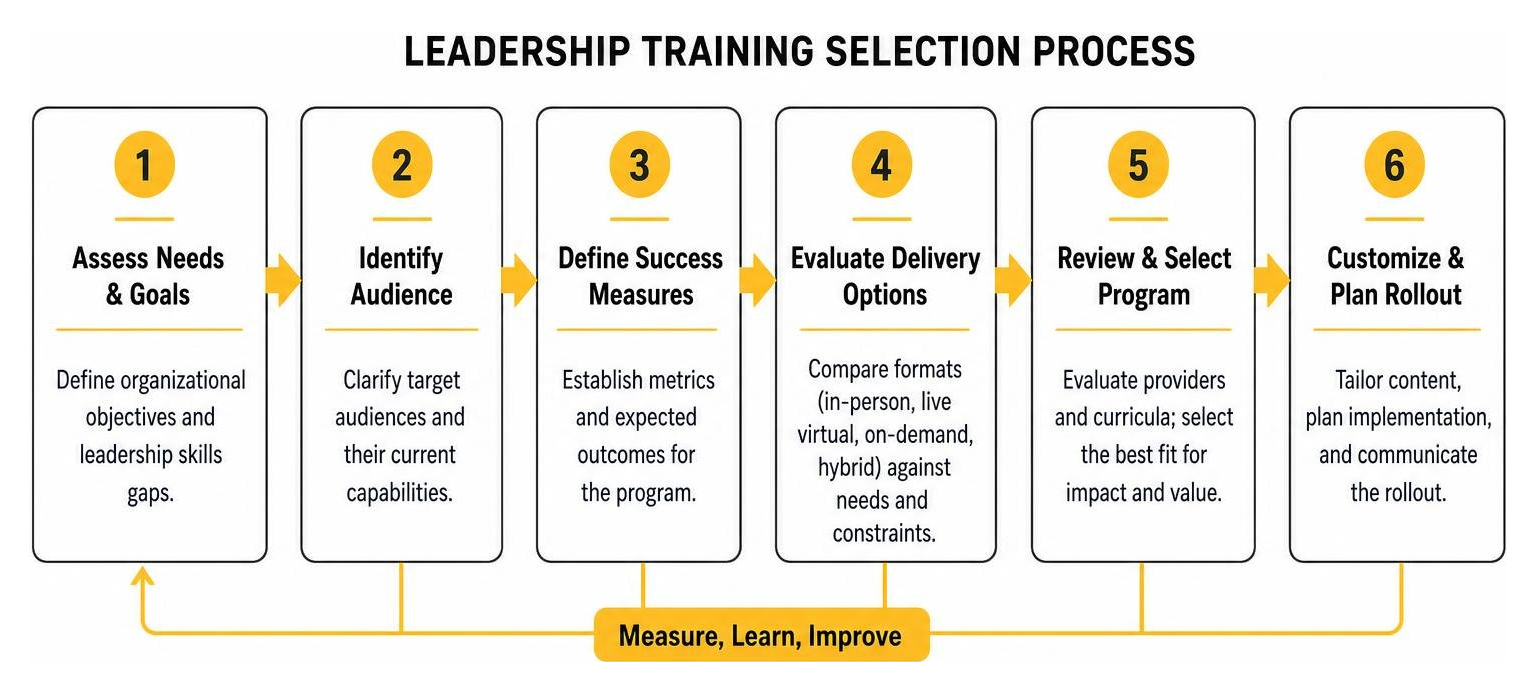
Customizing curriculum ensures training resonates with industry-specific realities. For example, law firms and professional service practices require heavy emphasis on ethical governance, billing management, and client partner communication, whereas manufacturing or technology firms prioritize agile project leadership and rapid innovation cycles.
To explore customizable frameworks tailored to your team’s needs, explore Leadership Development Pathways Choose Your Own Career Adventure.
Solving Common Career Challenges at Every Management Tier
Every leadership tier encounters predictable friction points that targeted development directly addresses:
- Frontline Managers: Suffer heavily from operational burnout caused by struggling to balance individual task execution with supervisor responsibilities. Training provides practical prioritization frameworks and delegation techniques.
- Mid-Level Leaders: Struggle with organizational silos and cross-departmental alignment. Development programs focus on matrix management, boundary-spanning collaboration, and diplomatic negotiation.
- Executives: Face strategic misalignment and isolation. Training delivers objective 360-degree feedback, strategic visioning exercises, and enterprise change frameworks.
Establishing continuous feedback loops across all tiers creates a cohesive corporate environment where clear expectations, shared accountability, and mutual respect thrive naturally.
Frequently Asked Questions About Leadership Training
How do US companies calculate the quantitative ROI of leadership training programs?
Companies calculate ROI by setting baseline operational and HR metrics prior to training kickoff. Quantitative indicators include tracking changes in voluntary employee turnover rates, comparing pre- and post-training team engagement scores, analyzing reductions in customer service or legal escalation incidents, and tracking the percentage of open managerial roles filled via internal promotions.
What is the ideal balance between in-person workshops and virtual online learning?
The ideal balance often follows a blended approach: immersive 1- to 2-day in-person workshops to build initial cohort trust, dynamic peer relationships, and psychological safety, followed by 6 to 12 weeks of live virtual coaching modules and self-paced digital microlearning. This hybrid approach ensures deep interpersonal connections while maintaining schedule flexibility for working professionals.
How do leadership training needs differ for new managers versus senior executives?
New manager training focuses primarily on tactical “people management” skills—learning how to delegate tasks, provide performance feedback, manage difficult interpersonal dynamics, and transition from doing work to guiding others. Senior executive training focuses on strategic capabilities—enterprise change management, driving organizational culture, succession planning, cross-functional alignment, and high-stakes decision-making during periods of market uncertainty.
Conclusion

Investing in robust leadership training programs for employees is no longer an optional perk—it is a core business strategy. As 86% of businesses continue to rank leadership development as their primary talent challenge, companies that proactively build strong managerial pipelines will consistently outperform their competitors in productivity, talent retention, and organizational resilience.
Whether operating within local hubs across New Orleans, Wilkes-Barre, Luzerne County, or Philadelphia, or supporting international teams in Antigua Guatemala and across the USA, strong leadership forms the foundation of sustainable growth. By matching targeted training formats to employee career stages, integrating continuous coaching, and measuring quantitative business ROI, organizations cultivate exceptional leaders who inspire high-performing, engaged teams.
Ready to transform your management team and unlock your business’s full potential? Empower your team with leadership development seminars hosted by Nicole Farber today!