Map Out Company Growth Fast With Proven Business Development Plan Templates
- Marketing
- Word of the Day
- September 9, 2026
Map Out Company Growth Fast With Proven Business Development Plan Templates
Choose a Business Development Plan Template That Turns Growth Into Action

The best business development plan templates turn a broad growth goal into a short list of owned, measurable work. Start with a template that helps your firm:
- Define the market, client segments, and competitors that matter most.
- Set revenue and client-acquisition goals with clear deadlines.
- Map the marketing, referral, partnership, and sales actions needed to reach them.
- Assign an owner, budget, milestone, and KPI to every major initiative.
- Review results quarterly and adjust based on what the data shows.
For a law firm, this might mean choosing one new practice area, targeting a defined client group in Pennsylvania or another priority market, building a referral channel, and tracking qualified consultations, signed matters, and revenue – not just website traffic.
A business development plan is not the same as a full business plan. A traditional plan covers the whole company over a three- to five-year horizon. A business development plan is a practical one- to two-year growth roadmap, usually checked each quarter, for winning new clients, entering markets, and building strategic relationships.
I am Nicole Farber, CEO of ENX2 Legal Marketing, with more than 15 years of experience helping law firms and businesses build stronger growth systems. I use business development plan templates to help teams replace scattered ideas with focused actions that support visibility, client acquisition, and sustainable growth.
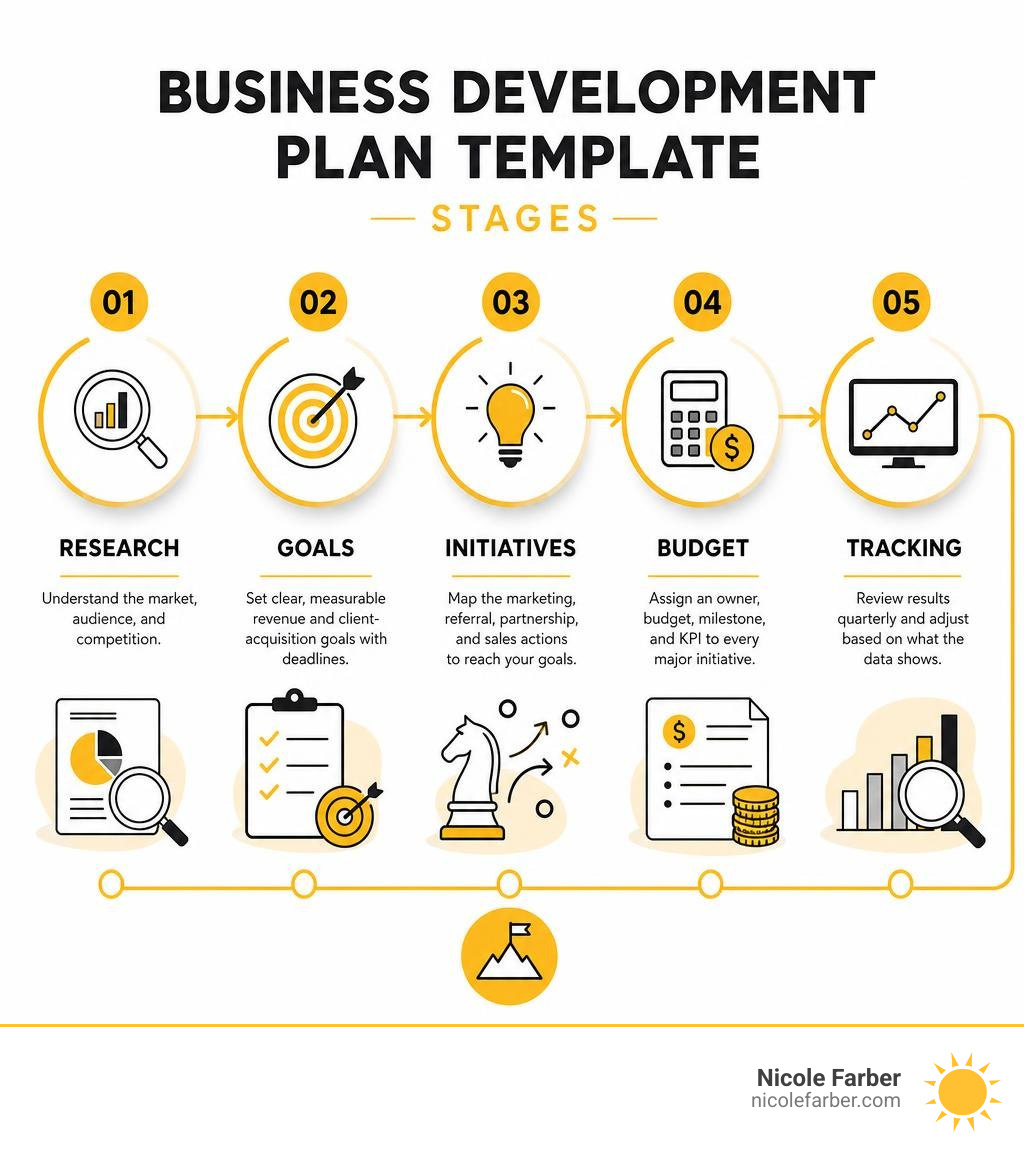
Business development plan templates terms explained:
Understanding the Core Frameworks of Business Growth
Sustainable business expansion does not occur by accident. It demands a deliberate framework that aligns your market positioning with clear revenue drivers. When evaluating entry into a new geographic area or rolling out a specialized service line, following established guidelines—such as state-level PA Business One-Stop Shop planning guidelines—ensures your team covers all operational, regulatory, and commercial baselines before deploying capital.
Growth frameworks establish how an organization captures untapped value. Rather than launching disconnected marketing tactics or uncoordinated sales calls, a structured framework forces us to identify where our highest-margin opportunities lie, what infrastructure is required to serve them, and how every business development effort ties directly into top-line revenue.
Why Fast-Moving Teams Use Business Development Plan Templates
High-performing teams rely on structured templates because growth requires strategic focus and execution speed. Without a repeatable blueprint, leaders frequently succumb to distraction, chasing unprofitable opportunities that drain resources.
It is time to stop winging it and use a business development plan template to establish disciplined, repeatable workflows. A proven template eliminates guesswork, allowing leadership to focus on high-impact initiatives. Whether we are coordinating commercial outreach in Philadelphia, managing client pipelines across Luzerne County, or scaling international consulting from Antigua Guatemala, a shared framework ensures every partner and team member executes against the same strategic priorities.
Business Development Plan vs. Traditional Business Plan
A standard business plan provides a comprehensive overview of an entire company—covering operations, governance, human resources, and initial capitalization over a 3- to 5-year timeline. It is primarily built for external stakeholders, such as lenders and investors.
In contrast, a business development plan is an internal execution document. It focuses tightly on a 1- to 2-year horizon with mandatory quarterly checkpoints. Its sole purpose is to drive commercial expansion through targeted client acquisition, strategic partnerships, and new market capture.
| Planning Dimension | Traditional Business Plan | Business Development Plan |
|---|---|---|
| Primary Horizon | 3–5 Years | 1–2 Years (with Quarterly Checkpoints) |
| Core Purpose | Company formation, operational overview, securing funding | Market expansion, partnership acquisition, revenue acceleration |
| Primary Audience | Investors, commercial lenders, board members | Revenue teams, practice leaders, executive leadership |
| Scope of Coverage | All operations, HR, legal structure, company overhead | Target segments, go-to-market channels, strategic alliances |
| Update Cadence | Annually or during major funding rounds | Monthly KPI tracking with comprehensive quarterly resets |
Essential Components of a Complete Growth Blueprint
A comprehensive growth blueprint organizes strategic intent into actionable, accountable phases. At its core, every business development plan must contain:
- Executive Summary: A concise 2- to 3-page synthesis detailing strategic objectives, target segments, required investment, and projected returns.
- Current-State Assessment: An honest evaluation of existing client concentration, baseline revenue, win rates, and pipeline health.
- Strategic Growth Pillars: 3 to 4 non-negotiable strategic priorities that will drive expansion over the next 12 to 24 months.
- Resource Allocation Plan: Budget, staffing capacity, and technology requirements linked directly to commercial goals.
- Risk Mitigation Register: Identification of operational and market bottlenecks with proactive contingency plans.
Market Analysis and the TAM SAM SOM Model
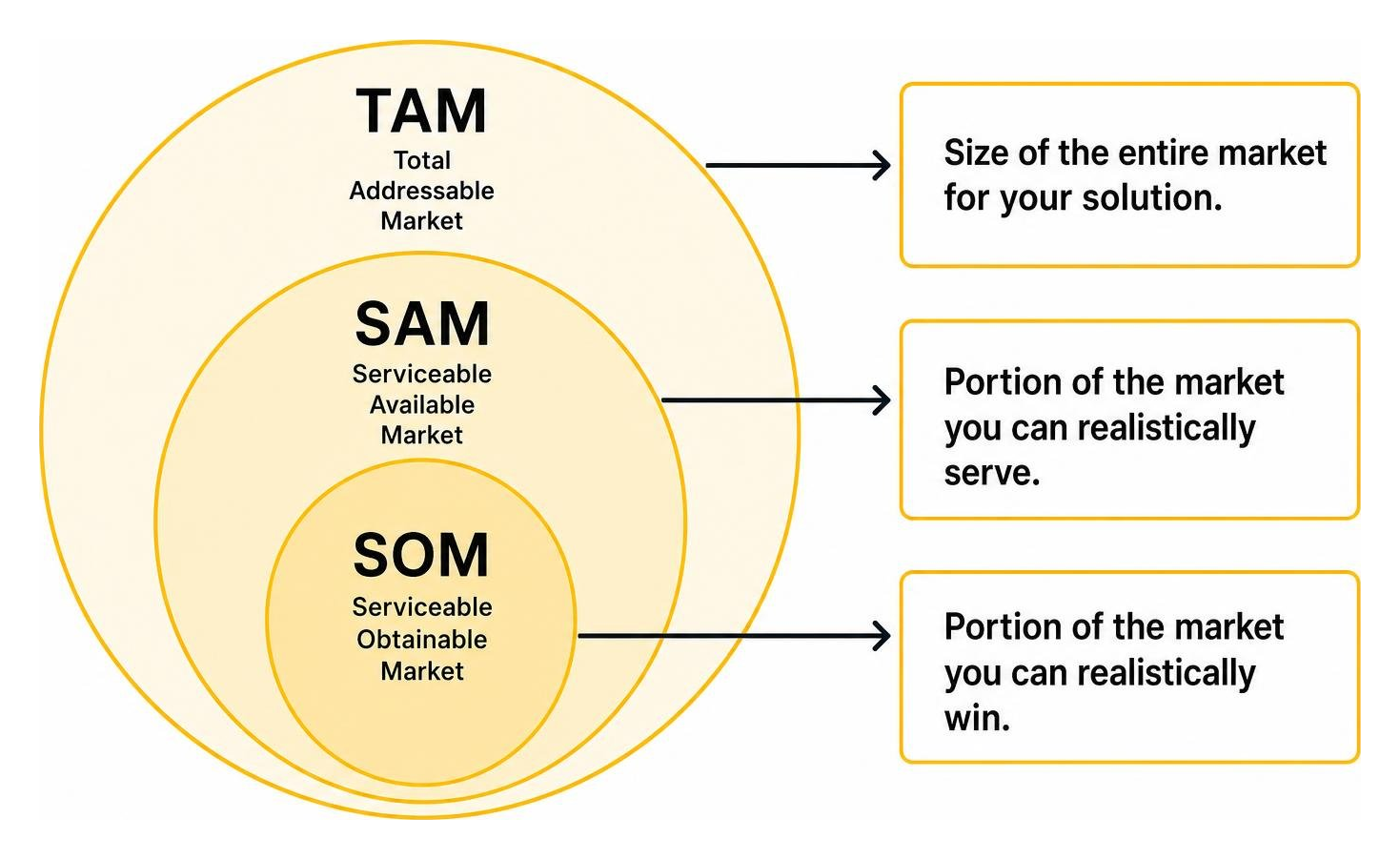
Accurately evaluating your market opportunity prevents your organization from pursuing segments that lack the scale or margin to support your overhead. We structure market sizing using the TAM, SAM, and SOM framework:
- Total Addressable Market (TAM): The absolute maximum revenue available if you captured 100% of your target industry.
- Serviceable Addressable Market (SAM): The specific portion of the TAM targeted by your offerings within your active geographic and operational scope.
- Serviceable Obtainable Market (SOM): The realistic market share your team can capture within the next 12 to 24 months based on current resources and competitive constraints.
Pairing this sizing model with competitor benchmarking allows us to identify underserved gaps. Implementing proven, winning business development strategies ensures that your value proposition directly addresses competitors’ service deficiencies and meets market demand.
Strategic Objectives, SMART Goals, and Revenue Roadmaps
Every growth objective must be translated into the SMART format: Specific, Measurable, Achievable, Relevant, and Time-bound. Vague aspirations—such as “expanding client relationships”—lead to disjointed activity. A defined objective states: “Acquire 12 enterprise accounts generating $1.2M in recurring revenue across the regional corridor by Q4.”
Research confirms that employees who understand how success is measured are 2x more likely to feel motivated. Clear revenue modeling bridges high-level objectives and daily activity quotas. For example, if your closing win rate is 20% and your average transaction size is $50,000, hitting a $1M expansion goal requires generating $5M in qualified pipeline.
Financial Forecasting, Budgets, and Break-Even Milestones
A business development plan requires robust financial modeling. Leaders must calculate the exact cost of client acquisition, necessary campaign investments, personnel additions, and partner enablement expenses.
Leveraging established SBA small business planning resources helps structure startup costs, evaluate semi-variable overhead, and calculate break-even targets. The fundamental break-even equation must guide all pricing and expansion targets:
$$\text{Break-Even Units} = \frac{\text{Fixed Costs}}{\text{Price per Unit} – \text{Variable Cost per Unit}}$$
Understanding your unit economics ensures you protect operating margins as revenue scales.
5 Proven Business Development Plan Templates for Every Stage

Selecting the right framework depends on your firm’s current lifecycle stage and primary expansion lever. Using proven business development plan templates helps structure these initiatives effectively across your team.
Strategic Growth and Market Expansion Template
Designed for established firms entering new geographic regions or launching secondary practice areas. This template outlines target buyer personas, regional demographic profiles, regulatory considerations, and competitive positioning.
When executing an expansion from Wilkes-Barre into major metropolitan centers or establishing service networks in New Orleans, having a clear strategy to grow business keeps your team focused on high-yield accounts while avoiding overextended resources.
Strategic Partnership and Channel Development Template
This model focuses on non-linear revenue generation through strategic alliances, co-selling agreements, and professional referral networks. Instead of relying solely on cold outbound prospecting, this framework structures:
- Partner Tier Definitions (e.g., Referral Advocate, Certified Co-Seller, Strategic Alliance).
- Commercial Incentive Structures and Fee Sharing Agreements.
- 90-Day Partner Activation Checklists.
- Co-branded asset deployment and mutual lead distribution protocols.
Structuring these relationships with well-crafted, winning business development proposals guarantees clear mutual obligations and accelerates contract signing.
Revenue Optimization and Pipeline Accelerator Template
Ideal for mid-market organizations seeking to maximize return from existing market penetration. This template centers on pipeline velocity, shortening sales cycles, raising win rates, and driving net revenue retention.
It focuses on critical metrics:
- Maintaining a Lifetime Value to Customer Acquisition Cost ratio (LTV:CAC) of at least 3:1.
- Reducing the CAC payback period to under 12 months.
- Systematizing cross-selling paths to increase client retention.
How to Execute, Track, and Optimize Your Growth Strategy

A plan remains an academic exercise without an execution cadence. Strategy succeeds when broken down into manageable operational rhythms, clear ownership hierarchies, and visible tracking mechanisms.
Translating Objectives into Measurable Milestones
Long-term goals must be decomposed into annual objectives, quarterly themes, and monthly operational milestones. Every initiative documented in your plan requires a single, named individual responsible for its execution.
Use a structured work breakdown structure to sequence dependencies. If launching an outbound campaign targeting institutional clients requires market research and collaterals, map these prerequisites on a timeline to prevent upstream delays from stalling downstream revenue generation.
Leveraging AI Workflows and Real-Time Dashboards
Modern business development execution integrates digital workflows to maintain momentum. Cloud-based platforms and AI tools streamline administrative workloads, draft outreach sequences, synthesize competitor research, and manage pipeline reporting.
Integrating dynamic dashboards provides leadership with instant visibility into leading indicators (such as discovery meetings booked and proposals delivered) rather than relying solely on lagging revenue figures. This allows teams to adjust outreach tactics before a quarterly revenue target is missed.
Best Practices and Mistakes to Avoid in Business Development
Executing business development initiatives requires avoiding preventable operational missteps while tailoring templates to industry-specific requirements.
Customizing Business Development Plan Templates for Specialized Industries
Generic templates must be adapted to industry-specific sales cycles and regulatory landscapes. In professional services, client acquisition relies heavily on trust, authority, and formal referral relationships rather than rapid transactional funnels.
In legal services, effective attorney business development requires strict adherence to jurisdictional ethics rules and advertising standards. Strategic law firm development focuses on deepening referral networks, expanding practice groups, and nurturing high-value institutional relationships across corporate networks.
Common Strategic Pitfalls and Governance Oversight
When analyzing growth initiatives that fail to meet projections, several recurring errors emerge:
- Targeting Too Many Segments: Spreading capital and outreach across five vertical markets simultaneously instead of dominating one or two primary niches.
- Unassigned Accountability: Assigning projects to teams rather than holding a single individual responsible for milestones and outcomes.
- Neglecting Enablement Budgets: Creating ambitious partnership goals without allocating resources for partner collateral, onboarding, and training.
- Failing to Track Leading Indicators: Monitoring closed revenue while ignoring pipeline creation metrics, leaving leadership unable to anticipate upcoming revenue shortfalls.
Frequently Asked Questions About Business Development Planning
How often should a business development plan be updated?
A business development plan should undergo a comprehensive annual overhaul paired with formal quarterly reviews. Action items, resource allocations, and tactical campaigns should be evaluated at the end of each quarter to reflect market shifts and internal performance data. Monthly reviews of core KPIs ensure your team remains on track throughout the year.
How long should a completed business development plan document be?
A standard, comprehensive business development plan typically runs 15 to 25 pages for full documentation, supported by detailed data appendices. However, it should always open with an accessible 2- to 3-page executive summary that highlights core growth targets, assigned owners, resource allocations, and primary milestones for rapid internal alignment.
What is the difference between a sales plan and a business development plan?
A sales plan focuses downstream on converting existing pipeline, managing quotas, setting territories, and closing immediate opportunities over a monthly or quarterly cycle. A business development plan operates upstream—identifying new target markets, establishing strategic partnerships, defining new revenue channels, and creating the long-term relationships that build sustainable sales pipelines.
Conclusion
Sustainable company growth is never the result of luck. It demands clear strategic vision, disciplined operational governance, and rigorous execution. By applying structured templates, our teams can cut through operational noise, align cross-functional resources, and build predictable, scalable revenue engines.
Whether your organization is expanding legal practices throughout Pennsylvania, scaling professional services across the Gulf Coast, or driving international enterprises, success begins with a clear, measurable roadmap. Invest the time to build your plan with intention, measure performance with precision, and lead your team with conviction.
Discover our full framework for building a business development plan and turn your firm’s growth objectives into measurable results today.