Leading Like a Boss: Strategies for Empowering Female Executives
- Leadership
- Word of the Day
- May 22, 2026
Leading Like a Boss: Strategies for Empowering Female Executives
The State of Female Leadership in 2026 (And Why It Matters Now)

Empowering female business leaders is one of the most important business conversations happening right now — and the numbers prove it.
Quick answers for women in leadership:
- Biggest barrier: The “broken rung” — women are promoted to manager at lower rates than men, creating a lasting pipeline gap
- Biggest opportunity: Gender-diverse executive teams are 25% more likely to achieve above-average profitability
- Key strategies: Mentorship, sponsorship, bias training, flexible work policies, and leadership development programs
- Current reality: Women hold just 28% of senior management roles globally, but momentum is building fast
- Economic power: Women-owned businesses contribute more than $2.5 trillion to the U.S. economy each year
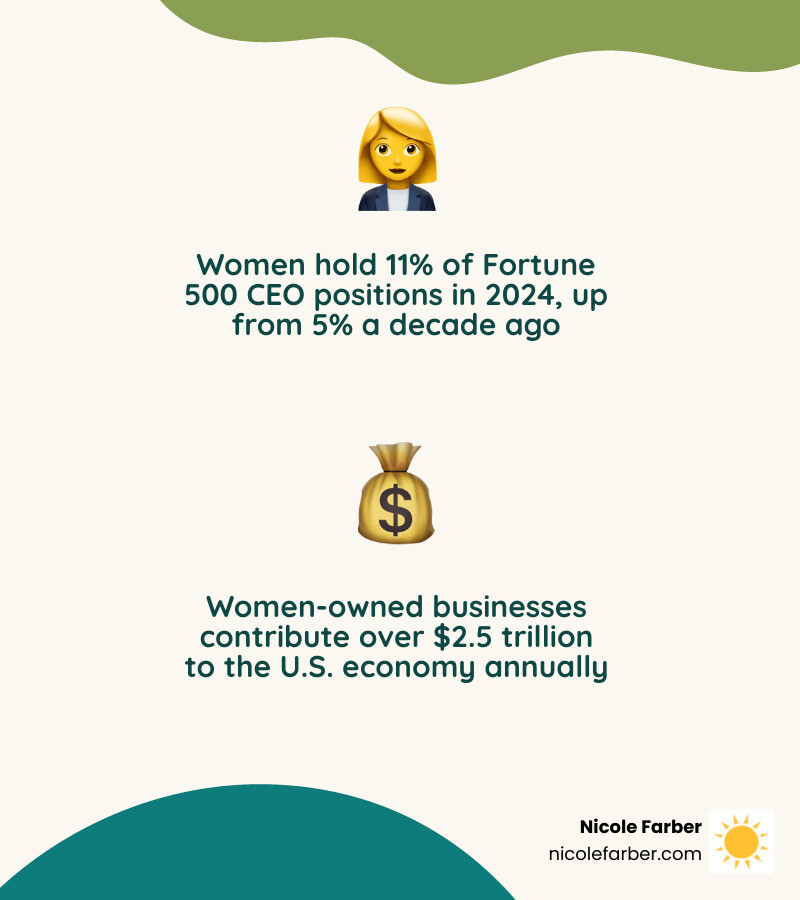
The progress is real. In 2024, women held 11% of Fortune 500 CEO seats and 30% of board seats — up from just 5% and 17% a decade earlier. Women’s aspiration to reach top management has jumped from 16% in 2014 to 54% in 2024. That is not a slow shift. That is a movement.
But momentum alone is not enough. There are still 11.6 million women-owned businesses in the U.S., women still earn 18 cents less per dollar than men for the same work, and women are still 14% less likely to be promoted than male peers — even when they outperform them.
The gap between potential and opportunity is still wide. Closing it takes strategy, community, and real talk about what works.
I’m Nicole Farber, CEO of ENX2 Legal Marketing and a single mother with 15+ years of experience building businesses and helping others do the same — and I’m passionate about empowering female business leaders at every stage of the journey. Below, I’ve gathered insights from top experts and leaders to give you a practical, honest roadmap for leading like a boss.
The Business Imperative of Empowering Female Business Leaders
When we talk about empowering female business leaders, we aren’t just talking about doing what’s “fair.” We are talking about what is smart. Research consistently shows that companies with gender-diverse leadership teams outperform their competitors. In fact, firms in the top quartile for gender diversity on executive teams are 25% more likely to have above-average profitability.
We’ve reached a historic milestone recently: 2023 was the first year in history where more than 10% of Fortune 500 CEOs were women. While that number is still far too low, the growth is accelerating. By 2024, that figure climbed to 11%, and board representation hit 30%. This isn’t just a trend; it’s a structural change in how the world’s most successful companies operate.
Inclusive leaders and organizations simply perform better. They are more innovative, better at problem-solving, and more resilient in the face of economic shifts. By Empowering Female Business Leaders, organizations tap into a broader range of perspectives that reflect their actual customer base.

To sustain this momentum, we must move Beyond Policies: Leadership Behaviors That Propel Women to the Top | Bain & Company. It’s one thing to have a diversity policy on paper; it’s another to foster a culture where women feel empowered to take risks, share their vision, and lead with authenticity.
Economic Impact and the Wage Gap
The economic power of women is staggering. There are more than 11.6 million businesses in the United States owned by women, and they generate a whopping $1.7 trillion in sales. When you look at the total impact, women-owned firms contribute over $2.5 trillion to the national economy every single year.
In places like Philadelphia and Wilkes-Barre, we see this impact firsthand. From local boutiques to major legal firms, women are the backbone of our local economies. However, we still face the persistent hurdle of the wage gap. As of 2022, women were still earning an average of 18 cents less than men for the exact same work.
This isn’t just a “women’s issue” — it’s an economic drag. When women are paid fairly, that money goes back into the community, into education, and into starting new ventures. Empowering Business Owners means advocating for pay transparency and equity so that the $2.5 trillion impact can grow even further.
Overcoming the Broken Rung and Pipeline Barriers
While the “glass ceiling” gets most of the headlines, the real problem often starts much earlier. It’s called the “broken rung.” This refers to the very first promotion from an entry-level role to a manager position.
Statistics show that women are 14% less likely to be promoted than their male coworkers, even when they outperform them. For every 100 men promoted to manager, only 87 women (and only 82 women of color) receive the same bump. This creates a bottleneck that thins out the pipeline before women even get a chance to look at senior management roles.
To fix this, we need to focus on Developing Female Leaders at the mid-career level. We can’t expect a diverse C-suite if we aren’t fixing the ladder at the bottom. Organizations must audit their promotion processes to ensure that performance, not just “potential” (which is often coded for “who looks like the current boss”), is the driving factor.
Core Competencies for Empowering Female Business Leaders
What does it actually take to lead at the highest levels? It isn’t just about technical skill; it’s about the “inner game.” Successful female executives often score higher on relational competencies, systems thinking, and purpose-driven vision.
We need to master specific skills like negotiation, self-advocacy, and resilience. Negotiation isn’t just about asking for a raise; it’s about navigating high-stakes, multi-party contexts to close gaps in compensation and authority. Programs like Executive Leadership for Women – Rice Business teach us how to manage our reputations and navigate the “glass cliff” — the phenomenon where women are more likely to be put in leadership roles during times of crisis.
Sometimes, the best way to sharpen these skills is through personalized support. That’s why many are discovering Unleash Your Inner Ceo Why A Female Leadership Coach Is Your Secret Weapon. A coach helps you depersonalize feedback and build the intrinsic confidence needed to take the top seat.

Shifting from Operator to Visionary CEO
One of the hardest transitions for any leader is moving from the “doer” to the “visionary.” Many women-led businesses get stuck because the founder becomes the bottleneck. We are often so good at the day-to-day operations that we struggle to let go.
Scaling a business requires a mindset shift. You have to move from managing tasks to managing outcomes. This involves:
- Strategic Delegation: Hiring people who are smarter than you in specific areas and empowering them to execute.
- Building Systems: Documenting your “business playbook” so the company can run without you.
- Data-Driven Leadership: Using KPIs and dashboards instead of just “gut feeling” to make decisions.
For more on this, check out Scaling a Women-Led Business: The Definitive Guide to Explosive Growth – Women Leaders Association News. If you feel like you’re drowning in the details, a Female Business Coach Ultimate Guide can provide the roadmap to help you step back and see the bigger picture.
Cultivating a Growth Mindset for Empowering Female Business Leaders
Leading boldly means being comfortable with being uncomfortable. Many of the most successful women CEOs thrive because they view failures as learning opportunities rather than indictments of their value. This is the essence of The inner game of women CEOs.
We must foster psychological safety within our teams, where risk-taking is encouraged. Authentic leadership means bringing your whole self to work — including your empathy and relational strengths. In an increasingly complex world, these human-centric skills are no longer “soft skills”; they are the hardest and most valuable skills a leader can possess.
Organizational Strategies to Support Women Executives
Empowering female business leaders isn’t just the responsibility of the women themselves. Organizations must change the systems around women rather than expecting women to change who they are.
Effective strategies include:
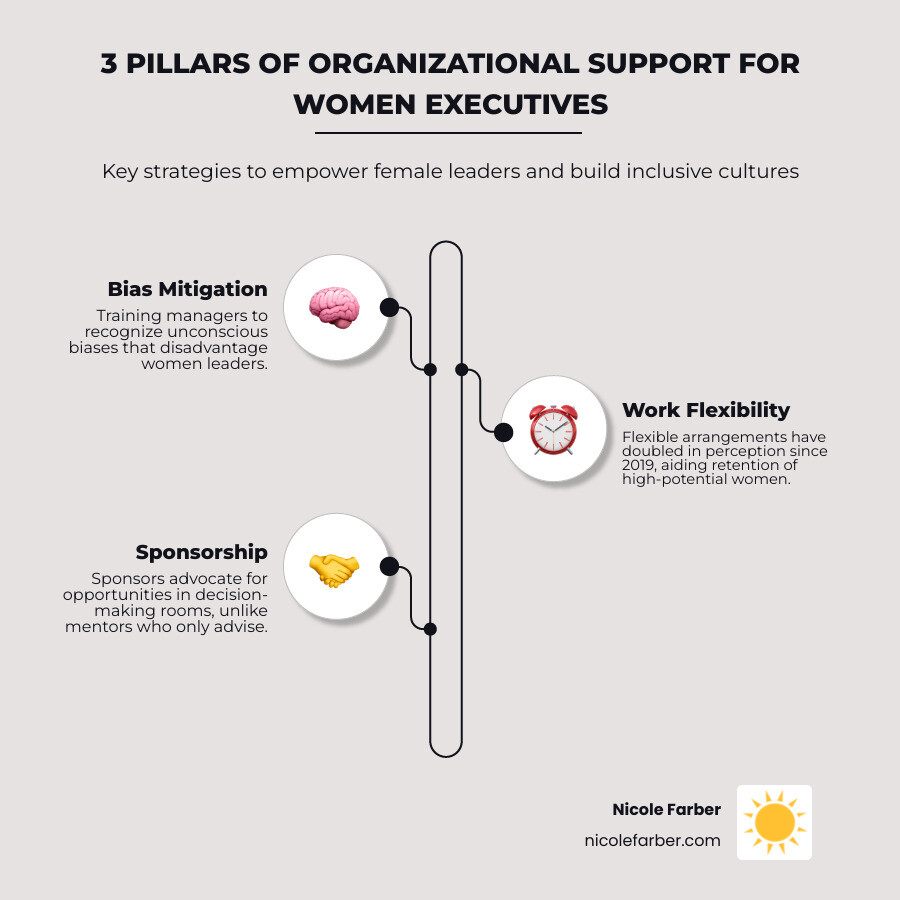
- Bias Training: Helping managers recognize the unconscious biases that lead them to describe women as “aggressive” for behaviors that are called “decisive” in men.
- Flexible Work Arrangements: Since 2019, the perception of available flexible work has jumped from 23% to 57%. This is crucial for retaining high-potential talent who are also managing the “second shift” at home.
- Transparent Career Paths: Maximize transparency about what is required to reach the next level.
Our Women In Business Empowerment Guide dives deep into how companies can build these inclusive cultures from the ground up.
Mentorship, Sponsorship, and Strategic Networking
There is a massive difference between a mentor and a sponsor. A mentor gives you advice; a sponsor gives you opportunities. A mentor talks to you; a sponsor talks about you in rooms where decisions are made.
To reach the next level, women need both. We need to build “relationship capital” early in our careers. This means:
- Strategic Networking: Using platforms like LinkedIn to connect with peers and leaders outside your immediate circle.
- Finding Male Allies: Sponsorship from male leaders is just as critical for breaking into male-dominated C-suites.
- Community Building: Joining groups where you can share “real talk” about the challenges of leadership.
Programs like Women in Leadership: Next Level Success | Columbia Business School ExecEd emphasize the power of building these networks. If you’re looking for more hands-on help, an Ultimate Business Coaching Female Entrepreneurs program can help you identify and approach potential sponsors.
Fostering Inclusive Cultures for Empowering Female Business Leaders
Whether you are in New Orleans, Luzerne County, or Antigua Guatemala, the need for community is universal. In Antigua Guatemala, initiatives like Emprender Mujer are helping women build economic power through local support. In New Orleans, we see a vibrant community of female entrepreneurs reshaping the city’s business landscape.
Fostering an inclusive culture means celebrating role models who don’t fit the traditional, masculine mold of leadership. It means creating spaces where a single mother in Wilkes-Barre feels just as empowered to lead as an executive in a Philadelphia skyscraper.
For more insights on this cultural shift, see how Business Women Leadership Experts Reveal How To Lead and how they are changing the game by putting people first.
Frequently Asked Questions about Female Leadership
What is the “broken rung” in female career progression?
The “broken rung” is the phenomenon where women get stuck at the very first step of the management ladder. While many people focus on the “glass ceiling” at the top, the data shows that the biggest gap happens at the first promotion to manager. Because fewer women are promoted to this entry-level leadership role, there are fewer women to promote to every subsequent level, leading to a permanent lack of diversity in senior management.
How do business degrees impact a woman’s path to the C-suite?
Formal education like a Bachelor of Science in Business Administration (BSBA) or an MBA acts as a catalyst. It provides the credentials and technical “hard skills” — like financial forecasting and strategic management — that help women stand out in competitive fields. Many top female CEOs started in technical roles (like engineering) and used an MBA to pivot into executive leadership.
Can women scale businesses without traditional venture capital?
Absolutely. While women-led businesses often receive a fraction of traditional VC funding, they can scale powerfully through “strategic bootstrapping,” revenue-based financing, or strategic partnerships. Scaling is about exponential revenue growth with incremental resource increases, and this can be achieved by focusing on product-market fit and documented systems rather than just external cash infusions.
Conclusion: Leading with Faith and Experience
Empowering female business leaders is a journey that requires both strategy and spirit. My own path as a single mother and CEO in the legal marketing industry has taught me that your “setbacks” are often just setups for your greatest successes. Whether we are working in Wilkes-Barre, Philadelphia, or New Orleans, we all face moments of doubt.
But I truly believe that when you lead with faith-driven perseverance and real-world experience, there is no ceiling you cannot break. You don’t have to choose between being a great leader and being your authentic self. In fact, being your authentic self is what will make you a great leader.
If you’re ready to take that next step, I encourage you to Empower Your Inner Boss Today. Your vision is too important to be stalled by broken systems or self-doubt. Let’s build something lasting together. For a deeper dive into leading with purpose, check out our Ultimate Faith-Based Leadership Guide.
The world is waiting for your leadership. It’s time to lead like a boss.