Empower Your Inner Boss Today
- Leadership
- In the News
- April 3, 2026
Empower Your Inner Boss Today
Why CEO Empowerment for Entrepreneurs Is the Leadership Edge You Need

CEO empowerment for entrepreneurs is the practice of leading by sharing power, not hoarding it — giving your team the autonomy, information, and trust they need to drive innovation and growth alongside you.
Here’s what it means in practice:
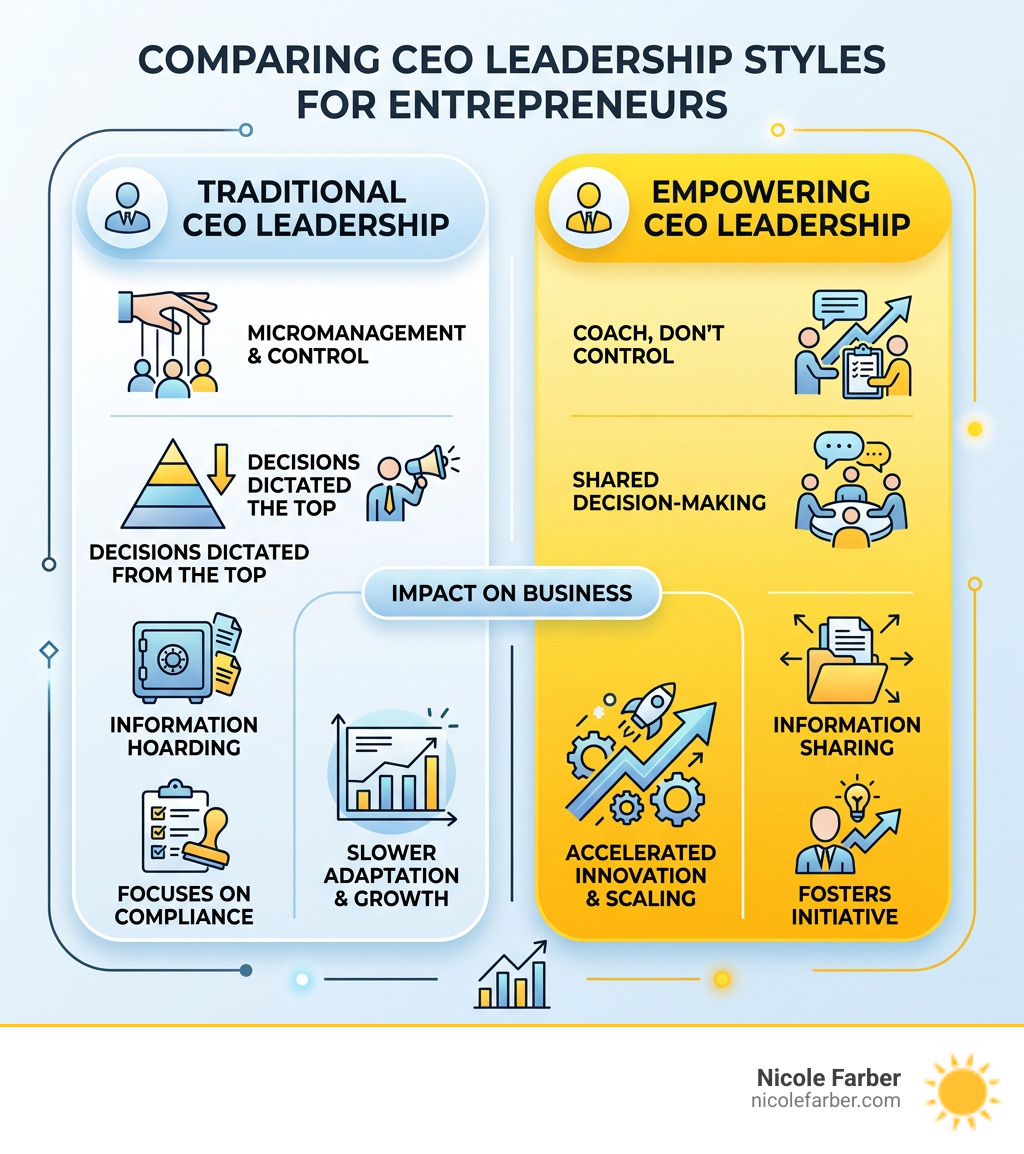
- Lead by example — model the work ethic and mindset you expect from your team
- Coach, don’t control — develop your people instead of micromanaging their output
- Share decisions — invite your top team into strategic conversations rather than dictating from the top
- Share information — keep your team informed so they can act with confidence
- Show genuine care — invest in the people who carry your vision forward
Research backs this up. A study of 97 firms found that empowering leadership directly and positively predicts corporate entrepreneurship (β = 0.32, p ≤ 0.01). The mechanism is simple: when leaders empower their teams, those teams share more information, think more creatively, and push the business forward in ways no single founder can do alone.
This is not soft leadership. It is strategic leadership.
Traditional command-and-control styles worked in slower, more predictable markets. Today — whether you’re running a law firm in Philadelphia, scaling a startup in Wilkes-Barre, or expanding into markets like Antigua Guatemala — the environment moves too fast for one person to hold all the answers. The leaders who win are the ones who build teams that think, adapt, and execute without waiting for permission.
And yet, 42% of startups still fail because they misread market demand — often because the founder never built a team capable of catching what they missed.
That gap is exactly what empowering leadership closes.
I’m Nicole Farber, CEO of ENX2 Legal Marketing, with over 15 years of experience helping law firms and businesses grow through smarter strategy and stronger leadership — and CEO empowerment for entrepreneurs is something I’ve lived, not just studied. In the next sections, I’ll walk you through the research, the real-world frameworks, and the practical steps that will help you lead with more impact and less burnout.
The Strategic Impact of CEO Empowerment for Entrepreneurs
When we talk about CEO empowerment for entrepreneurs, we aren’t just talking about being “nice.” We are talking about a fundamental shift in how a business breathes and grows. In traditional leadership, the CEO is the “bottleneck”—every decision, from marketing copy in Philadelphia to hiring in Luzerne County, has to pass through one desk. This creates a culture of “doers” rather than “decision-makers,” which is a recipe for stagnation.
Empowering leadership is different. It focuses on leading by example and coaching1099-1379(200005)21:3<249::aid-job10>3.0.co;2-#). Instead of telling people what to do, we show them how to think. This behavior fosters “corporate entrepreneurship”—the process where your team starts acting like owners. They look for new ventures, they suggest innovations, and they push for self-renewal within the company.
Scientific research shows that when a CEO exhibits empowering behaviors, it creates a ripple effect. It enhances the team’s perception of autonomy and creativity. When people feel they have the power to influence outcomes, they don’t just work harder; they work smarter. They stop solving “symptoms” and start building “systems.” For an entrepreneur, this is the only way to scale. If the business relies on your constant physical presence to function, you don’t own a business; you own a very high-stress job.
Why CEO Empowerment for Entrepreneurs Outperforms Traditional Command
The “Command and Control” model is dying because it fails to tap into the greatest asset any company has: collective intelligence. Traditional styles rely on extrinsic motivation—carrots and sticks. But CEO empowerment for entrepreneurs taps into intrinsic motivation and team efficacy.
When we empower our teams, we see several immediate shifts:
- From Output to Outcomes: Instead of measuring how many hours someone sat at a desk in New Orleans, we measure the impact of their decisions.
- Psychological Ownership: Team members stop saying “the company” and start saying “our company.” This shift is vital for unlocking business potential.
- Self-Management: Empowered teams don’t need a babysitter. They set their own high standards because they are personally invested in the mission.
Research by Kirkman and Rosen (1999) highlights that team empowerment leads to higher levels of customer service and productivity. In the legal marketing world, where we serve clients with high stakes, having a team that can pivot and make executive-level decisions without waiting for a 9:00 AM meeting is the difference between a win and a loss.
Scaling CEO Empowerment for Entrepreneurs Across Global Markets
As we expand our reach—whether that’s opening a new office in Wilkes-Barre or exploring opportunities in Antigua Guatemala—the complexity of the business grows exponentially. You cannot be everywhere at once. This is where international corporate entrepreneurship becomes the goal.
In global markets, environmental hostility and cultural differences can be high. A rigid, centralized leadership style often breaks under the pressure of local market dynamics. By using an empowering style, we allow our local leaders to adapt the business model to their specific environment while staying true to the core vision. This flexibility is what allows a business to remain resilient over the long term. We have found that empowering business owners through this model creates a sustainable legacy that transcends any single geographic location.
Maximizing TMT Information Elaboration for Startup Success
What exactly happens inside an empowered team that makes them so successful? The secret ingredient is something researchers call “TMT Information Elaboration.” TMT stands for Top Management Team. Information elaboration is just a fancy way of saying that the team is actually talking to each other, sharing unique knowledge, and debating ideas to find the best path forward.
CEO empowering leadership shapes these TMT processes by creating a “safe harbor” for information exchange. In a traditional hierarchy, subordinates often hide bad news or keep their best ideas to themselves to avoid conflict or “losing” to a colleague. In an empowered culture, the CEO acts as a facilitator.
For example, when we work with law firms in the Philadelphia VC space, we see that the most successful firms are those where the partners don’t just “stay in their lanes.” They elaborate on information. They take the diverse functional backgrounds of their team—marketing, legal, finance, operations—and they mash those perspectives together. This “elaboration” is what leads to those “aha!” moments that disrupt an industry.
To encourage this, we must:
- Foster a Trusting Atmosphere: Information won’t flow if people are afraid of being judged.
- Value Diversity of Thought: Don’t just hire people who agree with you. Hire people who challenge you, then empower them to speak up.
- Use Information Systems: Whether it’s a shared project board or a weekly “strategy day,” give your team the tools to share data in real-time.
Navigating Environmental Dynamism and Market Resilience
The business world is rarely a calm sea. It’s more like the unpredictable weather we sometimes see in New Orleans—one minute it’s sunny, the next there’s a storm surge. This is “environmental dynamism”—the rate and unpredictability of change in your market.
Statistics show that 42% of startups fail because they misread market demand. They build a product or service that nobody actually wants because they were looking at old data or ignoring the warning signs. Empowering leadership is a direct antidote to this.
In a highly dynamic environment, the CEO cannot possibly process all the incoming signals alone. You need “sensors” everywhere. When you empower your team, every member becomes a sensor. They notice the shift in client behavior, the new competitor tactic, or the emerging technology before it becomes a crisis.
However, there is a catch. Research suggests that while empowering leadership is more important in dynamic environments to get information flowing, there is a risk of “over-elaborating.” In a crisis, you can’t spend three weeks debating. You have to balance the effectiveness of strategic planning with the need for speed. The goal is to build a resilient business model that can absorb shocks and pivot quickly without losing its soul.
Practical Steps to Foster an Empowering Culture
So, how do we actually do this? How do we move from being an “operator” to being a “leader”? It starts with intentionality and small, daily habits.
- The 70% Rule: This is a game-changer for delegation. If someone on your team can do a task to at least 70% of your standard, delegate it. They will get better with practice, and your focus will be freed up for high-level CEO coaching services.
- Schedule “Strategy Days”: Block off time on your calendar that is non-negotiable. No operational meetings. No Slack messages. Just deep work on the vision and metrics of the business.
- Invest in Mentorship: Companies that engage with mentors raise 7x more money and see 3.5x better user growth. Whether you are in Wilkes-Barre or Luzerne County, find a community of peers who can hold you accountable.
- Use Social Media as a Listening Tool: 89% of small business owners find social media helps maintain customer engagement. Don’t just post; listen to what the market is telling you.
- Lead with Faith and Resilience: My own journey as a single mother taught me that resilience is the backbone of entrepreneurship. You will face setbacks. Your team will make mistakes. Empowering leadership means having the faith to let them fail, knowing that those failures are the “tuition” for future success.

At ENX2, we often say that we are “legal marketing with a soul.” That soul comes from a culture where every team member—from our offices in the USA to our partners in Antigua Guatemala—feels empowered to bring their whole selves to the table. We’ve found that empowering women entrepreneurs and leaders, in particular, often brings a unique level of empathy and strategic intuition to the CEO role.
Measuring Growth: Metrics for the Empowered Entrepreneur
“What gets measured gets managed.” If you are truly moving toward CEO empowerment for entrepreneurs, your metrics should reflect that shift. You should move away from “busy work” metrics and toward “impact” metrics.
Comparing Empowering vs. Transactional Growth Metrics
| Metric Type | Transactional/Traditional | Empowering/Strategic |
|---|---|---|
| Decision Speed | Decisions wait for CEO approval | Decisions made at the point of contact |
| Team Engagement | High turnover, low initiative | High retention, proactive problem solving |
| Growth Driver | Sales team hustle only | Innovation and “Corporate Entrepreneurship” |
| Customer Focus | One-time transactions | Customer retention (5% increase = 25-95% revenue boost) |
| CEO Role | Chief Problem Solver | Chief Vision Officer & Coach |
If your calendar reflects more strategic sessions and fewer “firefighting” meetings, you are on the right track. If your team is coming to you with solutions instead of just problems, that is a sign of success.
Frequently Asked Questions about CEO Leadership
What is the biggest risk of over-emphasizing information elaboration?
The biggest risk is “analysis paralysis.” In very fast-moving or dynamic environments, too much debate can slow down decision-making. The key for an empowered CEO is to know when to let the team elaborate and when to step in and say, “We have enough info—let’s execute.”
How does empowering leadership prevent the 42% startup failure rate?
Startups usually fail because they misread market demand. An empowering leader builds a team that is constantly “listening” to the market. By fostering information sharing and autonomy, you ensure that the person closest to the customer has the power to suggest a pivot before the cash runs out.
Can entrepreneurs in dynamic environments like New Orleans use this style?
Absolutely. In fact, it is more necessary there. Dynamic environments require high-speed adaptation. You cannot adapt quickly if every decision has to go through a central bottleneck. Empowering your team allows them to respond to local changes in real-time, which is the ultimate competitive advantage.
Conclusion
The journey from a hands-on founder to an empowered CEO is not an easy one. It requires us to get out of our own way, to trust others with our “baby,” and to redefine our value not by what we do, but by what we enable.
As a single mother who built a business from the ground up, I know the urge to control every detail. But I also know that true growth—the kind that allows you to serve law firms in Philadelphia, support communities in Wilkes-Barre, and impact lives in Antigua Guatemala—only happens when you empower others.
Unleash your inner CEO today. Start small. Delegate one task. Share one piece of strategic info. Show your team that you trust them. When you empower your team, you don’t just grow a business; you build a legacy.
We are here to help you navigate this transition. Whether you need business leadership coaching or a strategic partner to handle your legal marketing, your leadership is the ceiling of your business. Raise that ceiling today by empowering your inner boss.
Ready to lead with more impact? Connect with us at nicolefarber.com/speaking-engagements/ to learn how we can help you and your team reach new heights.