How to Trade Your Billable Hours for Executive Power
- Entrepreneurship
- Word of the Day
- May 20, 2026
How to Trade Your Billable Hours for Executive Power
Why CEO Coaching for Lawyers Is the Career Move You Can’t Afford to Skip

CEO coaching for lawyers is a specialized form of executive development that helps attorneys move beyond legal expertise and into strategic leadership — think managing partner, General Counsel, or law firm CEO.
Here’s a quick snapshot of what it involves:
- What it is: One-on-one coaching that builds business acumen, leadership skills, and executive presence — the things law school never taught you
- Who it’s for: Partners, managing partners, senior associates, and in-house counsel ready to lead, not just practice
- Key benefits: Stronger business development, better team management, higher promotion rates, and clearer career direction
- What it covers: Time management, delegation, firm economics, client growth, imposter syndrome, and career transitions
- How long it takes: Typically 3 to 24 months, with sessions once or twice a month
- What it costs: Generally $300–$500 per hour for an experienced coach
- Why it works: In-house counsel who work with a coach are twice as likely to be promoted to General Counsel
Law school teaches you to think like a lawyer. It does not teach you how to run a business, lead a team, or build a book of clients. That gap is real — and it shows up fast once you reach a senior level.
The pressure is real too. Whether you’re navigating the competitive Philadelphia legal market, managing a growing team in Wilkes-Barre, or trying to scale past the $1M revenue barrier in your own firm, the skills that made you a great attorney won’t automatically make you a great leader.
That’s exactly where CEO coaching comes in.
I’m Nicole Farber, CEO of ENX2 Legal Marketing, with over 15 years of experience helping law firms grow — and I’ve seen how CEO coaching for lawyers transforms not just careers, but entire firms. Whether you’re ready to break through a revenue ceiling or step into a leadership role with confidence, this guide will show you how to make that shift.
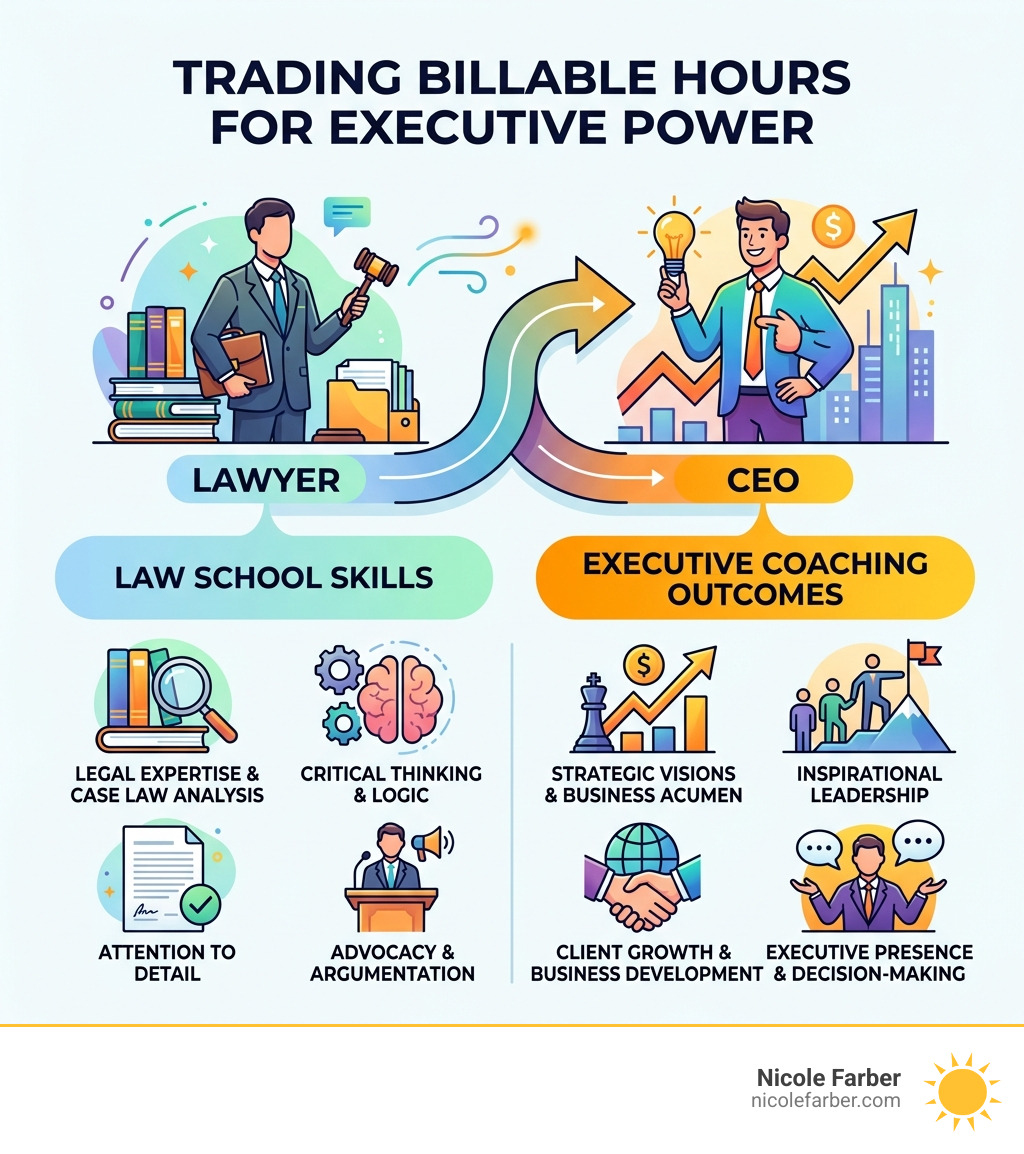
The Evolution of Legal Leadership: Why CEO Coaching for Lawyers is Essential in 2026
As we navigate the legal landscape of April 2026, the traditional model of the “brilliant solo practitioner” is fading. Today, the most successful firms in hubs like Philadelphia and Wilkes-Barre aren’t just led by great litigators; they are led by strategic CEOs. The evolution of legal leadership requires a move away from the “billable hour” mindset toward a “value-creation” mindset.
Law school is excellent at teaching you how to analyze case law, but it leaves massive gaps in business acumen and strategic influence. Most attorneys reach senior leadership roles only to realize they have never been taught how to read a P&L statement, how to inspire a disillusioned associate, or how to navigate the complex firm economics that dictate partner compensation.
More info about executive coaching helps bridge these gaps by providing a tailored, confidential space to develop the “soft skills” that yield hard results. In a market as competitive as Philadelphia, having a coach isn’t a sign of weakness; it’s a strategic edge that allows you to outmaneuver firms still stuck in 20th-century management styles.
Bridging the Gap Between Legal Expertise and CEO Coaching for Lawyers
The transition from a high-performing attorney to a high-performing executive requires significant behavioral shifts. As a lawyer, your value is often tied to your capability—how well you can draft a brief or argue a motion. As a CEO, your value is tied to your influence—how well you can lead a team to execute a collective vision.
In Wilkes-Barre and throughout Luzerne County, firm dynamics are often rooted in deep community ties and long-standing traditions. However, local leadership culture is shifting. Modern CEO coaching for lawyers focuses on helping you transition from “doing the work” to “leading the people who do the work.” This involves:
- Reframing Challenges: Moving from a reactive stance (solving the immediate legal problem) to a proactive stance (building systems to prevent problems).
- Effective Delegation: Learning that “if you want it done right, do it yourself” is the fastest way to stall a firm’s growth.
- Strategic Questioning: Using coaching methodologies to ask the right questions of your partners and staff, fostering a culture of accountability.
More info about CEO coaching services can help you identify the unproductive habits—like micromanaging or avoiding difficult feedback—that are holding your firm back from its next level of growth.
From Managing Partner to Strategic Visionary
The title of “Managing Partner” often feels like a burden of administrative tasks. We want to help you trade that burden for the role of a Strategic Visionary. This requires a deep understanding of organizational culture and firm economics.
In New Orleans, where legal traditions are as rich as the local culture, leadership trends are moving toward more inclusive and emotionally intelligent management. A strategic visionary doesn’t just manage the “chaos”; they design the future of the firm.
To make this shift, you must embrace several leadership mindset shifts:
- From Billable Hours to ROI: Focus on the return on investment of your time and your team’s energy.
- From Expertise to Empathy: Understanding that your team’s emotional buy-in is just as important as their billable output.
- From Conflict Avoidance to Conflict Resolution: Addressing partner disputes or staff performance issues head-on rather than letting them fester.
- From Individual Success to Collective Growth: Your legacy isn’t your win-loss record; it’s the strength of the firm you leave behind.
Key Benefits of Transitioning from Practitioner to Powerhouse
The benefits of CEO coaching for lawyers extend far beyond the balance sheet. According to industry statistics, 98.5% of coaching clients report satisfaction with their experience. Why? Because coaching addresses the internal barriers that technical expertise cannot touch.
One of the most significant hurdles for even the most successful lawyers is imposter syndrome. Despite winning major cases or making partner, many leaders feel like they are “faking it.” Coaching provides the tools to combat these confidence traps and build genuine executive presence. By developing emotional intelligence, you become a leader who doesn’t just command authority but inspires trust.
More info about the benefits of business coaching highlights how these internal shifts lead to external promotions. In fact, in-house counsel who hire a coach are twice as likely to be promoted to the General Counsel role.
Driving Growth Through Strategic CEO Coaching for Lawyers
Growth is often the primary driver for seeking coaching. Whether you are a solo practitioner in Luzerne County or a senior partner in a mid-sized Philadelphia firm, you will eventually hit a revenue barrier. These barriers are rarely caused by a lack of legal skill; they are caused by a lack of business development systems.
More info about building a law firm involves more than just getting more clients—it’s about getting the right clients. CEO coaching for lawyers helps you:
- Build a business development “muscle” that aligns with your personal style.
- Identify high-potential networking opportunities within the local community.
- Create a 12-month growth roadmap that moves you from “chugging along” to exponential scaling.
- Optimize your cash flow so you can reinvest in the talent and technology needed to grow.
Building High-Trust Teams and Accountability
A firm is only as strong as its team. If you find yourself saying, “I don’t want to be a jerk, but my associates give me crappy work,” you are facing a leadership challenge, not just a staffing one.
Coaching teaches you the art of delegation and the science of performance management. Instead of fixing work yourself—which kills your time and their growth—you learn to provide feedback that drives improvement. This builds a high-trust environment where subordinates feel empowered and are more likely to trust their leader’s abilities.

Navigating Modern Challenges: AI, Mergers, and Work-Life Balance
By April 2026, the legal industry is grappling with unprecedented disruptions. AI integration is no longer a “future” topic; it is a daily reality that changes how we bill and how we research. Furthermore, record numbers of firm mergers require leaders who can integrate disparate cultures without losing top talent.
The restorative power of a leadership retreat—perhaps in a serene setting like Antigua Guatemala—can provide the mental clarity needed to navigate these shifts. More info about leading instead of lawyering emphasizes that a leader’s job is to steer the ship through the storm, not just row harder.
Scaling Operations in a Disruptive Era
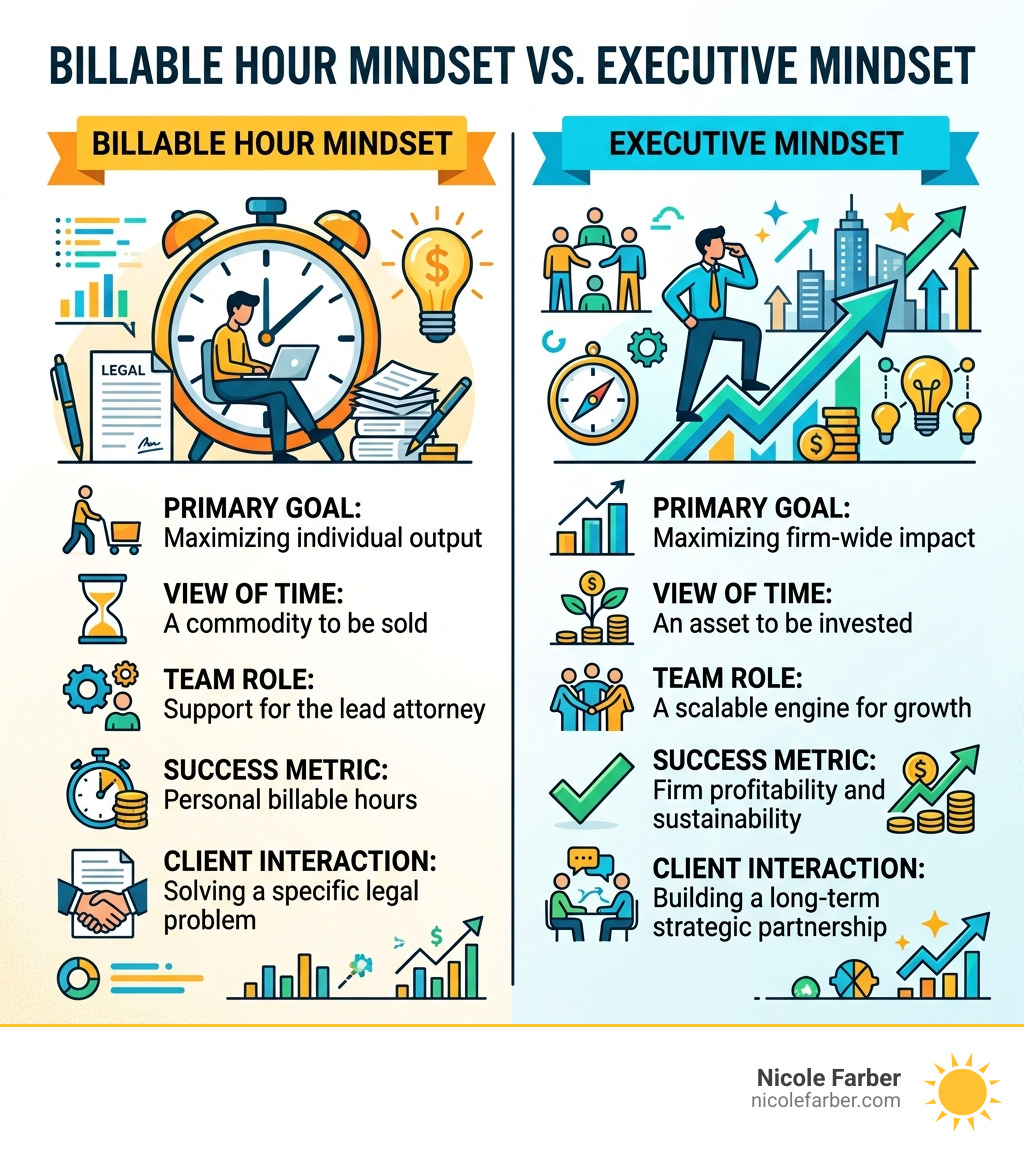
To scale in 2026, you must optimize your systems. This means moving away from manual processes and toward digital transformation. It also requires a fundamental shift in how you view your time.
| Feature | Billable Hour Mindset | Executive Mindset |
|---|---|---|
| Primary Goal | Maximizing individual output | Maximizing firm-wide impact |
| View of Time | A commodity to be sold | An asset to be invested |
| Team Role | Support for the lead attorney | A scalable engine for growth |
| Success Metric | Personal billable hours | Firm profitability and sustainability |
| Client Interaction | Solving a specific legal problem | Building a long-term strategic partnership |
Sustaining Performance Through Wellness and Boundaries
You cannot lead effectively if you are burnt out. The “always-on” culture of law is a recipe for disaster. CEO coaching for lawyers incorporates wellness and radical acceptance as core components of performance.
Learning to set effective boundaries with clients and partners is not about working less; it’s about working better. By managing distractions and prioritizing high-value tasks, you can achieve a work-life integration that keeps you sharp for the long haul. This is especially important for firm owners who are also balancing family responsibilities—a journey I know well as a single mother and CEO.

How to Select and Implement a Coaching Program
Selecting the right coach is a critical decision. You want someone who understands the unique economics of a law firm but also possesses the “gold standard” of coaching—ICF (International Coaching Federation) credentials.
When looking for CEO coaching for lawyers, consider these factors:
- Chemistry and Trust: You must feel comfortable sharing your deepest professional fears.
- Industry Experience: A coach who has sat in the GC or Managing Partner chair brings an “insider” perspective that general career coaches lack.
- Confidentiality: Ensure there is a clear, written contract regarding confidentiality, especially if your firm is sponsoring the program.
- Action-Oriented Approach: Look for a coach who provides a concrete action plan, not just a “venting session.”
More info about business leadership coaching can help you determine if you are truly ready for the commitment that coaching requires.
Structuring Your Executive Journey
A typical coaching engagement lasts between 6 and 12 months, though some leaders maintain a coaching relationship for years. The process usually begins with a 360-degree feedback assessment to identify your blind spots. From there, you set specific, measurable goals.
Measuring the ROI of coaching can be done through:
- Revenue Growth: Tracking firm profitability or your personal book of business.
- Promotion and Retention: Achieving that move to General Counsel or reducing associate turnover.
- Time Freedom: Measuring how many hours you’ve successfully delegated to others.
- Leadership Trust: Using follow-up surveys to see if your team’s trust in your leadership has increased.
Frequently Asked Questions about Legal Executive Coaching
How do you measure the ROI of CEO coaching for lawyers?
ROI is measured through both quantitative and qualitative metrics. Quantitatively, we look at increases in firm revenue, higher billable realization rates through better delegation, and the achievement of specific career milestones (like partner or GC appointments). Qualitatively, ROI is seen in reduced stress, improved team morale, and higher client satisfaction scores. Studies show that 98.5% of clients find the investment worthwhile.
Is executive coaching confidential when sponsored by a law firm?
Yes. Confidentiality is a cornerstone of the coaching relationship. While a firm may pay for the coaching, the specific details of the sessions remain between the coach and the attorney. A reputable coach will provide the firm with high-level progress reports regarding goal achievement without disclosing the private contents of the conversations. This should always be outlined in a written contract before the engagement begins.
How does coaching differ from traditional legal mentoring or therapy?
Mentoring is usually “past-oriented” or “advice-based,” where a senior attorney tells you how they did it. Therapy often focuses on healing past wounds. CEO coaching for lawyers is “future-oriented” and “action-based.” It focuses on behavioral shifts, strategic goal setting, and accountability. A coach doesn’t just tell you what to do; they help you unlock your own leadership potential through powerful questioning and objective feedback.
Conclusion
The journey from a practitioner to a powerhouse isn’t something you have to do alone. In the business world, there is no “gold star” for struggling in isolation. The most successful leaders in Philadelphia, New Orleans, and beyond have all relied on advisors to help them see what they couldn’t see themselves.
At Nicole Farber, we believe in the power of faith-driven leadership and real-life experience. My own journey as a single mother and CEO has taught me that resilience and strategic growth go hand-in-hand. Whether you are navigating a complex merger or simply trying to find your voice in the boardroom, we are here to provide the guidance you need to stop just lawyering and start leading.
Take the next step with our Business Leadership Coaching Guide and begin your transformation from a lawyer into a true CEO.