The Unwritten Rules of Real World Leadership Every Manager Needs
- Leadership
- In the News
- September 2, 2026
The Unwritten Rules of Real World Leadership Every Manager Needs
What Real World Leadership Looks Like in Practice

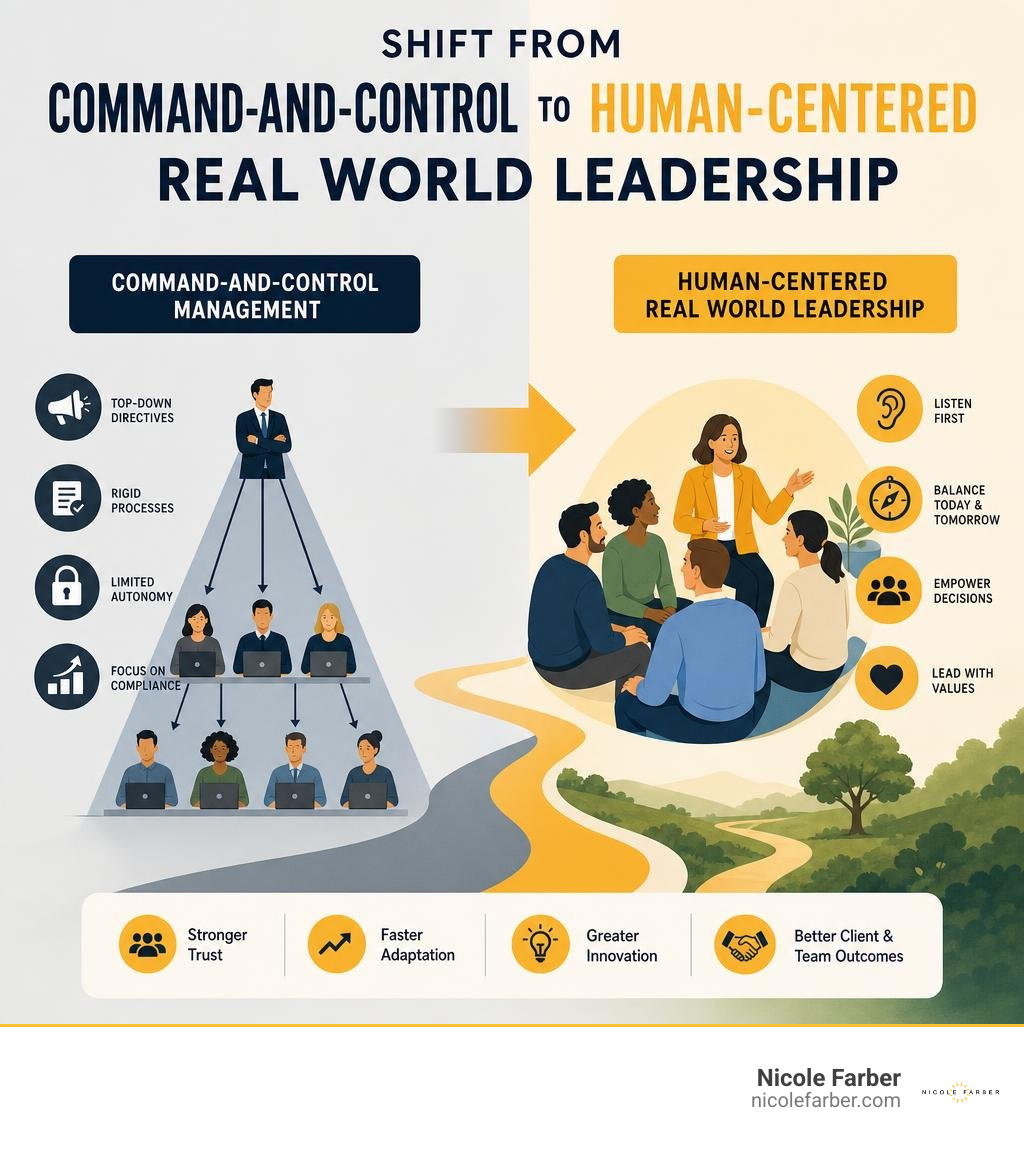
Real world leadership is the daily practice of guiding teams through rapid change with empathy, radical transparency, and clear direction rather than top-down control.
To apply practical leadership skills immediately in high-stakes environments, follow these four core rules:
- Listen before taking action: Replace rigid directives with active listening to uncover the real problem before prescribing a fix.
- Balance the present with the future: Keep your daily operations steady while testing new technology like AI with your team.
- Decentralize decision-making: Give frontline staff the autonomy to solve client issues quickly without bureaucratic bottlenecks.
- Choose values over convenience: Show up personally during tough moments to build genuine trust with your team and clients.
I’m Nicole Farber, CEO of ENX2 Legal Marketing, and over the past 15+ years, I have helped law firms and businesses across the country navigate disruption and build thriving cultures. Through hands-on turnarounds and national speaking, I teach managers how Real world leadership begins with self-awareness and transparent communication to unlock lasting team success.
Real world leadership terms to know:
The 4 Core Pillars of Real World Leadership
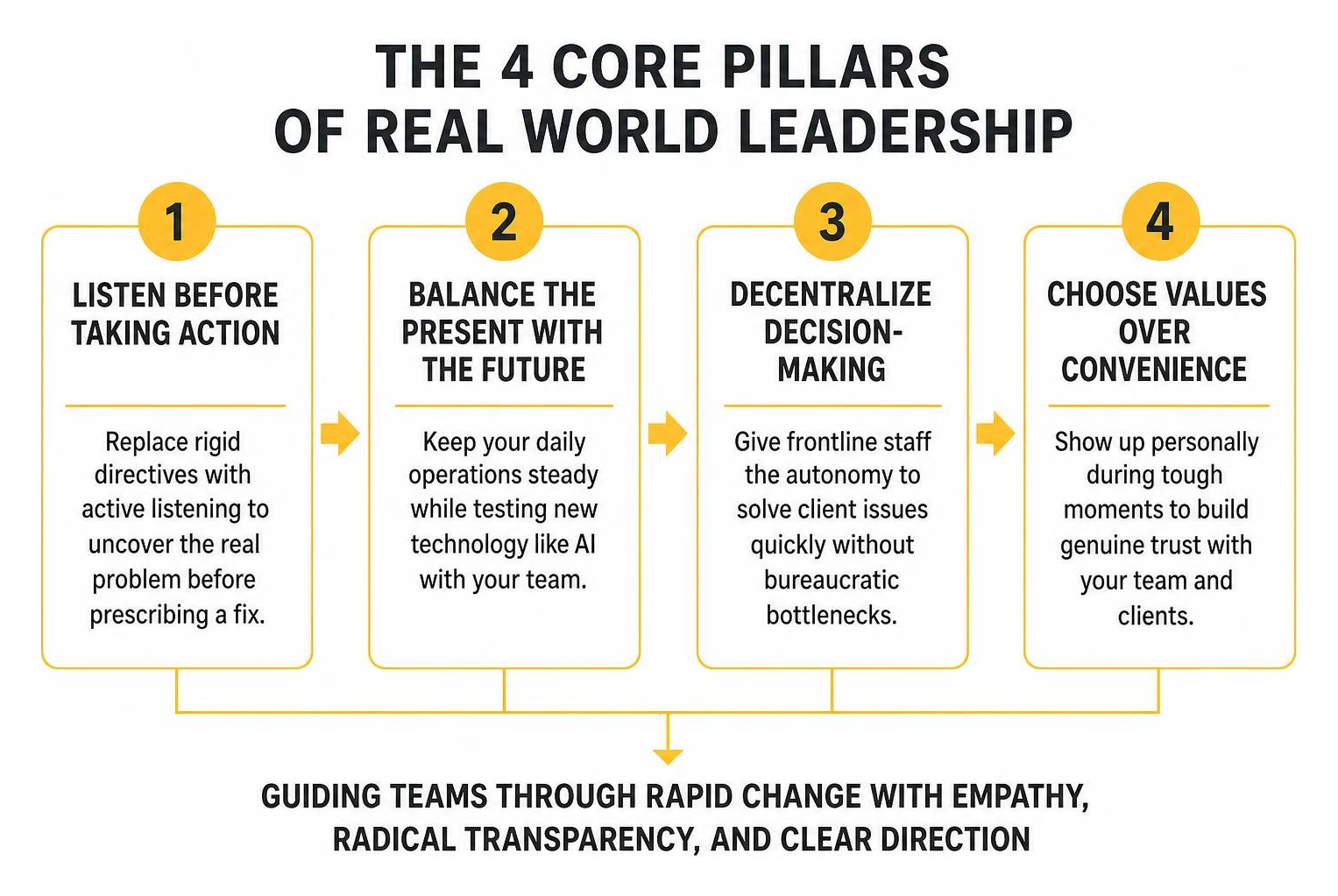
Academic theories often fall apart when deadlines loom and market conditions shift overnight. True transformational management relies on the full-range leadership model formulated by Bernard Bass and Bruce Avolio. When we coach executives across the USA—from bustling practices in Philadelphia to energetic teams in New Orleans—we consistently see that long-term organizational success relies on mastering four dynamic pillars. By sharpening your practical leadership skills and examples, you build a resilient, high-performing workplace.
- Idealized Influence (Leading by Example): Leaders embody the exact standards, humility, and work ethic they expect from their teams. When Satya Nadella took over at Microsoft, he transformed a cutthroat culture into one rooted in a “learn-it-all” mindset rather than a “know-it-all” attitude. Leading by example means you never ask your team to make a sacrifice you are unwilling to make yourself.
- Intellectual Stimulation (Encouraging Innovation): Real-world managers do not claim to have every answer. They encourage healthy debate, challenge standard assumptions, and invite team members to solve complex business bottlenecks. For instance, Melanie Perkins democratized complex graphic software at Canva by continually inviting user-centric experimentation and empowering product teams to overhaul legacy workflows.
- Individualized Consideration (Coaching the Person, Not Just the Role): True leadership treats employees as complete human beings with distinct strengths, personal goals, and family commitments. Research shows that simple policy shifts centered on employee well-being—such as extending paid parental leave—can slash maternal turnover by 50%. Leaders who mentor individuals directly build lasting loyalty and high retention.
- Inspirational Motivation (Articulating a Shared Purpose): Transformational leaders cast a compelling vision of what the future holds. They connect daily administrative tasks to a meaningful mission, rallying their workforce to navigate intense industry headwinds together.
How Real World Leadership Cultivates Radical Transparency and Trust
At least 75% of employees are demanding greater authenticity in their work. Modern professionals can spot corporate platitudes and empty buzzwords instantly. Genuine trust is built through horizontal, candid communication rather than top-down executive declarations.
Practicing transparency means being open about operational realities, client feedback, and financial health. When leaders openly share both victories and challenges, it fosters psychological safety. Team members stop hiding operational mistakes and start collaborating to fix them. As highlighted in a insightful Forbes analysis on attention over action, great management does not begin with frantic, reactive measures; it begins with mindful presence, deep listening, and intentional focus. Practicing being a good leader in the workplace means stepping away from micromanagement to build an environment rooted in mutual respect.
Navigating Adaptive Challenges Over Technical Quick Fixes
Most managerial mistakes happen when leaders treat complex people problems as simple mechanical glitches. Leadership scholar Ronald Heifetz famously distinguished between technical problems and adaptive challenges:
- Technical Problems: These have clear definitions and known solutions solvable through standard operating procedures, existing expertise, or software tools (like submitting an IT support ticket or updating a standard billing template).
- Adaptive Challenges: These require shifts in human values, daily habits, and organizational culture (such as integrating artificial intelligence into legacy workflows, resolving interdepartmental friction, or restructuring a firm after rapid growth).
Adaptive challenges cannot be solved for your staff; they must be solved by them through lived behavior. When executives offer superficial quick fixes to complex cultural dilemmas, they short-circuit collective growth and produce mere compliance rather than genuine buy-in. Real leadership requires regulating team distress, giving the work back to the people facing the dilemma, and understanding what leadership truly requires. Remember: people do not resist change itself—they resist the personal loss, uncertainty, and identity disruption that often accompany it.
Leading Through Crisis: Decentralized Teams and Self-Organization
During unexpected market disruptions, rigid corporate hierarchies often experience acute paralysis. When every decision must climb through multiple layers of administrative review, response times grind to a halt. Complexity science demonstrates that living systems survive chaos through self-organization, local initiative, and shared purpose rather than central control.
As documented in Margaret Wheatley’s research on living systems and crisis leadership, mechanistic bureaucracy is a fragile human construct that often collapses during real-world crises. During catastrophic events like Hurricane Katrina, rigid protocols left hundreds of certified emergency responders sitting idle in staging hotels for administrative briefings while decentralized volunteer boat networks successfully rescued thousands of stranded citizens.
| Dimension | Rigid Hierarchical Bureaucracy | Decentralized Network Response |
|---|---|---|
| Decision Authority | Centralized in top executive tiers | Distributed to frontline teams |
| Operational Flow | Standard procedures & strict approvals | Emergent order guided by shared purpose |
| Communication Channels | Vertical, compartmentalized silos | Horizontal, interconnected, and redundant |
| Response to Crisis | Protocol paralysis & paradigm blindness | Rapid self-organization & local innovation |
| Primary Motivation | Compliance, rules, and oversight | Shared purpose, empathy, and initiative |
Decentralized Decision-Making in High-Stakes Environments
Hierarchical organizations frequently suffer from paradigm blindness—a dangerous tendency to filter out critical on-the-ground data simply because it contradicts existing operational manuals. In high-stakes environments, leaders must distribute operational authority directly to frontline employees who possess immediate situational awareness.
Whether managing client intake for law firms in Wilkes-Barre or coordinating field teams across Luzerne County, decentralized operations rely on clear intent rather than micromanagement. When every employee understands the core mission, autonomous nodes can make rapid, values-aligned decisions that keep operations moving without managerial bottlenecks.
Practicing Selective Presence and Values-Based Moments of Truth
A defining test of executive character is what leadership experts call a “Moment of Truth.” This is the precise moment when the distance between what a leader claims to value and what they actually choose to do becomes clearly visible to everyone.
This is where the discipline of Selective Presence comes into play. Selective Presence is the conscious, values-driven choice of where a leader commits their physical time, emotional energy, and institutional attention. True leadership is not proven during comfortable quarters when resources are abundant; as explored in depth when navigating leadership when convenience ends, leadership begins when convenience ends and difficult moral trade-offs must be made.
Whether it means an executive personally attending a challenging meeting at a facility facing major restructuring or choosing to sit alongside staff in economy class during company-wide cost reductions, where you stand speaks louder than any mission statement. The enduring legacy of a leader is measured by the gap between their words and their daily footprints.
Balancing the Now and the Next in the Era of AI
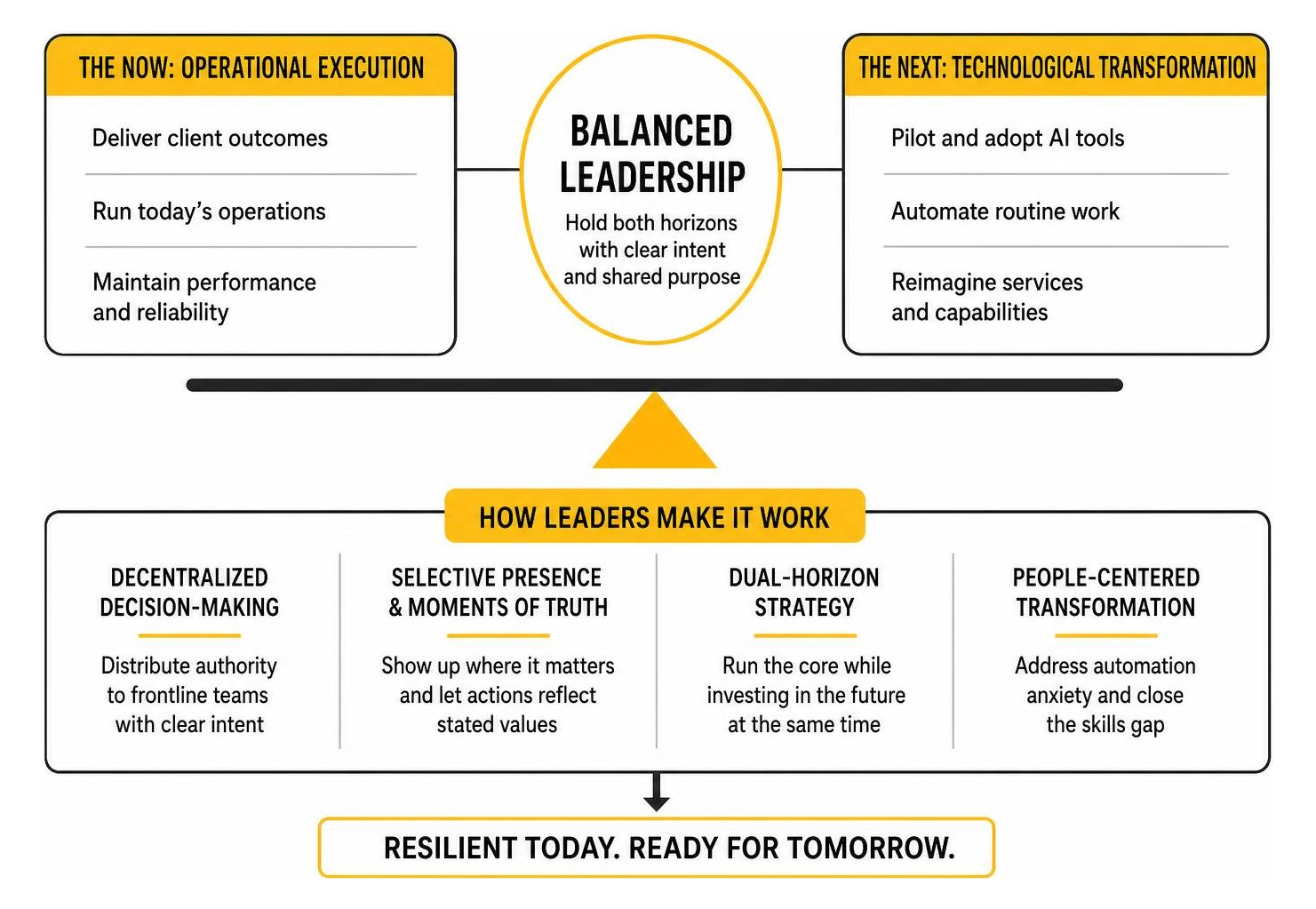
Modern executives face a difficult balancing act: sustaining immediate operational performance (“The Now”) while preparing their organizations for technological disruption and automation (“The Next”). Research presented at global economic forums shows that 50% of employees do not feel technology will make work better for them, while 41% fear their roles will be replaced by automation. Furthermore, 39% of core workforce skills will be disrupted by 2030.
Navigating this reality requires dual-horizon leadership. Leaders must learn the actionable steps to become an effective leader by adopting a multi-tempo transformation strategy. While certain operational units focus on immediate client deliverables, other teams pilot generative AI tools, automate routine administrative tasks, and reimagine legacy service models.
Mitigating Automation Anxiety and Closing the Skills Gap
When technological transformation accelerates, worker confidence often drops due to role ambiguity. Employees worry in silence about job obsolescence, which can cause productivity to stall. Leaders must replace fear with proactive clarity.
- De-mystify AI Tools Early: Introduce automated tools as assistants designed to eliminate repetitive administrative burdens rather than replace human critical thinking.
- Establish Transparent Upskilling Roadmaps: Provide dedicated training hours and career pathways for staff to develop transversal skills like strategic communication, client counseling, and creative problem-solving.
- Reward Continuous Learning Over Pure Output: Create a safe space where experimenting with new software workflows is celebrated, even when initial pilot tests fail. Reviewing a comprehensive guide to becoming a good leader will give your management team the tools needed to shepherd teams through technological pivots.
Leading with Attention and Aliveness Instead of Reactivity
The modern corporate workplace is often trapped in a state of chronic distraction and urgency. When leaders react impulsively to every notification, email, and market shift, they project anxiety across the entire organization.
Real-world leadership demands executive “aliveness”—the internal capacity to remain centered, attentive, and grounded under pressure. Before making high-stakes strategic choices, step back and pause. Reclaiming your attention from daily chaos allows you to respond with clear, strategic intent rather than defensive reactivity.
How to Build the Next Generation of Transformational Leaders

Sustainable leadership is not about creating followers; it is about cultivating future leaders. Building organizational durability requires active investment in talent development, mentorship, and succession planning. When managing global initiatives or cross-border partnerships—such as educational programs in Antigua Guatemala—we see that hands-on mentorship transforms emerging talent into confident decision-makers.
Utilizing intentional strategies for leading team development activities allows organizations to identify latent leadership potential early and nurture it through structured, real-world experience.
Applying Real World Leadership to Youth Mentorship and Team Growth
A powerful blueprint for modern leadership development comes from youth mentorship initiatives that pair underserved high school students with corporate executives. Rather than focusing solely on dry technical skills, these programs help emerging leaders discover that successful CEOs shared many of their same personality traits—such as natural curiosity, persistence, or unconventional thinking—during their formative teenage years.
Connecting early personality traits to executive success helps young professionals build authentic self-confidence. They realize that leadership is not an innate gift reserved for a select few, but a set of practical, daily behaviors that anyone can cultivate through intentional practice.
Dismantling Professional Ego and Embracing Service Leadership
In professional service firms, legal practices, and corporate enterprises, inflated professional ego is often the single greatest barrier to sustainable growth. Holding advanced credentials or a prestigious title does not justify placing personal status above client service and team well-being.
- Adopt the Mindset of Service: Treat every client interaction with empathy, active listening, and dedicated care.
- Build Ambassadors of First Impressions: Ensure that every client touchpoint—from receptionists to senior partners—communicates warmth, professionalism, and accessibility.
- Hire for Mindset and Cultural Alignment: Technical competencies can be taught, but a humble attitude, resilience, and a collaborative spirit are foundational traits that must be prioritized during hiring.
Frequently Asked Questions About Practical Management
What is the primary difference between traditional management and real-world leadership?
Traditional management relies on top-down authority, rigid operating procedures, and centralized command-and-control oversight. Real-world leadership is an adaptive, human-centered practice focused on radical transparency, active listening, psychological safety, and empowering decentralized teams to self-organize and solve complex problems.
How do leaders balance immediate results with future AI transformation?
Leaders balance both horizons through a multi-tempo change model. They maintain operational stability in “the now” by executing daily client deliverables, while simultaneously investing in “the next” through structured AI experimentation, transparent workforce upskilling, and open dialogues that dismantle employee automation anxiety.
Why does effective leadership start with attention rather than immediate action?
Leadership begins with intentional attention because frantic, reactive busyness clouds executive judgment and damages team connection. Cultivating mindful presence and emotional composure enables managers to diagnose the root causes of business challenges before taking decisive, measured action.
Conclusion
Practical, real-world leadership is not defined by a title on an office door, a corner office, or an academic degree. It is demonstrated daily through the courage to remain transparent, the humility to listen to your team, and the resilience to guide people through uncertainty with purpose and faith.
To cultivate practical leadership habits across your management team starting today:
- Practice intentional presence: Dedicate the first 10 minutes of major team meetings to open, active listening without immediately offering directives.
- Shrink the values gap: Consistently align your daily operational choices with your organization’s stated ethical values, especially during costly trade-offs.
- Empower frontline problem solving: Delegate clear decision-making authority to project teams to eliminate unnecessary managerial bottlenecks.
- Invest in human upskilling: Provide your staff with the resources and psychological safety needed to master emerging AI tools without fear of replacement.
To discover more actionable management frameworks and transform your organizational culture, explore our complete library of leadership development strategies today.