From Vision to Revenue: Craft a Strategic Plan That Fuels Long-Term Growth
- Marketing
- Word of the Day
- October 14, 2026
From Vision to Revenue: Craft a Strategic Plan That Fuels Long-Term Growth
How to Develop a Strategic Business Plan That Drives Growth

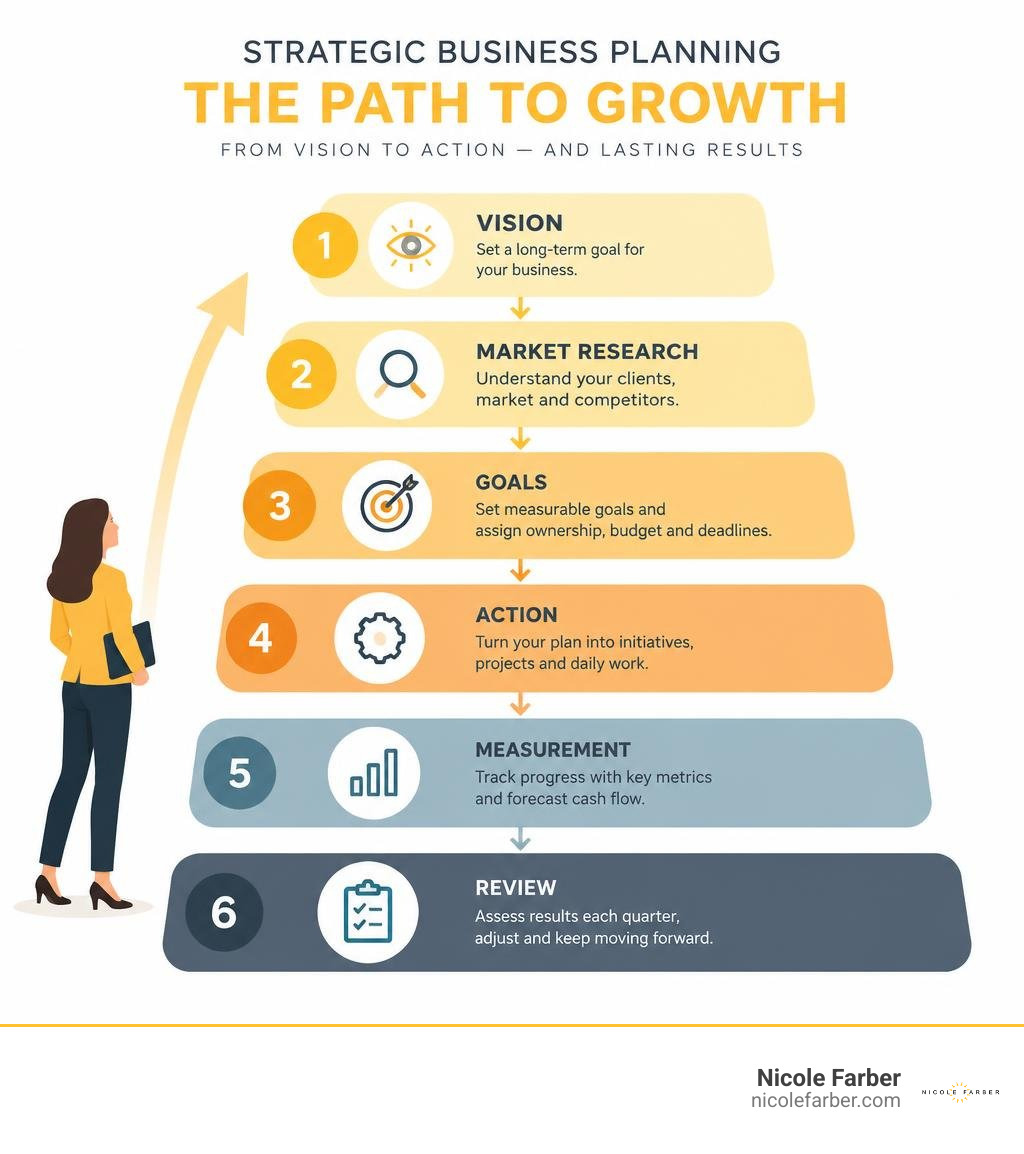
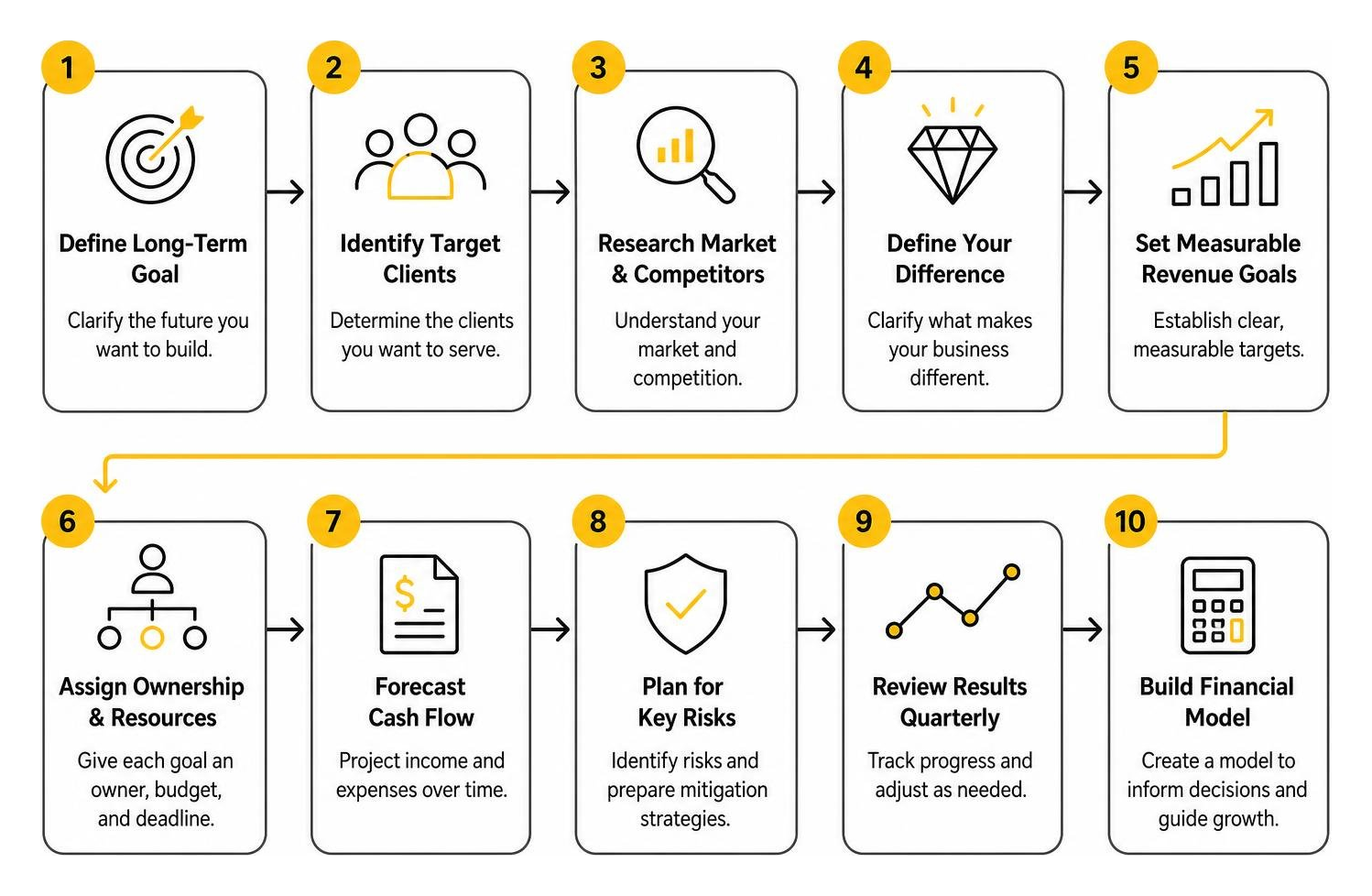
Start with a long-term goal. Identify the clients you want to serve, research your market and competitors, and decide what makes your business different. Set measurable revenue goals, then give each goal an owner, budget, and deadline. Forecast cash flow, plan for key risks, and review your results each quarter.
For a growing law firm, this turns marketing and client acquisition into choices that support the practice you want to build.
I’m Nicole Farber, CEO of ENX2 Legal Marketing, and I’ve spent more than 15 years helping law firms and other businesses grow. That experience shapes my approach to developing a strategic business plan: make it clear enough to guide real decisions, not just look good on paper.
Developing a strategic business plan helpful reading:
The Strategic Imperative: What a Business Plan Is and Why It Drives Success
A business plan is far more than a static document you assemble to satisfy a bank officer or check an administrative box. At its core, it functions as an operational GPS—a living roadmap that articulates where your enterprise stands today, where it is headed tomorrow, and exactly how resources will be allocated to cross the finish line.
Without a structured plan, leaders often fall into the trap of reactive decision-making. We find ourselves putting out daily fires rather than engineering intentional, sustainable growth. According to a 2025 business planning research review, disciplined planning substantially elevates the sustainability and profitability of emerging ventures while accelerating decision-making velocity across all levels of leadership.
When you establish clear operational guardrails, you eliminate ambiguity. You unlock business potential by aligning every marketing initiative, hiring decision, and service expansion with your core economic engine. Whether guiding a boutique legal practice in Philadelphia, managing an enterprise in Luzerne County, or scaling an international operation across Antigua Guatemala, structured strategic goal setting gives your team clarity and transforms ambitious vision into measurable, profitable execution.
Choosing Your Format: Traditional vs. Lean Startup Models
Every business operates within its own distinct lifecycle stage and audience requirements. Choosing the correct planning architecture ensures you don’t over-engineer a simple launch or under-deliver on the detailed due diligence required by commercial lenders and equity partners.
According to standard SBA business planning framework principles, planning documents generally fall into two distinct categories:
| Feature | Traditional Business Plan | Lean Startup Plan |
|---|---|---|
| Document Length | 15–20+ detailed pages | Single page / High-level canvas |
| Creation Time | Several weeks of in-depth research | As little as 1 hour |
| Primary Audience | Lenders, investors, institutional partners | Internal teams, founders, agile advisors |
| Primary Focus | Comprehensive forecasts, compliance, ops | Rapid iteration, value prop, market fit |
| Update Frequency | Annually or during major growth pivots | Weekly or monthly during discovery phases |
Core Components When Developing a Strategic Business Plan
A traditional format provides deep documentation and remains the gold standard for traditional bank financing, enterprise expansions, and complex organizational structures. When crafting a comprehensive document, follow a proven step-by-step blueprint for developing a small business plan to ensure every critical operational pillar is addressed:
- Executive Summary: A concise synthesis of your business model, value proposition, leadership background, and capital requirements.
- Company Description: The philosophical and operational foundation, outlining your mission, corporate structure, history, and target marketplace.
- Market Analysis: Detailed industry trends, competitor positioning, target demographic segments, and growth indicators.
- Organization and Management: Your internal hierarchy, leadership bios, governance structure, and organizational charts.
- Service or Product Line: Lifecycle descriptions, intellectual property, pricing strategies, and client onboarding pathways.
- Marketing and Sales Strategy: Client acquisition funnels, retention tactics, messaging, and digital channel distribution.
- Funding Request & Financial Projections: Capital requirements, planned resource allocation, and dynamic financial forecasts.
- Appendix: Resumes, contracts, leases, permits, and supporting legal documentation.
The Lean Startup Plan Alternative
If you operate in a high-velocity environment or need to validate an initial concept quickly, a lean startup plan gives you the agility to move fast without getting bogged down in administrative weight. Rather than drafting twenty pages before testing an offer, you can build a focused, single-page framework in about an hour.
This framework condenses your business down to its essential moving parts: key partnerships, activities, resources, distinct value propositions, customer segments, distribution channels, cost structures, and revenue streams. It gives you the structure you need to build a business plan and stop winging your startup, providing immediate clarity while maintaining the flexibility to pivot as fresh market feedback rolls in.
Step-by-Step Framework for Developing a Strategic Business Plan
Executing your growth roadmap requires bridging high-level vision with daily commercial execution. Whether leading an expanding firm in New Orleans or setting up shop in Wilkes-Barre, applying proven business growth strategies ensures your plan drives measurable revenue rather than collecting dust on a shelf.

Conducting Market Analysis and Competitive Intelligence
A strategy is only as dependable as the research supporting it. Grounding your plan in real-world data requires thoroughly analyzing your Total Addressable Market (TAM), Serviceable Available Market (SAM), and Serviceable Obtainable Market (SOM).
Start by assigning your enterprise the appropriate North American Industry Classification System (NAICS) codes to benchmark your performance against standard industry ratios and tax brackets. Next, look into how to form your company and evaluate markets by gathering tangible primary insights—such as conducting structured interviews with prospective clients.
Pair these external data points with a thorough SWOT analysis (Strengths, Weaknesses, Opportunities, Threats):
- Strengths: Proprietary service frameworks, exceptional team talent, or regional prestige.
- Weaknesses: Gaps in operational capacity, limited capital reserves, or low brand awareness.
- Opportunities: Underserved local market niches, digital shifts, or emerging corporate sectors.
- Threats: Regulatory shifts, local economic headwinds, or aggressive legacy competitors.
Structuring Financial Projections and Capital Requests
Financial modeling bridges your visionary aspirations with commercial reality. Lenders and investors expect grounded, conservative five-year projections that break down month-by-month cash flows for the first twelve months, transitioning into quarterly and annual models for years two through five.
Ensure your financial section clearly details:
- Pro Forma Income Statements: Realistic revenue streams minus cost of goods sold (COGS) and operational overhead.
- Cash Flow Statements: Accurate timing models reflecting actual cash collections versus outstanding accounts receivable.
- Pro Forma Balance Sheets: Structural assets, operational liabilities, and retained equity balances over time.
- Break-Even Analysis: The exact unit or revenue threshold required to cover all fixed and variable overhead.
- Capital Requests & Use of Funds: If seeking debt or equity financing, detail the exact amount required, repayment or equity terms, and explicit budget allocations (e.g., technology, talent acquisition, working capital).
Operational Execution: Risk Management, Communication, and Review Cycles
Even the most meticulously drafted strategic plan will fail without strong operational governance and consistent internal execution. Translating written pages into daily wins requires applying disciplined business leadership strategies across your entire team.

Mitigating Operational Risks While Developing a Strategic Business Plan
Strategic growth inherently exposes your organization to operational, economic, and legal risks. Integrating formal risk management standards—such as the structured protocols outlined in BSBESB401 business planning standards—ensures your firm remains resilient against unforeseen challenges.
Construct a risk assessment matrix evaluating potential events by likelihood and organizational impact:
- Regulatory & Compliance Hazards: Maintain strict adherence to local business laws, workplace health and safety (WHS) protocols, and employment standards.
- Financial Vulnerabilities: Build cash reserves for seasonal revenue slowdowns or unexpected capital expenses.
- Supply Chain & Tech Dependencies: Establish redundant vendor partnerships and secure, cloud-based data backups.
Aligning Stakeholders and Establishing Dynamic Review Cycles
A strategic plan should never remain an executive secret. Present the broader vision to your staff in a clear, digestible format that demonstrates how individual roles directly support overarching organizational goals. When you empower your team with clear KPIs, departmental ownership replaces confusion with accountable momentum.
Treat your document as an agile, living asset. In alignment with established Queensland business planning review principles, implement a disciplined quarterly review cadence. Sit down with your key leaders every ninety days to assess variance between your projected figures and actual performance, updating milestones as market conditions evolve.
Pitfalls to Avoid: Common Strategic Planning Mistakes
Writing a winning plan requires steering clear of predictable missteps. Leaders frequently fall victim to common traps that drain momentum and damage investor confidence:
- Overly Optimistic Projections: Lenders immediately spot hockey-stick revenue graphs that ignore realistic hiring timelines and customer acquisition costs. Keep your numbers grounded in market data.
- Unvalidated Assumptions: Never assume demand exists without verifying buyer intent through real surveys, pre-orders, or market research.
- Lack of a Clear Exit or Succession Strategy: Investors want to see your long-term roadmap, whether it involves an acquisition, partner buyout, or intergenerational transition.
- Static Planning Mindset: Treating your plan as a finished, untouchable document prevents you from adapting when industry conditions shift.
- Fuzzy Differentiation: If your plan fails to clearly articulate why a client should choose you over a competitor, refine your core value proposition before moving forward.
Save time and avoid starting from scratch by taking the time to stop winging it and use a business development plan template that keeps your team focused on structured execution.
Frequently Asked Questions about Developing a Strategic Business Plan
What is the standard length and time commitment for writing a business plan?
A traditional business plan typically runs 15 to 20 pages and requires several weeks of market research, operational modeling, and financial forecasting. Conversely, a lean startup plan focuses exclusively on high-level strategy and can be completed in as little as one hour on a single page, making it ideal for rapid internal validation.
How often should leadership review and update the business plan?
Leadership teams should review strategic plans quarterly to evaluate Key Performance Indicators (KPIs), budget variances, and active growth projects. A comprehensive operational review and forecast overhaul should take place annually, or sooner if triggered by significant regulatory changes or major shifts in the market.
What is the core difference between a business plan, strategic plan, and marketing plan?
A business plan outlines the overall commercial roadmap, operations, and financial viability of an entire organization. A strategic plan focuses primarily on high-level long-term vision, organizational alignment, and multi-year goals. A marketing plan operates as a tactical subset of your broader strategy, detailing the specific tactics used to attract and retain clients.
Conclusion
Building a sustainable, highly profitable business is never an accident—it is the direct product of intentional vision backed by disciplined strategic planning. When you ground your organizational goals in empirical market data, realistic financial models, and consistent quarterly reviews, you give your team the clarity and confidence needed to win in any economic environment.
If you are ready to stop guessing and start scaling with intention, take the next step by building a business development plan that provides your organization with an actionable roadmap for lasting growth.