How to Rule the C-Suite Without Losing Your Mind
- Leadership
- Word of the Day
- May 15, 2026
How to Rule the C-Suite Without Losing Your Mind
Why Life Coaching for Executives Is the Competitive Edge You’re Missing

Life coaching for executives is one of the fastest-growing tools high-performing leaders use to sharpen their edge, prevent burnout, and lead with lasting impact.
If you’re a law firm partner or C-suite leader, here’s what you need to know upfront:
What Life Coaching for Executives Does:
- Builds self-awareness and emotional intelligence so you lead people, not just processes
- Creates a private, structured space to think clearly without the pressure of the boardroom
- Addresses both professional performance and personal well-being as one connected system
- Helps you navigate career transitions, team dynamics, and high-stakes decisions with more confidence
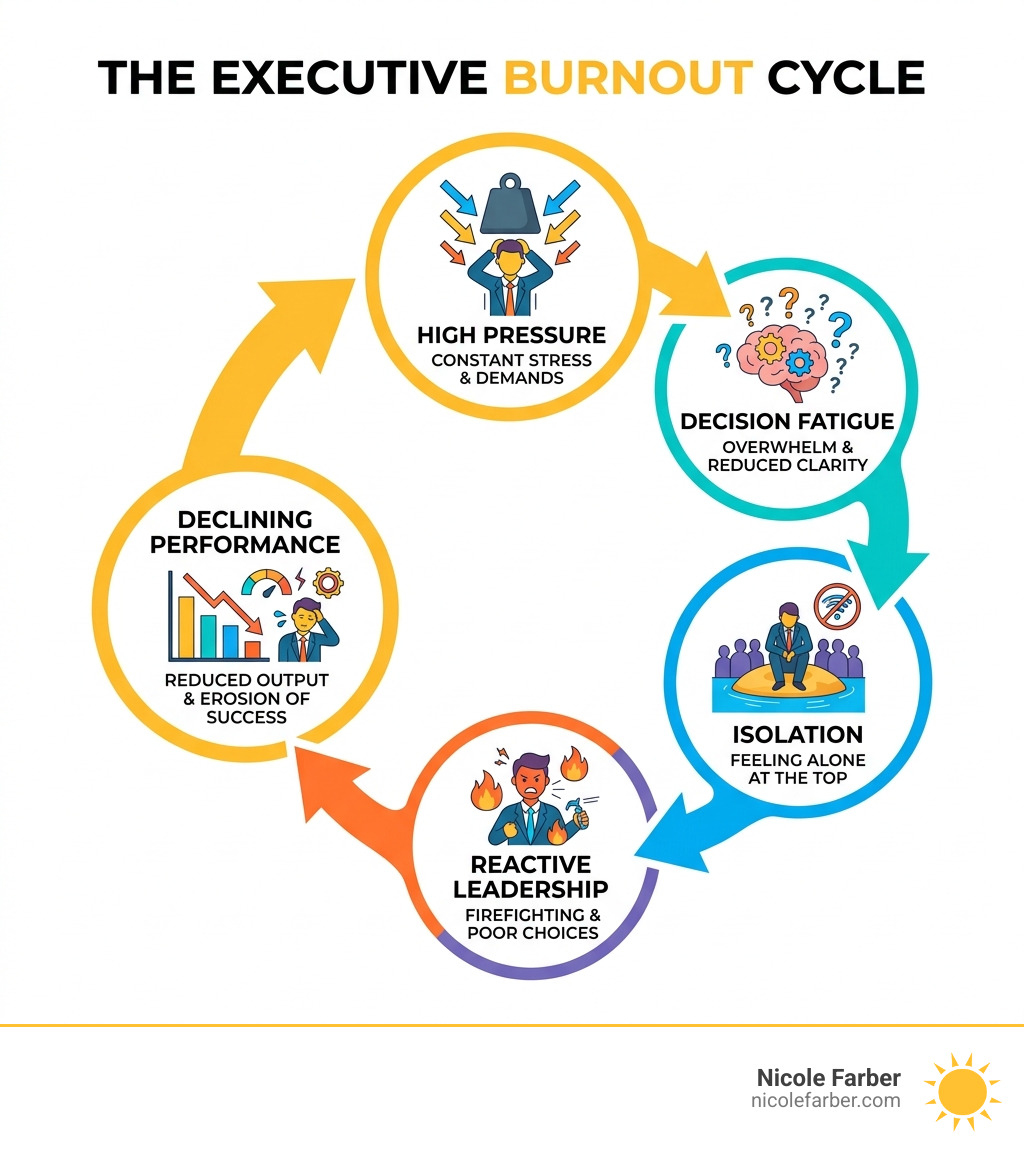
- Replaces reactive firefighting with intentional, strategic leadership habits
The results speak for themselves. Research from the Center for Creative Leadership found that 95% of executives who received coaching reported enhanced leadership capability and improved job performance. Another 92% said coaching drove greater business success.
Yet most leaders wait until something breaks before they ask for help.
The truth is, life coaching for executives works best when you’re already succeeding but sensing that something is quietly off — a persistent mental fog, a creeping sense of isolation at the top, or the nagging feeling that your career no longer fits who you’ve become.
That gap between where you are and where you could be? That’s exactly what this kind of coaching is designed to close.
I’m Nicole Farber — CEO, legal marketing expert, speaker, and single mother who has spent over 15 years in the trenches building businesses, leading teams, and helping law firms grow under pressure. My work with leaders across Philadelphia, Wilkes-Barre, and beyond has given me a front-row seat to exactly how life coaching for executives transforms not just careers, but the whole person behind the title. In the sections ahead, I’ll walk you through how to make it work for you.
Defining Life Coaching for Executives: Beyond the Boardroom
When we talk about life coaching for executives, we are moving past the traditional boundaries of corporate training. In April 2026, the most successful leaders in hubs like Philadelphia and New Orleans recognize that their professional output is inextricably linked to their personal health. You cannot lead a multi-million dollar firm effectively if your internal world is in chaos.
This approach is rooted in transformational coaching, which seeks to shift the underlying mindsets that drive your behavior. Unlike standard executive coaching services, which might focus solely on hitting quarterly KPIs or improving public speaking, executive-life coaching integrates the professional and the personal.
We often see leaders carrying “invisible work”—the heavy emotional lifting of managing team anxieties, navigating office politics, and balancing a high-stakes career with family life. Without proper work-life balance, this invisible work leads to a “thick air” feeling where every decision feels like wading through mud. In Luzerne County, where business standards are built on grit and community, we emphasize that true strength comes from emotional regulation—the ability to stay calm and clear-headed when the stakes are highest.

How it Differs from Traditional Mentoring
Mentoring is often about following in someone else’s footsteps. While valuable, it doesn’t always address the specific neurological patterns that hold you back. Life coaching for executives utilizes neuroscience and behavioral science to create sustainable change.
In the corporate culture of Philadelphia, leaders don’t just need advice; they need to develop their leadership through intentional habit shifts. This process helps you move from “accidental” success to “sustainable ambition”—the kind of drive that achieves massive results without sacrificing your sanity or your family.
Strengthening the Person Behind the Professional
The “person behind the professional” is the engine of your leadership. If that engine is neglected, the vehicle stops. We focus on empowering your inner boss by building deep self-awareness and emotional intelligence.
In New Orleans, where leadership styles often blend professional rigor with deep relational roots, understanding your core competencies is vital. Coaching helps you illuminate your values and align them with your professional decisions. When you know who you are at your core, you lead with a level of authenticity that inspires instinctive trust in your team.
Why High-Performers Seek Life Coaching for Executives
High performers don’t seek coaching because they are failing; they seek it because they refuse to plateau. As you climb higher, the margin for error shrinks and the pressure to deliver intensifies. This often leads to decision fatigue, where the sheer volume of choices drains your mental battery before noon.
Scientific research on executive leadership growth shows that coaching is one of the fastest ways to help a leader grow. It acts as a preventative measure against burnout and helps you maintain an entrepreneurial mindset. In Wilkes-Barre, our executive networking circles often discuss how strategic thinking is the first thing to go when a leader is overwhelmed. Coaching restores that capacity.

Addressing the Isolation of the Top Floor
It’s lonely at the top. The higher you rise, the fewer people there are to give you honest, unbiased feedback. You need a confidential space where you can ask the “hard questions” without appearing weak to your board or your employees.
Whether you are seeking CEO coaching services or attending leadership retreats in Antigua Guatemala, having an unbiased sounding board is essential. It allows you to test ideas, challenge your own assumptions, and manage complex stakeholder relationships with a clear head.
Navigating Complex Career Transitions
Transitions are the most vulnerable moments in a leader’s career. Whether you are stepping into a C-suite role for the first time or preparing for an exit, the shift requires more than just technical skill—it requires role alignment and legacy building.
Our entrepreneurship coaching guide highlights that transitions often trigger imposter syndrome or a loss of direction. By utilizing data-informed coaching for C-level executives, we help you navigate organizational change while staying true to your personal mission. We don’t just want you to survive the transition; we want you to define it.
The 3-Step Process to Sustainable C-Suite Success
Achieving lasting impact requires a move from reactive firefighting to proactive strategy. We use a structured approach to ensure every coaching engagement delivers a high return on investment.
| Feature | Reactive Leadership | Proactive Leadership (Coached) |
|---|---|---|
| Focus | Immediate crises and “firefighting” | Long-term vision and strategic goal setting |
| Decision Making | Driven by urgency and stress | Driven by data and business strategy |
| Team Impact | High turnover and team anxiety | High loyalty and psychological safety |
| Personal State | Chronic burnout and fatigue | Sustainable energy and mental clarity |
The process typically begins with an initial assessment and 360-degree feedback to uncover blind spots. From there, we build an outcome-based action plan with clear metrics for success and establish ongoing accountability to ensure the shifts stick.
Achieving Sustainable Ambition with Life Coaching for Executives
Energy management is the secret weapon of the elite executive. We often look at frameworks like BOSI (Executive DNA) to help you understand where you naturally thrive and where you are leaking energy.
For many of the women I work with, balancing motherhood and career is a primary focus. In Philadelphia, executive wellness isn’t just about a gym membership; it’s about protecting your cognitive capacity. We help you build an operating rhythm that matches your peak thinking times, ensuring you are doing your best work when it matters most.
Implementing Behavioral Shifts for Lasting Impact
Insight without action is just a hobby. To see real change, you must implement behavioral shifts. This includes refining your communication clarity and developing executive presence.
In New Orleans, professional growth is often tied to how well you can influence others without relying solely on your title. Resilience building is key here—learning to interrupt stress patterns before they become toxic habits. When you change your behavior, you change the results your entire organization achieves.
Choosing the Right Guide for Your Leadership Journey
Selecting a coach is a high-stakes decision. You aren’t just looking for a cheerleader; you’re looking for a partner who understands the unique pressures of the C-suite.
Whether you’re looking into business coaching for lawyers or general executive support, look for credentials from the International Coaching Federation (ICF) and a coach who has “walked the talk.” From an Antigua Guatemala business perspective, cultural alignment and trust are the foundations of any successful coaching relationship.
Qualities of an Elite Executive-Life Coach
An elite coach should offer more than just a sympathetic ear. They should possess:
- Deep Listening: The ability to hear what isn’t being said.
- Inquisitive Mindset: Asking the thought-provoking questions that lead to breakthroughs.
- Bold Feedback: Being willing to challenge your thinking and hold your feet to the fire.
In Luzerne County, we value mentorship that is grounded in real-world experience. A great coach helps you refine your definition of leadership so you can lead with confidence, purpose, and influence that lasts.
Frequently Asked Questions about Executive-Life Coaching
What is the ROI of life coaching for executives?
The return on investment is both quantitative and qualitative. Beyond the $2B+ in combined revenue impact seen in major coaching studies, there is a 95% boost in leadership capability. For many, the greatest ROI is the ability to scale a business without losing their marriage or their health. We also see significant gains in life coaching for women, where the impact on team morale and retention is massive.
How long does a typical coaching engagement last?
Most successful engagements follow a six-month timeline. This allows enough time for deep behavioral shifts to take root and for the leader to navigate at least two full business quarters with their new tools. Some leaders choose to continue through coaching classes or long-term advisory roles to maintain their momentum.
Can coaching help with specific industry challenges?
Absolutely. Whether it’s navigating the hyper-competitive world of legal marketing or leading STEM professionals who require high-precision communication, coaching is tailored to your specific context. In Wilkes-Barre, we focus on industry trends like AI integration and digital transformation, ensuring executive coaching for lawyers and tech leaders stays ahead of the curve.
Conclusion
Ruling the C-suite doesn’t have to mean losing your mind. By embracing life coaching for executives, you are choosing a path of “both/and”—both massive professional success and deep personal fulfillment.
At Nicole Farber, we believe in a faith-based life coaching approach that integrates your highest values with your boldest ambitions. Whether you are leading a firm in Philadelphia or scaling a startup in Antigua Guatemala, your leadership presence is your winning strategy. It’s time to lead with confidence, purpose, and a mind that is fully your own.