Strategy Unpacked: Why Workshops Are Your Business’s Best Friend
- Entrepreneurship
- Word of the Day
- February 20, 2026
Why Business Strategy Workshops Are Essential for Your Law Firm’s Growth

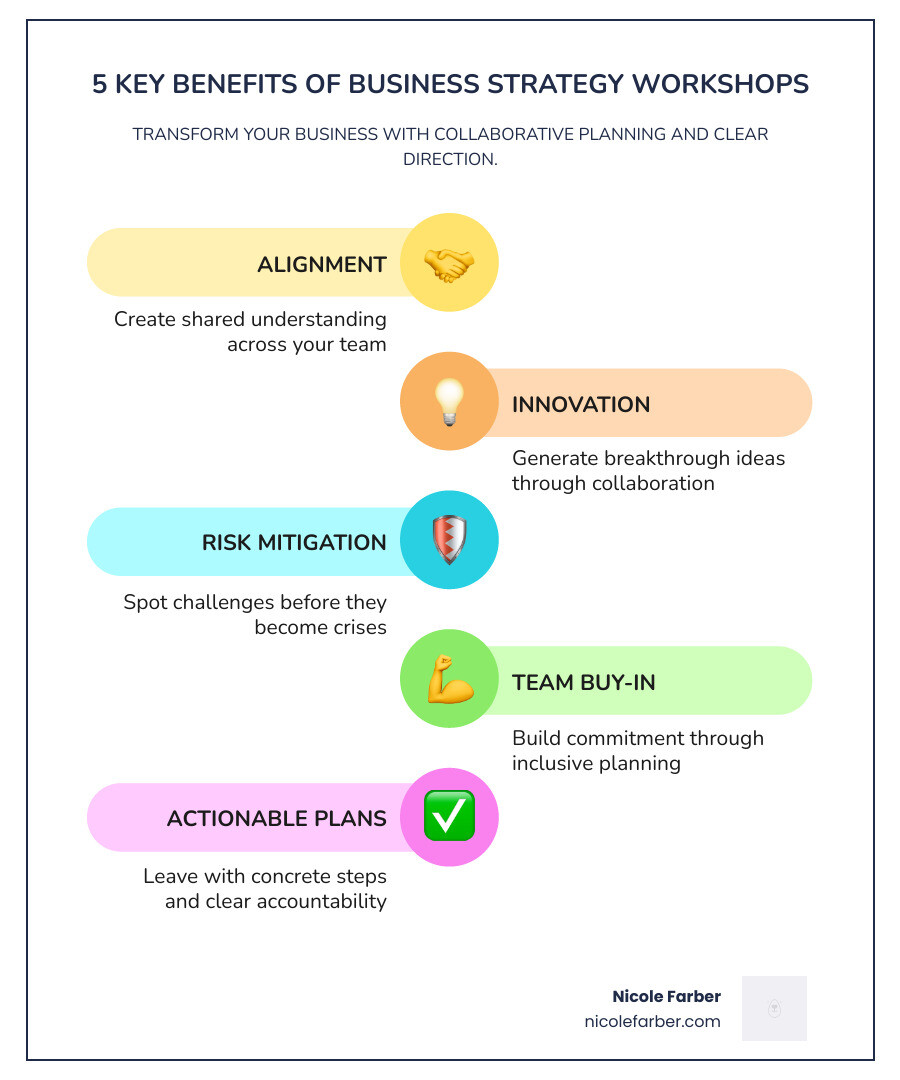
Business strategy workshops are structured, collaborative sessions where leadership teams come together to define direction, set goals, and create actionable plans for their organization’s future. Here’s what makes them valuable:
- Alignment: Get everyone on the same page about mission, vision, and priorities
- Innovation: Generate fresh ideas through diverse team perspectives
- Risk Mitigation: Identify potential challenges before they become crises
- Team Buy-in: Build commitment by involving key stakeholders in the planning process
- Actionable Plans: Walk away with concrete steps, not just abstract ideas
If you’ve ever felt like your law firm is moving forward without a clear map, you’re not alone. Many managing partners and firm leaders struggle with competing priorities, market pressures, and the challenge of getting their entire team rowing in the same direction. A well-designed business strategy workshop cuts through the noise. It creates space for focused thinking, honest conversation, and the kind of collaborative planning that turns vision into reality.
The research is clear: a properly facilitated workshop saves time and money by helping teams work out complex strategies and reach consensus faster. Workshops gather diverse insights from different practice areas and roles, enriching the strategy development process. They help identify potential risks early, before they become expensive problems.
I’m Nicole Farber, and over my 15+ years turning around law firms and businesses, I’ve seen how business strategy workshops transform overwhelmed firms into focused, growth-oriented practices. Whether I’m facilitating sessions in Philadelphia boardrooms, Wilkes-Barre conference rooms, or even retreat settings in New Orleans or Antigua, Guatemala, the power of bringing the right people together with the right framework remains constant.
Why a Strategy Workshop is Your Business’s North Star
Imagine setting off on a cross-country road trip from Philadelphia to New Orleans without a GPS or even a paper map. Sounds a bit chaotic, doesn’t it? That’s precisely what running a business without a clear strategy feels like. Our research shows that a proper strategy serves a similar role to a GPS device in your vehicle; you wouldn’t start a long journey without planning it first. It provides direction and scope, defining where your company is going in the long term and outlining the actions needed to achieve those ambitious business goals. Without it, we’re just driving in circles, burning fuel, and getting nowhere fast.
A robust business strategy is the bedrock of a company’s success. It’s crucial for adapting to constantly evolving competition and technological advancements. In today’s world, standing still means falling behind. A clear strategy allows us to anticipate market shifts, capitalize on new opportunities, and maintain a competitive edge. It helps us understand our core competencies, competitive advantage, and value chain activities, ensuring we can sustain those advantages.
Furthermore, a well-defined strategy fosters team alignment and a shared understanding across all levels of our organization. When everyone knows the destination and the route, they can work together more effectively. This collective experience, gathered through diverse insights from different teams and divisions, enriches the strategy development process significantly. It also enables proactive risk management, helping us identify potential risks early in the strategy development process, before they become full-blown crises.
For more insights on leading your team towards success, explore our Business Leadership Strategies Guide and learn about Building a Successful Business.
The Primary Objective of a Strategy Session
So, what exactly are we trying to achieve with a business strategy workshop? At its core, the primary objective is to gain clarity and direction for our business. These workshops provide the dedicated time and space to ask ourselves numerous critical questions about our current situation and future aspirations. In a rapidly changing environment, this focused inquiry is invaluable.
The goal isn’t just to talk; it’s to emerge with a clear strategic direction, a well-defined scope for our actions, and an actionable roadmap for the future. We aim to gain consensus among key stakeholders, ensuring everyone is on the same page and committed to the chosen path. This collaborative environment also fosters innovation, allowing diverse perspectives to converge and generate fresh ideas. As the research suggests, a well-designed strategic planning meeting is often the quickest way to work out the best ideas, shorten decision-making processes, and gather necessary data and knowledge efficiently. It helps us make decisions more efficiently and gain confidence in our choices by identifying potential risks and uncertainties upfront.
A business strategy workshop is about transcending day-to-day operations to focus on the bigger picture, helping us define our long-term mission, goals, and the actions necessary to achieve them. It’s about empowering us to Unlock Business Potential that might otherwise remain untapped.
When is a Workshop Most Beneficial?
While strategy is an ongoing process, certain moments cry out for the focused energy of a dedicated workshop. Think of it like a pit stop in a long race – sometimes you need to pull over, reassess, and fine-tune your approach.
Here are some key scenarios where a business strategy workshop session is most beneficial for strategic planning:
- Annual Planning Cycles: This is the classic scenario. As part of our yearly planning, a workshop ensures we’re not just repeating old patterns but actively evolving our strategy.
- Market Shifts: When the competitive landscape changes dramatically, a new technology emerges, or customer behavior shifts (especially relevant for law firms adapting to digital client acquisition), a workshop helps us pivot effectively.
- New Leadership: A change at the top is an ideal time for a workshop to align the new vision with the existing team and chart a fresh course.
- Product or Service Launches: Before bringing a new offering to market, a workshop can validate ideas, refine the value proposition, and ensure internal readiness.
- Overcoming Stagnation: If our business feels stuck, or growth has plateaued, a workshop can inject fresh perspective and identify new avenues for development.
- Mergers and Acquisitions: Integrating two entities requires a unified strategy. A workshop can facilitate this complex alignment.
- Findy Phase: As the research highlights, workshops are helpful when we have a vision but don’t know what to do next, or when we’re in the findy phase of a project and need to validate new ideas.
- Need for a Fresh Perspective: When internal teams have become too insular, an external facilitator can bring an unbiased viewpoint and encourage new ways of thinking.
Mature companies periodically review and adjust their strategies to remain relevant and capitalize on new opportunities. These workshops are a fantastic way to proactively manage change and turn potential challenges into growth opportunities. After all, sometimes, Chaos Brings Opportunity.
How to Design and Run Effective Business Strategy Workshops
Now that we understand the ‘why’ and ‘when,’ let’s dive into the ‘how.’ Designing and running effective business strategy workshops is an art form, but with the right preparation and approach, it’s an art we can all master. Whether we’re gathering a small team in a cozy Wilkes-Barre office or orchestrating a larger retreat in the vibrant setting of New Orleans or the serene landscapes of Antigua, Guatemala, the principles remain the same.
Our research emphasizes that effectively running a workshop involves setting clear goals, gathering relevant data, identifying the right stakeholders, appointing a skilled facilitator, creating a detailed workshop plan, and choosing an appropriate work environment (be it face-to-face or online). The environment itself plays a crucial role – a bright, comfortable space in a Philadelphia high-rise can inspire creativity, just as a change of scenery can spark new ideas.
Essential Tools and Materials for Your Business Strategy Workshops
Just like a chef needs the right utensils, we need the right tools to cook up a winning strategy. Fortunately, the essentials are often quite simple:
- Whiteboards and Flip Charts: These are our canvases for capturing ideas, drawing connections, and visualizing concepts. Don’t underestimate the power of a good old-fashioned whiteboard in a Luzerne County meeting room!
- Sticky Notes and Markers: The humble sticky note is a workshop MVP. They allow for individual idea generation, easy grouping, and democratic participation.
- Laptops and Projector: For presenting pre-workshop data, displaying frameworks, and documenting outputs.
- Digital Collaboration Tools: For remote or hybrid workshops, platforms like Miro or Mural can replicate the whiteboard experience, allowing teams to collaborate seamlessly across different locations.
- Strategic Frameworks: These are the blueprints that guide our discussions and analysis. Nicole Farber often uses frameworks such as:
- Business Model Canvas: For a holistic view of our business.
- SWOT & SOAR Analysis: To identify Strengths, Weaknesses, Opportunities, Threats (SWOT) and Strengths, Opportunities, Aspirations, Results (SOAR).
- Value Proposition Canvas: To deeply understand customer needs and how our offerings meet them.
- Customer Journey Maps: To visualize the client experience and pinpoint areas for improvement.
The research confirms that basic office materials are essential, but more specific tools like these strategic canvases, templates, and pre-workshop surveys or interviews are vital for a comprehensive session. Using graphics, diagrams, and mind maps helps participants understand complex concepts more easily, making the workshop both productive and engaging. These tools are critical for fostering Business Innovation Strategies.
Key Steps to a Flawless Workshop
Running a business strategy workshop isn’t just about showing up and talking; it’s about meticulous preparation and expert execution. Here’s our roadmap to a flawless session:
- Set Clear Objectives: Before anything else, define what you want to achieve. Do you want to redefine your mission? Outline a new service offering? Identify growth opportunities for your firm in New Orleans? Clear goals, as our research points out, are non-negotiable.
- Select the Right Participants: Who needs to be in the room? This isn’t just about seniority; it’s about diversity of thought, expertise, and perspective. Include leaders, key team members, and anyone whose buy-in or insights are critical.
- Gather Pre-Workshop Data: Don’t go in blind. Conduct pre-workshop surveys or interviews with key stakeholders. Compile relevant company data—financial reports, market analysis, customer feedback, operational metrics. Gather industry reports, competitor analysis, and market trends. This data provides the foundation for informed discussions.
- Create a Structured Agenda: A detailed agenda with timed segments keeps the workshop on track. Balance presentation, discussion, and interactive exercises. Build in breaks to avoid fatigue.
- Establish Ground Rules: At the outset, set clear expectations for respectful communication, active listening, constructive feedback, and focusing on the issues, not the personalities. This ensures a safe and productive environment.
- Document Everything: Assign a dedicated note-taker or use digital tools to capture all ideas, decisions, and action items. This documentation is crucial for follow-up and accountability.
By following these steps, we create a structured yet dynamic environment where our team can engage deeply and contribute meaningfully to our Strategic Goal Setting.
Ideas and Exercises for a Successful Session
The magic of a business strategy workshop often lies in its interactive elements. These aren’t just “fun games”; they’re carefully designed activities to stimulate creative thinking, uncover insights, and drive collaboration. Here are some effective ideas and exercises we’ve found successful:
- Icebreakers with a Strategic Twist: Start with an activity that gets everyone talking and thinking about the business. Instead of “two truths and a lie,” try “What’s one thing our firm does exceptionally well, and one thing we could do better?”
- “What If” Scenarios: This exercise encourages proactive risk management and innovative thinking. Ask, “What if our biggest competitor offered our core service for free?” or “What if a major technological disruption changed how our clients access legal services?” This helps identify risks and uncertainties.
- Brainwriting (not just Brainstorming): Instead of shouting out ideas, participants silently write down their thoughts for a few minutes. Then, they pass their papers around, adding to others’ ideas. This ensures all voices are heard, not just the loudest.
- Role-Playing: Have team members role-play as clients, competitors, or even future versions of your firm. This can provide fresh perspectives on challenges and opportunities.
- Competitor Analysis Deep Dive: Use a dedicated segment to analyze key competitors. What are their strengths? Weaknesses? What can we learn from them?
- Visioning Exercises: Ask participants to imagine the firm five or ten years in the future. What does success look like? What services are we offering? Who are our clients? This helps define the long-term mission and goals.
- SWOT/SOAR Analysis: As mentioned earlier, these classic frameworks are excellent for structured discussion.
- Case Studies: Analyzing real-world business case studies, either internal or external, can provide valuable lessons and stimulate discussion on how to apply strategic thinking to our own challenges.
These exercises, combined with the use of specific canvases and models, enable participants to ask critical questions effectively, understand different perspectives, and collaboratively search for answers. For a deeper dive into cultivating strategic thinking, explore More on strategic thinking.
Managing Disagreements Constructively
It’s inevitable that strong opinions will surface in a business strategy workshop, especially when passionate professionals are discussing the future of their firm. Disagreements aren’t a sign of failure; they’re often a sign of healthy engagement and diverse perspectives. The key is to manage them constructively, turning potential friction into productive dialogue. As our research notes, conflicts can become opportunities for learning, collaboration, and innovation if handled effectively.
Here’s how we can steer those moments:
- Acknowledge All Perspectives: The facilitator’s role is to ensure everyone feels heard. Validate each viewpoint, even if you don’t immediately agree with it. Phrases like “I hear your concern about X” or “That’s an interesting point about Y” can de-escalate tension.
- Focus on Shared Goals: Remind everyone of the workshop’s overarching objectives and the common mission. Often, disagreements stem from different ideas on how to achieve a shared goal, rather than a disagreement on the goal itself.
- Use a “Parking Lot” for Off-Topic Ideas: If a discussion veers off track but contains valuable points, jot them down on a “parking lot” flip chart. Promise to revisit them later, either in the workshop or in a separate session. This keeps the current discussion focused without dismissing good ideas.
- Facilitator Mediation: A skilled facilitator acts as a neutral mediator, guiding the conversation, asking clarifying questions, and encouraging compromise. They can help reframe arguments and find common ground.
- Take Breaks to Diffuse Tension: If emotions are running high, a short break can work wonders. Stepping away for a few minutes allows participants to cool down and return with a clearer head.
- Establish Ground Rules Early: As noted in our preparation steps, setting ground rules at the beginning helps. These might include “one speaker at a time,” “criticize ideas, not people,” or “seek to understand before being understood.”
- Document Agreements and Disagreements: Clearly document points of agreement and, if necessary, areas where consensus couldn’t be reached, along with the reasons. This ensures transparency and provides a reference for future discussions.
By fostering an environment where disagreements are seen as opportunities for deeper understanding, we can truly Empower Your Team to contribute their best.
From Whiteboard to Reality: Ensuring Strategy Implementation
The whiteboard is clean, the sticky notes are organized, and the energy in the room is buzzing. We’ve just wrapped up a fantastic business strategy workshop in our New Orleans office, brimming with innovative ideas. But the real work, and the true measure of success, begins now: implementation. A brilliant strategy that gathers dust is just a missed opportunity. Our goal is to bridge the gap from creative brainstorming to tangible results.
This phase is all about translating those high-level strategic decisions into concrete action. It means clearly defining action items, assigning accountability to specific individuals or teams, setting realistic timelines, developing a robust communication plan to keep everyone informed, and allocating the necessary resources—financial, human, and technological. Without these critical steps, even the most groundbreaking strategy will falter. This is where we shift from planning to actively Building a Business Development Plan.
Crucial Follow-Up Actions
The workshop doesn’t end when everyone leaves the room. The follow-up is as critical as the session itself. Here’s how we ensure our strategic plans move from concept to execution:
- Distribute a Summary Report: Within a day or two, send out a concise report summarizing key decisions, insights, and proposed action items. This reinforces commitment and provides a clear record.
- Assign Owners to Action Items: Every action item identified during the workshop needs a specific owner (an individual or team) with clear responsibilities and deadlines. This eliminates ambiguity and drives accountability.
- Set Up OKRs or KPIs: Translate strategic goals into measurable Objectives and Key Results (OKRs) or Key Performance Indicators (KPIs). These metrics allow us to track progress and verify our strategy’s effectiveness regularly. As the research states, use the strategy as a foundation for defining OKRs and KPIs and verify them regularly.
- Schedule Regular Check-in Meetings: Don’t wait until the next annual review. Schedule frequent, shorter meetings (weekly, bi-weekly, or monthly) to review progress, discuss challenges, and make necessary adjustments.
- Gather Feedback for Continuous Improvement: After initial implementation, gather feedback from participants and stakeholders. What worked well? What could be improved for future strategy sessions or the implementation itself? This fosters a culture of continuous learning.
- Address Challenges Collaboratively: Implementation rarely goes exactly as planned. When obstacles arise, convene relevant team members to address them collaboratively and adapt the plan as needed.
- Allocate Necessary Resources: Ensure that the financial, human, and technological resources required for implementation are allocated and accessible.
- Develop a Communication Plan: Keep all stakeholders informed about progress, successes, and any necessary adjustments to the strategy. Transparency builds trust and maintains buy-in.
- Celebrate Milestones: Acknowledge and celebrate small wins along the way. This boosts morale and reinforces the value of everyone’s contributions.
- Periodically Review and Adapt: Our strategic landscape is dynamic. Periodically review the implemented strategies to ensure their continued relevance and effectiveness, adapting them as market conditions or internal capabilities evolve.
By diligently executing these follow-up actions, we ensure that the energy and insights generated in our business strategy workshops translate into tangible, sustainable growth for our firm. These are Key Strategies for Growing a Business.
Elevating Your Strategy with an Expert Facilitator
We’ve seen how powerful business strategy workshops can be when run effectively. But what if you could boost that process, ensuring even greater efficiency, deeper insights, and more robust outcomes? That’s where an expert facilitator comes in. Think of it this way: you wouldn’t perform surgery on yourself, even if you read all the books. You’d call in a specialist. The same applies to guiding your business’s future.
Our research highlights that benefits of strategic planning meetings include optimizing time and cost, predictable outcomes, professional support, collective experience, alignment, and efficient problem-solving. An expert facilitator embodies these benefits. They bring objectivity, ensuring that internal politics or pre-existing biases don’t derail discussions. They possess a deep well of expertise in proven frameworks and methodologies, guiding the team through complex analyses with confidence.
Perhaps most importantly, an expert facilitator excels at managing group dynamics. They know how to draw out quiet voices, gently rein in dominant personalities, and steer discussions away from unproductive tangents. They keep the session on track, ensuring every minute is maximized for value. This professional support significantly increases the return on investment (ROI) of your workshop, changing it from a mere meeting into a high-impact strategic event. Investing in a skilled facilitator for your team in Luzerne County, for example, can save countless hours and resources down the line.
For more insights on how expert guidance can shape your leadership, explore our Business Leadership Mentor Tips 2025. And, of course, we offer dedicated Nicole Farber’s Business Strategy Workshops designed to meet your firm’s unique needs.
How an Expert Improves Your Business Strategy Workshops
An experienced facilitator doesn’t just run the clock; they lift the entire strategic planning process. Someone like Nicole Farber, who is available for events from Wilkes-Barre to New Orleans and even Antigua, Guatemala, brings a unique set of advantages:
- Unbiased Perspective: An external expert has no vested interest in the firm’s internal politics or historical decisions. This allows them to challenge assumptions, ask tough questions, and guide discussions towards what’s truly best for the business, rather than what’s comfortable.
- Ensures All Voices Are Heard: A skilled facilitator creates an inclusive environment where every participant feels comfortable contributing. They employ techniques to prevent a few dominant voices from monopolizing the discussion, ensuring a richer, more comprehensive collection of insights.
- Challenges Assumptions and Pushes for Deeper Insights: We all operate with assumptions. An expert facilitator is adept at gently questioning these assumptions, prompting the team to dig deeper, explore alternative viewpoints, and uncover insights that might otherwise remain hidden. They can educate inexperienced teams on strategic thinking principles while guiding them to a finished plan.
- Manages Conflict Constructively: As we discussed, disagreements are normal. An expert facilitator is a master at navigating these moments, changing potential clashes into productive dialogues. They can act as a neutral mediator, seeking common ground and redirecting conversations back to the workshop goals.
- Applies Proven Frameworks and Tools: They bring a toolkit of battle-tested strategic frameworks and exercises, ensuring that the workshop uses the most effective methods for analysis, idea generation, and decision-making.
- Maintains Focus and Momentum: Workshops can easily lose steam or veer off track. An expert facilitator acts as a conductor, keeping the team focused on the agenda, managing time effectively, and maintaining high energy levels throughout the session.
- Simplifies Complex Concepts: Expert support can help simplify complex concepts, offer comprehensive analysis, and foster a common language and understanding among stakeholders.
By leveraging an expert, you’re not just getting a meeting manager; you’re gaining a strategic partner who maximizes the value of your team’s time and talent, leading to clearer, more actionable strategies. Learn more about expert guidance through our CEO Coaching Services and Leadership Development Seminars.
Conclusion
We’ve explored the profound impact that well-orchestrated business strategy workshops can have on your organization. From providing a clear GPS for your business journey to fostering innovation, mitigating risks, and ensuring team alignment, these workshops are far more than just meetings—they are catalysts for growth and success. We’ve walked through the primary objectives, identified the most beneficial times to convene, and detailed the essential tools, steps, and exercises needed to design and run these sessions flawlessly. We’ve also highlighted how to constructively manage disagreements and, crucially, how to ensure that the brilliant ideas generated translate into real-world action through diligent follow-up.
The journey from chaos to clarity, from scattered ideas to a unified vision, is made significantly smoother and more effective through collaborative strategic planning. The power of bringing diverse minds together, under expert guidance, to forge a shared future cannot be overstated. For leaders in Luzerne County, Philadelphia, New Orleans, and beyond, a well-run workshop is truly the fastest path to a unified, actionable strategy.
If you’re ready to transform your firm’s potential into tangible results, Nicole Farber provides expert facilitation to help your team build a powerful roadmap for the future. Don’t let your strategy gather dust; let’s unpack it, refine it, and put it into action.
Transform your business with expert strategy coaching.