The Art of the New: How to Master Business Innovation
- Entrepreneurship
- In the News
- January 7, 2026
Why Innovation is Your Ultimate Competitive Advantage

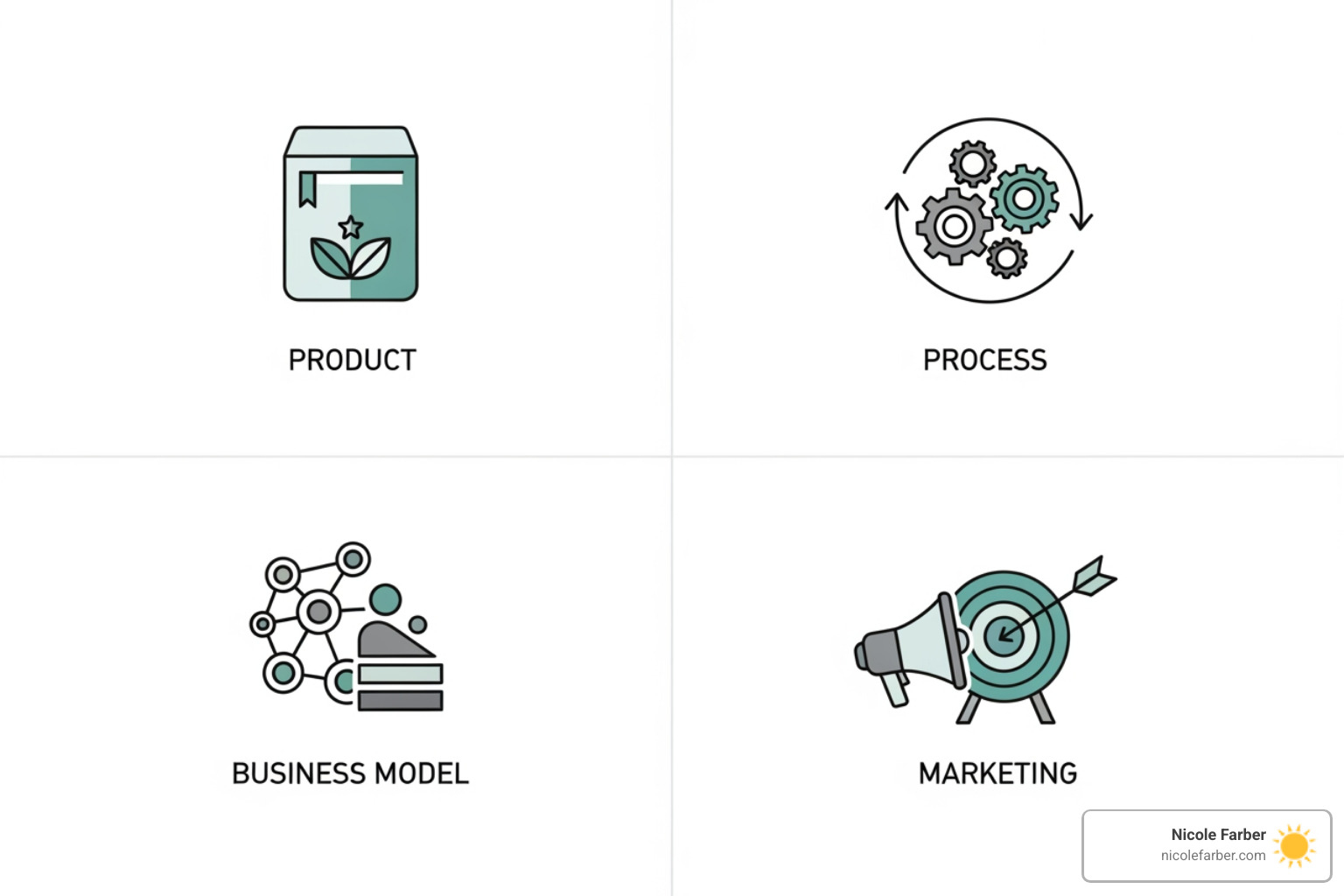
Business innovation strategies are the roadmaps companies use to implement new ideas, workflows, and business models that drive growth and competitive advantage. Here’s what you need to know:
- Product Innovation: Creating new products or improving existing ones
- Process Innovation: Streamlining operations and reducing costs
- Business Model Innovation: Changing how you create and capture value
- Marketing Innovation: Reaching customers through new channels and messaging
Key Statistics:
- 60% of the most innovative companies have grown by more than 10% in recent years
- 70% of innovation leaders invest more in R&D than their peers
- 82% of CEOs believe AI will significantly impact their business
Innovation isn’t just about having brilliant ideas. It’s about turning those ideas into real results that keep you ahead of the competition.
Think about the legal market in Philadelphia or New Orleans right now. Firms that simply do what they’ve always done are losing ground. The ones that win are asking hard questions: How can we serve clients better? What new revenue streams make sense? How do we leverage technology without losing the human touch?
The business world has changed. Your clients have changed. Their expectations have changed. Innovation is no longer optional—it’s survival.
Here’s the good news: you don’t need a massive budget or a team of tech wizards to innovate. You need a clear strategy, the willingness to experiment, and the courage to accept that not every idea will work. Some of the most powerful innovations come from small changes that compound over time.
Whether you’re running a law firm in Luzerne County, managing a business in Antigua Guatemala, or leading any organization that wants to grow, the principles are the same. Innovation starts with understanding where you are, where you want to go, and the gaps between the two.
I’m Nicole Farber, CEO of ENX2 Legal Marketing, and over 15+ years I’ve helped law firms and businesses across the country develop and implement Business innovation strategies that drive real growth. I’ve seen how the right innovation approach transforms struggling practices into thriving ones, even during challenging times like the global pandemic.
The core reason innovation is crucial for competitiveness is simple: the business landscape is always shifting. As a systematic literature review on innovation and competitiveness from 2024 highlights, innovation strategy has a positive and significant effect on a firm’s ability to compete and succeed. Companies that accept innovation aren’t just adapting; they’re shaping the future.
Understanding the Four Pillars of Innovation
Innovation comes in many forms, each with its own power to transform your business. We like to think of these as the four pillars that support a robust business innovation strategy.
Product and Process Innovation
When we talk about innovation, often the first thing that comes to mind is a new product. Product innovation involves creating entirely new products or services, or significantly enhancing existing ones with new features, improved performance, or a fresh design. Think about the evolution of smartphones or the constant stream of new software updates that add capabilities we didn’t even know we needed. For a legal practice, this could mean developing a new, specialized legal service package for a niche market or a digital tool that simplifies client intake.
On the other hand, process innovation focuses on optimizing how you do things. This means streamlining operations, reducing costs, improving efficiency, and enhancing the quality of your output. It’s about working smarter, not just harder. For example, a Philadelphia-based manufacturer might streamline its production line by implementing new automation technologies, leading to faster delivery times and lower manufacturing costs. In a law firm, this could involve automating routine administrative tasks or implementing a new case management system to improve workflow and client communication.
Business Model and Marketing Innovation
Beyond what you offer and how you create it, innovation can also transform the very structure of your business. Business model innovation is about making significant changes to how your business operates to create, deliver, and capture value. This could involve altering your value proposition, identifying new revenue streams, or targeting different customer segments. Consider how companies like Netflix revolutionized entertainment by shifting from DVD rentals to streaming subscriptions.
For a New Orleans tour company, this might mean shifting from single-day tours to an annual subscription model offering exclusive access to local events and experiences for residents, effectively creating a new revenue stream and customer segment. This is a powerful way to redefine your market and differentiate yourself. As a book on Business Model Innovation Strategy points out, this type of innovation is crucial for building resilient businesses that operate efficiently and provide more value than their competitors.
Finally, marketing innovation is all about how you connect with your customers. This includes exploring new channels, developing novel messaging, and reaching new audiences in creative ways. It’s about making sure your brilliant innovations don’t go unnoticed. For a law firm, this could mean leveraging AI to personalize marketing campaigns or using interactive content to engage potential clients in Wilkes-Barre. The legal marketing industry itself has seen early pioneers who broke the mold by introducing television advertising for legal services in the late 1970s, showcasing how innovation in marketing can profoundly impact client acquisition and market share.
Disruptive vs. Sustaining Innovation
Not all innovation is created equal. We often categorize it into two main types based on its impact: disruptive and sustaining.
Disruptive innovation creates new markets and value networks, eventually displacing established market leaders, products, and alliances. It often starts simple, in a niche, and then grows to challenge the status quo. Think about how streaming services disrupted traditional cable television or how ride-sharing apps changed the taxi industry. These innovations are game-changers, and while they often come from startups, established companies can also pursue them to stay ahead.
Sustaining innovation, on the other hand, focuses on incremental improvements to existing products, services, or processes. It’s about making what you already do, better. This type of innovation serves existing customers and aims to improve performance along dimensions that current customers already value. This could be a new feature added to a piece of software or a more efficient manufacturing process. Both are vital for long-term success.
Here’s a quick comparison:
| Characteristic | Disruptive Innovation | Sustaining Innovation |
|---|---|---|
| Target Market | New, often overlooked segments | Existing, mainstream customers |
| Performance | Initially lower on traditional metrics, improves rapidly | Continuously improves existing product performance |
| Risk | High | Lower |
| Impact | Creates new markets, displaces incumbents | Extends product life, maintains market share |
| Origin | Often startups or new business units | Established companies |
Proactive vs. Reactive Strategies
Beyond the type of innovation, a company’s overall approach to innovation can be proactive or reactive.
A proactive strategy means actively seeking new opportunities, investing in research and development, and aiming to be a first-mover in the market. Companies with a proactive strategy are often technology market leaders, taking big bets and embracing higher risks for the potential of significant rewards. They set the pace for the industry.
Conversely, a reactive strategy involves waiting for market shifts or competitors’ innovations before making changes. These companies are followers, often looking for low-risk opportunities and copying proven innovations. While this approach can minimize risk, it also means missing out on first-mover advantages and potentially losing market share to more agile competitors.
There are also active and passive approaches. An active strategy defends existing markets while being ready to respond quickly once technologies are proven, often using broad knowledge sources and in-house R&D. A passive strategy waits until customer demand explicitly requires a change in products or services. Knowing where your business stands on this spectrum is critical to shaping your innovation efforts.
Developing Your Core Business Innovation Strategy
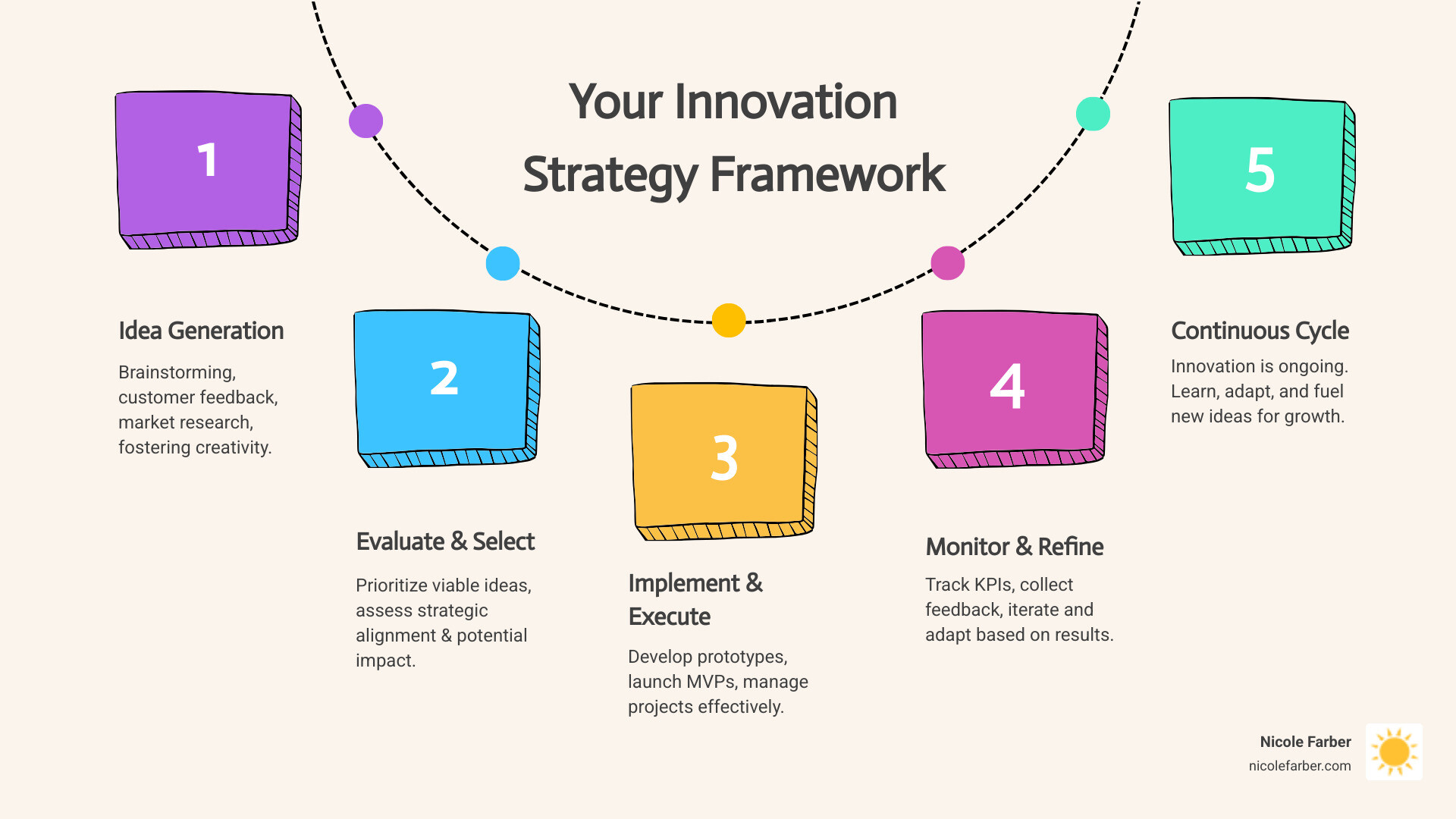
Developing a robust business innovation strategy is like charting a course for a ship. You need a clear destination, a map to get there, and a crew ready to steer any storms.

Stage 1: Idea Generation and Management
Every great innovation starts with an idea. But ideas alone aren’t enough; you need a system to generate, capture, and nurture them. This is where idea generation and management come into play.
We encourage diverse brainstorming techniques, bringing together cross-functional teams from different departments. The best solutions often come from unexpected collaborations. Actively solicit customer feedback, conduct thorough market research, and even look at what’s happening in seemingly unrelated industries. For instance, what innovations in customer service in New Orleans could inspire a law firm in Philadelphia?
Implementing robust idea management systems can provide a structured framework for employees at all levels to contribute their thoughts. This not only uncovers potential innovations but also fosters a culture of continuous improvement and boosts employee engagement. We’ve seen how fostering creativity in teams, whether they’re operating in the busy cities of the USA or the serene landscapes of Antigua Guatemala, can open up incredible potential.
Stage 2: Key Components of Business Innovation Strategies
Once ideas are flowing, you need to channel that energy into actionable strategies. This involves several key components:
- Technology Scouting: This is the proactive search for new technologies and emerging trends that could impact your business. It’s about identifying, evaluating, and acquiring technologies that can solve existing problems or create new opportunities. Are there AI tools that could revolutionize legal research or client communication?
- Trend Management: This systematic process involves identifying, analyzing, and responding to trends that affect your business strategy and operations. Understanding shifts in market and consumer behavior allows you to anticipate changes and adapt proactively. For example, a law firm needs to keep an eye on evolving client expectations regarding digital services.
- Continuous Improvement (Kaizen): This is an ongoing effort to improve products, services, or processes by making incremental changes over time. Unlike radical innovation, continuous improvement focuses on small, consistent changes that collectively lead to substantial progress. It embeds a culture of excellence and efficiency.
- Innovation Portfolio Management: Just like a financial portfolio, your innovation efforts need strategic management. This involves managing a diverse range of innovation projects to align with your overarching goals and risk appetite. The benefits are immense: better decision-making and resource allocation. It enables companies to assess the potential value and risk of different projects, ensuring a balanced mix of safe bets and ambitious experiments. This approach also helps in identifying gaps in your innovation efforts. It’s about balancing quick wins with long-term, high-risk ventures.
Stage 3: Execution and Monitoring
Ideas are great, and strategies are essential, but nothing happens without execution. This stage is about bringing your innovations to life and ensuring they deliver on their promise.
Effective project management is non-negotiable. Break down your innovation into manageable steps, assign responsibilities, and set realistic timelines. We’re big believers in prototyping and developing Minimum Viable Products (MVPs). Don’t wait for perfection; get a basic version of your innovation out there, test it, and gather feedback. This agile approach allows for rapid learning and iteration.
Equally important is setting clear Key Performance Indicators (KPIs) to track your progress. Are you meeting your innovation ROI goals? What’s your time to market? Are customer adoption rates increasing? Continuously monitoring these metrics allows you to adapt your strategy, make necessary adjustments, and ensure your innovation efforts are truly effective.
Building a Thriving Culture of Innovation
Innovation isn’t just a department; it’s a mindset that needs to permeate your entire organization. Creating a thriving culture of innovation is paramount for long-term success.
The Role of Leadership and R&D
It all starts at the top. Leadership buy-in and a clear vision are non-negotiable. Leaders must champion innovation, articulate its importance, and allocate the necessary resources. Investing in R&D is a critical part of this commitment. We know that 70% of innovation leaders invest more in research and development than their less innovative peers. This investment isn’t just about creating new products; it’s about finding more efficient ways to operate and staying ahead of the curve.
Empowering employees is another cornerstone. Give your teams the autonomy and resources to experiment, and crucially, accept that failure is a natural part of the learning process. As we often say, if you’re not failing sometimes, you’re not pushing hard enough. The most innovative organizations understand that embracing the risk of failure is necessary for true breakthroughs.
Leveraging AI and Diverse Teams
In today’s rapidly evolving world, artificial intelligence (AI) is becoming an indispensable tool for innovation. We’re seeing companies leverage AI for everything from sophisticated data analysis to predictive trend management. It’s no wonder that 82% of CEOs and senior leaders believe AI will have a significant or even extreme impact on their business. More than half of the most innovative companies are creating dedicated teams that leverage AI capabilities across business functions. This isn’t just about adopting new tech; it’s about fundamentally rethinking processes and services.
Beyond technology, the composition of your teams plays a huge role. Diverse teams, across functions and with varied backgrounds, bring fresh perspectives and challenge the status quo. This leads to richer solutions and a greater ability to capture new markets. Encouraging shared best practices and expanding responsibility for innovation across the entire business, not just within R&D, ensures that everyone feels a sense of ownership and contribution. When everyone is an innovator, the possibilities are endless.
Best Practices for Implementing Business Innovation Strategies
To truly embed innovation, we advocate for several best practices:
- Fostering a Culture of Quality: This means constantly evaluating and optimizing everything you do, from client interactions in Wilkes-Barre to operational workflows in New Orleans.
- Empowering Cross-Functional Teams: Break down silos and encourage collaboration. When legal, marketing, and operations teams work together, magic happens.
- Open Communication: Create an environment where ideas, feedback, and even failures can be discussed openly without fear of judgment.
- Celebrating Both Successes and Failures: Acknowledge achievements, but also learn from what didn’t work. Each failure is a step closer to success.
- Providing Resources and Training: Equip your teams with the tools, knowledge, and time they need to innovate effectively.
Measuring and Rewarding Success
You can’t manage what you don’t measure, and innovation is no exception. Establishing clear metrics and rewarding innovative efforts are vital to sustaining momentum.
Establishing Meaningful Metrics
For your business innovation strategies to be effective, you need to know if they’re actually working. We recommend focusing on a balanced scorecard of metrics:
- Innovation ROI: What financial return are your innovation investments generating?
- Time to Market: How quickly can you bring a new idea from concept to launch?
- Customer Adoption Rates: Are your new products or services gaining traction with clients?
- Employee Engagement Surveys: Are your employees feeling empowered and engaged in the innovation process?
- Number of New Ideas Generated: A healthy pipeline of ideas is a good indicator of an innovative culture.
- Business Process Innovation (BPI) Impact: Are your process improvements leading to tangible benefits like cost savings or increased efficiency?
These metrics help you understand the true impact of your efforts and allow for continuous optimization. If you can’t measure the performance, you won’t be able to innovate later on.
Creating Effective Reward Programs
To truly embed innovation, you need to incentivize it. Reward programs don’t just motivate; they signal what’s truly valued within your organization. This can include:
- Financial Bonuses: Direct monetary rewards for successful innovations.
- Recognition and Awards: Public acknowledgment of innovative contributions, such as an “Innovator of the Quarter” award.
- Career Advancement Opportunities: Giving innovators more challenging roles or leadership positions.
- Aligning Rewards with Strategic Goals: Ensure that what you reward directly supports your overall business innovation strategies.
But rewards aren’t just about money. Non-monetary rewards can be incredibly powerful:
- Increased Autonomy: Giving innovators more control over their projects.
- Professional Development: Providing access to specialized training or conferences.
- Mentorship Opportunities: Connecting innovators with senior leaders.
- Public Praise: Acknowledging contributions in company-wide communications.
- Time Off: A well-deserved break after a challenging project.
- Flexible Work Arrangements: Showing appreciation through work-life balance.
- Involvement in Strategic Decisions: Giving innovators a seat at the table.
- Opportunity to Lead New Projects: Empowering them with new responsibilities.
The Future of Innovation: Trends and Changes
The world of business is a dynamic place, and what’s innovative today might be standard practice tomorrow. Staying ahead means keeping an eye on the horizon.
The Rise of Sustainable and Digital Business Models
One of the most significant shifts we’re witnessing is the intertwining of digital change and sustainability. Digital change is not just about technology; it’s about fundamentally reshaping business models. We see the proliferation of platform models, e-commerce integration, and the use of data to create hyper-personalized experiences.
Simultaneously, sustainability is no longer a niche concern but a core driver of innovation. Companies are exploring circular economy principles, designing products for longevity and recyclability, and integrating environmental and social responsibility into their core operations. As a book on the topic explores, contemporary issues in business model innovation increasingly concern digital change and sustainability. This means not only green innovation in products but also sustainable practices in your processes and business model, for example, a legal firm optimizing its digital presence to reduce paper waste and energy consumption.
Preparing for Tomorrow’s Challenges
To thrive in this environment, organizations must cultivate a forward-thinking mindset. This means anticipating market shifts, building organizational agility to pivot quickly, and embracing continuous learning. What works in Philadelphia might need adaptation for the unique market of Antigua Guatemala, but the core principles of agility remain universal.
This is where entrepreneurship coaching becomes invaluable. It helps leaders and teams develop the resilience, creativity, and strategic thinking needed to steer uncertainty and turn challenges into opportunities.
Conclusion: Your Journey to Becoming an Innovation Leader
We’ve covered a lot of ground, from defining what business innovation strategies truly mean to understanding the different types of innovation, the stages of developing a strategy, and the critical role of culture, leadership, and measurement. The key takeaway is this: innovation is not a one-time project; it’s a continuous journey, an ongoing commitment to improvement and adaptation.
Empowerment through leadership, a willingness to accept risk, and a dedication to fostering a creative and diverse environment are the hallmarks of innovation leaders. If you’re ready to accept change, master the art of the new, and transform your business for sustained growth, the path to becoming an innovation leader starts now.
At Nicole Farber, we believe in empowering business owners and guiding them through overcoming business challenges by implementing robust business innovation strategies. Whether you’re looking for business strategy coaching, a business growth keynote speaker, or simply need help building a successful business, we’re here to help you open up your full potential. Don’t let chaos bring you down; instead, let it bring opportunity.