Stop Managing and Start Leading with These Professional Seminars
- Leadership
- In the News
- March 16, 2026
Stop Managing and Start Leading with These Professional Seminars
Why Management and Leadership Training Matters for Law Firm Growth

Management and leadership training helps professionals develop the distinct skillsets needed to plan operations and inspire teams. Here’s what you need to know:
Quick Answer: Top Management and Leadership Training Options
| Training Type | Best For | Time Commitment | Key Benefits |
|---|---|---|---|
| In-Person Workshops | First-time supervisors, partners managing teams | 2 days to 1 week | Hands-on practice, networking, immediate feedback |
| Online Courses | Busy executives with limited time | 10 hours/week, self-paced | Flexibility, credential building, accessible from anywhere |
| One-on-One Coaching | CEOs facing specific challenges | 1-2 hours/week | Personalized guidance, real-time problem solving |
| Certificate Programs | Leaders without business backgrounds | 3 years max (self-paced) | Formal credentials, structured learning paths |
Here’s the reality: management controls the day-to-day operations while leadership inspires people to follow. As one expert put it, “People can’t be ‘managed’ like a spreadsheet or a supply chain.” The best executives excel at both.
For law firm partners in Philadelphia and Wilkes-Barre, this distinction matters even more. You’re juggling client acquisition, team supervision, and practice growth—all while trying to stand out in a crowded market. Without the right training, you risk learning through costly trial and error.
Research shows that over 15 million professionals have invested in leadership training, with programs ranging from intensive two-day workshops to flexible online certificates. The most effective programs combine emotional intelligence, practical frameworks like EOS or OKRs, and real-world application to challenges like supervising former peers or leading hybrid teams.
I’m Nicole Farber, CEO of ENX2 Legal Marketing with over 15 years helping law firms and businesses grow. Through my work with the American Bar Association and Legal Marketing Association, I’ve seen how management and leadership training transforms overwhelmed partners into confident leaders who build thriving practices.
The Core Pillars of Management and Leadership Training
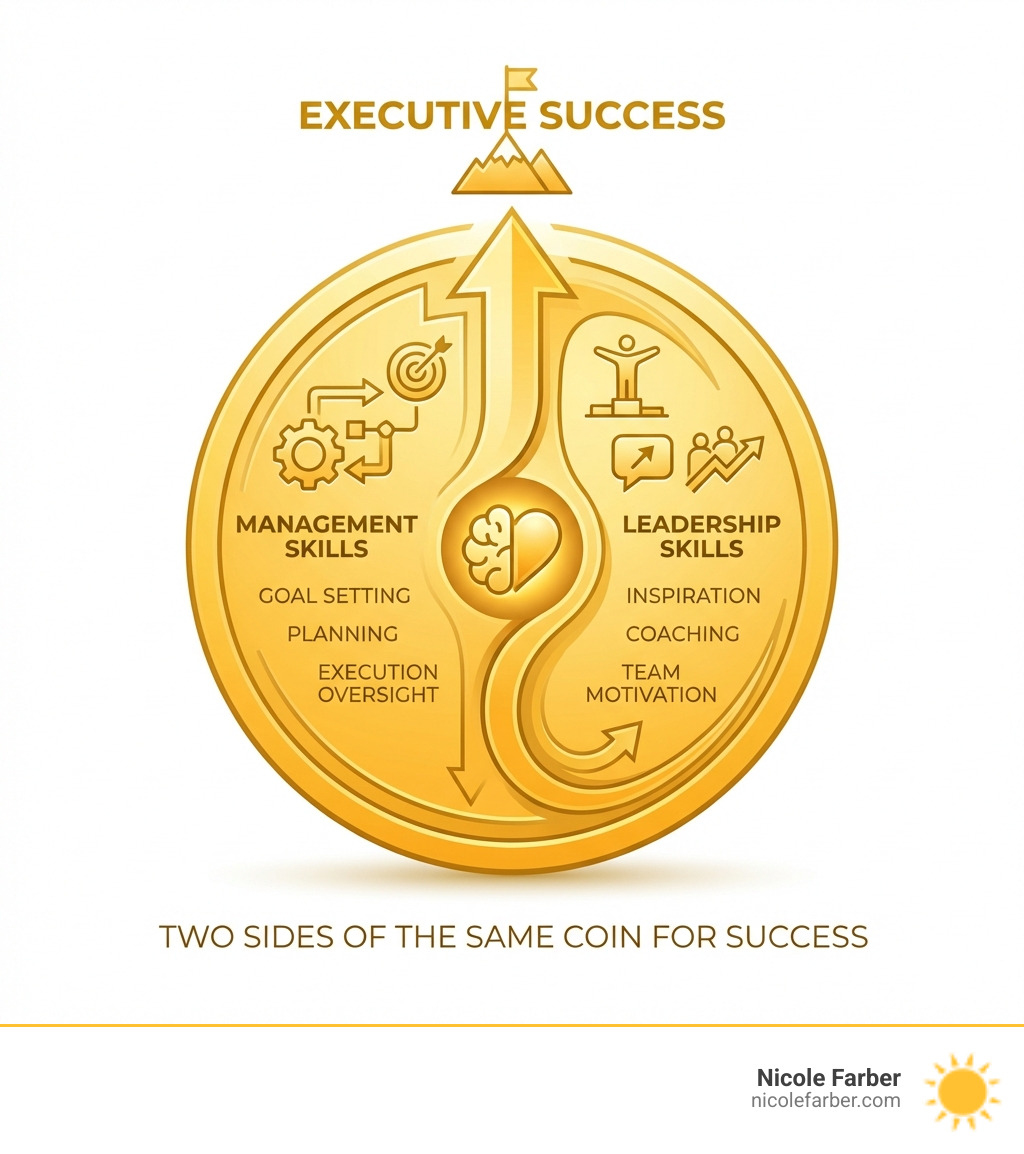
To truly excel, we must recognize that management and leadership are two sides of the same coin. Management involves the technical aspects of the job: setting business goals, planning for achievement, and overseeing execution. Leadership, on the other hand, is about the human element—mentoring, coaching, and reaching individuals to harness their potential.
In our offices from Luzerne County to Philadelphia, we’ve seen that the most successful executives are those who master both. Effective management and leadership training focuses on several core pillars:
- Emotional Intelligence (EQ): This is the ability to understand and manage your own emotions while recognizing and influencing the emotions of others. It is the bedrock of What is Leadership.
- Active Listening: Leaders who listen build trust. This is especially vital in high-stakes environments like law firms in Wilkes-Barre or New Orleans.
- Strategic Vision: Establishing a clear direction for the firm and communicating it in a way that others want to follow.
- Feedback Loops: Creating a culture where feedback is constructive, frequent, and flows in both directions.

Understanding Why Executives Need Leadership Development is the first step toward organizational health. Without these skills, firms often suffer from high turnover and stagnant growth.
Transitioning from Manager to Leader
Many of us start our careers as individual contributors or “managers” of tasks. However, moving into the C-suite requires a significant mindset shift. You are no longer just responsible for the work; you are responsible for the people doing the work.
To Develop Executive Presence, we must focus on how we show up in the room. This includes:
- Coaching vs. Mentoring: Learning when to provide the answer (mentoring) and when to ask the right questions to help an employee find the answer themselves (coaching).
- Decision Making: Moving from tactical decisions to executive decision-making that considers long-term strategic impact.
- Harnessing People: Recognizing that your team is your most powerful competitive advantage.
High-Impact Management and Leadership Training for New CEOs
New CEOs, especially those in small IT companies or boutique law firms with about 10 employees, often feel they lack a formal business background. If you have only 10 hours a week to dedicate to growth, your training must be high-impact.
Common challenges for new leaders include:
- Time Estimation: Learning how to accurately predict how long a project will take to avoid missing deadlines.
- Deadline Management: Implementing systems that ensure project completion without burnout.
- Supervising Former Peers: Navigating the social complexity of leading people who used to be your equals.
For those seeking Leadership Training New Orleans, we focus on these practical hurdles to ensure you don’t just learn theory, but gain tools you can use Monday morning.
Top-Rated Seminars and Courses for Busy Executives
Choosing the right program depends on your specific needs and location. Whether you are looking for a Leadership Speaker Wilkes-Barre or a virtual workshop, the options are vast.
| Program Provider | Format | Location Focus | Key Specialization |
|---|---|---|---|
| Nicole Farber Signature Seminars | In-Person / Virtual | Philadelphia, Wilkes-Barre, New Orleans | Faith-driven leadership, legal marketing, and personal empowerment |
| HBS Online (Harvard) | Virtual / Asynchronous | Global / Online | Credential building (CORe/CLIMB) for non-business backgrounds |
| MIT Sloan Executive Education | Hybrid | Global / Online | Executive Certificate in Management and Leadership |
| OPM Center for Leadership | In-Person / Online | USA (Federal Focus) | Tiered programs for supervisors, managers, and senior executives |
| Center for Creative Leadership (CCL) | Various | Global | Research-backed, feedback-rich programs with 50+ years of experience |
For those in Luzerne County, the L3C Microcredential Academy offers accessible ways to build skills locally. If you are looking for a structured path, our Leadership Development Seminars provide the roadmap needed to navigate modern business complexities.
Low-Cost and Accessible Learning Paths
You don’t need a massive budget to start your management and leadership training. Many world-class resources are available for the price of a book or a monthly subscription.
- Online Platforms: Become a Leader through LinkedIn Learning paths that cover transitioning from manager to leader.
- Books: Traction by Gino Wickman is a must-read for anyone struggling with organizational structure.
- Micro-learning: Breaking down complex topics into 15-minute daily modules can fit into even the busiest CEO’s schedule.
- Federal Resources: The OPM.gov website offers a wealth of information on leadership competencies that apply even outside the government sector.
Specialized Credentials for Non-Business Backgrounds
Many successful entrepreneurs in Philadelphia or Antigua Guatemala started as specialists—lawyers, engineers, or developers—without formal business schooling. Certificate programs are an excellent way to bridge this gap.
Programs like the OPM LEAD Certificate or Business Strategy Coaching are designed to help you build a foundational understanding of business acumen, accountability, and building coalitions. These programs often allow you to earn credentials at your own pace, typically over a three-year window.
Practical Frameworks to Master Time and Team Efficiency
Frameworks provide the “skeleton” for your business operations. Without them, projects often stall. We see this frequently in small IT companies where technical brilliance is present, but organizational structure is lacking.
- EOS (Entrepreneurial Operating System): As detailed in the book Traction, this helps you get everyone on the same page with a shared vision and clear metrics.
- Agile: Originally for software, Agile is now used across industries to deliver value frequently and adapt to change quickly.
- OKRs (Objectives and Key Results): A framework used by Google and many startups to track progress toward ambitious goals.
Implementing these tools allows you to Empower Your Team by giving them a clear roadmap for success, reducing the need for micromanagement.
Solving the Mid-Project Motivation Slump
A common issue for small teams is the “30-40% hurdle.” This is the point where the initial excitement of a new project wears off, but the finish line is still far away.
To maintain momentum, we recommend:
- Frequent Milestones: Break large projects into smaller “wins” that can be celebrated.
- Value Delivery: Ensure the team sees the impact of their work early and often.
- Enthusiasm Checks: Use our Become Good Leader Team Guide to learn how to reignite morale when it starts to dip.
Choosing the Right Format: Coaching vs. Online Workshops
How you learn is just as important as what you learn. In Philadelphia and Wilkes-Barre, we offer a variety of formats to suit different learning styles:
- One-on-One Coaching: Best for high-level executives who need a safe space to troubleshoot specific difficulties and explore opportunities. Our Business Leadership Coaching Guide explains how personalized advising can accelerate your growth.
- Virtual Workshops: Ideal for teams spread across different locations, such as a hybrid team with members in New Orleans and Antigua Guatemala.
- In-Person Retreats: Nothing beats the energy of a live seminar. These are perfect for intensive skill-building and networking.
When to Hire an Operations Manager
As your team grows past 10 or 12 employees, the CEO often becomes a bottleneck. This is when you should consider hiring an operations manager or an “Integrator.”
In our Small Business Leadership Guide 2025, we discuss how a Visionary leader (the CEO) needs an Integrator to handle the day-to-day execution. This allows the founder to delegate project management and focus 80% of their time on business development and strategic leadership.
Evaluating the ROI of Management and Leadership Training
How do you know if your investment in management and leadership training is paying off? You must track specific performance metrics:
- Employee Retention: Are your turnover rates dropping?
- Project Completion: Are deadlines being met more consistently?
- Team Morale: Use anonymous surveys to gauge how the team feels about your leadership.
- Handling Difficult Situations: Are you more confident in supervising former peers or handling “chronic complainers”?
Leading a hybrid or remote team requires even more intentionality. Learning How to Become an Effective Leader in a digital world means mastering tools like Slack, Linear, and Zoom while maintaining a human connection.
Frequently Asked Questions about Management and Leadership Training
How much time should a CEO dedicate to training?
We recommend at least 10 hours per week for new CEOs or those in a growth phase. This doesn’t have to be 10 hours of “class time.” It includes reading high-impact books like Traction, engaging with a coach, or applying new frameworks to your real-world projects.
Can I earn a leadership credential without an MBA?
Absolutely. Many of the world’s most successful leaders do not have an MBA. Programs like our Leadership Development Seminars or the HBS Online Certificate Programs provide the specific skills you need without the time and cost of a two-year degree.
What are the best frameworks for small IT teams?
For teams of around 10 people, Agile and EOS are game-changers. Agile helps with time estimation and avoiding the mid-project slump, while EOS (Traction) ensures that the right people are in the right seats and that the company is moving toward a single vision.
Conclusion
At the end of the day, management and leadership training is an investment in yourself and your people. As a single mother who built a business from the ground up, I know that leadership isn’t just about spreadsheets—it’s about faith, resilience, and the courage to empower others.
Whether you are seeking Leadership Training New Orleans or inspiration in Wilkes-Barre, we are here to help you move from simply managing tasks to truly leading your team. Stop stumbling through trial and error and start building a legacy.
Ready to take the next step? Explore our Leadership Development Seminars and let’s grow together.