Mastering the Obstacle Course of Modern Business
- Entrepreneurship
- In the News
- April 8, 2026
Mastering the Obstacle Course of Modern Business
Mastering the Obstacle Course: Your Guide to Overcoming Business Challenges

When facing business obstacles, here’s what to keep in mind:
- Mindset Shift: View setbacks as opportunities for growth, not just problems.
- Realistic Optimism: Stay hopeful but grounded in reality.
- Actionable Strategies: Implement practical steps like smart financial management and adapting your offerings.
- Team Resilience: Build a team that finds solutions and adapts quickly.
- Continuous Learning: Plan and reflect to prepare for future disruptions.
Every entrepreneur faces hurdles, and mastering the art of overcoming challenges in business is not just about survival, but about thriving. Challenges are an inevitable part of the journey. They are not roadblocks but often serve as a “pause button” for reflection and growth. Instead of seeing them as problems, you can reframe them as opportunities to innovate and strengthen your business.
This guide will show you how to shift your mindset, implement practical strategies, and build a resilient team. You’ll learn to lead effectively through uncertainty and even tackle complex issues. By facing these difficulties head-on, you can improve your business’s financial performance, market position, and reputation.
I’m Nicole Farber, and I’ve spent over 15 years helping law firms and other companies navigate and overcome challenges in business, including successfully guiding my own small business through a global pandemic. My passion lies in empowering leaders and teams to achieve their best, ensuring their success is my success.
Introduction
In the heart of Philadelphia or the growing business hubs of Wilkes-Barre, every entrepreneur shares a common thread: the encounter with obstacles. It is often said that dealing with setbacks is simply part of the “Entrepreneurial DNA.” Things will happen that are out of our control—market shifts, global health crises, or sudden technological disruptions—and it is up to us, and no one else, to deal with them.
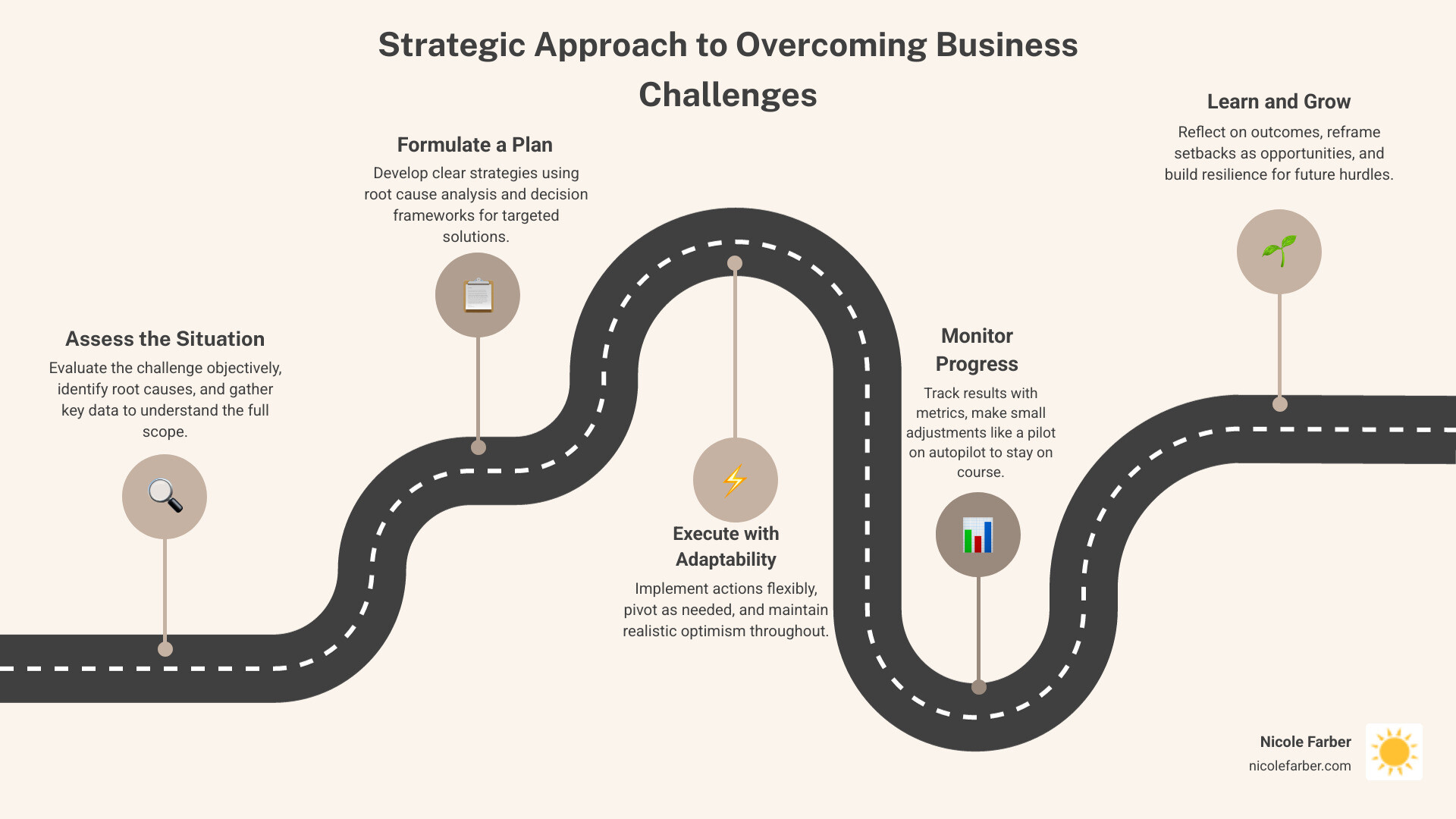
We like to think of a major setback as a “pause button.” It’s an invitation to stop, breathe, and ask: “Where do we really want to be, and how can we get there?” Research shows that even the most successful businesses aren’t those that avoid trouble, but those that pivot effectively. For instance, while planes are on autopilot 90% of the time, pilots are constantly making small adjustments to stay on course. Overcoming challenges in business requires that same level of constant calibration.
Shifting Your Mindset: The Power of Realistic Optimism
How we talk to ourselves during a crisis determines how we lead our teams. There is a profound difference between fascination and frustration. When a problem arises, do we meet it with anger, or do we look at it with fascination, asking what lesson it is trying to teach us?
Developing an Entrepreneurial Mindset Development plan involves moving toward “realistic optimism.” This isn’t the same as blind optimism—the “everything will be fine” attitude that ignores mounting debt or unhappy customers. Realistic optimism means facing the brutal facts of your current reality while maintaining unwavering faith that you will prevail in the end.
Reframing Setbacks as Opportunities
In business, Chaos Brings Opportunity. When we lean into a growth mindset, we stop seeing obstacles as stop signs and start seeing them as signals to pivot. As Ryan Holiday explores in The Obstacle Is The Way philosophy, the very thing standing in your path can become the path itself. If a competitor moves into your territory in Luzerne County, it’s not just a threat; it’s an opportunity to refine your unique value proposition and serve your community better.

Practical Strategies for Overcoming Challenges in Business
Once the mindset is right, we need boots-on-the-ground tactics. One of the most common avoidable obstacles is uncontrolled spending. We’ve all seen startups get a bit of funding and suddenly start spending like a Fortune 500 company.
Identifying the “Gnarly” Challenges
True strategy isn’t just a 20-page PowerPoint full of mission statements and “fluff.” Real strategy involves Building a strategy for tough obstacles by identifying your “gnarliest” challenges first.
- Clarity: Is the problem a lack of capital, or is it a talent gap?
- Root Cause Analysis: Are you losing customers because of price, or because your outbound marketing is outdated?
- Decision-Making: 32% of business leaders report feeling paralyzed by uncertainty. To move past this, treat decisions as experiments. Instead of saying “We are betting the company on this,” say “Our hypothesis is that this new service will meet a need.”
Financial Resilience and Resource Management
In Philadelphia and Wilkes-Barre, we’ve seen businesses thrive by sticking to “frugality as a value.” Remember Microsoft’s “Shrimp and Weenies” memo? In their early days, they urged employees to choose cheap hot dogs over expensive shrimp to save resources for what mattered: innovation.
Implementing a Strategy to Grow Business today often involves:
- Cash Buffers: Having 3-6 months of operating expenses can be the difference between a pivot and a shutdown.
- Inbound Marketing: Instead of chasing leads, use HubSpot strategies to create valuable content that pulls customers toward you.
- Sticking to the Knitting: As Tom Peters suggested in In Search of Excellence, stay focused on what you do best. Don’t over-diversify into areas where you have no expertise.
- AI ROI: Businesses making significant investments in AI typically realize a return on that investment in less than two years. Using AI for Key Strategies for Growing a Business can automate the mundane, allowing your team to focus on high-level problem solving.
Building a Resilient Team and Solution-Oriented Culture
Your business is only as resilient as the people inside it. If you are a leader who “distances” themselves from the daily struggles, you miss the chance to cultivate a solution-oriented culture.
Training Your Team for Overcoming Challenges in Business
One of our favorite Business Leadership Strategies is the “Two-Solution Rule.” We train our teams to never present a problem without also presenting at least two potential solutions. This shifts the team from a “complaint” mindset to a “consultant” mindset.
This approach also helps humanize the workplace. In industries like janitorial services, the annual average turnover rate is around 400 percent. However, businesses that focus on employee humanity and connection see those numbers drop dramatically. When people feel valued, they stay—and they fight for the company’s success during hard times.
Sensemaking and Leadership in Times of Chaos
During times of immense change, leaders must practice “sensemaking.” According to MIT Sloan insights on leading through chaos, sensemaking involves:
- Learning: Gathering data from diverse viewpoints.
- Mapping: Creating a shared understanding of the situation.
- Experimenting: Testing solutions quickly to see what works.
This process creates a sense of “collective safety.” When we use “we” and “us” in our communications, we remind our team that we are in this together. Whether you are navigating the post-pandemic landscape in New Orleans or setting up a new venture in Antigua Guatemala, data-driven supply chains and clear Business Leadership Ultimate Guide principles are your best defense against chaos.
Navigating Wicked Problems and Long-Term Performance
Some challenges aren’t just simple obstacles; they are “wicked problems.” These are complex, interconnected issues like climate change or systemic economic shifts that don’t have a single “right” answer.
Strategic Approaches to Overcoming Challenges in Business
Addressing these requires a long-term mindset. Research shows a strong positive association between a company’s social performance and financial performance. In fact, purpose-driven organizations that focus on material ESG (Environmental, Social, and Governance) issues outperform competitors by more than 3% annually in stock returns.
| Feature | Short-Term Focus | Long-Term Strategic Focus |
|---|---|---|
| Primary Goal | Quarterly profits | Sustainable value creation |
| Risk Management | Reactive / Defensive | Proactive / Resilient |
| Innovation | Incremental / Safe | Disruptive / Bold |
| Stakeholder View | Shareholder only | Multi-stakeholder (Employees, Community) |
| Crisis Response | Panic / Cost-cutting | Sensemaking / Strategic Pivot |
Community-Led Change and Regional Resilience
We see the power of resilience in the locations we serve. Take New Orleans post-Katrina, where the Propeller hub for change became a beacon for community-led business growth. Similarly, in Luzerne County, growth tips often emphasize the power of local support networks. Whether it’s a roadmap for business confidence in Antigua Guatemala or a small business startup in Wilkes-Barre, the “smartest first step” is often channeling the power of your local community.
Frequently Asked Questions about Business Obstacles
What is the difference between realistic and blind optimism?
Blind optimism is the belief that things will get better simply because you want them to, often leading to a refusal to see red flags. Realistic optimism is action-oriented hope. It involves facing the brutal reality—such as a 30% drop in sales—while maintaining the faith that through hard work, strategic pivoting, and team mobilization, you will find a way to succeed.
How can I prevent decision paralysis during a crisis?
When uncertainty hits, 42% of leaders admit to putting off decisions because it’s uncomfortable. To combat this, use scientific language. Frame your next move as a “hypothesis” or an “experiment.” This lowers the emotional stakes and allows for “small wins” that build momentum. Break the big problem down into what you can and cannot control, then execute on the “can” list immediately.
Why is ‘sticking to the knitting’ important for growth?
“Sticking to the knitting” means staying focused on your core competencies—the things you do better than anyone else. Many businesses fail not from “starvation” (lack of opportunity) but from “indigestion” (taking on too many unrelated projects). By focusing on your bread-and-butter customers, you ensure your primary income stream remains strong while you navigate external disruptions.
Conclusion
Overcoming challenges in business is a journey I know well. As a single mother building a career in the legal marketing industry, I have faced my share of “gnarly” obstacles. My path has been paved with faith-driven leadership and the belief that every setback is just a setup for a greater comeback.
Whether you are leading a law firm in Philadelphia or a startup in Wilkes-Barre, you already have the DNA to succeed. Use your challenges as a pause button, lean into realistic optimism, and never be afraid to hit the reset button when it’s time to get creative.
Ready to transform your obstacles into your greatest competitive advantage? Explore our full guide on Overcoming Business Challenges and start building your resilient future today.