Law Firm Business 101: Essential Processes for Modern Attorneys
- Entrepreneurship
- In the News
- August 26, 2026
Law Firm Business 101: Essential Processes for Modern Attorneys
Why the Law Firm Business Is More Than Just Practicing Law

Running a law firm business successfully means managing far more than courtroom strategy or client casework. It means running a real company — with finances, marketing, people, and processes that all have to work together.
Here’s a quick overview of what managing a law firm actually involves:
- Business structure — Choosing between partnership models, equity vs. non-equity partners, and compensation systems
- Financial management — Tracking revenue drivers like billable hours, retainer fees, and alternative fee arrangements
- Business planning — Building a living roadmap with clear goals, market analysis, and a marketing strategy
- Seven core processes — Strategy, finances, matter management, client management, business development, people, and execution
- Client acquisition — Identifying target clients, building referral networks, and managing intake to retention
- Technology and AI — Adopting the right tools to stay competitive in a rapidly changing legal market
- Marketing and visibility — Standing out in crowded markets like Philadelphia, Wilkes-Barre, or New Orleans through digital strategy and local presence
Most attorneys are trained to practice law — not to run a business. That gap between legal expertise and operational know-how is exactly where many firms struggle.
As one industry framework puts it, a law firm business plan is “first and foremost a management tool” — a recipe that forces you to think through issues you might otherwise never consider until they become real problems.
The firms that grow — and stay profitable — are the ones that treat their practice like a business from day one.
I’m Nicole Farber, CEO of ENX2 Legal Marketing, with over 15 years of experience helping law firms across the country build stronger, more competitive law firm businesses through smarter marketing and sharper strategy. If you’re ready to stop guessing and start growing, this guide is for you.
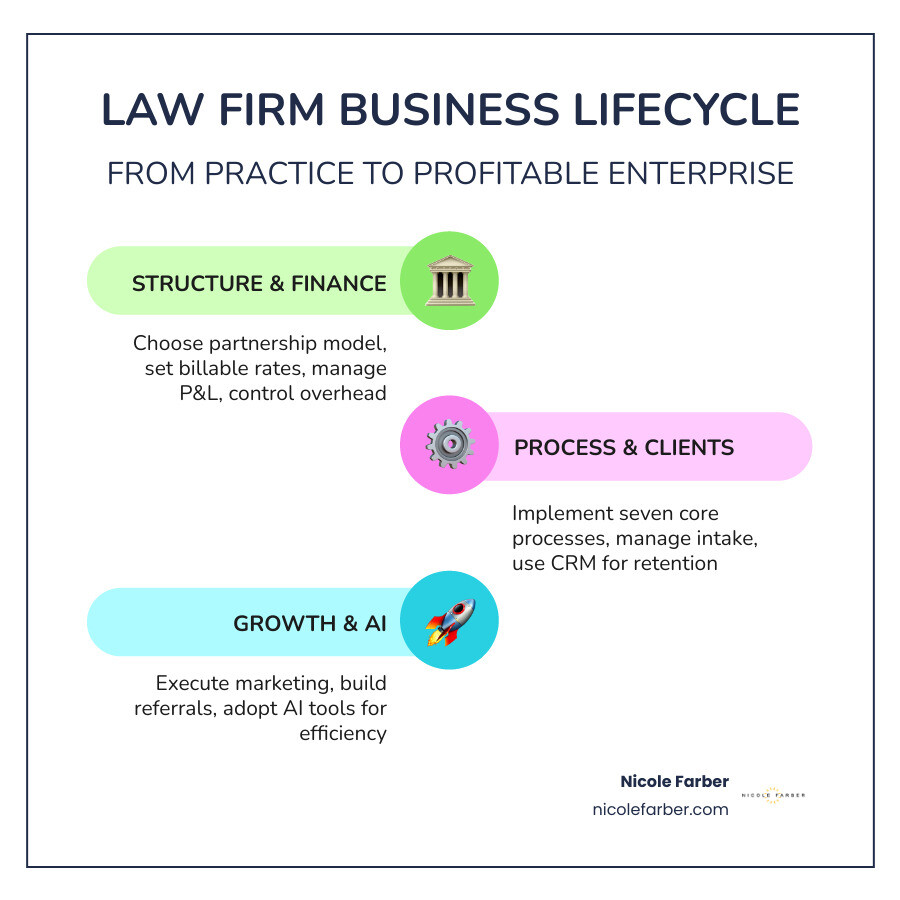
Law firm business terms to learn:
Designing a Resilient Law Firm Business: Structures and Financial Drivers
To build a resilient law firm business, we must first look at how the firm is structured and how money actually flows through it. Historically, law firms have operated as traditional partnerships. In these structures, partners own the firm and share in the profits, while associates and support staff work toward the firm’s overall goals, often with the ultimate aim of being promoted to a partner role.
However, the way firms manage their partnerships has a massive impact on their financial health and internal alignment. Some firms stick to a single-tier partnership model to foster deep cultural cohesion. For example, as we look at the financial landscape leading up to 2026, we can see how major firms have navigated this. According to financial reports, Cooley Continues Upward Trajectory as Revenue Hits $2.15B | Law.com by leveraging a diversified practice mix and maintaining a single-tier partnership structure. Their leadership emphasized that keeping a single-tier model resonates with how the firm supports itself internally and presents its brand to the market.
At the same time, many other firms are moving toward dual-tier structures, dividing partners into equity and non-equity (or income) tiers. This financial engineering allows firms to scale their headcount and retain top talent without immediately diluting the profit pool of the founding owners. To make these models work, we must incentivize attorneys properly. This means balancing the traditional billable hour with rewards for “rainmaking” (bringing in new clients) and efficient matter management. If you want to move away from the exhausting cycle of trading time for dollars, you must learn How To Trade Your Billable Hours For Executive Power to build true equity and operational leverage.
The Core Components of a Law Firm Business Plan
If you do not write a business plan, or if you write one and immediately hide it away in a drawer, you have not built a useful tool. A business plan is a dynamic, living roadmap with clear milestones. It serves as a management tool to guide your daily decisions, a strategic guide to help you transition your mindset from “practicing attorney” to “business owner,” and a sales tool to secure bank financing or attract high-performing partners.
When building a law firm, your business plan should contain these essential, non-financial components:
- Executive Summary: A concise summary of what your firm does, where it is going, and why it will succeed. Pro tip: Always write this section last, after the rest of the plan is completely finished.
- Description of Your Firm: Your mission, vision, legal structure (e.g., PLLC, LLP), and what makes your practice unique.
- Analysis of Your Market: A deep dive into your target client demographics and the economic trends affecting your practice areas.
- SWOT Analysis: A focused look at your strengths, weaknesses, opportunities, and threats. Keep your SWOT analysis tightly focused on how you compare directly to your competitors, rather than just listing your internal history.
- Your Marketing Strategy: A measurable, specific plan with a set schedule to acquire clients.
- Competitor Analysis: Identifying who your true local competitors are and finding the “edge” that sets your firm apart.
To avoid looking like you simply copied a generic template, stay away from rigid, “techy” numbering systems that business plan software often spits out. Keep it clean, professional, and tailored to your specific market. If you are ready to put this into action, do not start from scratch. You can stop winging it and use a business development plan template to map out your firm’s future.
Financial Drivers and Expense Management
To keep your law firm business healthy, you must master the drivers on your Profit and Loss (P&L) statement. On the revenue side, cash flow is driven by retainer fees, hourly billing rates, billable time, and alternative fee arrangements (AFAs) like flat fees or contingency models. Managing AFAs efficiently can actually drive higher profit margins than traditional hourly billing, provided you have tight control over your operational workflows.
On the expense side, firms face professional expenses, business development costs, salaries, and office overhead. If we do not manage these expenses with extreme discipline, rising costs can quickly eat away at our hard-earned revenue.
Consider the real-world case of the Am Law 200 firm Vorys. In their financial reviews, we see that As Firm Expenses Grew by $15M, Vorys’ Revenue Rose but Profits Declined | Law.com despite achieving a 4% increase in top-line gross revenue to $231 million. Their profit decline was driven by heavy investments in new ancillary businesses, overhead for new offices, lawyer compensation, and inflation. This highlights a critical lesson: scaling revenue is meaningless if your operational expenses are allowed to grow unchecked.
To help you visualize how different partnership tiers impact your firm’s cash flow and profit distribution, review this comparison:
| Financial Metric / Feature | Equity Partners | Non-Equity (Income) Partners |
|---|---|---|
| Ownership Stake | Yes (Holds equity in the firm) | No (Salaried employee status) |
| Compensation Type | Share of firm profits (PEP) | Fixed salary + performance bonuses |
| Capital Contribution | Required to buy into the partnership | None required |
| Voting Rights | Full voting power on strategic decisions | Limited or no voting power |
| Risk Exposure | High (Personally liable for firm debts) | Low (Protected as an employee) |
To protect your bottom line, we must learn How To Make Your Firm More Profitable Than A Lawyer In A Room Full Of Problems by optimizing our pricing strategies. We typically use three primary pricing models: cost-based (cost plus a target profit margin), cost-plus-fixed-markup, or market-based (aligning with the local market norm and adjusting based on our unique value).
The Seven Essential Law Firm Business Processes
To drive consistent operational success, we must view our practice through the lens of structured business processes. Borrowing from classic business systems, we can organize a modern law firm around seven essential business processes. Defining and constantly improving these processes is the only way to adapt to a rapidly changing legal industry.
- Law Firm Strategy and Planning: Conducting competitive research, tracking legal sector trends, and updating your business plan at least semi-annually.
- Managing Finances: Overseeing cash flow, budgeting, accounts payable/receivable, and expense tracking. A firm can book dozens of cases in a single month and still go bankrupt if it lacks the immediate cash flow to cover overhead.
- Managing Matters: Tracking “matter economics,” which includes daily time entry, managing work-in-progress (WIP), and timely billing and invoicing.
- Managing Clients: Overseeing client relationship management (CRM), organizing client intake, and executing long-term account planning.
- Business Development: Aligning client analysis, brand management, and referral marketing to bring in new business.
- Managing People: Recruiting, training, internal communications, and leadership development.
- Execution: Integrating technology and legal process planning to simplify legal transactions.
Whether you are running a boutique practice in Luzerne County or scaling a larger firm in Wilkes-Barre, implementing these processes is key to long-term survival.
By focusing on structured law firm development, we can streamline these processes. Leading global firms, as shown in the Annual Business Report FY25, have successfully scaled past major revenue milestones by focusing heavily on industry-aligned growth, process execution, and technological integration.
Navigating the Four Law Firm Business Model Scenarios in the AI Era
The rapid rise of artificial intelligence is fundamentally changing client expectations. Clients no longer want to pay high hourly rates for basic document drafting or routine contract reviews. In this new landscape, we see four distinct business model scenarios emerging for law firms:
- The Tech-Led Disruptor: Firms that lead with proprietary technology, automated workflows, and subscription-based pricing models to deliver rapid, low-cost legal services.
- The Elite Boutique: Highly specialized firms that charge premium rates for deep, niche expertise and complex litigation that cannot be automated.
- The Integrated Powerhouse: Large, diversified firms that combine traditional legal services with non-legal consulting branches (like risk advisory or data analytics software) to provide a one-stop-shop for corporate clients.
- The Traditional Firm: Firms that rely solely on manual processes and standard hourly billing. Warning: This model faces the highest risk of obsolescence as clients demand greater efficiency.
To see this disruption in action, look at how some modern practices operate. For instance, Global Law Firm Enhanced by Artificial Intelligence showcases how a firm can combine highly experienced lawyers across multiple jurisdictions with low-cost hourly rates, flexible subscription models, and AI-powered contract reviews to eliminate administrative bottlenecks.
For a deeper look at how to protect your margins while adopting these new tools, read The Lawyers Guide To Ai And Roi to ensure your technology investments actually translate into bottom-line profitability.
Client Relationship Management from Intake to Fulfillment
Your relationships with your clients are your firm’s most valuable asset, and they thrive best under active, structured management. Client relationship management starts the very moment a prospect reaches out to your firm.
An effective CRM system should track every step of this journey:
By automating your client intake, you reduce friction for the client and ensure your staff doesn’t waste time on manual data entry. Once a client is onboarded, consistent communication is the key to retention. If you want to build a steady stream of cases, you must focus on proactive client acquisition for lawyers. This means understanding client behavior and learning How To Find Clients Before They Meet Their Maker by positioning your firm as a trusted advisor long before an emergency occurs.
Strategic Market Analysis and Client Acquisition
To build a thriving law firm business, we must conduct a thorough market analysis. This means looking outward to identify our target clients, analyze our competitors’ marketing tactics, and define our Unique Selling Proposition (USP). What is the specific “edge” your firm has? What specialized knowledge or client-care standards do you bring to the table that others cannot match?

When we analyze the local market—whether in Philadelphia, Wilkes-Barre, or New Orleans—we must look at what truly influences a client’s decision to retain an attorney. Price is rarely the only factor; specialized industry knowledge, rapid response times, and clear communication are often far more important. For a step-by-step guide on how to position your firm in a competitive local market, consult our comprehensive law firm marketing consultant guide to align your brand with the needs of your ideal clients. Once your positioning is clear, you can focus on active attorney business development to turn local visibility into consistent fee-earning files.
Developing and Executing Marketing and Business Development Strategies
An effective marketing strategy must be highly measurable, specific, and tied to a strict schedule. Gone are the days when a billboard on the highway was enough to sustain a firm. Today, we must deploy a multi-channel digital marketing strategy that includes local SEO, targeted content marketing, and professional referral networks.
When planning your growth, we must address these key marketing channels:
- Local SEO: Optimizing your Google Business Profile so your firm appears at the top of local searches in your target cities, such as Philadelphia or New Orleans.
- Referral Networks: Building structured, reciprocal relationships with other professionals (like accountants, real estate agents, and other attorneys) to generate high-quality leads.
- Lead Magnets: Offering valuable resources, such as free guides or webinars, to capture prospect information early in their decision-making process.
To make sure your marketing efforts are actually profitable, you must establish a clear attorney marketing budget and track your client acquisition costs (CAC) closely. Additionally, focusing on building a referral network allows you to lower your overall marketing costs by acquiring highly qualified clients through trusted professional introductions.
Balancing Strategic Planning with Day-to-Day Execution
The greatest challenge of running a law firm business is balancing long-term strategic planning with the urgent demands of daily client work. It is incredibly easy to get trapped in “firefighter mode”—spending all your energy reacting to immediate crises while your firm’s long-term growth stalls.
To break this cycle, we must invest in leadership development. If you want to grow, you must transition your mindset from “practicing lawyer” to “business leader.” We encourage you to stop lawyering and start leading with these coaching tips to help you delegate routine tasks and focus on high-value firm strategy.
By building a clear path from the courtroom to the boardroom, you can overcome operational bottlenecks and build a practice that runs smoothly even when you aren’t in the office. For a complete roadmap on making this transition, read our from courtroom to boardroom law firm leadership development guide.
Frequently Asked Questions About Managing a Law Firm
What are the most critical financial drivers for a law firm?
The most critical financial drivers are billable hours, alternative fee arrangements (AFAs), retainer fees, and billing rates on the revenue side. On the expense side, the primary drivers are professional expenses, lawyer compensation, overhead, and marketing costs. Keeping a close eye on your WIP-to-cash cycle is essential to maintaining healthy cash flow.
How does AI impact modern law firm business models?
AI is shifting the legal industry from a pure “time-billing” model to an “efficiency-billing” model. By automating routine tasks like contract reviews, legal research, and document drafting, AI allows firms to lower their operational costs. This shift is driving the rise of tech-led disruptors and integrated powerhouses that offer flat-rate or subscription pricing.
Why is a structured business plan essential for attorneys?
A business plan is first and foremost a management tool. It forces you to think through critical issues—like your competitive edge, target demographics, pricing models, and operational workflows—before they become real-world problems. It also serves as a strategic roadmap to guide your growth and a sales tool to secure financing or attract partners.
Conclusion
Building a highly profitable, resilient law firm business requires a deliberate shift in mindset. You must stop viewing your practice as just a collection of legal files and start managing it as a structured, modern business. By mastering your financial drivers, implementing the seven essential business processes, and embracing the technological shifts of the AI era, you can build a firm that stands out in competitive markets like Philadelphia, Wilkes-Barre, and New Orleans.
At the heart of every successful business is strong, visionary leadership. As a single mother who built a leading legal marketing agency from the ground up, I know the dedication, faith, and strategic discipline it takes to turn a vision into a thriving reality. Our team is dedicated to empowering law firms and legal entrepreneurs to lead with confidence, scale their operations, and achieve lasting success.
Are you ready to stop winging your firm’s growth and start leading with power and purpose? Learn more about motivational leadership coaching with us today, and let’s build the future of your practice together.