Think Like a Founder: Your Guide to Entrepreneurial Mindset Development
- Entrepreneurship
- Word of the Day
- December 1, 2025
The Mind is Everything: Why Entrepreneurial Mindset Development Powers Success

Entrepreneurial mindset development is the process of cultivating key mental attitudes—like recognizing opportunities, embracing calculated risks, and learning from failure—that enable you to create value and thrive in uncertainty.
Quick Answer: Core Elements of Entrepreneurial Mindset Development
- Vision & Goal-Setting – Seeing possibilities and breaking them into actionable steps
- Resilience & Anti-Fragility – Bouncing back stronger from setbacks
- Calculated Risk-Taking – Making bold decisions with incomplete information
- Creativity & Innovation – Spotting opportunities others miss
- Proactiveness – Taking initiative without waiting to be told
- Adaptability – Pivoting strategies when circumstances change
- Leadership & Collaboration – Building and inspiring effective teams
- Continuous Learning – Embracing a growth mindset for lifelong development
“The mind is everything. What you think, you become.” This wisdom captures why your mindset matters more than your resume or business plan. Entrepreneurship sparks innovation and drives solutions, but it requires a specific mindset as its catalyst. This isn’t just for startup founders; it’s for anyone who wants to succeed in a changing world—from law firm partners in Philadelphia to professionals in Wilkes-Barre and business leaders in New Orleans.
The good news? An entrepreneurial mindset is not something you’re born with—it’s something you develop. Research shows these skills can be fostered through practice and education. Yet many are unprepared for success because traditional education often ignores the mindset that makes technical skills actionable.
This guide will walk you through what an entrepreneurial mindset is, why it matters, and how to develop its eight core traits. You’ll find practical strategies, real-world examples, and answers to common questions about cultivating this powerful way of thinking.
I’m Nicole Farber, CEO of ENX2 Legal Marketing. For over 15 years, I’ve helped businesses transform their growth through entrepreneurial thinking. My work has shown me that success isn’t about having all the answers—it’s about developing the mindset to find them.
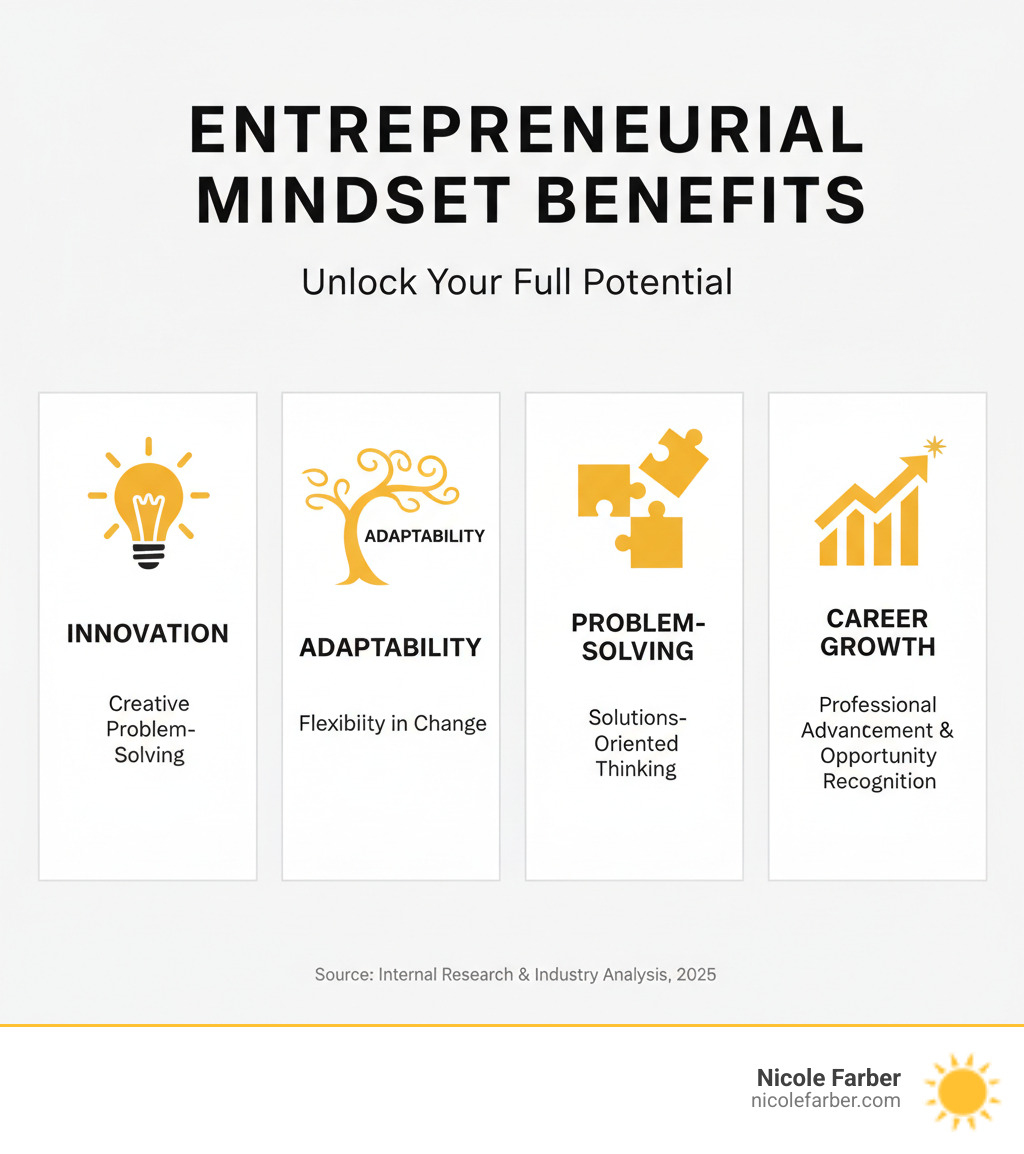
What is an Entrepreneurial Mindset (And Why It’s Your Ultimate Career Asset)?
Think about the last time you faced a problem. Did you freeze, or did you brainstorm solutions? That difference—between paralysis and possibility—is the essence of an entrepreneurial mindset.
Entrepreneurial mindset development is about how you perceive and respond to the world. It’s the ability to sense and act on opportunities under uncertainty. In simpler terms, it’s seeing doors where others see walls. This way of thinking helps leaders create value by acting on opportunities, making decisions with limited information, and staying resilient in complex conditions. It’s about seeing possibilities in chaos, a concept we explore in Chaos Brings Opportunity.
Why does this matter for your career? The world isn’t slowing down. Whether you’re a law firm partner in Philadelphia, a professional in Wilkes-Barre, or a business leader in New Orleans, the ability to steer uncertainty is essential. This mindset is highly valued by employers, boosts performance, and is fundamental for innovation.
Entrepreneurial vs. Traditional Business Mindset
While both mindsets aim for success, they take different paths. The traditional business mindset avoids risk, prefers stability, and follows detailed plans. It sees failure as something to prevent and moves cautiously with data-driven decisions.
The entrepreneurial mindset accepts calculated risks as part of the process. Failure becomes a learning experience. Instead of being limited by current resources, it finds creative ways to acquire what’s needed. Planning is agile, and action is decisive, even with incomplete information. A traditional mindset optimizes what exists; an entrepreneurial one creates what’s next.
How This Mindset Helps You Thrive in Uncertainty
Uncertainty is where opportunity lives. When you develop an entrepreneurial mindset, you see challenges as invitations for growth. Research shows individuals with this mindset have optimistic interpretations of adverse events, reframing obstacles into springboards.
This mindset empowers you to make informed decisions without perfect data and to pivot quickly. You learn to trust your judgment and course-correct along the way. Resourcefulness becomes your superpower. Entrepreneurs don’t wait for ideal conditions; they create them, leveraging networks, skills, and even constraints to find innovative solutions. A limited budget forces creativity; a small team demands efficiency.
This mindset isn’t just for startups. In corporations, it fosters intrapreneurship, where employees drive innovation from within. In non-profits, it fuels new solutions to societal problems. Whether you’re in Philadelphia, Luzerne County, New Orleans, or a social enterprise in Antigua, Guatemala, the ability to adapt and create value matters everywhere. An entrepreneurial mindset doesn’t just help you keep up—it helps you lead the way.
The Core DNA: 8 Traits of a Powerful Entrepreneurial Mindset
To think like a founder, you need to cultivate specific, actionable traits. When practiced consistently, these behaviors and perspectives become second nature.

1. Vision, Future Orientation & Goal-Setting
Entrepreneurs are visionaries who see possibilities others miss. This involves creating a clear picture of the future and then breaking that vision into concrete, actionable steps. We guide clients through this process with Strategic Goal Setting to connect long-term vision with achievable milestones.
2. Resilience, Perseverance & Anti-Fragility
Failure is an inevitable part of the journey. The key is to learn from it and bounce back stronger. Beyond simple resilience, an entrepreneurial mindset strives for anti-fragility—the ability to not just survive change but become better because of it. This means acting with a plan and marshaling resources quickly when faced with adversity.
3. Calculated Risk-Taking & Comfort with Ambiguity
Entrepreneurs are not reckless; they take calculated risks. This means assessing potential outcomes and making bold decisions with incomplete information. It’s about moving forward despite ambiguity, knowing that inaction is often the greatest risk. This is crucial for Overcoming Business Challenges.
4. Creativity, Innovation & Opportunity Recognition
Thinking outside the box and connecting disparate ideas is central to this mindset. It means constantly asking “What if?” and looking for novel solutions. Whether it’s a tech startup in Philadelphia or a social enterprise in Antigua, Guatemala, creativity fuels progress and uncovers unforeseen opportunities. Sometimes, you just need to It’s Time to Hit the Reset Button and Get Creative.
5. Proactiveness, Initiative & Self-Reliance
An entrepreneurial mindset is action-oriented. It means taking ownership, identifying problems, and initiating solutions without waiting to be told. It’s about being self-directed and turning ideas into reality through sheer will and initiative.
6. Adaptability & Flexibility
In a fast-changing world, rigidity leads to obsolescence. Adaptability means embracing change, pivoting strategies when needed, and learning on the fly. It’s about staying focused on your core mission while remaining flexible in your approach.
7. Leadership, Communication & Collaboration
Entrepreneurs rarely succeed alone. They inspire teams, build strong networks, and communicate their vision effectively. This involves fostering collaboration, listening actively, and building consensus. Strong Business Leadership Ultimate Guide principles are essential for bringing people together to achieve a common goal.
8. Continuous Learning & Growth Mindset
A true entrepreneur is a lifelong learner driven by curiosity. They possess a growth mindset—the belief that abilities can be developed through dedication and hard work. This commitment to continuous learning fuels innovation and ensures they stay relevant. Our Goal Achievement Coach services emphasize this improvement loop.
Your Blueprint for Entrepreneurial Mindset Development
Developing an entrepreneurial mindset is a continuous journey of intentional practice. The good news is that you can start building these mental muscles today, whether for your own growth or to foster this mindset across your organization.

Cultivating Your Personal Mindset: Practical Daily Habits
The path to entrepreneurial mindset development begins with small, consistent actions.
- Seek out challenges. Step outside your comfort zone. Take on the project that seems just beyond your skill level. Each challenge trains your brain to see opportunities, not threats, whether you’re a professional in Wilkes-Barre or a business owner in New Orleans.
- Treat failure as a teacher. When something goes wrong, get curious. Ask what you can learn and what you would do differently. Entrepreneurs extract the lesson and move forward.
- Feed your curiosity. Read outside your field, talk to people with different perspectives, and take a course on something new. Cross-pollination of ideas is where innovation lives. Our Free Life Coaching Courses are a great place to start.
- Be intentional about your circle. Surround yourself with mentors and peers who challenge you to think bigger and support you through tough times.
- Break your vision into small steps. Grand ambitions can be paralyzing. Set small, actionable goals and celebrate each victory to build momentum.
Fostering the Mindset in Your Organization
If you lead a team in a startup, a Philadelphia law firm, or a Luzerne County non-profit, you can create a culture that encourages entrepreneurial thinking.
- Make room for experimentation. Create safe spaces for your team to test new ideas without fear of punishment if they fail.
- Recognize and reward initiative. When a team member identifies a problem and proposes a solution, celebrate that behavior.
- Build psychological safety. Team members must feel comfortable sharing ideas, asking questions, and admitting mistakes. This openness is essential for innovation and aligns with principles for How to Become an Effective Leader.
- Break down silos. Encourage cross-departmental collaboration. Diverse perspectives lead to better solutions.
The Role of Education in Entrepreneurial Mindset Development
Education is a powerful catalyst for this mindset. Research confirms that non-cognitive skills are malleable and can be taught, especially through experiential methods like challenge-based learning. This approach puts students in real-world situations where they must recognize opportunities and act despite uncertainty.
Programs like the Wilkes-Barre LaunchBox and initiatives at Loyola University New Orleans use this hands-on model. Research on Challenge-based Learning confirms its effectiveness. Mentorship programs are also critical, connecting aspiring entrepreneurs with experienced individuals for guidance and real-world insights.
The Entrepreneurial Mindset in Action: Real-World Examples
Theory is one thing, but seeing the entrepreneurial mindset in the real world brings it to life. This way of thinking drives innovation across every sector, from startups to corporations.

Startup Success Stories
Classic entrepreneurs like Steve Jobs and Thomas Edison embodied vision and resilience. But entrepreneurial mindset development isn’t just for historical figures. It’s happening right now in our communities.
I’ve seen small business owners in New Orleans rebuild after hurricanes, refusing to let disaster define them. In Philadelphia, legal tech startups are making legal services more accessible. In Luzerne County, community leaders are launching creative initiatives with limited budgets but unlimited determination. These local heroes prove that an entrepreneurial mindset powers success at every level. It’s the core of Building a Successful Business—having the mindset to execute an idea despite obstacles.
Corporate Innovation (Intrapreneurship)
Entrepreneurship is “much, much bigger than just startups.” Some of the most impactful innovation happens inside established organizations through intrapreneurship—spotting and seizing opportunities from within.
An intrapreneur might be an employee at a large Philadelphia law firm who streamlines a complicated client intake process. That’s entrepreneurial thinking in action. The best corporate leaders are “ambidextrous,” able to manage existing operations while pioneering new approaches. They foster a culture where teams can experiment and solve problems creatively. This mindset transforms you from someone who executes tasks to someone who drives value, a key part of Being a Good Leader in the Workplace.
Impact in Non-Profits and Social Enterprises
Some of the most inspiring applications of entrepreneurial thinking occur in the social sector, where resources are scarce but problems are urgent.
I’ve been moved by social entrepreneurs in Antigua, Guatemala, who apply business principles to tackle challenges like poverty and sustainability. Social entrepreneurship creates sustainable solutions, proving you can do good while doing well. This approach resonates with my own values, as I’ve seen how entrepreneurial thinking can transform communities.
The work of Empowering Women Entrepreneurs is particularly close to my heart. Equipping women with an entrepreneurial mindset provides tools that strengthen families, communities, and economies for generations.
Frequently Asked Questions about the Entrepreneurial Mindset
Can an entrepreneurial mindset be taught or are you born with it?
An entrepreneurial mindset absolutely can be taught. You are not born with it. Research shows that non-cognitive skills—the foundation of entrepreneurial mindset development—are malleable and can be strengthened over time. There’s growing evidence that entrepreneurship can be taught, especially through experiential learning.
Like learning an instrument, some may pick it up faster, but anyone can develop these skills with practice, education, and experience. Programs from Philadelphia to Wilkes-Barre prove this daily. The key is intentional practice—consistently seeking challenges and learning from failure.
What’s the difference between a business mindset and an entrepreneurial one?
While the terms sound similar, the distinction is critical for growth. A business mindset focuses on managing and optimizing what already exists. It’s about improving processes, maintaining stability, and stewarding current structures.
An entrepreneurial mindset, in contrast, is about opportunity recognition and creation under uncertainty. It challenges the status quo, asking, “What if we tried something new?” For example, a business mindset in a New Orleans law practice might focus on efficiency, while an entrepreneurial mindset would ask what new legal services the community needs.
Both are valuable. The most successful leaders learn to toggle between them, managing current operations while scanning for new opportunities.
What is the single most important element of an entrepreneurial mindset?
If one element ties it all together, it’s the ability to recognize and act on opportunities, combined with the resilience to learn from setbacks. You need both.
Opportunity recognition without action is just daydreaming. Action without resilience means the first obstacle will stop you. This powerful combination requires vision, creativity, and proactiveness to move forward, and the grit to keep going when things get tough.
Entrepreneurs in Luzerne County and professionals in Philadelphia who transform their careers are set apart by this pairing: seeing possibilities and having the courage to pursue them. Developing this core capacity—to spot opportunities and persist through challenges—is the ultimate career asset.
Conclusion: Start Thinking Like a Founder Today
The journey of entrepreneurial mindset development is about fundamentally shifting how you see the world—turning challenges into possibilities and setbacks into stepping stones.
We’ve explored the eight core traits that define this way of thinking: vision, resilience, calculated risk-taking, creativity, proactiveness, adaptability, leadership, and continuous learning. Together, they create a mindset that helps you thrive in a rapidly changing world.
This is a journey of continuous growth, not a destination. You don’t need it all figured out on day one. You just need to start.
As I’ve walked this path myself—building ENX2 Legal Marketing while raising my children—I’ve learned that an entrepreneurial spirit is about building a successful life rooted in resilience and faith-driven leadership. When you develop this mindset, you change your entire approach to life’s possibilities.
Whether you’re a law firm partner in Philadelphia, a professional in Wilkes-Barre, or a business leader in New Orleans, your first step starts now. Take control of your career and life by embracing these principles daily.
Start small. Seek one challenge this week. Reframe one setback as a lesson. Set one small, actionable goal. These tiny shifts compound over time, building the mental muscles of entrepreneurial thinking.
To continue your journey, we invite you to explore our comprehensive resources on Entrepreneurship. You’ll find guidance designed to help you think—and succeed—like a founder.
The mind is everything. What you think, you become. What will you choose to think today?