Divine Direction: How Faith Can Transform Your Business Leadership
- Faith
- Word of the Day
- February 25, 2026
Why Leading with Faith Matters More Than Ever

Leading with faith means trusting in something greater than yourself while making difficult business decisions, motivating your team through uncertainty, and navigating moral complexity with integrity. It’s about aligning your actions with your deepest values and believing that purpose-driven leadership creates lasting impact.
Key Elements of Leading with Faith:
- Trust – Relying on spiritual guidance and moral principles when accountability fades
- Integrity – Making ethical choices even when no one is watching
- Service – Putting the needs of your team and clients before personal gain
- Resilience – Finding strength through spiritual grounding during setbacks
- Purpose – Connecting daily work to a mission larger than profit
Today’s business leaders face relentless pressure. Markets shift overnight. Teams experience burnout. Moral dilemmas arise constantly. In cities like Philadelphia and Wilkes-Barre, law firm partners compete in crowded markets while trying to maintain their values. Many feel disconnected from their deeper calling.
Research shows that 82% of CEOs say their top motivator is having a positive impact on others. Yet only 51% of Christian CEOs report that faith actively motivates their leadership. There’s a gap between belief and practice.
Faith can be your compass in this chaos. It provides an anchor when external pressures mount and a framework for decisions that honor both your clients and your conscience. Whether you’re navigating a difficult case in New Orleans or building your practice in Luzerne County, faith-based principles offer practical wisdom for sustainable success.
I’m Nicole Farber, CEO of ENX2 Legal Marketing, and I’ve spent over 15 years helping law firms grow while maintaining their integrity and values. Through speaking at leadership conferences and working with firms nationwide, I’ve seen how leading with faith transforms not just business outcomes, but the lives of everyone involved.
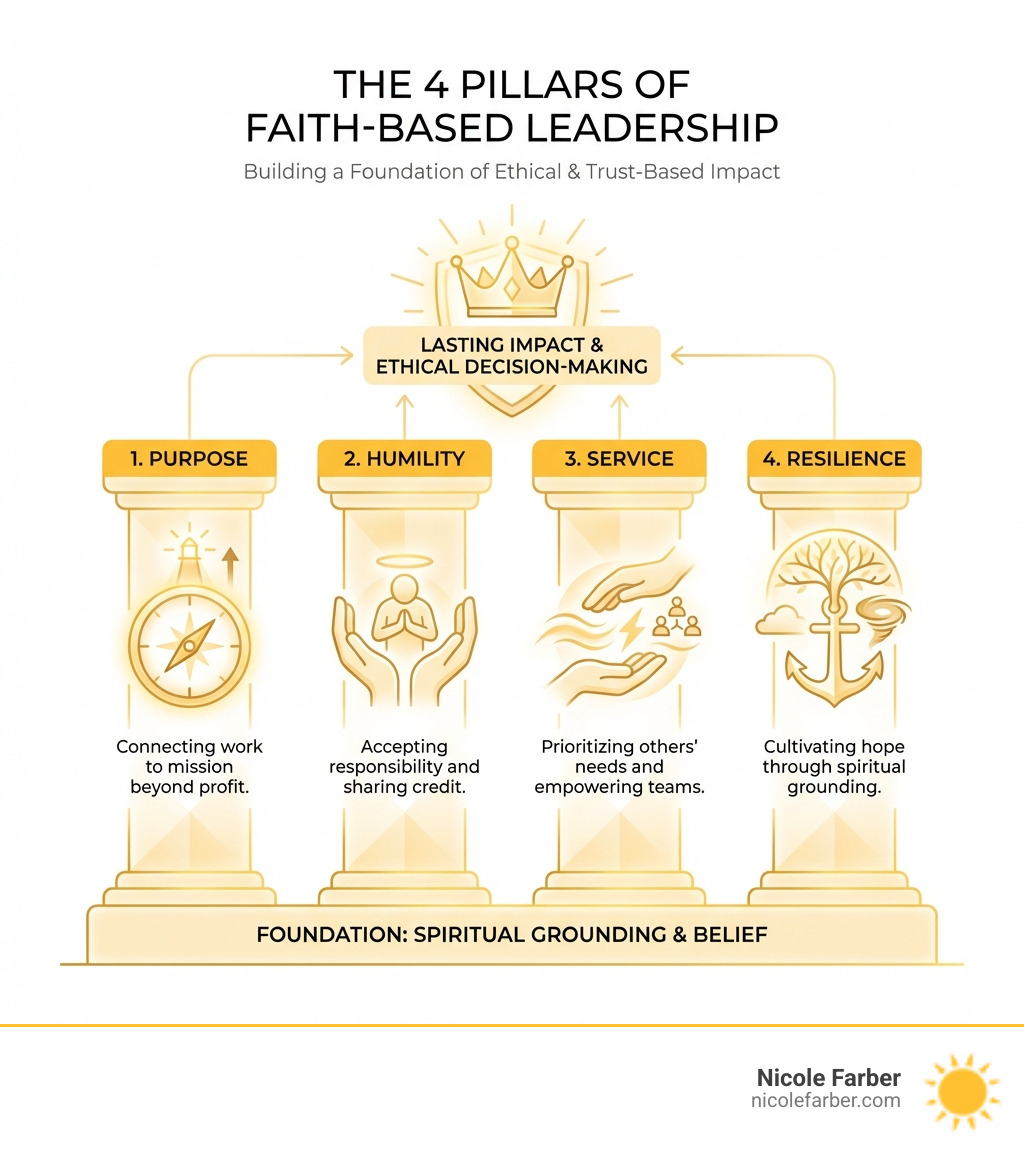
This infographic illustrates the four foundational pillars of faith-based leadership: Purpose (connecting work to mission beyond profit), Humility (accepting responsibility and sharing credit), Service (prioritizing others’ needs and empowering teams), and Resilience (cultivating hope through spiritual grounding and God’s faithfulness). Each pillar supports ethical decision-making, builds trust, and creates lasting impact in your organization.
The Bedrock of Belief: Defining Faith-Based Leadership
When we talk about leading with faith, we’re not just discussing a vague sense of optimism or self-belief. Instead, we dig into a profound conviction that shapes every aspect of our leadership journey. At its core, faith-based leadership is rooted in a biblical definition of faith, which is far more than just passive acknowledgment; it’s a dynamic combination of belief and action. It’s trusting in divine promises, not just hoping for the best.
This approach acknowledges that our human efforts alone are often insufficient, particularly in challenging endeavors like revitalizing a struggling organization or launching a new venture. It aligns our beliefs with the objective truth of God’s promises, making His faithfulness the bedrock upon which we build our strategies and efforts. This kind of leadership creates an ethical framework that guides our decisions and interactions. We draw wisdom from biblical narratives, seeing figures like Moses, David, and Esther as timeless examples of leaders who steerd immense challenges by relying on something greater than themselves. Their stories provide a powerful foundation for how Christian principles can lead to ethical and effective leadership, even today. For a deeper dive into how spiritual insights can shape your leadership, explore a theory of spiritual leadership. For a comprehensive guide to this approach, check out our ultimate faith-based leadership guide.
What is the biblical definition of faith in leadership?
In the context of leadership, biblical faith, as described in Hebrews 11:1, is “the substance of things hoped for, the evidence of things not seen.” It’s a radical trust that God is who He says He is, did what He said He did, and will do what He says He will do. This isn’t about blind optimism; it’s about a deep-seated conviction that empowers us to move forward, acting on our beliefs with radical trust and dependence on God’s promises.
For leaders, this means aligning our vision and strategies with God’s truth, rather than being swayed by fluctuating circumstances or human opinions. It’s the confidence that even when the path ahead is unclear, God’s plan will prevail. This distinction is crucial: while confidence in ourselves is valuable, the true source of our strength and vision as faith-filled leaders must always be God. We accomplish nothing of eternal value outside of Him, even though He provides us with gifts and opportunities. He adds the favor, power, and blessing that makes the real difference.
How to embody Christ-shaped leadership in any institution
Embodying Christ-shaped leadership means making Christian thought and practices second nature, allowing them to habitually inform how we lead, no matter the institution, secular or faith-based. It’s about seeing all our work in relation to Christ, refusing to compartmentalize our faith from our professional lives. This means leading with love, grace, and mercy, rather than purely transactional motives.

Imagine a leader in a New Orleans law firm, mentoring a junior attorney not just on legal tactics, but on integrity and ethical practice, patiently guiding them through complex moral dilemmas. This isn’t about proselytizing, but about demonstrating core values through action. It’s about being supportive and calm, even when the pressure is intense.
We integrate faith by fostering environments of trust, respect, and compassion. This includes acknowledging our own failures and offering grace and mercy to others, creating a culture where people feel valued and empowered. Whether we’re leading a non-profit in Luzerne County or a multinational corporation, Christ-shaped leadership calls us to a higher standard—one that prioritizes human dignity, ethical conduct, and service to others above all else.
The Inner Compass: How Faith Shapes a Leader’s Mindset and Resilience
Faith profoundly influences a leader’s motivation and mindset, especially when navigating challenging times. It provides an inner compass, steadying us when external pressures threaten to throw us off course. The Barna CEO study revealed that while 75% of surveyed CEOs have a Christian background, 82% are primarily motivated by having a positive impact on others. This highlights how faith, even when not explicitly stated, subtly shapes a leader’s drive for good.
In moments of doubt or uncertainty, faith isn’t about having all the answers, but about trusting the One who does. It’s about cultivating a mindset that sees obstacles not as dead ends, but as opportunities for divine intervention. This perspective helps us balance confidence with humility, recognizing our strengths while acknowledging our dependence on a higher power. It’s a delicate dance: believing in our capabilities while remaining open to guidance and correction. This journey of trusting in God’s plan and not just our own vision is often called walking by faith not by sight.
Inner work, reflection, and spiritual grounding are not luxuries for leaders; they are necessities. Engaging in practices like prayer, meditation, or journaling allows us to clarify our purpose, process challenges, and reconnect with our core values. This spiritual grounding is essential for cultivating resilience, enabling us to bounce back from setbacks with renewed strength and perspective. For women, especially single mothers like myself, this inner work is crucial for managing the intense pressures of both family and professional life, ensuring we lead from a place of peace, not panic.
Practical ways to cultivate your faith when leading with faith
Cultivating faith isn’t a one-time event; it’s an ongoing journey that requires intentional practice. Here are some practical ways we can deepen our faith as leaders:
- Daily Prayer and Scripture Study: Start each day by seeking spiritual nourishment. Even 15 minutes of quiet reflection, prayer, or reading scripture can ground us and set a positive tone for the day. This practice helps us align our thoughts and intentions with a divine perspective.
- Sabbath Rest: In our world, prioritizing rest seems counterintuitive, but it’s a divinely ordained practice for renewal. Setting aside time for genuine rest and reflection—whether it’s a full day or dedicated hours—allows us to recharge spiritually, mentally, and physically.
- Faith-Based Mentorship: Connect with other faith-driven leaders who can offer guidance, support, and accountability. A strong network of like-minded individuals, perhaps through local business groups in Wilkes-Barre or professional organizations in New Orleans, can be invaluable in navigating complex leadership challenges.
- Journaling God’s Faithfulness: Regularly record instances where you’ve witnessed God’s hand in your life or business. Reflecting on past successes and challenges overcome through faith strengthens our conviction for future endeavors. This builds a personal history of divine faithfulness.
- Community Involvement: Engage in service or community initiatives that align with your values. Volunteering our time and resources, whether it’s supporting local charities in Luzerne County or participating in mission trips to places like Antigua Guatemala, reminds us of our broader purpose and the impact we can have beyond our professional sphere.
The relationship between faith, resilience, and navigating failure
Failure is an inevitable part of any leadership journey. But for faith-driven leaders, it’s not the end; it’s a powerful catalyst for growth and resilience. We often hear the saying, “God doesn’t give us more than we can handle,” but the truth is, He often does, precisely so we learn to rely on His strength in our weakness. This is where faith truly shines.

Consider Jesus’ ministry: it seemingly ended in failure on the cross, only to be followed by the ultimate triumph of resurrection. This pattern teaches us that learning from and even embracing failure is a hallmark of Christ-shaped leadership. Resilience, in a Christian sense, is a lived hope rooted in God’s permanent faithfulness. It’s the ability to keep getting up, even when things seem dire, because we trust in a God who redeems broken things for His glory.
In competitive markets like Philadelphia, where setbacks can be frequent and intense, our faith becomes the anchor that prevents us from being swept away by disappointment. It allows us to view business failures not as personal condemnations, but as opportunities to learn, adapt, and refine our approach, knowing that our ultimate success isn’t solely dependent on our own efforts.
Walking the Talk: Practical Steps for Leading with Faith
Leading with faith isn’t just a philosophy; it’s a daily practice that transforms how we interact with our teams, make decisions, and shape our organizational culture. It calls us to accept principles like grace and humility, which are often overlooked in traditional leadership models but are foundational to creating truly thriving environments. When we lead with these values, we naturally lean into servant leadership, a model where our primary goal is to serve our team and empower them to reach their full potential. The concept of compassionate love as a cornerstone of servant leadership beautifully illustrates this approach. For those looking to integrate these values into their professional life, becoming a Christian business leader offers a pathway to purposeful growth.
This means consciously integrating our faith into every decision, big or small. It’s about following God’s vision for our business, rather than being swayed by fleeting human opinions or market trends. When we prioritize a divine vision, we foster a culture of genuine trust, knowing that our actions are guided by integrity and a deeper purpose. This empowers our teams, creating an environment where everyone feels valued and inspired to contribute their best.
How servant leadership differs from traditional models
The contrast between servant leadership and traditional leadership models couldn’t be starker. While traditional leadership often centers on the accumulation and exercise of power, servant leadership flips that dynamic entirely, prioritizing the needs of others and the collective good.
| Feature | Servant Leadership | Traditional Leadership |
|---|---|---|
| Primary Focus | Needs and growth of others | Leader’s power, authority, and personal achievement |
| Decision-Making | Shares power, encourages participation | Top-down, directive, centralized control |
| Motivation | Inspires, empowers, develops people | Rewards/punishments, control, individual incentives |
| Goal | Helps people achieve their purpose, builds community | Organizational goals, efficiency, personal success |
| Leader’s Role | Facilitator, coach, steward | Commander, decision-maker, authority figure |
| Culture Created | Trust, collaboration, service, growth | Compliance, competition, hierarchy, individualistic |
As servant leaders, we share power, put the needs of our team members first, and focus on helping them achieve their purpose. This approach isn’t about being “soft”; it’s about recognizing that true leadership creates the conditions for others to be their best. It’s about leading with grace and humility, accepting responsibility for losses and ensuring that wins belong to the entire team. This distinction is particularly powerful in any business setting, fostering loyalty and innovation that traditional models often miss.
How to effectively integrate your faith into daily leadership practices
Integrating faith into our daily leadership practices means making conscious choices that reflect our core values. It’s about letting our beliefs translate into tangible actions that benefit our teams, clients, and communities.
- Ethical Decision-Making: Faith provides an unwavering ethical framework. When faced with tough choices, we ensure our decisions reflect Christian values like integrity, honesty, fairness, and compassion. This means choosing the right path, even if it’s not the easiest or most profitable in the short term.
- Compassionate Communication: We lead with empathy, actively listening to our team members and understanding their perspectives. This involves communicating with grace, offering constructive feedback, and fostering an environment where everyone feels heard and respected.
- Prioritizing People Over Profits: While profitability is essential for any business, faith-driven leadership reminds us that people are our greatest asset. This means investing in employee well-being, offering fair compensation, and creating a supportive work-life balance.
- Modeling Integrity: We lead by example, demonstrating consistency between our words and actions. This builds trust and encourages our team to uphold similar standards of honesty and accountability.
- Creating a Supportive Work Environment: We strive to cultivate a culture of psychological safety, where team members feel comfortable taking risks, learning from mistakes, and contributing authentically. This environment thrives on mutual respect and shared purpose.
- Service-Oriented Projects: We look for opportunities to extend our impact beyond our immediate business. This could mean spearheading local initiatives in Luzerne County, supporting community development projects in Philadelphia, or even organizing team mission trips to places like Antigua Guatemala. Such endeavors not only serve others but also unite our team around a shared, higher purpose.
By consistently applying these practices, we don’t just lead a business; we lead a mission, demonstrating that success and significance can indeed go hand in hand.
The Tangible Impact: Outcomes and Opportunities of Faith-Driven Leadership
When we commit to leading with faith, the impact extends far beyond our personal lives, creating tangible outcomes within our organizations and communities. This approach isn’t just about internal conviction; it’s about demonstrating God’s power and presence through our leadership style, which manifests in a gentle demeanor, loving service, and an unwavering commitment to integrity. Research consistently shows that employees tend to have a higher level of respect and trust for leaders who openly practice and integrate their faith into their leadership style. Furthermore, leaders who incorporate their faith into their professional lives tend to exhibit higher levels of integrity and ethical behavior. This aligns with the 77% of faith-forward CEOs who cite upholding moral standards in business as a top motivator.
Risk-taking plays a crucial role in this journey. It’s through stepping out in faith, often into the unknown, that we develop and demonstrate a deeper reliance on divine guidance. This isn’t recklessness, but a calculated courage that trusts in a greater plan. It’s about being “dead to self,” meaning we surrender our personal ambitions and ego for the mission of our organization or church. This selflessness allows us to lead with a profound sense of purpose, focusing on the collective good rather than individual gain.
In today’s complex business and social environments, faith-based leaders face unique challenges, such as navigating skepticism in secular workplaces or balancing faith expression with inclusivity. However, these challenges also present incredible opportunities to stand out as guides of ethical leadership, building bridges in a polarized society and demonstrating that care, humility, and courage can indeed triumph over control, hierarchy, and convenience.
What are the signs of a leader who is leading with faith?
A leader who is leading with faith stands apart, not by proclaiming their beliefs from the rooftops, but by embodying them in their daily actions and character. Their leadership style reflects a deep internal compass that guides them through all circumstances.
Here are the unmistakable signs we see in such leaders:
- Humility: They accept responsibility for failures and generously attribute successes to their team. They don’t seek the limelight but lift others.
- Integrity: Their word is their bond. They make ethical decisions consistently, even when no one is watching, and uphold moral standards without compromise.
- Compassion: They genuinely care for their team members, understanding their struggles and celebrating their triumphs. They lead with empathy and a desire to serve.
- Resilience: They bounce back from setbacks with renewed determination, drawing strength from their faith. Failure is seen as a learning opportunity, not a defeat.
- Purpose Over Personal Gain: Their motivations are driven by a mission larger than themselves or their bottom line. They seek to make a positive impact on others and build a positive company culture.
- Trust from Their Team: Their consistent character and genuine concern earn the deep respect and trust of those they lead. People feel safe and valued in their presence.
- A Calming Presence Under Pressure: In times of crisis or high stress, they remain steady and composed, offering a sense of peace and direction to their team, much like a steady hand guiding a ship through a storm in New Orleans.
These leaders don’t need to intimidate or demand obedience through title; their gentle demeanor and loving service demonstrate God’s presence, earning trust and loyalty organically.
Navigating the challenges and opportunities for faith-based leaders today
Today’s business landscape is a minefield of complexities, but for faith-based leaders, it’s also a fertile ground for profound impact. We face specific challenges, such as addressing skepticism or even resistance in secular workplaces when our faith informs our decisions. There’s a delicate balance required to express our faith authentically without imposing our beliefs on others, ensuring inclusivity for a diverse workforce. This is a critical ethical consideration for leaders today.
However, these challenges are also immense opportunities. Our faith can be a unique strength, setting us apart in a world often starved for ethical leadership. We can leverage our values to:
- Build Bridges: In a polarized society, faith-driven leaders can foster understanding and collaboration by focusing on universal values like justice, compassion, and human dignity.
- Inspire Trust: In an era of corporate scandals and shifting loyalties, our unwavering integrity and ethical behavior can build profound trust with employees, clients, and partners.
- Drive Purpose-Driven Innovation: Our commitment to a higher purpose can inspire creative solutions that benefit both our businesses and the wider community, changing challenges into opportunities for growth and positive change.
- Cultivate Resilience: By openly demonstrating how faith provides strength in adversity, we can model true resilience for our teams, helping them steer their own uncertainties.
Leading with faith in today’s complex environment means becoming a guide of ethical leadership, demonstrating that business success and spiritual principles are not mutually exclusive but can powerfully reinforce each other.
Frequently Asked Questions about Leading with Faith
How can I lead with faith in a secular company without imposing my beliefs?
Leading with faith in a secular environment is less about explicit proselytization and more about embodying universal virtues that resonate with everyone. Focus on demonstrating values derived from your faith, such as unwavering integrity, genuine compassion, a commitment to service, and profound humility. These qualities naturally foster an environment of trust and respect. For instance, in a law firm in Philadelphia, consistently acting with fairness and ethical clarity will speak volumes, building credibility and inspiring others, regardless of their personal beliefs. Your actions, character, and the positive culture you cultivate will be the most powerful testament to your faith-driven leadership.
What’s the first step to becoming a more faith-driven leader?
The first and most crucial step is to prioritize inner work. This involves dedicating consistent time for personal reflection, prayer, or meditation to clarify your core values and purpose. Understand what truly anchors you. Once you have a clearer sense of your internal compass, begin by making small, intentional choices each day that align with those values. This could be as simple as choosing empathy over judgment in a difficult conversation, or handling a conflict with grace rather than aggression. Over time, these small acts build into a powerful, faith-driven leadership style that is authentic and impactful.
Can faith-based leadership improve business outcomes?
Absolutely. Faith-based leadership can significantly improve business outcomes by cultivating a workplace culture rooted in integrity, trust, and purpose. Leaders who operate with high ethical standards and prioritize the well-being of their teams often see increased employee engagement, higher retention rates, and improved collaboration. When employees feel respected, valued, and part of a mission larger than themselves, their motivation and productivity soar. A purpose-driven mission, guided by faith, inspires a deeper commitment, leading to remarkable results that benefit both the organization and its stakeholders.
Conclusion
We’ve explored how leading with faith is far more than a personal conviction; it’s a transformative leadership strategy. It provides a bedrock of biblical principles, an inner compass for resilience, and practical steps for walking the talk in our daily practices. From defining faith as belief in action to understanding the profound differences of servant leadership, we’ve seen how integrating faith shapes not only our decisions but also the very culture of our organizations.
It’s about demonstrating humility, integrity, and compassion, fostering trust, and navigating challenges with a steady presence. In today’s complex world, whether you’re running a business in Wilkes-Barre or expanding a global enterprise, leading with faith offers a powerful framework for success and significance. It’s a call to lead with purpose, integrity, and service, creating lasting positive impacts on our teams, clients, and communities.
The journey of a faith-driven leader is one of continuous growth, learning, and reliance on something greater than ourselves. It’s about becoming the leader you were always meant to be. I’ve seen this change in countless leaders, and I know it’s possible for you too. Become the leader you were called to be with motivational leadership speaking.