Leading the Way: How Business Leadership Coaching Can Transform Your Enterprise
- Leadership
- In the News
- January 14, 2026
Why Leadership Coaching is the Key to Business Growth

Business leadership coaching is a personalized development process that helps leaders make better decisions, develop stronger teams, and drive measurable business results. It’s not about telling leaders what to do—it’s about drawing out their own wisdom, identifying blind spots, and creating accountability for growth.
Key Benefits of Business Leadership Coaching:
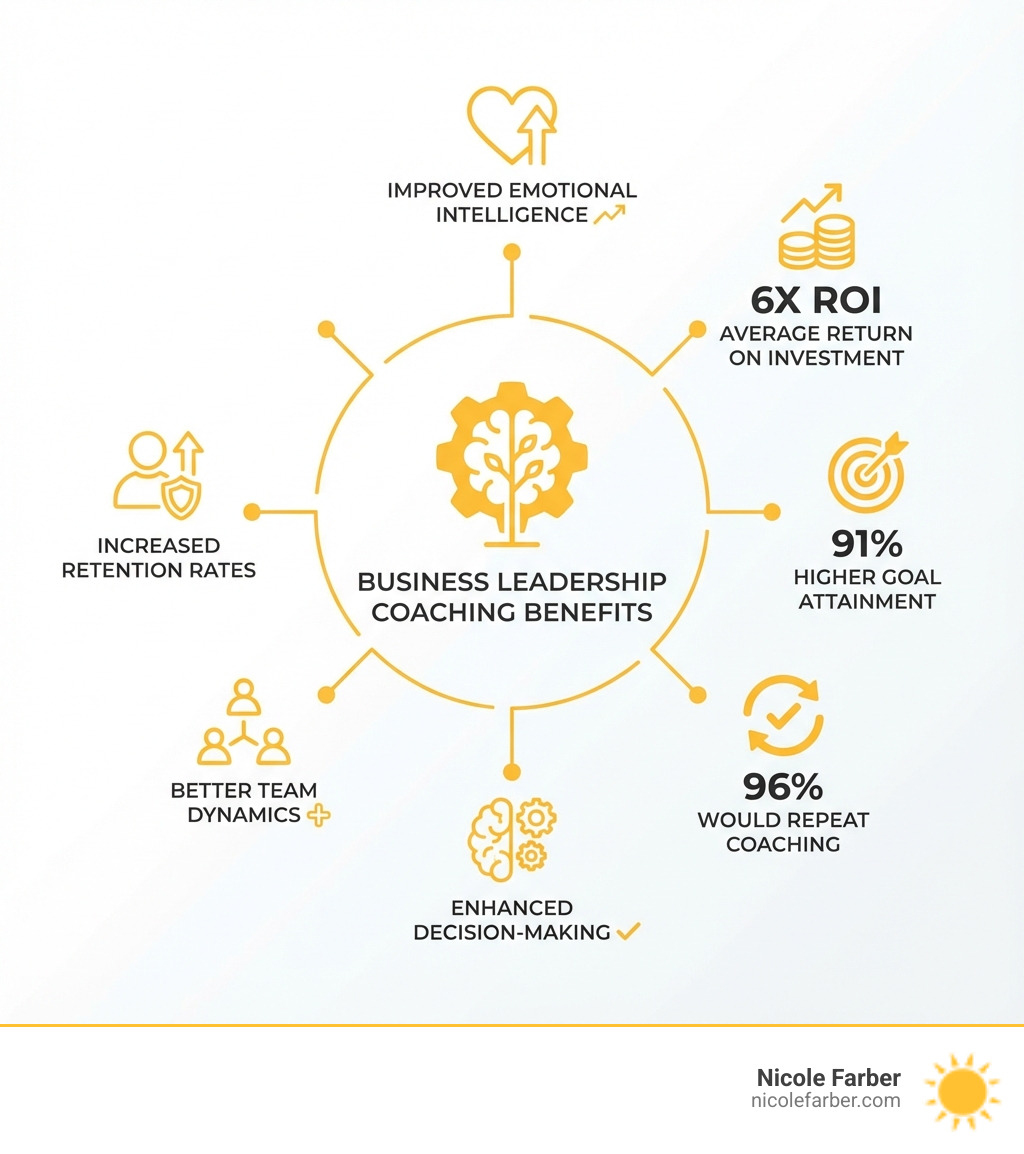
- Improved Decision-Making – 91% of coached leaders achieve higher goal attainment
- Stronger ROI – Organizations see an average return of nearly 6x their initial investment
- Better Retention – Coaching creates cultures that keep top talent engaged
- Increased Self-Awareness – Leaders develop emotional intelligence and empathy
- Faster Growth – Coached leaders avoid costly mistakes and achieve goals more efficiently
Harvey S. Firestone, founder of the Firestone Tire Company, once said: “The growth and development of people is the highest calling of leadership.” These words still ring true today—perhaps even more so in our rapidly changing business world.
Leadership isn’t something you’re born with. It’s a skill that’s developed, honed, and sharpened over time. The global leadership coaching market reflects this truth, predicted to reach $105.69 billion in 2025 and grow to $206.08 billion by 2032.
The reality is stark: Nearly two-thirds of CEOs do not receive outside leadership advice. Yet 96% of leaders who have experienced coaching would do it again. After coaching, 56% report improved leadership effectiveness.
Whether you’re a law firm partner in Philadelphia struggling to stand out in a crowded market, a business owner in Wilkes-Barre navigating growth challenges, or an entrepreneur in New Orleans seeking to scale—coaching provides the outside perspective and accountability that transforms good leaders into great ones.
As Nicole Farber, I’ve spent over 15 years helping law firms and businesses across the country grow through strategic guidance that combines real-world marketing expertise with business leadership coaching principles. My approach focuses on helping leaders develop from within first, then watching that change ripple through their entire organization.
Understanding the Core of Business Leadership Coaching
This section defines what coaching is, its powerful benefits, and how it differs from other forms of professional development, setting the foundation for why it’s a critical business strategy.
What is Leadership Coaching?
At its heart, business leadership coaching is a transformative process designed to guide, advise, encourage, challenge, and develop an organizational leader. It’s about empowering individuals to improve their performance, achieve desired metrics, and ultimately reach organizational outcomes. Unlike a one-size-fits-all training program, coaching is a highly personalized journey. It helps leaders open up their deeper purpose and tap into untapped potential within themselves and their teams.
We view leadership coaching as a structured, confidential space where leaders can troubleshoot difficulties, ask challenging questions, explore new opportunities, and discuss important topics without judgment. It’s about fostering clarity and confidence, enabling leaders to guide others with integrity and insight. For a deeper dive into our philosophies, you can explore more info about business leadership strategies.
Coaching vs. Mentoring vs. Managing
One of the most common questions we encounter is how business leadership coaching differs from traditional management or mentorship. While all three aim to develop individuals, their approaches and objectives are distinct:
| Feature | Coaching | Mentoring | Managing |
|---|---|---|---|
| Primary Goal | Open up potential, improve performance, self-findy | Guide career, share experience, offer advice | Direct tasks, oversee performance, achieve goals |
| Relationship | Collaborative, thought-provoking, non-directive | Advisory, supportive, experience-based | Hierarchical, directive, performance-driven |
| Focus | Future-oriented, skill development, behavioral change | Long-term career growth, specific industry insights | Task completion, operational efficiency |
| Approach | Asks powerful questions, challenges assumptions | Shares personal stories, provides wisdom | Gives instructions, delegates responsibilities |
| Expertise | Process expert (how to think) | Subject matter expert (what to do) | Organizational expert (what needs to be done) |
As you can see, coaching focuses on drawing out answers from the individual, helping them find their own solutions rather than simply providing them. It’s about empowering leaders to lead themselves first, then their teams.
The Transformative Benefits for Leaders and Organizations
The impact of business leadership coaching ripples through an organization, benefiting both the individual leader and the entire enterprise.
For individuals, the benefits are profound:
- Improved Self-Awareness: Coaching provides a safe, structured space to examine habits, mindsets, and blind spots. Leaders gain a clearer understanding of their strengths and areas for development.
- Career Development: Through coaching, leaders can clarify their career goals, develop strategies for advancement, and steer transitions more effectively. It’s a powerful tool for retention, as employees are more likely to stay with organizations that invest in their growth. In fact, coaching plays a key role in supporting career development and employee retention.
- Improved Decision-Making: By challenging assumptions and exploring opportunities, coaching sharpens a leader’s strategic thinking. Coached leaders are better equipped to make informed, impactful decisions.
For organizations, the advantages are equally compelling:
- Improved Performance: When leaders perform better, their teams perform better. This translates directly into higher productivity, innovation, and overall business success.
- Effective Change Navigation: In today’s dynamic environment, organizations are constantly evolving. Coaching equips leaders with the resilience and adaptability needed to guide their teams through periods of significant change and drive change (Q8).
- Stronger ROI: The numbers speak for themselves. Organizational investment in senior-level coaching produces an average ROI of nearly six times the initial cost. After coaching, 91% of leaders achieve higher goal attainment. These are not just soft benefits; they are measurable business outcomes.
We’ve seen these changes with our clients. For instance, a law firm in Philadelphia leveraged coaching to help its senior partners refine their communication and client acquisition strategies, leading to significant growth in their practice areas. Similarly, a small business owner in Wilkes-Barre, initially overwhelmed by scaling challenges, found clarity and developed a robust growth strategy through targeted coaching. And in Luzerne County, an executive credited coaching with helping them steer a major organizational restructuring with confidence and empathy, ensuring team morale remained high. You can read more about the impact of coaching on our clients’ journeys in these leadership coaching success stories.
Boosting Emotional Intelligence (EI) and Soft Skills
One of the most critical contributions of business leadership coaching is its ability to foster emotional intelligence (EI) and other essential soft skills. As entrepreneur and leadership guru Mercy Matsika aptly puts it, EI is the “silent engine behind great leadership. It enables a leader to connect, influence, and inspire.” Simply Psychology writer Mia Belle Frothingham agrees, noting that EI is “a fundamental element of compassion and comprehending the deeper reasons behind other people’s actions.”
Coaching sharpens a leader’s EI by:
- Developing Empathy: Coaches help leaders understand and share the feelings of others, fostering deeper connections with their teams and clients.
- Enhancing Communication Skills: From active listening to articulating visions clearly, coaching refines how leaders interact and influence.
- Improving Conflict Resolution: Leaders learn to approach disagreements constructively, turning potential clashes into opportunities for growth.
An emotionally intelligent leader is not just managing tasks but also managing people, energy, and emotions. Dr. Mary Kay emphasizes that leaders grounded in their values are more likely to act ethically, stay true to their purpose, and inspire others. Coaching supports leaders in intentionally cultivating these qualities. We’ve seen how coaching empowers female leaders, in particular, to harness their emotional intelligence to create more inclusive and productive environments. Learn more about developing female leaders here.
As one of our clients, a prominent female attorney in New Orleans, once shared, “My coach helped me realize that my intuition and ability to connect on an emotional level weren’t weaknesses, but superpowers. It completely transformed how I led my team and engaged with clients.”
The Leadership Coaching Process and Models
Explore the practical “how-to” of coaching, from the structure of an effective engagement to the various models available to suit different organizational needs and goals.
Key Components of an Effective Coaching Engagement
An effective business leadership coaching process is structured yet flexible, designed to meet the unique needs of each leader. While specific methodologies may vary, key components consistently drive success:
- Intake and Assessment: The journey typically begins with an initial session or assessment phase to clarify goals, identify current challenges, and establish a baseline. This might involve self-assessments, 360-degree feedback, or discussions about the leader’s context.
- Goal Setting: Collaboratively, the coach and coachee define clear, measurable, and achievable goals. These goals are often aligned with both personal development and organizational objectives (Q10). For insights into effective goal-setting, check out our guide on strategic goal setting.
- Action Planning: Once goals are set, the focus shifts to creating actionable steps. The coach helps the leader develop a “Massive Action Plan” (M.A.P.) with specific strategies and timelines.
- Accountability: A core function of coaching is to hold leaders accountable for their commitments. Through regular check-ins, coaches monitor progress, celebrate successes, and help leaders steer obstacles.
- Confidentiality: Confidentiality is paramount in the coaching relationship (Q9). This creates a safe space for honest reflection, exploration of vulnerabilities, and open dialogue, fostering the trust essential for deep personal and professional growth.
Types of Business Leadership Coaching
Just as leaders and organizations are diverse, so too are the types of business leadership coaching available (Q4). We often leverage a blend of these to tailor solutions to specific needs:
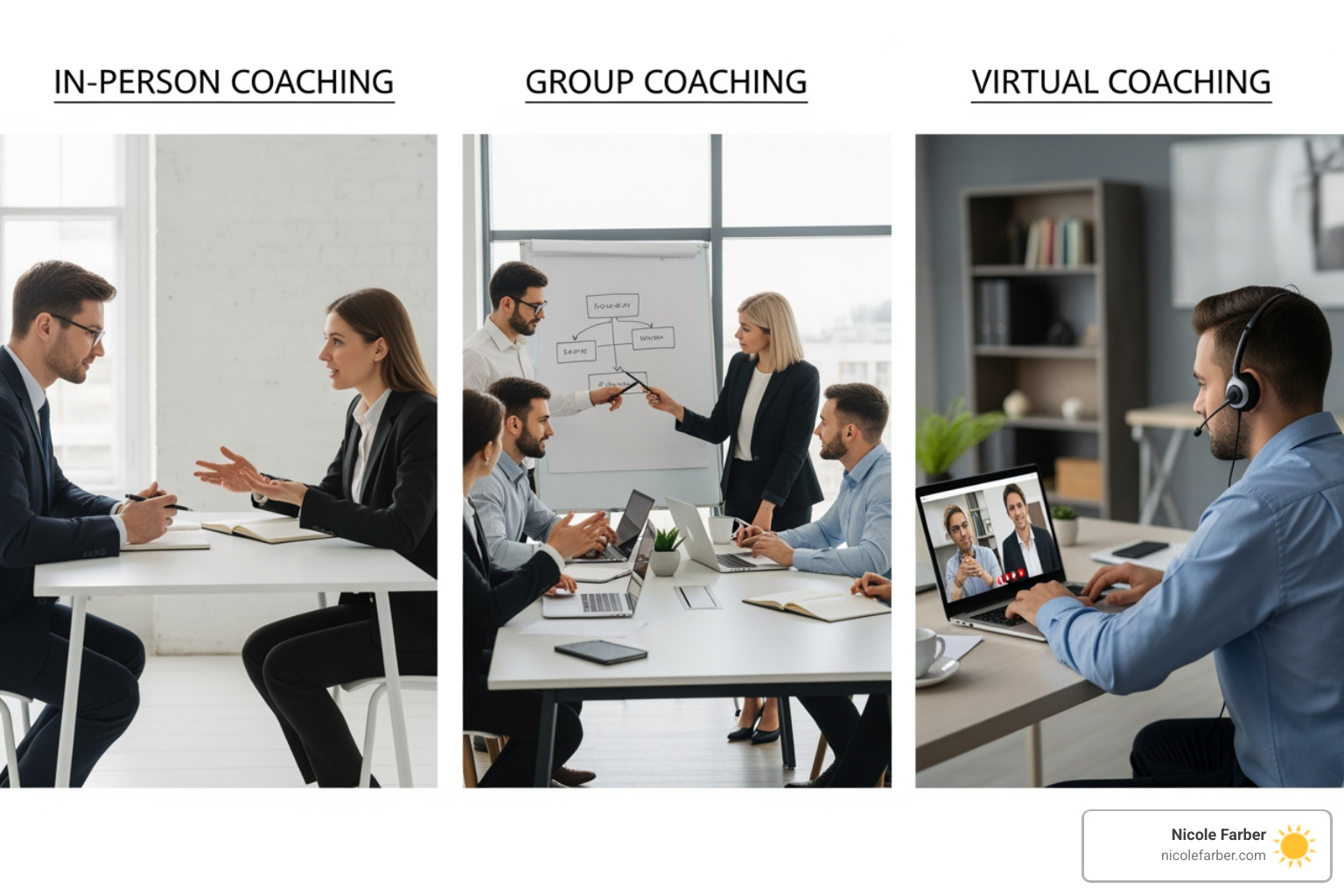
- Executive Coaching: This is typically one-on-one coaching for senior leaders, executives, and high-potential individuals. It focuses on strategic thinking, decision-making, executive presence, and navigating complex organizational challenges. Executive coaching strengthens performance by giving top leaders the tools they need to make key transitions and drive organizational change. We offer specialized CEO coaching services designed for this level of leadership.
- Team Coaching: This approach works with an entire team to improve dynamics, collaboration, communication, and collective performance. It’s invaluable for fostering healthy interactions and ensuring a cohesive unit, whether it’s a project team or a departmental leadership group.
- Integrated Coaching: This blends coaching sessions into a broader leadership development program, reinforcing lessons learned in training workshops and ensuring sustained behavioral change. It’s a powerful way to maximize the impact of your learning investments.
- Virtual Coaching: With distributed teams becoming the norm, virtual coaching offers flexibility and accessibility. It’s ideal for delivering personalized coaching to individual leaders and teams that are hybrid or remote, as well as for those who need to easily integrate development into a hectic schedule. We’ve successfully coached leaders virtually across diverse locations, from Philadelphia to Antigua Guatemala, proving that geography is no barrier to growth.
Internal vs. External Coaching: Which is Right for You?
Organizations often weigh the benefits of internal versus external coaches when implementing business leadership coaching programs (Q13). Both have distinct advantages:
- Internal Coaches: These are employees within the organization trained in coaching methodologies. They possess deep institutional knowledge, understand the company culture, and can be more cost-effective for broad-scale initiatives. However, they might struggle with maintaining strict confidentiality or providing a truly unbiased perspective due to their internal affiliations.
- External Coaches: These professionals are independent of the organization. They bring fresh perspectives, specialized expertise, and a guaranteed level of objectivity and confidentiality. Their experience across various industries can offer invaluable insights. For businesses in Wilkes-Barre, Luzerne County, or New Orleans, an external coach might be particularly beneficial for bringing in outside best practices and challenging entrenched ways of thinking without internal political considerations.
The choice depends on your organization’s specific goals, culture, and resources. Many businesses find a blended approach, utilizing internal coaches for broader development and external coaches for senior leadership or highly sensitive situations, to be most effective.
The Role of Technology in Modern Coaching
Technology has dramatically improved the delivery and accessibility of business leadership coaching (Q14). Virtual coaching platforms have made it possible to connect leaders with expert coaches regardless of their physical location. This is especially beneficial for global teams or individuals with demanding travel schedules.
Beyond video conferencing, technology now offers:
- AI-driven insights: Some platforms use AI to analyze coaching conversations (anonymously, of course) or provide personalized learning paths, complementing human coaching.
- Digital progress tracking: Leaders and program managers can easily track goal attainment, skill development, and overall impact through intuitive dashboards.
- 24/7 access to resources: Coachees often have access to supplementary materials, exercises, and communication tools between live sessions, ensuring continuous learning and reinforcement.
This technological integration allows for greater scalability, consistency, and measurable outcomes in coaching programs, ensuring that even the busiest leaders can prioritize their development.
Measuring Impact and Overcoming Problems
Learn how to prove the value of coaching with tangible metrics and steer the common obstacles that can prevent a successful implementation.
How to Measure the ROI of Business Leadership Coaching
Measuring the ROI and impact of business leadership coaching programs is crucial for demonstrating value and securing continued investment (Q5). We look at both quantitative and qualitative metrics:

Quantitative Metrics:
- Revenue Growth: Studies have shown that companies that invest in coaching and leadership development often see higher revenue growth compared to those that don’t.
- Retention Rates: Coaching contributes to a positive work culture, which in turn reduces employee turnover.
- Goal Attainment: A significant indicator of coaching effectiveness, with 91% of leaders achieving higher goal attainment after coaching.
- Performance Metrics: Improvements in specific KPIs related to the coaching goals (e.g., sales targets, project completion rates, efficiency gains).
Qualitative Metrics:
- 360-Degree Feedback: Assessments from peers, subordinates, and superiors before and after coaching provide insights into behavioral changes and perceived leadership effectiveness.
- Cultural Assessments: Surveys and feedback sessions can gauge improvements in team morale, communication, and overall organizational culture.
- Leader Narratives: Testimonials and stories of personal change from leaders provide powerful anecdotal evidence of coaching’s value.
Industry reports show that organizational investment in senior-level coaching produces an average ROI of nearly six times the initial cost. This robust return underscores that coaching is not merely a perk, but a strategic investment. You can learn more about how to measure coaching ROI on our dedicated page.
Common Challenges and How to Overcome Them
While the benefits of business leadership coaching are clear, organizations often face problems when implementing these programs (Q7).
- Lack of Senior Leader Buy-in: Industry surveys show that up to 50% of organizations report insufficient buy-in from senior leaders as a significant barrier. This can stem from skepticism about coaching’s value or a perception that it’s only for underperformers.
- Overcome this by: Securing executive sponsorship from the outset. Clearly communicate the strategic objectives and expected ROI of coaching. Showcasing real-world examples and testimonials can also help build belief.
- Skepticism about Value: Some leaders may be initially resistant, like Eric Schmidt, former Google CEO, who initially thought, “I don’t really need a coach.”
- Overcome this by: Providing evidence-based results and case studies. Highlight how coaching supports high-performers, not just those struggling. Emphasize that top athletes and executives across all fields use coaches.
- Time Constraints: Busy leaders often feel they don’t have time for coaching sessions.
- Overcome this by: Offering flexible scheduling options, including virtual sessions, and demonstrating how coaching ultimately saves time by improving efficiency and decision-making. Frame coaching as an investment in their most valuable asset—themselves.
Overcoming these challenges requires clear communication, a strong business case, and a commitment to integrating coaching into the organizational culture. When leaders feel empowered and supported, the entire team thrives. This is fundamental to our approach to empower your team.
Finding the Right Leadership Coach
A great coach is a game-changer. This section provides a clear guide on what qualifications, experience, and personal qualities to look for in a coaching partner.
Qualifications to Look For in a Coach
When seeking a business leadership coach, discerning the right fit is crucial (Q11). We recommend prioritizing coaches with:
- Accredited Certifications: Look for certifications from reputable bodies like the International Coaching Federation (ICF). Top-tier certifications, such as PCC (Professional Certified Coach) or MCC (Master Certified Coach), ensure a high standard of professional practice.
- Relevant Industry Experience: While a coach doesn’t need to be an expert in your specific field, understanding the broader business landscape and leadership challenges relevant to your industry (e.g., legal marketing, tech, healthcare) is invaluable.
- Proven Track Record: Ask for testimonials, case studies, or references. A coach should be able to demonstrate tangible results they’ve helped clients achieve.
- Extensive Coaching Hours: Experience matters. Look for coaches who bring an average of 2,000+ coaching hours and 10+ years of leadership experience, indicating a deep understanding of the coaching process.
Experience and Fit: The ‘Art’ of Coaching
Beyond formal qualifications, the “art” of coaching lies in the coach’s ability to connect with and truly understand a leader. While the “science” of coaching is methodical and measurable, the “art” is creative, individual, and flexible. This involves:
- Chemistry and Trust: The relationship between a coach and coachee is deeply personal. A strong rapport and mutual trust are essential for open, honest, and transformative conversations.
- Ability to Challenge and Support: A great coach knows when to push you out of your comfort zone and when to offer unwavering support. They provide an outside perspective that reveals strengths and areas for improvement.
- Specialized Coaching: For professionals in niche industries, such as law, finding a coach with an understanding of their unique challenges is key. Our expertise includes business coaching for lawyers, addressing the specific dynamics of legal practice and firm leadership.
Questions to Ask a Potential Coach
To ensure you find the best match for your business leadership coaching needs, we suggest asking these key questions:
- What is your coaching philosophy and approach?
- How do you measure success in a coaching engagement?
- Can you share a success story or case study (while respecting confidentiality) that aligns with my challenges?
- What is your experience working with leaders in my industry or facing similar organizational issues?
- How do you handle confidentiality and sensitive information?
- What is your process for goal setting and accountability?
- How do you adapt your coaching style to different personalities and leadership levels?
- Can you tell me about your experience in our city or region, for example, with the unique business landscape of New Orleans?
- What are your certifications and how many coaching hours do you have?
These questions will help you assess not only a coach’s credentials but also their fit with your personality and specific organizational goals.
Frequently Asked Questions about Business Leadership Coaching
How long does a typical leadership coaching engagement last?
The duration of a business leadership coaching engagement can vary significantly based on individual goals and organizational needs. While some focused engagements might last for 3-6 months, many standard programs run for about 6 months. For senior executives or complex organizational changes, coaching can be ongoing for continuous development. It’s truly a journey, not a one-time event, designed to embed lasting change.
Is leadership coaching only for underperforming leaders?
Absolutely not! This is a common misconception. While coaching can certainly help leaders address performance gaps, it is overwhelmingly used by high-potential individuals, top performers, and seasoned executives looking to further hone their skills and achieve even greater success. Eric Schmidt, the former CEO of Google, initially thought he didn’t need a coach, but later attested that Bill Campbell helped him become a more effective leader. The statistic that nearly two-thirds of CEOs do not receive outside leadership advice, yet those who do achieve higher goal attainment and improved effectiveness, underscores that coaching is for those who aspire to excel, not just those who are struggling.
Can small businesses and entrepreneurs benefit from coaching?
Yes, unequivocally! Business leadership coaching is incredibly beneficial for small businesses and entrepreneurs. The challenges of starting and growing a business can be immense, often leading to isolation and decision-making fatigue. Coaching helps entrepreneurs clarify their vision, develop strategic plans, identify blind spots, and steer growth challenges. It provides the accountability needed to stay focused and avoid common pitfalls. Whether you’re launching a new venture in Luzerne County or scaling an existing business in Antigua Guatemala, a coach can be an invaluable partner in achieving sustainable growth and personal fulfillment. For more custom guidance, explore our Small Business Leadership Guide 2025.
Conclusion: Your Path to Changeal Leadership
In today’s rapidly evolving business landscape, business leadership coaching is not a luxury; it’s a strategic investment. It’s the catalyst for developing emotionally intelligent leaders who can steer change, foster innovation, and drive measurable results. The booming global market and impressive ROI statistics clearly demonstrate its indispensable value.
The right coach open ups potential, changing individuals and, by extension, entire enterprises. From a law firm partner in Philadelphia seeking to lift their practice to an entrepreneur in Antigua Guatemala striving to scale their vision, coaching provides the perspective, tools, and accountability needed for profound growth.
At Nicole Farber, we believe in a holistic approach to leadership development, combining real-world experience, strategic insights, and faith-driven principles to empower leaders to not only succeed but to thrive with purpose and integrity. We understand the personal journey behind every leader, having walked a similar path ourselves.
Are you ready to transform your leadership and your enterprise? Ready to move beyond mere management to truly inspire, influence, and innovate? Let us help you chart your course to impactful leadership. Explore how a trusted speaker for attorneys can inspire your next event or reach out to find how our business leadership coaching can lift your journey.