Marketing for Lawyers: Unlocking Growth with Expert Support
- Marketing
- In the News
- January 12, 2026
Introduction: The New Client Journey

Attorney marketing support is the strategic framework of expertise, tools, and actions that law firms use to attract their ideal clients, build a powerful brand reputation, and drive sustainable, long-term growth. In today’s digital-first world, this means a sophisticated blend of online strategies—like search engine optimization (SEO), content marketing, and social media engagement—with the timeless power of traditional networking and referral systems. The key is to create a seamless, client-focused experience that meets potential clients exactly where they are, all while upholding the highest ethical standards of the legal profession.
Quick answer for law firm partners seeking marketing support:
- Core Functions: Building a recognizable and trusted brand, implementing data-driven SEO and content marketing strategies, managing client communications and online reputation, generating qualified leads, and providing strategic planning for growth.
- Team Roles: Depending on firm size, this can range from a dedicated Marketing Director or Business Development Manager to a versatile Marketing Coordinator or a specialized outsourced agency.
- Recommended Budget: The U.S. Small Business Administration suggests that established businesses allocate 7-8% of gross revenue to marketing to maintain their position and grow.
- Key Strategies: A professional, mobile-friendly website optimized for search engines (SEO), a consistent content marketing plan, a proactive strategy for gathering and managing online reviews, targeted local search optimization, and a structured referral networking program.
- Measurement: Success isn’t guesswork. It’s measured by tracking key performance indicators (KPIs) like website traffic, lead sources, conversion rates, and, most importantly, the return on investment (ROI) of your marketing spend, reviewed on at least a quarterly basis.
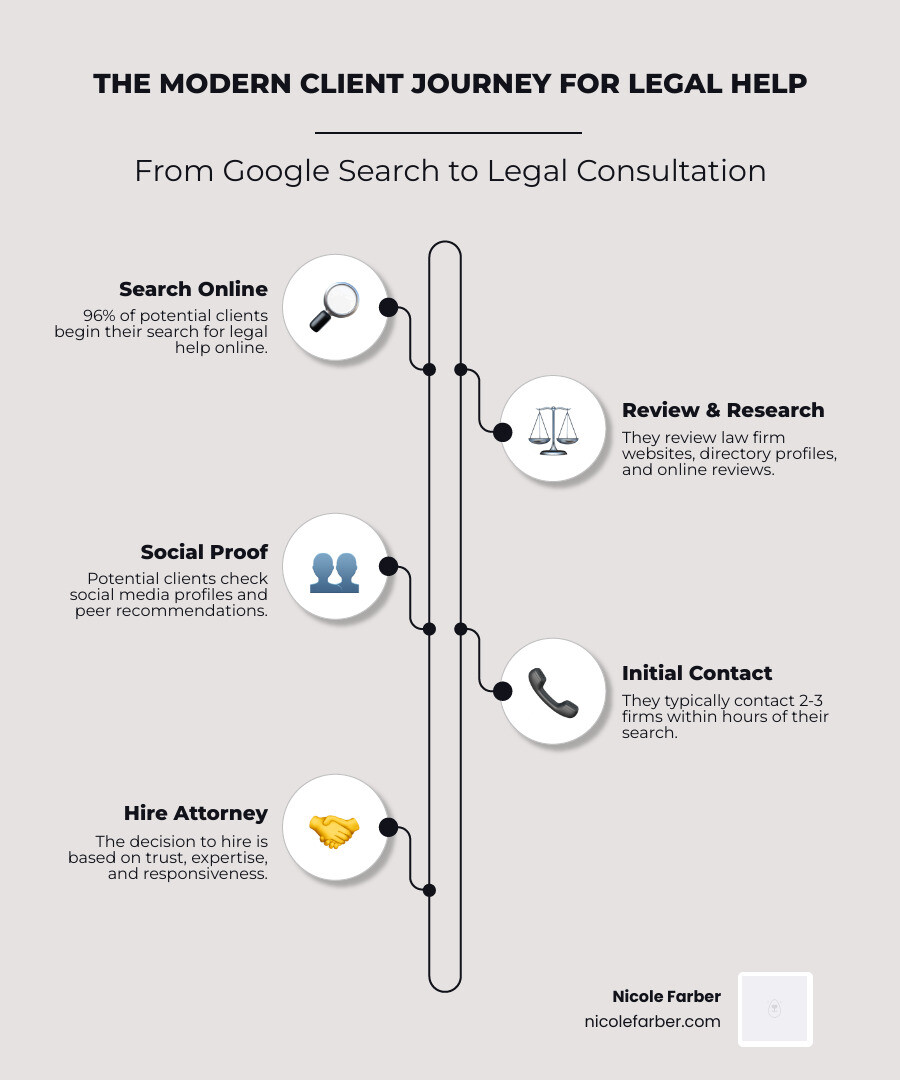
The legal landscape has been irrevocably transformed. Gone are the days when a Yellow Pages ad and a good local reputation were enough. Today, 96% of people seeking legal advice use a search engine in their journey. They are researching law firms, comparing attorney profiles on sites like Avvo, and reading client reviews before ever picking up the phone. Whether your practice is in a busy metropolitan area like Philadelphia, a growing community like Wilkes-Barre, a vibrant market like New Orleans, or even reaching clients internationally from a base in Antigua Guatemala, your first impression is almost always digital. The client journey no longer starts with a handshake; it starts with a Google search.
This fundamental shift demands that law firms become not just legally proficient, but also digitally visible, credible, and accessible. While traditional word-of-mouth and professional referrals remain invaluable, they are now amplified and validated by a firm’s online presence. A potential client referred by a friend in Luzerne County is still likely to Google your name, read your reviews, and browse your website before making contact. Today’s most successful firms understand this synergy and weave digital marketing into the very fabric of their business development, creating a holistic strategy that captures leads from all channels.
However, for many partners and managing attorneys, digital marketing can feel like a complex, ever-changing maze. It is easy to feel overwhelmed by the jargon and unsure of where to invest your firm’s time and resources for the best return. This is precisely where professional attorney marketing support becomes a game-changer. By entrusting this critical function to experts—whether an in-house team or a specialized agency—you can bridge the gap between your legal expertise and the marketing acumen needed to thrive. This support system handles everything from the technicalities of SEO and the creativity of content creation to the nuances of reputation management and the science of lead conversion, freeing you to do what you do best: practice law.
I am Nicole Farber, CEO of ENX2 Legal Marketing. With over 15 years of experience, I have dedicated my career to helping law firms steer this new landscape and achieve remarkable growth. My team and I have partnered with firms of all sizes—from solo practitioners just starting out to established practices in competitive markets like Philadelphia and Wilkes-Barre, regional firms serving all of Luzerne County, high-growth practices in New Orleans, and internationally minded firms based in Antigua Guatemala—to build and execute marketing strategies that do not just generate leads, but attract the right clients and create a foundation for sustainable, long-term success.
Building Your Team: The Core Functions of Attorney Marketing Support

When we talk about attorney marketing support, we are referring to a multifaceted, integrated system designed to ensure a law firm’s sustained success and profitability. It is not just about placing an ad or launching a website; it is a continuous, strategic effort. Think of it as the engine room of your firm’s growth, with many moving parts working in concert. The core functions are all driven by a singular mandate: to generate a consistent flow of high-quality cases. This means not just bringing in more clients, but attracting the right clients—those whose needs align with your firm’s expertise and whose cases contribute to your bottom line.
At its heart, attorney marketing support is about:
- Brand Building: This is the foundation of your firm’s identity. It is about crafting and communicating a clear, compelling message about who you are, what you stand for, and why clients should choose you. This goes beyond a logo and a color scheme; it encompasses your firm’s voice, your values, and the client experience you deliver. A strong brand builds trust and differentiates you in a crowded market, whether you are a family law practice in Luzerne County, a boutique firm in Antigua Guatemala serving U.S. expats, or a corporate firm in Philadelphia.
- Client Communication: This involves every touchpoint a potential or current client has with your firm. From the initial website visit and phone call to email newsletters and social media interactions, your communication must be clear, consistent, professional, and empathetic. Effective communication builds relationships and turns prospects into clients, and clients into advocates.
- Strategic Planning: A successful marketing effort is never accidental. It requires a well-researched, data-driven roadmap. This strategic plan should outline your marketing goals, define your target audience (client personas), analyze your competitors, and detail the specific tactics you will use to achieve your objectives. It includes setting measurable Key Performance Indicators (KPIs) to track progress and ensure accountability, whether your firm is based in Wilkes-Barre or expanding into New Orleans.
- Lead Generation: This is the active process of attracting potential clients who have a need for your legal services. Modern lead generation for law firms involves a mix of strategies, including search engine optimization (SEO), pay-per-click (PPC) advertising, content marketing (blogs, videos, guides), and social media marketing. The goal is to create a predictable pipeline of qualified leads.
- Reputation Management: Your firm’s reputation is largely defined by what people find online. Proactively managing your online presence is crucial. This includes encouraging satisfied clients to leave positive reviews on Google, Avvo, and other platforms, as well as monitoring and responding to all reviews, both positive and negative, in a professional manner. For firms in smaller communities like Luzerne County, a handful of reviews can significantly shape public perception.
- Client Retention: It is often more cost-effective to retain an existing client or earn a referral than to acquire a new one. Client retention strategies focus on nurturing relationships with past and current clients through regular communication, exceptional service, and demonstrating ongoing value. A happy client is your most powerful marketing asset.
For firms in competitive markets like New Orleans or specialized niches in places like Antigua Guatemala, having dedicated attorney marketing support is no longer a luxury but a necessity. It ensures that your firm is not just reacting to market changes but is proactively shaping its future and securing its position as a leader.
Marketing vs. Business Development: What is the Difference?
While often used interchangeably, marketing and business development are two distinct but deeply interconnected functions. Understanding this difference is crucial for building an effective growth strategy. Think of it this way: marketing makes the phone ring; business development ensures the call is answered correctly and the caller becomes a client.
| Function | Focus | Goal | Typical Activities | Analogy |
|---|---|---|---|---|
| Marketing | One-to-many. Marketing aims to reach a broad audience of potential clients. | Generate leads and build brand awareness. Create a pipeline of opportunities for the firm. | SEO, content creation (blogs, videos, FAQs), social media, online and offline advertising, email campaigns, public relations, brand positioning. | Marketing is like casting a wide net from Philadelphia to Wilkes-Barre to New Orleans, making sure your firm is visible wherever your ideal clients are looking. |
| Business Development | One-to-one or one-to-few. Business development is about building and nurturing relationships. | Convert leads into clients and foster long-term partnerships and referral sources. | Client intake processes, consultations, follow-up calls, networking events, bar association involvement, client relationship management (CRM), referral programs. | Business development is the art of carefully reeling in the fish, securing them, and encouraging them to tell other fish where to find the best bait. |
In many small and midsize firms, especially in places like Luzerne County or Antigua Guatemala, attorneys themselves wear both hats. Partners may oversee marketing initiatives (approving budgets, reviewing website content) while also handling business development (meeting prospects, following up on referrals). As your firm grows, formal attorney marketing support—either in-house or outsourced—helps separate these functions so each can be executed with greater focus and expertise.
Key Roles and Responsibilities in a Law Firm
To implement marketing and business development effectively, most growing firms eventually rely on a mix of the following roles. You may not need all of them on day one, but understanding what each role contributes will help you decide how to staff or outsource.
- Chief Marketing Officer (CMO): Provides high-level strategy and leadership. A CMO is responsible for aligning marketing with firm-wide business goals, managing budgets, and overseeing all campaigns and initiatives. Larger firms in cities like Philadelphia or New Orleans may hire a full-time CMO; smaller firms can gain similar strategic insight through a fractional CMO or marketing coach.
- Marketing Director: Translates strategy into actionable plans. The director manages day-to-day execution, coordinates vendors and agencies, supervises staff, and ensures campaigns are launched on time and on budget.
- Business Development Manager: Focuses on relationship-building and sales. This role supports attorneys with pitch preparation, tracks prospects in a CRM, develops referral programs, and organizes networking and client appreciation events. For example, a Wilkes-Barre firm targeting medical malpractice work may rely on a business development manager to cultivate relationships with local medical professionals.
- Marketing Coordinator: The hands-on executor. A coordinator manages social media posts, updates the website, assists with email campaigns, tracks analytics, and helps keep all marketing tasks moving. For many small firms in Luzerne County or Antigua Guatemala, this is the first dedicated marketing hire.
- Communications or Content Specialist: Crafts the words and stories that define your firm. This role writes blog posts, practice area pages, email newsletters, press releases, and scripts for videos and webinars. High-quality content fuels SEO, demonstrates expertise, and builds trust.
A common guideline in professional services is an ideal lawyer-to-marketer ratio of around 30:1. In other words, once you have about 30 attorneys, it is usually time to invest in at least one full-time marketing professional. For very small firms in Philadelphia, Wilkes-Barre, or New Orleans, that support can come from a part-time coordinator or an external agency until the caseload justifies internal staff.
Leveraging Attorney Marketing Support in Small Firms
Not every firm is ready to build a full marketing department, and that is perfectly fine. Small and growing practices can still compete—often very effectively—by being intentional about how they structure attorney marketing support.
1. Outsourcing strategically
Solo and small firms in places like Wilkes-Barre, Luzerne County, or Antigua Guatemala can outsource key functions such as:
- Website design and maintenance
- SEO and local SEO (Google Business Profile optimization, local citations)
- Content creation (practice area pages, blogs, FAQs, videos)
- Paid search and social media advertising
This approach gives you access to specialized expertise without the cost of full-time salaries and benefits.
2. Utilizing and training existing staff
Your receptionist, paralegal, or office manager may be able to take on basic marketing tasks with the right guidance, such as:
- Collecting and requesting client reviews after successful matters
- Updating attorney bios and case results on the website
- Posting firm news or community involvement on social media
With clear processes and simple templates, even a few hours per week can move the needle.
3. Focusing resources for maximum impact
Instead of trying to do everything at once, small firms should prioritize:
- A fast, mobile-friendly website that clearly explains who you help and how
- A strong Google Business Profile for your specific city (Philadelphia, Wilkes-Barre, New Orleans, or your town in Luzerne County)
- A plan for consistently generating and responding to online reviews
- One or two content formats you can sustain (for example, a monthly blog or short videos answering common questions)
4. Saving billable hours with systems and support
Every hour you spend fiddling with your website is an hour you are not billing. Professional attorney marketing support creates systems so that:
- Intake is streamlined and fewer leads slip through the cracks
- Follow-up emails and reminders are automated
- Reporting is clear, so you know which efforts are actually paying off
Even for a two-attorney firm in Wilkes-Barre, a part-time marketing coordinator or an external agency can free up dozens of hours per month—time that can be redirected to client service, trial preparation, or strategic growth.
As a business coach and CEO who has built a legal marketing company from the ground up as a single mother, I understand the pressures on small firm owners. My approach to attorney marketing support blends practical, data-driven tactics with real-world empathy. Whether you are opening your first office in Philadelphia, expanding a long-standing practice in Luzerne County, testing a new practice area in New Orleans, or serving an international clientele from Antigua Guatemala, the right marketing support meets you where you are and scales as you grow.