Bounce Back Better: Essential Business Resilience Strategies
- Entrepreneurship
- In the News
- March 2, 2026
Why Business Resilience Strategies Are Your Competitive Edge

Business resilience strategies are frameworks that enable organizations to adapt, withstand, and recover from disruptions while maintaining operations and emerging stronger. These strategies go beyond traditional risk management by focusing on proactive preparation and operational flexibility. Key elements include financial fortification, adaptive leadership, operational agility, technology integration, strong stakeholder relationships, and continuous learning.
In today’s volatile environment, the only constant is change. Whether you’re navigating market shifts in Philadelphia, managing operations in Wilkes-Barre, serving clients in New Orleans, or expanding to markets like Antigua Guatemala, your organization faces unprecedented challenges. Organizations that prioritize resilience are better positioned to respond quickly to shifts and disruptions. The ability to not just survive but thrive in the face of adversity separates market leaders from those left behind.
The difference isn’t luck; it’s preparation. True resilience is an offensive strategy, building an organization so adaptable that challenges become opportunities for growth.
I’m Nicole Farber, CEO of ENX2 Legal Marketing. With over 15 years of experience guiding law firms and businesses through everything from market pressures to a global pandemic, I’ve seen how business resilience strategies separate thriving practices from struggling ones. My team and I have implemented the resilience frameworks in this guide to help firms steer immense challenges successfully.
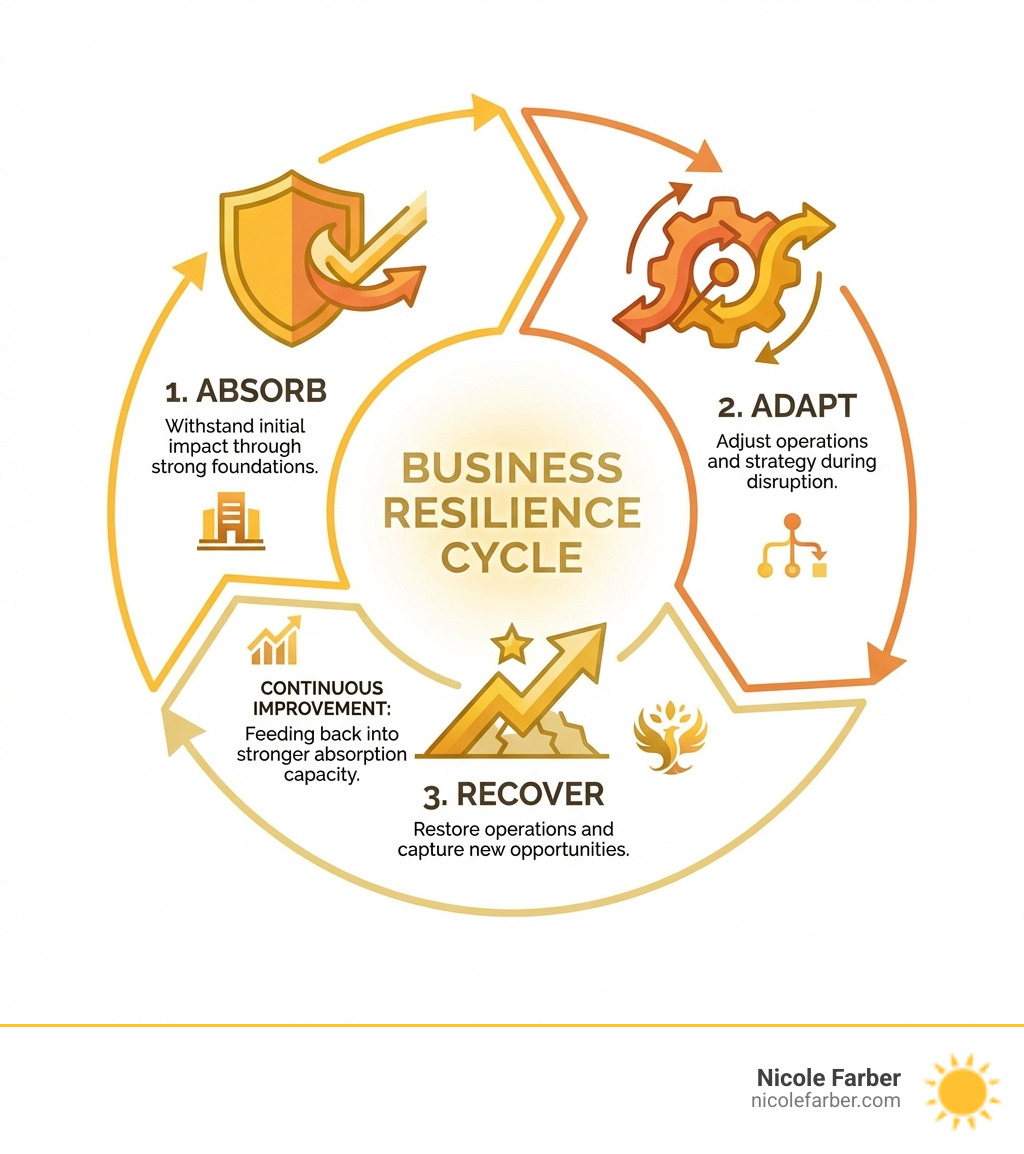
Understanding the Foundations of Business Resilience
What is Business Resilience? (And What It’s Not)
At its core, business resilience is an organization’s ability to adapt to and recover from disruptions, emerging with improved strength. It’s not just about bouncing back; it’s about “bouncing forward”—learning and growing stronger from every challenge. While often confused, resilience is distinct from related concepts:
- Traditional Risk Management focuses on preventing specific, foreseeable threats.
- Business Continuity Planning (BCP) outlines how to maintain essential functions during a disaster.
- Business Resilience is a broader, proactive ability to adapt and thrive through any disruption. It integrates risk management and BCP into a holistic, forward-looking strategy that builds long-term success.
Here’s a quick comparison:
| Feature | Traditional Risk Management | Business Continuity Planning (BCP) | Business Resilience Strategies |
|---|---|---|---|
| Focus | Preventing specific, foreseeable risks | Maintaining critical operations during disruption | Adapting, evolving, and thriving through any disruption |
| Time Horizon | Short to Medium-term | Short-term (during/after incident) | Long-term, continuous |
| Approach | Reactive/Preventative | Reactive/Restorative | Proactive/Adaptive/Transformative |
| Goal | Minimize harm from known risks | Ensure operational uptime | Sustainable growth, competitive advantage, agility |
While risk management and BCP are crucial, business resilience embeds adaptability into an organization’s DNA.
Why Resilience is Non-Negotiable in Today’s Volatile World
In today’s global economy, unpredictability is the new normal. From market shifts in Philadelphia to logistical challenges in Wilkes-Barre, organizations are constantly tested by factors like:
- Market Volatility: Rapid economic and technological changes.
- Supply Chain Disruptions: Global events halting the flow of goods.
- Cyber Threats: Constant risk of data breaches and cyberattacks.
- Geopolitical Instability: Conflicts and policy changes impacting trade.
- Public Health Crises: Sudden shifts in work models and consumer demand.
Organizations that prioritize resilience are better positioned to respond quickly to shifts and disruptions in a volatile world. They don’t just react; they anticipate, prepare, and leverage challenges as opportunities. This proactive approach is fundamental to minimizing business disruptions and safeguarding people, assets, and brand equity. For more on preparing for the unexpected, explore our guide on Overcoming Business Challenges.
The 5 Pillars of a Resilient Organization

Just as a magnificent building stands tall on strong foundations, a resilient organization is built upon several interconnected pillars that enable it to withstand, adapt, and thrive.
Pillar 1: Resilient Leadership & Culture
The foundation of any resilient organization is its leadership and the culture it fosters. An organizational culture that values resilience fosters an adaptive mindset and a willingness to learn from challenges.
- Leadership’s Role: Leaders must champion resilience by setting a tone of transparency and decisiveness. In our work with clients in Wilkes-Barre and Luzerne County, we see that strong leadership commitment is vital for making resilience a core value.
- Adaptive Mindset: Encourage a culture that views change as an opportunity, accepts new technologies, and is open to pivoting strategies.
- Psychological Safety: Create an environment where employees feel safe to speak up, share concerns, and learn from mistakes. This encourages collective problem-solving.
- Employee Empowerment: When employees understand their role in the organization’s recovery, they are more engaged. Empowering teams to take initiative improves collective resilience.
To truly empower your team to be part of your resilience strategy, visit our page on Empower Your Team.
Pillar 2: Strategic & Financial Preparedness
Financial strength and strategic planning are non-negotiable for long-term resilience.
- Financial Strength: Maintain strong financial health by performing stress tests, keeping ample cash reserves, and planning for various revenue scenarios. This provides maneuvering room during tough times.
- Revenue Diversification: Depending on one product or customer increases risk. Diversifying offerings, exploring new customer segments, or expanding into different markets spreads risk and captures new growth.
- Scenario Planning: Prepare for multiple futures instead of trying to predict one. Analyze variables like supply disruptions and regulatory shifts to build best-case, base-case, and worst-case scenarios.
Effective strategic planning is a cornerstone of resilience. Learn more about setting impactful goals with Strategic Goal Setting.
Pillar 3: Operational Agility
Operational agility means building flexibility into your processes, supply chains, and workforce.
- Flexible Operations: Adopt flexible models, like remote work, and streamline workflows to scale operations up or down quickly in response to uncertainty.
- Supply Chain Diversification: Relying on a single supplier is a major vulnerability. Diversify suppliers across different regions to mitigate this risk.
- Speed in Decision-Making: During a crisis, favor speed over perfect information. Decisive action can significantly mitigate disruption, while delays often lead to greater losses.
- Identifying Crisis Responsibility Gaps: Know exactly who is responsible for what during a crisis, both internally and with external partners. For instance, in Philadelphia, integrating local emergency protocols into your plans is key.
A well-defined plan is crucial for agility. Find how to build one with our Business Development Plan.
Pillar 4: Technological Fortitude
Technology is a powerful tool for resilience, as IT systems form the backbone of most modern operations.
- Automation & Data Analytics: Automate routine tasks to increase efficiency and use data analytics to monitor performance, identify emerging risks, and make informed decisions quickly.
- Cybersecurity: Robust cybersecurity is essential. This includes prevention (encryption, intrusion detection), rapid response protocols, and recovery plans.
- Key Metrics: RPO, RTO, RTA: Understanding these metrics is vital for managing tech disruptions.
- RPO (Recovery Point Objective): The maximum acceptable data loss.
- RTO (Recovery Time Objective): The target time for restoring a business process.
- RTA (Recovery Time Actual): The actual time taken to recover. The goal is for RTA to be less than or equal to RTO.
Investing in technology improves adaptability. For more on leveraging technology for growth, check out our Business Innovation Strategies.
Pillar 5: Stakeholder & Community Integration
A business’s resilience is intertwined with its relationships with customers, suppliers, and the community.
- Sustainability: Sustainable practices build a more stable operating environment. In places like New Orleans, where environmental concerns are paramount, integrating sustainability can build stronger community ties.
- Customer & Supplier Relationships: Strong customer relationships build loyalty that sustains a business through downturns. Collaborative partnerships with suppliers ensure support when you need it most.
- Community Engagement: Engaging with local communities, whether in Luzerne County or Antigua Guatemala, helps businesses understand their needs and build mutual support networks. Listening to a diverse set of voices helps avoid narrow decision-making.
Building strong relationships is key to long-term success. Find how to foster these connections with our guide on Building a Successful Business.
Proactive Business Resilience Strategies You Can Implement Today

Now that we understand the pillars of resilience, let’s look at actionable strategies to fortify our businesses.
Fortify Your Finances and Diversify Revenue
Financial stability is the bedrock of resilience.
- Actionable Financial Planning: Perform stress tests on financial forecasts, maintain ample cash reserves, and use rolling forecasts to adapt to current conditions.
- Building Cash Reserves: A “war chest” allows you to weather revenue dips, cover costs, and make strategic investments when others are retracting.
- Exploring New Markets & Services: Diversify your offerings and expand your reach. Adopting digital delivery, exploring new customer segments, or entering international markets like Antigua Guatemala can create multiple income streams.
For a deeper dive into expanding your business horizons, check out our Business Growth Strategies Ultimate Guide.
Cultivate an Unshakeable, Adaptive Culture
A resilient culture empowers everyone to contribute.
- Leadership Training: Invest in development programs focused on crisis management, adaptive leadership, and effective communication.
- Open Communication: Establish consistent, transparent communication with all stakeholders to build trust and alignment, especially during a crisis.
- Celebrating Lessons from Failure: Analyze what went wrong to extract lessons and foster a continuous improvement mindset.
- Cross-training Employees: Ensure critical functions can continue even if key personnel are unavailable. This operational redundancy is a simple but powerful strategy.
To strengthen your leadership capabilities and foster a more resilient team, explore ways to Develop Your Leadership.
Essential Tech-Driven Business Resilience Strategies
Technology is a strategic asset for building resilience.
- Data Analytics & Simulations: Use real-time data to monitor operations and identify disruptions early. Regularly conduct scenario simulations (e.g., for cyberattacks) to test your plans and train your teams.
- Cybersecurity Investment: Continuously invest in robust cybersecurity. This includes defensive tech, proactive threat intelligence, employee training, and a well-rehearsed incident response plan. This is vital for growing service sectors, such as in Antigua Guatemala, to ensure stability.
To stay ahead in a rapidly evolving technological landscape, examine our Business Innovation Strategies.
Real-World Resilience: Learning from Those Who Bounced Back
Real-world examples provide compelling evidence of resilience in action, showing how challenges can become opportunities.
The Pandemic Pivot: From Restaurants to Manufacturers
The COVID-19 pandemic was a real-time stress test. We saw countless businesses adapt to meet changing consumer needs.
- Local Business Adaptation: Many restaurants in Philadelphia pivoted from dine-in to sophisticated takeout and delivery models. Manufacturers in industrial areas like Wilkes-Barre and Luzerne County re-tooled to produce PPE.
- Pivoting Operations: These pivots were about innovation under pressure, demonstrating how a flexible mindset and quick decision-making can open new avenues for business.
The Local Turnaround: Regional Success Stories
Resilience is also about local ingenuity and determination.
- Reinvention and Innovation: In Luzerne County, community-led initiatives and innovative partnerships have helped stimulate the local economy after setbacks.
- Crisis Response in New Orleans: The city has developed robust “Guiding Strategies – Resilience & Sustainability” plans, acknowledging its unique challenges and preparing its businesses for future events.
- Antigua Guatemala’s Booming Service Sector: The economic resilience and growth in Antigua Guatemala, driven by its service sector, highlight how strategic focus and adaptability can drive regional success.
The Market Adapters: Continuous Improvement
Resilient organizations continuously adapt and evolve to maintain market leadership. They constantly reassess their value, monitor consumer behavior, and accept technological breakthroughs. They understand that continuous improvement is fundamental to long-term success.
This constant drive for improvement is a core principle we advocate for in Building a Successful Business.
Frequently Asked Questions about Building Business Resilience
What is the first step in creating a business resilience plan?
The first step is to conduct a thorough risk assessment and a Business Impact Analysis (BIA).
- Risk Assessment: Identify potential risks (cyberattacks, supply chain failures, etc.) and assess their likelihood and potential impact.
- Business Impact Analysis (BIA): Identify and prioritize your critical business functions. This helps you focus planning efforts where they matter most.
- Define Objectives: Based on this analysis, you can define your Recovery Point Objectives (RPO) and Recovery Time Objectives (RTO) for critical functions, whether you’re facing a hurricane threat in New Orleans or a data breach in Philadelphia.
How often should we test our resilience plan?
A resilience plan is a living document. We recommend comprehensive testing at least annually, with more frequent exercises after significant organizational changes.
- Testing Methods: Use tabletop exercises to test decision-making and communication, and conduct drills for critical functions like system outages.
- Continuous Improvement: After any real-world disruption, conduct a post-incident review to capture lessons learned and update your plans.
Can a small business afford to implement these strategies?
Absolutely. Resilience is more about mindset than budget, and small businesses, like many we work with in Luzerne County, often have an inherent agility that is a powerful asset.
- Low-Cost Strategies: Many effective strategies are low-cost, such as cross-training employees, building strong supplier relationships, and developing clear communication protocols.
- Leveraging Resources: Organizations like the U.S. Small Business Administration (SBA) and local Small Business Development Centers (SBDCs) offer invaluable guidance and resources for small businesses looking to build resilience.
Resilience is about smart planning, not massive spending. Many principles in our Business Growth Strategies Ultimate Guide can be adapted for businesses of all sizes.
Conclusion: From Surviving to Thriving
In today’s unpredictable business landscape, business resilience strategies are a necessity. Resilience is not just about surviving storms but learning to find opportunities in them. It’s a continuous journey that transforms challenges into stepping stones for growth.
Our journey through these strategies highlights the importance of a proactive mindset, robust planning, an adaptive culture, and technology integration. From Philadelphia to Wilkes-Barre and from New Orleans to Antigua Guatemala, these principles apply universally.
Resilience starts with strong leadership characterized by transparency, decisiveness, and a commitment to empowering teams. My personal journey as a single mother and business leader, rooted in faith-driven principles, has shown me that resilience is built through intentional effort and an unshakeable belief in our ability to adapt.
Cultivating resilience will allow your company to thrive in the face of any challenge. If you’re looking to embed these principles in your organization, consider how a motivational leadership keynote speaker can ignite that spirit of resilience and turn disruptions into remarkable opportunities.