Beyond the Basics: Demystifying Transformational Coaching
- Leadership
- Word of the Day
- December 24, 2025
Why Changeal Coaching Matters for Driven Leaders

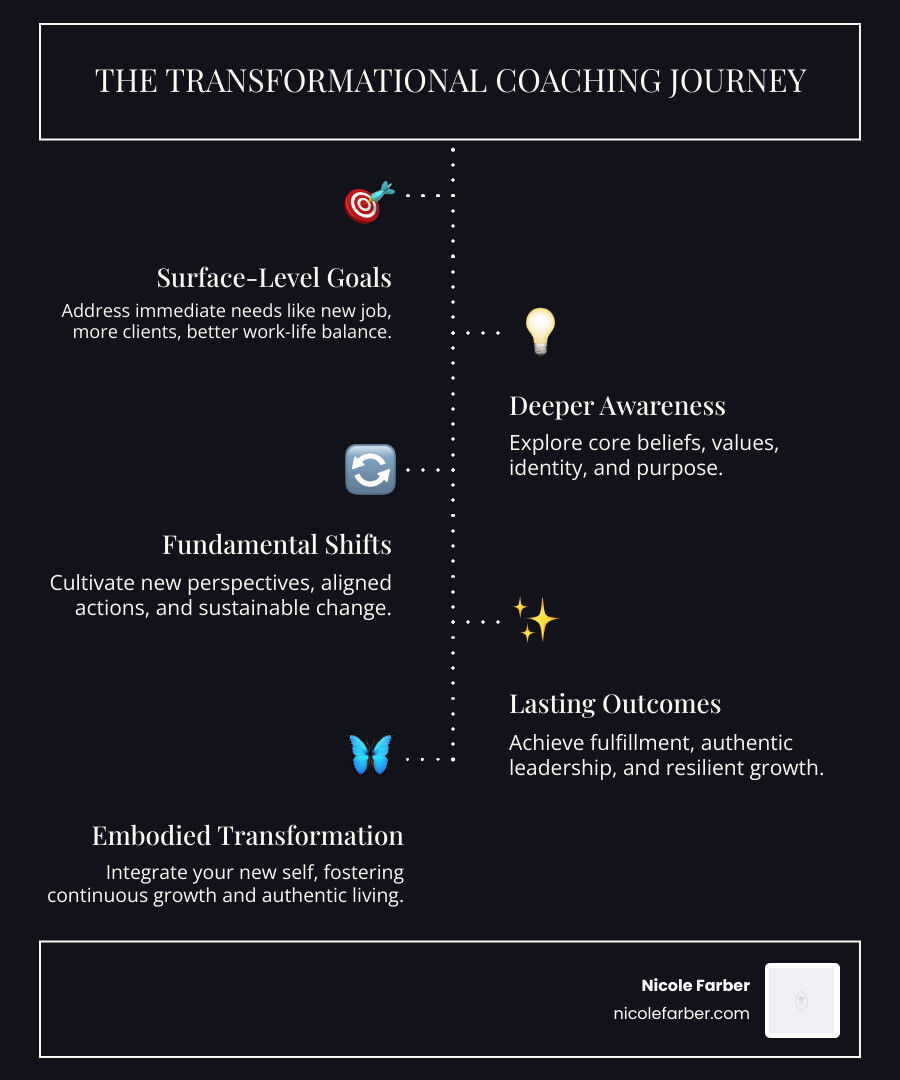
Coaching changeal is a profound approach to development that shifts how you see yourself, your challenges, and your potential. Unlike traditional coaching focused on tactics, it works at the level of beliefs, values, and identity to create lasting change.
What makes changeal coaching different:
- Focus: Changes who you are, not just what you do.
- Goal: Internal shift in perspective, not just external achievement.
- Approach: Explores beliefs, values, and purpose holistically.
- Timeline: Long-term sustainable change (6-12+ months).
- Outcome: A new relationship with yourself and the world.
Many leaders find themselves at a crossroads: crushing revenue targets but feeling empty, or leading a team while questioning their path. Changeal coaching addresses these deeper questions, moving beyond surface-level fixes. While strategic plans can yield 30% more growth, this coaching ensures that growth aligns with your authentic self.
The process requires courage. As one coach said, “Autopilot keeps us locked into past patterns. But changing your life? That requires courage, commitment, and effort.”
This approach is gaining traction from Philadelphia to New Orleans because it solves a common problem for high-achievers: success that feels hollow. Whether you’re in the legal market in Wilkes-Barre or building a practice in Luzerne County, it helps you lead from within.
I’m Nicole Farber. With 15+ years of experience, I’ve seen how coaching changeal principles create sustainable success beyond marketing tactics. My work combines business strategy with faith-driven leadership to help you become the leader you’re meant to be.
What is Changeal Coaching?
Imagine a mirror showing not just who you are, but who you’re capable of becoming. That’s the essence of coaching changeal work. It’s a partnership that supports you through significant growth, fundamentally changing who you are as you steer challenges.
Traditional coaching might help you find a new job. Changeal coaching helps you understand why you felt stuck, what you truly value, and how to show up differently in any role. It’s the difference between a band-aid and true healing.
This deeper work happens at the level of your beliefs, values, identity, and purpose. When you shift these foundations, your actions naturally follow. You develop a new relationship with yourself and how you respond to pressure. The psychologist Abraham Maslow called this “self-actualization”—becoming all you’re capable of. Changeal coaching guides you there, not by fixing what’s broken, but by open uping what’s waiting to emerge.
The Role of Self-Awareness and Identity
Real change starts with knowing your true self, not the version running on autopilot. Coaching changeal work uncovers your blind spots—the assumptions you’ve carried for years. Perhaps you’re a professional in Philadelphia who believes success requires 80-hour weeks, or a leader in Wilkes-Barre who thinks asking for help is a weakness. These beliefs shape your reality.
Changeal coaching helps you pause and ask: What are my core values? What is my “why”? Understanding your personal paradigms is essential for creating change that lasts. This is especially powerful for developing female leaders, who often face conflicting societal expectations. Coaching helps you cut through the noise and lead from a place of authentic strength. By understanding your identity, you can challenge old stories and step into a more empowered version of yourself.
How It Facilitates Sustainable Change
Changing your behavior without changing your mindset is like painting over rust; old patterns eventually return. Sustainable change happens when you shift your underlying beliefs and identity. This is where coaching changeal principles create lasting impact.
As you rewire how you see yourself, your brain forms new neural pathways. You’re not just learning new behaviors; you’re becoming a different person. This moves you from being reactive to proactive, navigating challenges with confidence. The work requires courage, but when it’s time to hit the reset button and get creative, this framework makes the shifts stick.
This is an “evolution of selfhood.” The work begins with who you choose to be, and your actions flow from there. Whether you’re leading a team in Luzerne County or building a practice from scratch, this deeper work ensures your growth is permanent. You develop resilience and creativity that carry you through whatever comes next.
Changeal Coaching vs. Other Approaches: What’s the Real Difference?
When seeking support, the options—life coach, executive coach, therapist, mentor—can be overwhelming. While many approaches aim to help you grow, coaching changeal works at a fundamentally different level. It’s not about checking boxes; it’s about changing the lens through which you see your world.
A life coach helps you climb the ladder faster. A changeal coach helps you figure out if it’s the right ladder and, if not, helps you build a new one.
| Feature | Changeal Coaching | Life Coaching | Transitional Coaching |
|---|---|---|---|
| Primary Focus | Being (identity, beliefs, values, purpose) | Doing (goals, actions, performance) | Moving from point A to point B (specific life events) |
| Goal | Internal shift, rewriting reality, self-actualization | External achievement, skill development, productivity | Successful navigation of a specific change (e.g., new job) |
| Timeline | Long-term, sustainable, profound change (6-12+ months) | Mid-term, goal-oriented (weeks to a few months) | Short-term, task-focused (can be as few as 3 sessions) |
| Approach | Holistic, deep inquiry, challenging core assumptions | Strategy-oriented, accountability, practical steps | Problem-solving, planning, support during transition |
| Key Question | “Who do you need to become?” | “What do you want to achieve?” | “How can you get through this change effectively?” |
It’s also important to distinguish coaching from therapy. Therapy addresses past trauma and mental health conditions, providing healing and treatment. Coaching changeal work is forward-focused, helping mentally well individuals open up future possibilities. If you’re ready to evolve, that’s where changeal coaching shines.
The Focus of a Life Coach
A life coach is a partner in getting things done. They help you set clear goals, create action plans, and hold you accountable. The work is practical and strategy-oriented, focusing on the “what” and “how” of your aspirations. Whether you’re a lawyer in Wilkes-Barre building a client base or an entrepreneur in New Orleans launching a venture, a life coach helps you hit your targets. Our goal achievement coaching is an example of this results-driven approach.
The Focus of a Changeal Coach
A changeal coach asks different questions: Who are you at your core, and who are you becoming? We explore the whole person, co-creating possibilities and identifying the limiting beliefs that keep you stuck. Instead of a blueprint, we facilitate “aha” moments that shift everything.
I’ve seen this with leaders from Philadelphia to Antigua, Guatemala. A client wants to “scale their firm” but finds they’ve been chasing someone else’s definition of success. The real work becomes redesigning their life around what’s truly meaningful. When you choose to embrace your gift and let it shine, a changeal coach helps you uncover what that gift truly is. This is powerful for professionals in competitive markets like Luzerne County, bringing you back to yourself so your achievements feel meaningful.
The Core of Changeal Coaching: Principles and Techniques
Working with a changeal coach is a partnership built on trust and the courage to look at yourself honestly. The approach is holistic, recognizing you as a whole person—mind, body, and spirit. In a safe, non-judgmental space, your coach offers both support and constructive challenges, asking questions that spark paradigm shifts. You begin to see that the limiting voices in your head are just old stories, not truths. For leaders from Philadelphia to Wilkes-Barre, these internal shifts change everything.

Key Principles and Frameworks
Coaching changeal change rests on several foundational principles. The work is relational, humanistic, and dialogic, meaning change emerges through deep, honest conversation. It’s phenomenological, honoring your unique lived experience. We accept unknowing and emergence, allowing change to unfold organically. The work is also paradigmatic (challenging core beliefs), holistic (integrating mind, body, and spirit), and recognizes you as part of larger systems (family, community). Finally, it’s a collaborative and integrative journey, drawing from multiple models to create a personalized business leadership strategy.
Frameworks like the RISE Technique (Realization, Identification, Source & Siege, Empowerment) or the 4R Model (Reflect, Reframe, Reconstruct, Reaffirm) help structure this deep work.
Powerful Techniques Used in Changeal Coaching
To facilitate these shifts, coaches use a variety of powerful techniques:
- Positive psychology focuses on your strengths and resilience, building from your existing power.
- Motivational interviewing helps you uncover your own intrinsic reasons for change, which is far more powerful than external pressure.
- Somatic awareness brings your body into the conversation, helping you tune into physical signals and the wisdom they hold.
- Visualization and shadow work allow you to connect with your desired future self and integrate suppressed parts of your personality, open uping hidden energy. As we walk by faith not by sight, these techniques tap into inner wisdom.
- Neuro-linguistic programming (NLP) helps reprogram thought patterns, while Acceptance and Commitment Therapy (ACT) principles help you accept difficult emotions and commit to value-aligned actions.
These are not quick fixes; they are tools for deep, sustainable change, whether you’re in New Orleans or Luzerne County.
The Lasting Impact: Benefits for Individuals and Organizations
When you commit to coaching changeal work, you’re not just solving one problem; you’re changing how you show up in every area of your life. The impact radiates outward to your relationships, work, and community. Leaders who do this work develop resilience, open up creativity, and find fulfillment that goes beyond mere achievement.

This isn’t just personal growth. When leaders transform, they empower their teams and create environments where others can thrive. The change spreads organically because it’s rooted in authenticity.
Benefits for Individuals
The personal change from coaching changeal work is profound. You gain clarity on what truly matters, which becomes your compass for decisions. Your relationships deepen as you learn to communicate from an authentic place. Navigating major life transitions becomes an opportunity for intentional growth, not just survival. You build a deep, unshakeable confidence rooted in self-acceptance. This is especially powerful for women balancing motherhood and career, who often face immense external pressures.
Benefits for Organizations and Leaders
For organizations, coaching changeal principles transform cultures. Leaders who’ve done this work embody leadership instead of just performing it. They communicate authentically and inspire others without force. This is invaluable in competitive markets like the legal industries in Philadelphia or Wilkes-Barre. Our CEO coaching services help executives develop this inner clarity.
Innovation flourishes because people feel safe to think differently. Employee engagement and retention increase because team members feel seen and valued. When navigating organizational change, these leaders have a distinct advantage. While strategic plans can lead to 30% more growth, changeal leadership ensures those shifts stick. This deep work creates sustainable growth for any organization, from Luzerne County to New Orleans or Antigua, Guatemala.
The Anatomy of a Changeal Coach
A changeal coach is a guide who helps you see what you couldn’t see before, asks the question that changes everything, and holds space for your breakthroughs. Becoming one requires a unique combination of skill, heart, and a deep commitment to one’s own personal development. Effective changeal coaches possess high emotional intelligence, unwavering presence, and keen intuition. This awareness, combined with strict ethical practice, creates the safe environment needed for changeal work. As anyone on a journey to become an effective leader knows, you can only guide others as far as you’ve gone yourself.
Essential Skills and Training
Not all coaching is created equal. Coaching changeal change requires rigorous training. The gold standard is a credential from the International Coach Federation (ICF), which signifies a commitment to ethical practice and proven competency. Beyond certification, professional coaches complete hundreds of hours in specialized programs focusing on psychology, consciousness, and spiritual wisdom.
Continuous supervision and mentoring are also critical for refining skills and maintaining healthy boundaries. A strong foundation in psychology and adult learning theories provides the roadmap for guiding clients through profound shifts. For those interested in the field, some organizations offer free life coaching courses to provide a glimpse of what’s involved.
How to Find the Right Coach for You
Finding the right changeal coach is a personal process where chemistry and trust are paramount. Whether you’re in Philadelphia or connecting remotely from Antigua, Guatemala, the right fit is crucial.
- Get Clear on Your Needs: Are you a law firm owner scaling up? A leader feeling empty despite success? Knowing your situation helps you find a coach with relevant experience.
- Research and Vet: Look for coaches who specialize in your area of need. The International Coach Federation’s directory is an excellent resource for finding credentialed professionals.
- Use the findy Call: Most coaches offer a complimentary session. This is your chance to assess the connection. Do they listen deeply? Do their questions make you think? Do you feel a sense of safety and possibility?
- Trust Your Gut: A strong, trusting relationship is the foundation of this work. If it feels right, it’s worth exploring. If not, keep looking.
A coach who understands your context, like the business landscape in Luzerne County or the pressures of the legal industry in Wilkes-Barre, can add significant value. This search is an act of self-awareness—choose a partner who will champion your deepest change.
Frequently Asked Questions about Changeal Coaching
What is an example of changeal coaching?
Imagine a successful professional, Anna, who feels stuck and unfulfilled despite having a great career on paper. A traditional coach might help her find a new job. A changeal coach goes deeper.
Together, they would explore Anna’s core identity, challenge her limiting beliefs about success, and uncover what genuinely matters to her. Through this process, Anna might realize she doesn’t just need a new job—she needs a complete career reinvention, like starting a nonprofit or a new business aligned with her true passion. This is coaching changeal: a fundamental shift in how Anna sees herself and her life’s possibilities, leading to fulfillment beyond external achievements.
How long does changeal coaching take?
Coaching changeal is a journey, not a quick fix. While some coaching wraps up in a few sessions, changeal work typically unfolds over six to twelve months, or even longer. You’ve spent decades developing your current beliefs and patterns; rewiring them requires patience and commitment.
This extended timeline allows for deep “aha” moments to integrate and gives you space to practice new ways of being. The evolution of selfhood doesn’t happen overnight. For leaders from Wilkes-Barre to New Orleans, this investment of time creates change that lasts a lifetime.
Is changeal coaching a form of therapy?
No, coaching changeal is not therapy, though both involve deep personal exploration. The key difference is focus: therapy often looks backward to heal past wounds, diagnose conditions, and treat psychological pain. It helps people move from dysfunction to function.
Changeal coaching, on the other hand, is forward-looking. We partner with mentally well individuals who are ready to explore their potential and create their future. The focus is on growth and possibility. A responsible coach knows their boundaries and will refer a client to a therapist if issues like unprocessed trauma arise. It’s about getting you the right support for where you are in your journey.
Conclusion
True change isn’t just about new goals; it’s about fundamentally shifting who you are. Coaching changeal offers this deeper pathway, moving beyond quick fixes to create lasting shifts in your identity, beliefs, and values. This approach helps you lead from a place of authentic power, build resilience, and find clarity on what truly matters.
The benefits ripple outward, creating more inspiring leadership and engaged teams. Organizations that invest in this development see tangible results, from the 30% growth advantage of strategic alignment to greater innovation.
As Nicole Farber, I’ve walked this path. My work weaves business strategy with faith-driven principles to empower leaders. Whether you’re a law firm owner in Wilkes-Barre, an entrepreneur in Philadelphia, or a leader in New Orleans or Luzerne County, this work meets you where you are.
Your extraordinary future is waiting. The question isn’t if you’re capable of profound change—it’s if you’re ready to begin.
Explore more about personal and professional growth and find how we can partner to open up your full potential.