Mind Over Matter: Developing Your Inner Entrepreneurial Leader
- Leadership
- Word of the Day
- December 19, 2025
The Catalyst for Success

Entrepreneur mindset development is the process of cultivating attitudes like resilience, adaptability, and opportunity recognition. It’s what enables you to take calculated risks, steer challenges, and create value in your business and life.
Key Components of Entrepreneur Mindset Development:
- Growth Mindset – Believing your abilities can improve through effort and learning from failure
- Resilience – Bouncing back from setbacks and viewing them as learning opportunities
- Adaptability – Embracing change and pivoting strategies when needed
- Opportunity Recognition – Seeing potential where others see obstacles
- Calculated Risk-Taking – Making informed decisions despite uncertainty
- Solutions-Oriented Thinking – Focusing on what can be done rather than what can’t
You’re running a successful law firm, perhaps in Philadelphia or New Orleans, but client acquisition feels overwhelming. The truth is: your technical skills got you here, but your mindset will take you further.
Research confirms that entrepreneurial skills aren’t innate—they can be learned. Developing this mindset boosts performance and pairs traditional skills with the innovation today’s market demands. The difference between firms that thrive and those that plateau isn’t just legal expertise; it’s about seeing opportunities where others see chaos. Whether you’re in Wilkes-Barre or Luzerne County, this mindset is your competitive advantage.
Think of it this way: you have the “what” (legal expertise). You need the “how” (entrepreneurial thinking) to scale your practice and stand out.
The good news? This mindset can be developed. It’s not about working harder—it’s about thinking differently.
As Nicole Farber, I’ve spent over 15 years helping business owners transform their approach to growth. My work in entrepreneur mindset development has shown me that the most successful professionals are those who accept change, learn from setbacks, and consistently take action despite uncertainty. Shifting your mindset creates a ripple effect that transforms not just your business, but your entire approach to professional challenges.
What is an Entrepreneurial Mindset and Why is it Crucial?
An entrepreneurial mindset is a way of thinking that empowers you to create real value. It’s not just for tech startups; whether you’re in a Philadelphia law firm or a New Orleans practice, it turns good professionals into exceptional business leaders.
Rowena Barrett, an expert in the field, notes it helps leaders create value by “recognizing and acting on opportunities, making decisions with limited information, and remaining adaptable and resilient…”
This means you spot market gaps others miss (opportunity recognition), move forward with the best available information (strategic decision-making), and pivot quickly when conditions change (adaptability and resilience). This mindset drives innovation and is the foundation of every strategy in our Business Growth Strategies Ultimate Guide, regardless of your industry.

From Philadelphia to Antigua Guatemala: A Universal Tool for Success
The truth is, entrepreneur mindset development is a universal tool. Bill Aulet of MIT Sloan says entrepreneurship is “much, much bigger than just startups.” In large organizations, it’s called corporate intrapreneurship—employees driving innovation from within.
For law partners in Luzerne County or solo practitioners, it means constantly problem-solving and anticipating client needs. This mindset equips you with adaptability, innovation, and leadership, helping in Empowering Business Owners to build something that lasts, whether in Philadelphia or Antigua Guatemala.
Entrepreneurial vs. Traditional Management Mindset
Both entrepreneurial thinking and traditional management have their place, and the best leaders know when to use each. Traditional management focuses on stability and control, optimizing existing systems. An entrepreneurial mindset actively seeks opportunity and accepts calculated risks.
MIT Sloan calls for “ambidextrous leaders” who can shift between both mindsets—managing the present while innovating for the future. This balance is essential for robust Business Leadership Strategies.
| Feature | Entrepreneurial Mindset | Traditional Management Mindset |
|---|---|---|
| Approach to Risk | Actively seeks and accepts calculated risks. | Mitigates and avoids risk; prioritizes stability. |
| Focus | Opportunity recognition and creation. | Resource management, optimization, and control. |
| Orientation | Action-oriented; experiments and learns from doing. | Planning-oriented; emphasizes detailed forecasting. |
| Response to Change | Accepts change; adaptable and flexible. | Seeks stability and predictability; resistant to disruption. |
| Decision-Making | Decides with limited information; agile. | Requires comprehensive data; methodical. |
The professionals who succeed long-term master both approaches and know which one the moment demands.
The Anatomy of an Entrepreneur: Core Traits and Characteristics
So, what defines an entrepreneur? When we talk about entrepreneur mindset development, we’re looking at a mix of traits that drive growth. Experts like Rowena Barrett and Bill Aulet highlight that entrepreneurs are solutions-oriented, adaptable, and anti-fragile—meaning they don’t just endure stress, but get stronger from it.

- Solutions-oriented entrepreneurs are resourceful and see setbacks as opportunities.
- An adaptable spirit accepts change and pivots when needed.
- Anti-fragility, as Aulet explains, combines a strong Heart (Confidence), a clear Head (Plan), capable Hands (Execution), and a supportive Home (Community).
These traits, along with strong vision and proactiveness, are the secret to Building a Successful Business.
The Power of Resilience and a Growth Mindset
The entrepreneurial journey is rarely a straight line. Whether in Philadelphia or Luzerne County, you’ll face roadblocks. This is where resilience—the ability to bounce back from failure—and adaptability—the willingness to pivot—become your superpowers. As Nicole Farber, I know that Overcoming Business Challenges means learning from missteps. Adaptability helps you see chaos not as a threat, but as fertile ground for new ideas, because as I often say, Chaos Brings Opportunity.
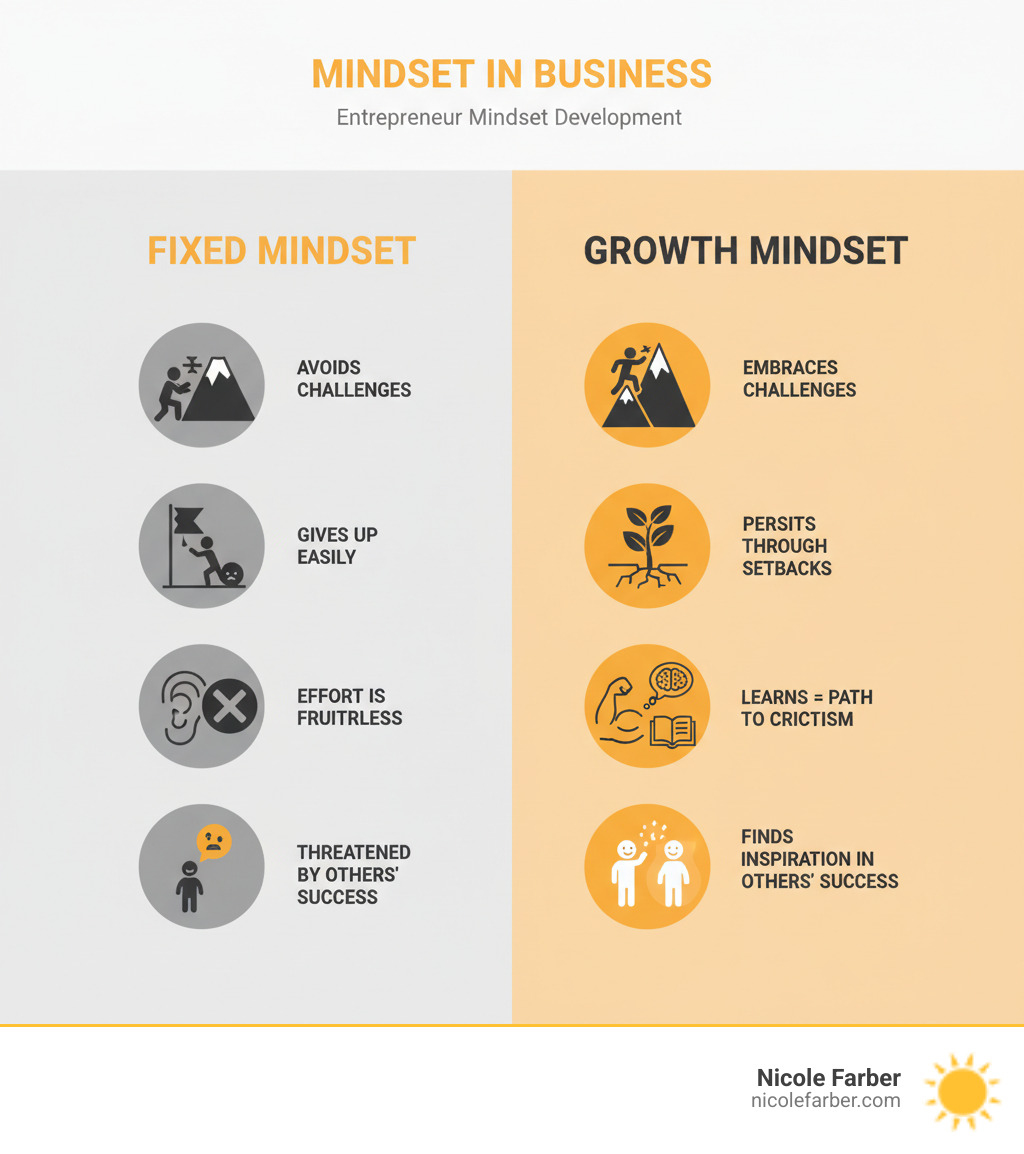
At the heart of these traits is the growth mindset, a concept from psychologist Carol Dweck. It’s the belief that your abilities can be developed through effort. A person with a growth mindset sees a challenge as a chance to learn, not a threat to their ego. This belief fuels the self-confidence needed to take on big goals. For me, this is connected to faith-driven leadership—the understanding that there’s a purpose and a path forward, a core part of my Ultimate Faith-Based Leadership Guide.
The Blueprint for Your Entrepreneur Mindset Development
Developing an entrepreneurial mindset requires intentional action. It’s a skill that can be cultivated through actionable steps, a journey of self-improvement we explore in our Entrepreneurship Speaker Guide 2025.
Step 1: Cultivate a Growth Mindset
This is the bedrock of success. To foster a growth mindset, you must see challenges as learning opportunities and prioritize growth over approval. Start by:
- Accepting challenges as a chance to expand your skills.
- Celebrating effort, not just perfect outcomes.
- Cultivating curiosity by constantly asking “why” and “how.”
- Surrounding yourself with growth-minded mentors and peers.
A growth mindset is a key part of effective Strategic Goal Setting, as it reframes every goal as a chance to learn.
Step 2: Practice Strategic Risk-Taking
Entrepreneurs take calculated and strategic risks, not reckless ones. It involves careful assessment before making a move. To build this skill:
- Start small and learn fast. Experiment with smaller changes to learn with lower stakes.
- Analyze every outcome. Whether a risk pays off or not, ask what you can learn for next time.
- Build confidence gradually. Each small, calculated risk prepares you for larger challenges, like expanding from Wilkes-Barre to a market like Philadelphia.
This strategic approach is a hallmark of effective Business Strategy Coaching.
Step 3: Sharpen Your Opportunity Recognition Skills
Opportunities are everywhere, but you have to train your mind to see them. This involves looking for problems to solve and thinking critically about the status quo.
- Focus on problem-solving. Every unmet need is a potential opportunity.
- Accept customer-centric innovation. Listen to your clients’ pain points to find ways to serve them better.
- Look for gaps in the market. Find underserved niches or missing services to find unforeseen opportunities.
To help, ask yourself these 5 questions:
- What frustrates my clients the most?
- What emerging trends could be applied to my industry?
- What are common complaints about competitors?
- Is there an underserved demographic or area (like a community in Antigua Guatemala) that needs my expertise?
- How can my existing skills solve a problem in a new context?
Debunking Myths and Building Your Legacy
The myth that entrepreneurs are born, not made, has stopped too many talented people. As MIT’s Bill Aulet confirms in his book debunking myths, entrepreneur mindset development is about deliberate practice, not innate genius.
Success stories like Steve Jobs or Indya Wright, who launched a PR firm without a background in it, were built on a growth mindset and relentless learning. You don’t need to look to Silicon Valley for inspiration. I see entrepreneurial spirit in the business owners of Luzerne County, community leaders in New Orleans, and professionals in Wilkes-Barre who adapt and innovate. They are real-world proof that this mindset can be developed. It’s this commitment to growth we focus on in CEO Coaching Services—because if they can do it, so can you.
Can an Entrepreneurial Mindset Be Taught?
Yes, absolutely. Research and organizations like NFTE (Network for Teaching Entrepreneurship) prove that non-cognitive skills like resilience and problem-solving are malleable. NFTE has successfully taught these principles since 1987, with students showing improved critical thinking and becoming highly valued by employers. They even created a measurable Entrepreneurial Mindset Index to track growth in areas like Initiative & Self-reliance and Comfort With Risk. If students can develop these skills, so can you, whether through formal education or by working with Entrepreneur Motivational Speakers.
Your Personal Journey to Entrepreneur Mindset Development
Your path will be unique. It starts with honest self-reflection: How do you react to challenges? What opportunities are you overlooking due to fear? From there, set clear goals for your mindset development, like practicing optimistic interpretations of setbacks or taking one calculated risk each month.
Find mentors who embody the traits you admire, whether you’re in Philadelphia or Antigua Guatemala. The power of community is also crucial; surrounding yourself with like-minded peers creates a supportive environment for growth, a core element of effective Goal Achievement Coach programs. Your journey is a process of continuous learning. What matters is that you keep showing up.
Frequently Asked Questions about Entrepreneur Mindset Development
What is the single most important trait of an entrepreneurial mindset?
While many traits are crucial, the foundation is adaptability and resilience. The business world doesn’t stand still. Your ability to pivot when markets shift and bounce back from setbacks is what determines long-term success. Adaptability turns obstacles into opportunities and keeps you moving forward when others are stuck.
How long does it take to develop an entrepreneurial mindset?
It’s a lifelong journey, not a destination. However, you can see real changes in your thinking within a few weeks or months of conscious practice. When you start viewing challenges as learning opportunities and taking small, calculated risks, your confidence and perspective begin to shift quickly. What feels uncomfortable today will become second nature over time.
Can you have an entrepreneurial mindset without starting a business?
Absolutely. This mindset is about how you solve problems and create value, which is applicable in any role. An attorney in New Orleans who streamlines client intake is using entrepreneurial thinking. These “corporate intrapreneurs” drive change from within existing organizations. The mindset is about being solutions-oriented, adaptable, and proactive, regardless of your job title.
Conclusion: Lead with Your Mindset
We’ve explored how entrepreneur mindset development is a true catalyst for success, far beyond the startup world. It’s a skill that can be learned, not an innate trait. By embracing a growth mindset, practicing strategic risk-taking, and sharpening your ability to spot opportunities, you can build the resilience to thrive in any environment.
Your mindset is the foundation of everything you achieve—it’s your inner compass for navigating uncertainty and the engine for your innovation. Here at Nicole Farber, my approach, rooted in real-life experience and faith-driven leadership, is designed to help you change your entire approach to leadership and life. Whether you’re in Philadelphia or Antigua Guatemala, the power to lead with your mindset is within you.
Ready to take the next step? Explore how Women Entrepreneur Coaching can provide personalized guidance. Together, we can cultivate the mindset to open up your fullest potential and build the legacy you envision.