Your Game-Changing Guide to Building a Business Development Plan
- Entrepreneurship
- In the News
- October 2, 2025
Why Building a Business Development Plan Is Your Firm’s Secret Weapon

Building a business development plan is the strategic process of creating a roadmap to identify growth opportunities, cultivate key relationships, and increase your firm’s long-term value. It’s your growth GPS, aligning your team and showing you where to invest limited time and resources.
Without a clear plan, teams often argue over priorities—one side demanding more leads, the other better closing rates. This confusion leads to wasted hours on the wrong prospects and marketing dollars spent on ineffective channels. The reality is that 82% of sellers have had to quickly adapt to new ways of selling, and 81% of buyers now do their own research before ever reaching out. If you’re not strategic, you’re falling behind.
A plan prevents you from chasing every shiny opportunity and helps you stand out in competitive markets like Philadelphia or New Orleans. Here’s how to get started:
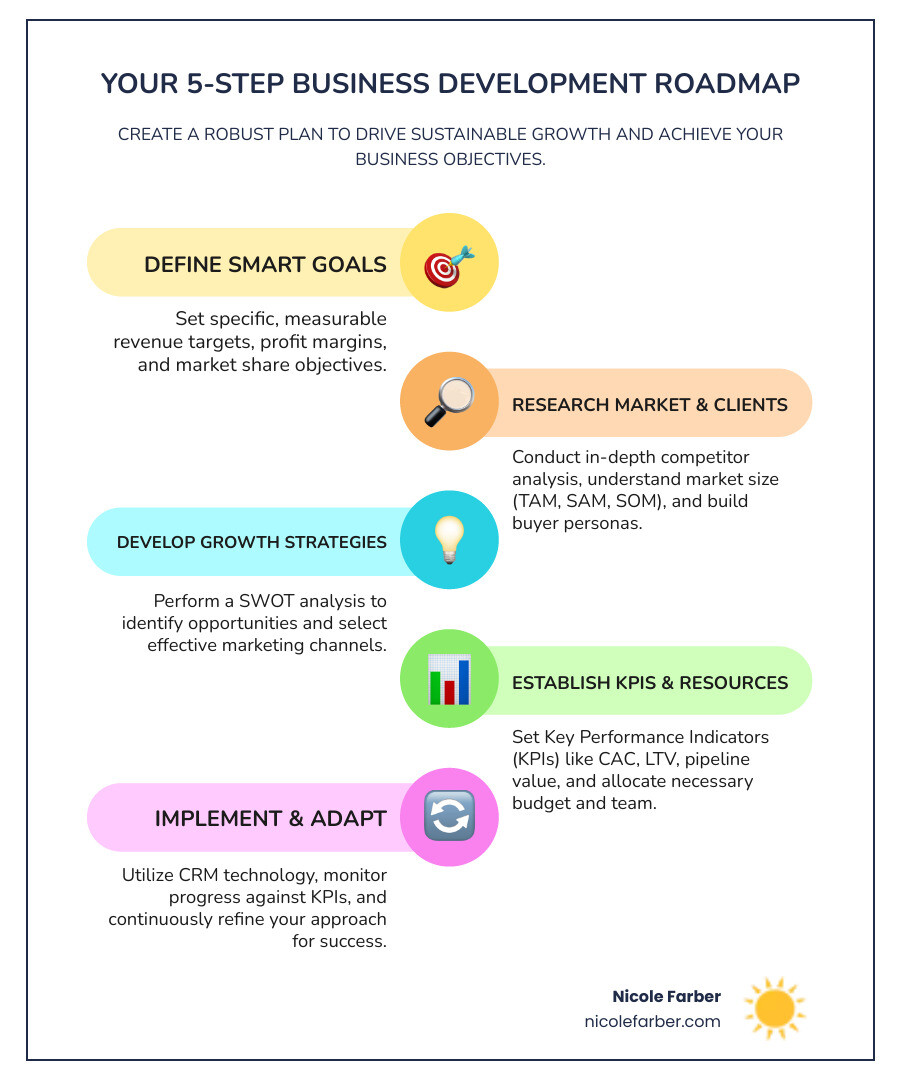
- Set SMART goals – Define specific, measurable financial targets.
- Research your market – Analyze competitors and understand market size (TAM, SAM, SOM).
- Identify your ideal client – Build detailed buyer personas.
- Choose growth strategies – Select marketing channels and partnership opportunities.
- Establish KPIs – Track metrics like lead conversion rate and CAC.
- Implement and adapt – Use CRM technology and continuously refine your approach.
The good news? Building a plan doesn’t require an MBA. It requires strategic thinking and an honest assessment of where you are and where you want to go. The legal landscape has changed; over half of potential clients rule out firms before talking to anyone, and digital channels dominate. Traditional advertising is even associated with slower growth.
This guide will walk you through creating a plan that works. As Nicole Farber, CEO of ENX2 Legal Marketing, I’ve spent over 15 years helping law firms—from small practices in Luzerne County to established firms in new markets—transform into thriving businesses. I’ll share proven strategies to help you build your roadmap to sustainable growth.
The Foundation: Understanding Your Business Development Plan
Think of building a business development plan as creating your firm’s GPS for growth. It’s the strategic roadmap that shows you where you’re going and how to get there. For law firms in Philadelphia or small practices in Luzerne County, the common frustration of working hard without seeing growth often stems from navigating without this map.
A business development plan creates long-term value by outlining clear goals and the specific steps to achieve them. It provides the clarity your team needs to invest resources wisely and shows potential partners or investors that you are serious about strategic growth.
For more on how strategic direction transforms your leadership, explore our insights on Business Leadership Strategies.
What is a Business Development Plan?
A business development plan is a dynamic document that helps you implement your growth strategy step-by-step. It’s a detailed roadmap of actions to expand your business, backed by research on your market, customers, and competitors. It focuses on identifying growth opportunities, such as new markets, partnerships, and ways to deepen customer relationships.
This is not the same as a traditional business plan, which covers all aspects of operations and management. A business development plan is laser-focused on one question: How will we expand and create more value? It’s agile and evolves with your market, making it a concise and powerful tool for growth. Without it, you’ll waste time on mismatched prospects and wonder why competitors seem to be steps ahead.
Business Development vs. Sales: A Critical Distinction
One of the biggest sources of confusion is the distinction between business development and sales. They are not the same, and understanding the difference is critical for an effective growth strategy.
Business development is strategic and top-of-funnel. It’s about identifying opportunities, building relationships, and creating long-term value. BD professionals are prospectors, conducting market research, qualifying leads, and nurturing prospects until they are ready for a sales conversation.
Sales is tactical and bottom-of-funnel. It’s about converting those qualified opportunities into clients. Sales professionals take the nurtured leads and work them through the pipeline to close deals.
Here’s how they compare:
| Feature | Business Development (BD) | Sales |
|---|---|---|
| Focus | Strategic, top-of-funnel, relationship building, identifying new opportunities and markets | Tactical, bottom-of-funnel, closing deals, converting leads into customers |
| Activities | Market research, lead qualification, strategic partnerships, ecosystem mapping, nurturing leads | Working leads through the pipeline, presenting services, negotiating, closing deals |
| Goal | Expand the company’s reach, increase overall value, build a robust pipeline of qualified prospects | Meet revenue targets, convert opportunities, achieve sales quotas |
| Time Horizon | Long-term, patient process focused on future growth | Short-term, focused on immediate conversions |
The magic happens when both teams work together seamlessly. Business development qualifies and nurtures opportunities, then hands them off to sales at the right moment. This handoff process is where many firms either excel or stumble.
Why Every Business Needs a Plan
Working hard without a strategic plan leads to burnout, not growth. A business development plan is essential for several reasons:
- It prevents wasted resources. A clear strategy ensures every hour and dollar is invested in activities that align with your goals.
- It aligns your entire team. With a shared roadmap, marketing, sales, and operations work in unison toward common objectives.
- It improves your brand image. Strategically pursuing opportunities positions you as an industry leader, whether in Philadelphia or Antigua Guatemala.
- It increases revenue while lowering costs. A plan helps you identify profitable opportunities and avoid costly mistakes.
- It makes you adaptable. With 82% of sellers having to quickly adapt to new ways of selling, a living plan allows you to anticipate market shifts and pivot effectively.
The Blueprint: A Step-by-Step Guide to Building a Business Development Plan

Building a business development plan is a structured process that moves from vision to execution. Breaking down the task of “growing your business” into manageable steps creates a solid framework for sustainable growth.
Step 1: Set SMART Goals and Define Your Financial Vision
Many plans fail because of vague goals like “we want to grow.” Your goals must be Specific, Measurable, Attainable, Relevant, and Time-Bound (SMART). For example: “We will increase our client base in Luzerne County by 15% within 12 months, resulting in a 10% increase in recurring revenue.” This provides a clear target, a way to measure progress, and a deadline.
Your financial vision should include specific revenue targets, profit margin goals, and market share objectives. Focusing on a few important goals creates momentum, whereas scattered efforts lead to exhaustion. A free template for SMART goal setting can provide the structure you need.
Step 2: Conduct In-Depth Market and Competitor Research

Once you know your destination, you must understand the terrain. Market research is the intelligence that guides your strategy. As RJ Living founder David Janovic notes, it’s crucial when entering new markets, whether it’s New Orleans or Antigua Guatemala.
First, determine your market size:
- Total Addressable Market (TAM): The total revenue opportunity.
- Serviceable Addressable Market (SAM): The portion of TAM you can realistically serve.
- Serviceable Obtainable Market (SOM): The share you can realistically capture.
Understanding these numbers helps you invest your resources wisely. Next, conduct a competitor analysis. Identify direct and indirect competitors and study their offerings, pricing, strengths, and weaknesses. Customer reviews are a goldmine for finding what clients love and what frustrates them about your competition. One Philadelphia firm I worked with found their rival had poor communication, which became their own competitive advantage. Tools like NAICS codes can help you analyze specific industry segments.
Step 3: Refine Your Ideal Customer and Build Buyer Personas
With 81% of buyers doing their own research before contacting you, it’s critical to know your ideal clients intimately. You need to understand their challenges, what they’re searching for, and where they’re looking for answers.
Building buyer personas goes beyond demographics. You must also understand their psychographics—values, fears, and aspirations. What are their pain points and motivations? Start by examining your best current clients to find common traits. Then, use surveys and interviews to dig deeper.
For example, instead of targeting all “law firms,” you might identify your ideal client as a solo practitioner in Luzerne County who feels overwhelmed by marketing and needs to see a clear ROI. This level of specificity changes everything about how you communicate and is key to Empowering Business Owners. A business development plan template can guide you through creating your own personas.
Step 4: Develop Your Growth Strategies and Marketing Channels
With goals, market intelligence, and buyer personas, you can now develop effective growth strategies. Start with a SWOT analysis to assess your Strengths, Weaknesses, Opportunities, and Threats. This honest assessment helps you identify realistic growth paths, like launching a new service or expanding geographically.
When choosing marketing channels, 57% of buyers prefer engaging through digital channels. Your strategy should include:
- Digital Marketing: SEO, content marketing, and social media are essential for reaching modern buyers. Since 96% of leads do their homework online, your digital presence is your first impression.
- Content Marketing: Quality content positions you as an expert, improves search rankings, and nurtures leads. This aligns with our Category: Marketing strategies.
- Networking: Build genuine relationships both in-person at events in Philadelphia or Wilkes-Barre and digitally on platforms like LinkedIn.
- Referrals: Nurturing current clients is smart business development, as 72% of a company’s revenue comes from existing customers.
Focus your energy on channels that effectively reach your ideal clients. While traditional advertising has a place, studies show it’s often associated with slower growth.
Execution and Adaptation: Bringing Your Plan to Life

A brilliant plan is useless without execution. The firms that thrive are those that implement their strategies, monitor progress, and adapt. This phase transforms your strategic thinking into tangible results by putting systems in place to track performance, integrate technology, and foster a culture of continuous improvement.
Establish Key Performance Indicators (KPIs) to Measure Success
To know if your efforts are working, you must measure them. Key Performance Indicators (KPIs) are measurable values that remove guesswork and show whether you’re hitting your targets. Focus on a handful of metrics that directly reflect your SMART goals:
- Revenue Growth Rate: The percentage increase in revenue over a specific period.
- Lead Conversion Rate: The percentage of prospects who become paying clients. A low rate may signal issues in your nurturing or sales process.
- Customer Acquisition Cost (CAC): How much you spend to acquire each new client. This is crucial for making smart budget decisions, especially for a small firm in Wilkes-Barre.
- Customer Lifetime Value (LTV): The total revenue expected from a single client. A healthy business has an LTV significantly higher than its CAC.
- Pipeline Value: A forward-looking view of potential revenue currently in your sales pipeline, essential for forecasting.
When starting with building a business development plan, pick three to five key metrics and master tracking them before adding more.
Leverage Technology and Cultivate Core Skills
Technology is essential for modern business development. Customer Relationship Management (CRM) platforms help track interactions and standardize outreach. AI-powered tools are also leveling the playing field, with 63% of sales leaders believing AI makes competing easier for firms of all sizes, from Philadelphia to New Orleans.
However, technology only supports your process; it doesn’t replace it. A well-defined strategy must come first. Alongside tech, cultivate these core skills:
- Data Analysis: The ability to interpret metrics and make data-driven decisions is non-negotiable.
- Communication: No technology can replace the ability to build genuine relationships, listen to client needs, and communicate value clearly.
- Project Management: Efficiently executing initiatives is key to turning great ideas into results.
- Simplifying Complex Concepts: Translating technical expertise into clear, digestible information builds trust and closes deals.
Developing these skills is a cornerstone of strategic leadership. Our Business Leadership: The Ultimate Guide offers practical frameworks to help.
Avoiding Common Pitfalls When Building a Business Development Plan
The pitfalls of business development are predictable and avoidable. Here are the most common traps:
- Thinking Short-Term: Business development is a long game. Focusing only on quick wins means you’re constantly starting from zero instead of building momentum.
- Underestimating Costs: Growth requires investment in marketing, technology, and people. Track your ROI to avoid burning through capital on strategies that don’t deliver.
- Generating Leads Without Nurturing Them: Since 81% of buyers do their own research, your job is to be helpful throughout their journey, not rush them into a sale.
- Failing to Adapt: Your plan is a living document. Continuously review results and adjust your strategies to stay effective in a changing market.
- Lack of Focus: Trying to do everything at once spreads your resources too thin. Execute a few high-impact initiatives excellently before adding more.
Navigating these challenges requires honesty and a willingness to change course. For more guidance, see our insights on Overcoming Business Challenges.
Frequently Asked Questions about Building a Business Development Plan
How often should a business development plan be updated?
Your business development plan is a living document, not a static one. I recommend reviewing your plan quarterly to check KPIs and make small adjustments. At least once a year, conduct a comprehensive update to revisit your core goals, market research, and overall strategy.
However, be ready to adapt more frequently. If a major competitor enters your Philadelphia market, a new regulation impacts your practice, or an unexpected opportunity arises, pull out the plan immediately. The goal is relevance, not perfection. An 80% accurate plan that’s regularly updated will always outperform a perfect but outdated one.
What’s the main difference between a business development plan and a sales plan?
Think of it this way: business development is the architect, and sales is the builder.
A business development plan is your high-level strategy for long-term growth. It focuses on the big picture: identifying new markets (like expanding from Wilkes-Barre to New Orleans), creating strategic partnerships, and finding opportunities to increase your firm’s value.
A sales plan is tactical and short-term. It outlines specific targets, techniques, and activities to convert qualified leads into paying clients within a set timeframe, like a quarter or a year.
They are complementary functions. Business development identifies and qualifies opportunities, then hands them to sales to close. A clear handoff process is crucial for creating a powerful and efficient growth engine.
Can a solopreneur or small law firm benefit from this process?
Absolutely—in fact, you need it more than larger firms.
As a solopreneur or small practice in a place like Wilkes-Barre, your resources are limited. You can’t afford to waste time or money on activities that don’t move the needle. A business development plan provides focus, which is your greatest competitive advantage.
A plan transforms a vague goal like “I need more clients” into a concrete strategy: “I’m targeting small business owners in Luzerne County who need employment law services, and here’s how I’ll reach them.” It helps you prioritize your budget, choose the right networking events, and even gives you permission to say no to opportunities that don’t align with your vision.
For personalized guidance, our Business Coaching for Lawyers program offers the strategic support that many solopreneurs and small firms find invaluable.
Conclusion: Your Roadmap to Sustainable Growth
Building a business development plan is not a one-time task; it’s an ongoing commitment to strategic thinking that will guide every decision you make. It is the compass that keeps your firm on course, whether you’re a solo practitioner in Wilkes-Barre or an established firm expanding into markets like Philadelphia or New Orleans.
This process empowers you to be proactive, not reactive. You’ll be shaping your future by choosing your ideal clients, selecting the right growth opportunities, and building relationships that create lasting value. This is a living document. As markets shift and new opportunities emerge in places from Luzerne County to Antigua Guatemala, your plan must adapt. Regular reviews will ensure it remains a powerful tool.
As I’ve seen in my 15+ years in legal marketing, the firms that thrive are the ones with clarity. They know where they’re going and have a map to get there. That is what a solid business development plan delivers.
My mission at ENX2 Legal Marketing is to guide entrepreneurs and law firms toward building sustainable businesses using proven, real-world strategies. You have what you need to start. Set your goals, know your market, and take action.
Your journey to sustainable growth begins now. You don’t just let growth happen to you—you create it, one smart decision at a time.
Ready to explore even more ways to accelerate your firm’s growth? Check out Your ultimate guide to business growth strategies for additional insights and proven tactics.