The CFO’s Secret Sauce: How to Unlock Your Business’s Full Potential
- Entrepreneurship
- In the News
- December 22, 2025
Why Open uping Your Business’s Potential Matters

To open up business potential means achieving maximum growth, efficiency, and impact. It’s not just about making more money; it’s about building a resilient, innovative, and sustainable business that thrives.
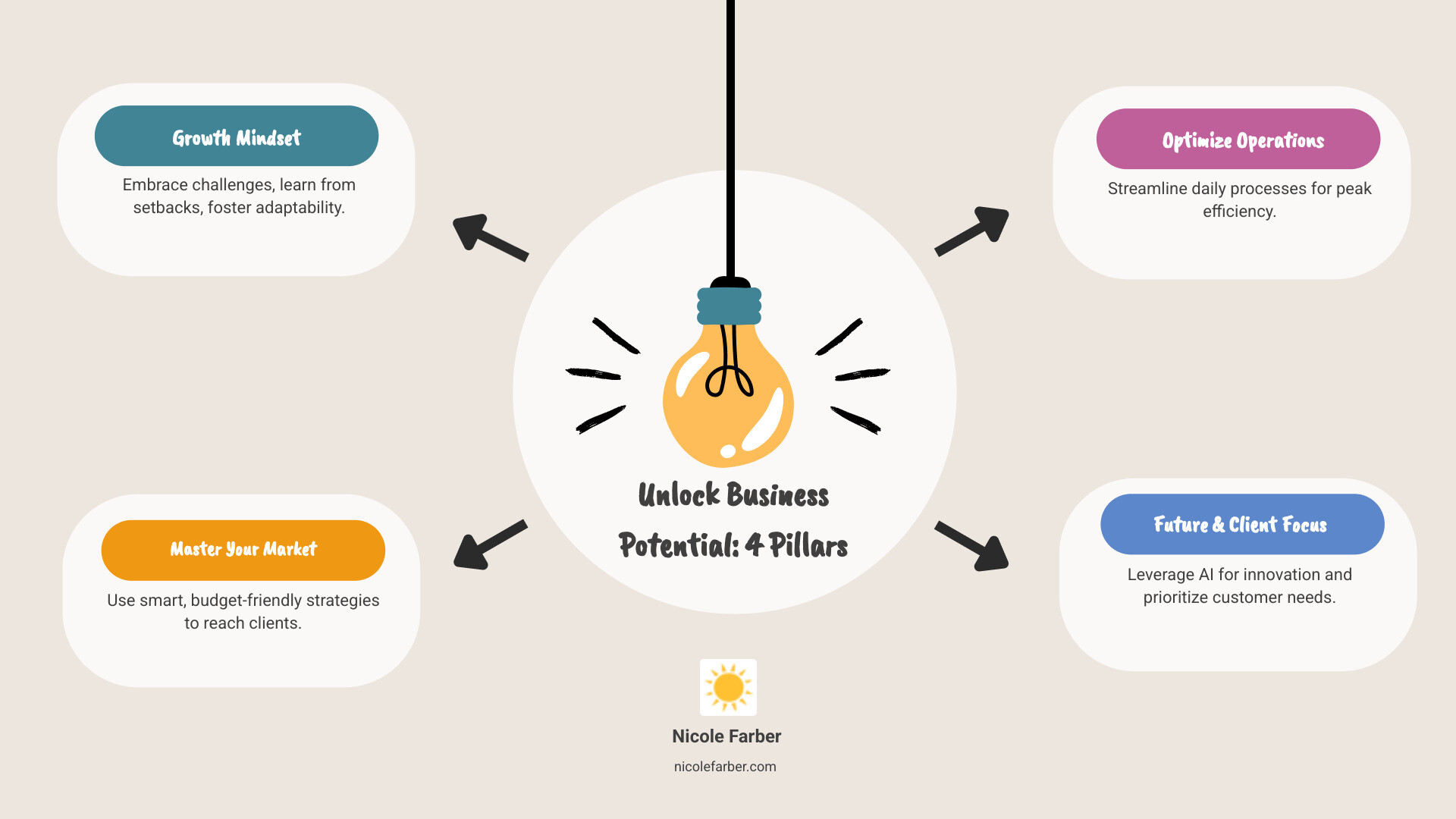
Here’s a quick overview of what it takes:
- Cultivate a Growth Mindset: Accept challenges and learn from every setback.
- Master Your Market: Use smart, budget-friendly marketing strategies to reach clients.
- Optimize Operations: Streamline your daily processes for peak efficiency.
- Harness Future Forces: Leverage new technologies, especially Generative AI, for innovation.
- Prioritize Customer-Centricity: Build lasting loyalty by deeply understanding client needs.
For law firm partners and business owners in places like Philadelphia or Wilkes-Barre, the path to growth can feel overwhelming. Juggling clients, teams, and daily demands often leaves little room for strategic thinking about digital marketing or client acquisition. It’s easy to feel stuck in operational details, but a clear strategy can be the “secret sauce” to move beyond these challenges.
As CEO of ENX2 Legal Marketing, I’ve spent over 15 years helping law firms and companies open up business potential. My passion is empowering business owners to thrive, driving success and impact.
1. Cultivate a Growth Mindset: The Foundation of Potential

After years working with entrepreneurs and law firm leaders, I’ve learned the key difference between thriving and struggling isn’t talent or resources—it’s mindset.
I’ve watched brilliant attorneys in Philadelphia and driven business owners in Wilkes-Barre hit invisible walls because they approached challenges with a fixed mindset, the belief that our abilities are set in stone. This makes us avoid challenges for fear of failure.
But a growth mindset changes everything. It’s the belief that our abilities can be developed through dedication. With this perspective, challenges become opportunities, and mistakes become learning experiences. This is the foundation we need to open up business potential.
Before adopting a growth mindset, self-awareness is key. Yet, research in the Harvard Business Review shows only 10-15% of people are truly self-aware. This means honestly assessing our strengths and weaknesses to build a complementary team and identify where we need to develop. For more insights, explore our Business Leadership Strategies.
How a Growth Mindset Helps Open up Business Potential
Clients with a growth mindset respond to setbacks not with self-doubt, but by asking, “What can I learn from this?” This perspective fosters adaptability, innovation, and resilience, changing the internal dialogue from “I’m not good at this” to “This is an opportunity to grow.”
Positive self-talk is a practical tool for building the resilience needed for Overcoming Business Challenges. Here are three daily habits to build a stronger growth mindset:
-
Be Human: Accept that imperfection is part of the learning process. This compassion creates space for growth.
-
Be Brave: View challenges as opportunities. Confronting difficulties builds the confidence needed for success.
-
Be Mindful: Pay attention to your thoughts. Redirect negativity to foster self-respect and ethical behavior.
From Employee to Entrepreneur: Making the Mental Shift
The mental shift from employee to entrepreneur is huge. I’ve walked this path myself as a single mother building a business and guided many others through it.
This journey requires a shift to a 24/7 ownership mindset. You move from executing decisions to making them, demanding new leadership skills, greater risk tolerance, and a clear vision. For guidance on these capabilities, check out How to Become an Effective Leader.
But vision isn’t enough. I’ve seen entrepreneurs in Luzerne County and beyond get caught up in an idea without a realistic business plan that considers time, funding, and knowledge.
This is where financial literacy is crucial. Many talented people fail because they don’t understand cash flow or profit margins. The U.S. Small Business Administration offers a great free resource, Money Smart for Small Business, to master these concepts.
The shift isn’t easy, but it’s achievable. It starts with a growth mindset—believing you can learn, adapt, and grow into the leader your business needs.
2. Master Your Market: Budget-Friendly Strategies for Growth

Marketing can feel overwhelming, but effective strategies don’t require a huge budget. They require smart planning, consistency, and a genuine connection with your audience.
For any business, from a law firm in Philadelphia to a startup in Wilkes-Barre, marketing is how you tell your story, show your value, and open up business potential. The foundation is understanding your ideal customer: Who are they, what are their problems, and where do they spend their time online? Once you know, you can reach them through channels like social media, SEO, and email marketing.
Leveraging Digital Channels on a Shoestring Budget
Small businesses with tiny budgets can outperform large competitors by focusing on high-ROI strategies.
Social media costs nothing to create authentic, engaging content that resonates with your audience. Being real, helpful, and consistent is key.
SEO might sound technical, but it’s about making your website helpful and easy to steer. For local businesses, local SEO is gold. A law firm optimizing for “Philadelphia family attorney” can attract qualified leads without spending on ads.
Email marketing delivers a high return by nurturing relationships with personalized, valuable content. It’s about being a trusted resource, not bombarding inboxes.
Other budget-friendly strategies include collaborating with non-competing businesses, hosting community events in places like Wilkes-Barre, creating referral programs, and encouraging user-generated content. These tactics build authentic connections and social proof, aligning with strategies for Building a Referral Network and are detailed in our guide on Key Strategies for Growing a Business.
Understanding and Adapting to Market Trends
The businesses that thrive are not always the smartest or best-funded; they are the most adaptable.
To open up business potential, you must watch your market. Consumer behavior shifts constantly. A restaurant owner in New Orleans adding plant-based options or a boutique owner pivoting to sustainable fashion are examples of meeting these shifts.
Competitive analysis isn’t about copying; it’s about finding market gaps and solving customer complaints. This market research informs smart decisions.
The businesses that survived post-Katrina New Orleans were those that pivoted strategies and adapted. This adaptability is crucial whether facing a disaster or shifting market conditions.
Adaptability means staying connected to customers and evolving when needed, without abandoning core values. This is essential for a strong Building a Business Development Plan.
3. Optimize Operations: Streamlining for Peak Efficiency
Your business operations are the engine. Without an efficient engine, great marketing and strategy won’t get you far. To truly open up business potential, your operations must run smoothly.
Integrating tools like CRM systems and project management platforms transforms how you organize tasks and communicate. For example, a Philadelphia law firm can go from manual client management to automated follow-ups, ensuring nothing falls through the cracks. This is the power of operational efficiency and why we emphasize Process Before Promotion – solid operations are essential for marketing to succeed.
Prioritizing for Impact with the Eisenhower Matrix
Feeling busy isn’t the same as being productive. We often feel like we’re drowning in tasks without making real progress.
The Eisenhower Matrix offers a simple solution, classifying tasks by urgency and importance:
- Urgent AND Important: Do now (crises, deadlines).
- Important but NOT Urgent: Schedule (strategic planning, relationship building).
- Urgent but NOT Important: Delegate (interruptions, minor tasks).
- Neither Urgent nor Important: Eliminate (distractions, time-wasters).
For a business owner in Wilkes-Barre, this framework aligns efforts with core business objectives. Focusing on high-value activities helps open up business potential and is key to Strategic Goal Setting.
The Strategic Use of Technology and Outsourcing
Technology, when used wisely, is a secret weapon. For example, platforms like SAP Business Technology Platform (BTP) have delivered incredible results, with a projected three-year ROI of 514 percent. Businesses using it have achieved 3x faster app development, reduced integration costs, and automated hundreds of processes. This shows how automation and technology integration can transform operations, a key part of our Business Growth Strategies Ultimate Guide.
Equally important is knowing when to outsource. Outsourcing non-core tasks like web design or accounting is a strategic move, not a weakness. I’ve seen entrepreneurs from New Orleans to Luzerne County burn out trying to do everything. Hiring freelancers or specialized firms is often more cost-effective and frees you to focus on your core competencies.
Optimizing operations with technology and outsourcing creates a foundation for scalable, sustainable growth, allowing you to open up business potential.
4. Harness Future Forces: Leveraging Generative AI to Open up Business Potential
Generative AI is a transformative force, much like the smartphone. It offers remarkable opportunities for businesses to open up business potential by automating tasks, personalizing customer interactions, and driving growth.
Whether in Philadelphia, Wilkes-Barre, or an emerging market like Antigua Guatemala, AI can improve, not replace, the human touch that makes your business unique. For guidance on integrating these strategies, explore our CEO Coaching Services.
Key Insights from Recent AI Reports
The numbers around generative AI are staggering. McKinsey’s 2023 report, The Economic Potential of Generative AI, estimates it could add up to $4.4 trillion to the global economy annually, with 75% of that value in four key areas: Customer Operations, Marketing and Sales, Software Engineering, and R&D.
The technology could automate 60-70% of employee tasks and boost labor productivity significantly through 2040. Investment in generative AI soared to $25.2 billion in 2023, but public perception is mixed. A Pew survey found over half of Americans are more concerned than excited, highlighting the need for responsible leadership.
The 2024 AI Index Report by Stanford helps clarify AI’s current capabilities:
| AI Strengths (Excels) | AI Weaknesses (Falls Short) |
|---|---|
| Image Classification | Advanced Mathematics |
| English Comprehension | Strategic Planning |
| Text, Image, Code Generation | Complex Reasoning |
| Customer Support Automation | Deep Empathy & Human Nuance |
This table shows AI excels at tasks like content generation but falls short in strategic planning or understanding human nuance, where judgment remains irreplaceable, especially when dealing with clients in places like New Orleans.
Practical Steps to Open up Business Potential with AI
Approach generative AI strategically, aligning it with your business goals.
First, identify key use cases. A Gartner survey shows executives prioritize AI for customer experience, revenue growth, and cost optimization. For a Luzerne County law firm, this could be drafting client communications; for a retailer, personalizing marketing.
Second, align AI initiatives with business goals. Link every project to measurable KPIs, ensuring technology serves a purpose, like improving client acquisition. This is fundamental to Building a Successful Business.
Third, start small with pilot projects. Test AI in one department or for a specific task to learn and build confidence before a larger rollout.
Finally, mitigate AI’s risks. These are practical challenges every business must address:
- Bias: AI can amplify biases from its training data. Implement human review for all outputs, especially for client interactions or hiring.
- Cybersecurity: Generative AI increases risks like deepfakes and phishing. Work with your cybersecurity team to add safeguards, especially for firms in competitive areas like Philadelphia.
- Intellectual Property & Privacy: Protect your IP and client data with clear governance policies. Educate staff on what data can be shared with AI systems.
- Responsible AI: Draft a clear policy defining responsible AI use, addressing transparency and ethics. Emphasize that AI is a tool to augment human judgment, not replace it.
By taking these steps, you can strategically use generative AI to open up business potential while protecting your business and clients.
Frequently Asked Questions about Maximizing Business Potential
What is the single most important factor in open uping a business’s potential?
There’s no single magic bullet, but the foundation for everything is a growth mindset. It keeps you flexible, curious, and resilient when facing challenges.
However, true success comes from a holistic approach. You must combine this mindset with genuine customer-centricity—truly understanding your clients—and continuous adaptation. It’s how these elements work together that allows you to open up business potential.
How can a small business with a limited budget compete with larger companies?
I hear this from entrepreneurs in Philadelphia and Wilkes-Barre often. The truth is, small businesses have unique advantages.
First, your agility is priceless. You can test and adapt ideas in days, while large companies are stuck in meetings. Second, focus on niche marketing. Being the best solution for a specific group in Luzerne County or an emerging market like Antigua Guatemala gives you an edge.
Use budget-friendly tactics like local SEO to attract qualified leads. Combine this with authentic social media engagement and strategic email marketing. Also, leverage community engagement, perhaps using resources like the Luzerne County Small Business Grant, and collaborate with non-competing businesses.
Your secret weapon is exceptional customer service. Knowing clients personally creates experiences large companies can’t replicate. This is how you win.
Is adopting AI necessary for every business to succeed today?
No, AI isn’t mandatory for every business. A New Orleans bakery or a boutique law firm can thrive without it if other areas of the business are strong.
However, AI is a growing competitive differentiator. Using it strategically provides advantages in efficiency and customer experience. It’s not about jumping on a trend; it’s about solving real problems.
My advice is to start small and practical. Find one specific pain point AI can solve, like automating routine customer service or personalizing marketing content. Assess your specific needs—a Philadelphia law firm might use AI for legal research, while a retailer might use it for inventory management.
Stay informed and open-minded. Use AI as a tool to open up business potential because it serves your goals, not just because it’s popular.
Conclusion: Your Blueprint for Lasting Success
We’ve covered a lot of ground on how to open up business potential, from mindset to AI. Your business, like a garden, needs constant care and thoughtful strategy to blossom.
Here is your five-pillar blueprint for lasting success:
- Cultivate a Growth Mindset to see challenges as opportunities for growth.
- Master Your Market with smart, budget-friendly strategies like local SEO in Philadelphia to connect with ideal clients.
- Optimize Operations by streamlining processes with technology and outsourcing to improve efficiency.
- Harness Generative AI strategically to drive innovation and efficiency.
- Prioritize Customer-Centricity to build lasting loyalty by deeply understanding and serving your clients, from Wilkes-Barre to Antigua Guatemala.
Entrepreneurship, whether in New Orleans or Luzerne County, is a dynamic journey demanding continuous learning and adaptation. Implementing these strategies will define your success.
Ready to take the next step and transform your business from “good” to “unforgettable”? For entrepreneurs and law firm leaders looking to implement these strategies with expert guidance, Nicole Farber provides faith-driven leadership and coaching. She’s passionate about empowering business owners to become the best versions of themselves, driving success and impact.
Get personalized guidance with Business Strategy Coaching.