The Top 5 Struggles of Christian Business Leaders and How to Overcome Them
- Entrepreneurship
- In the News
- December 3, 2025
Why Christian Business Leaders Face Unique Challenges in Today’s Marketplace

Christian business leaders steer a complex landscape where faith meets commerce and conviction meets compromise. While every executive faces pressure, those committed to leading with biblical principles encounter an additional layer of challenges that can feel isolating and overwhelming.
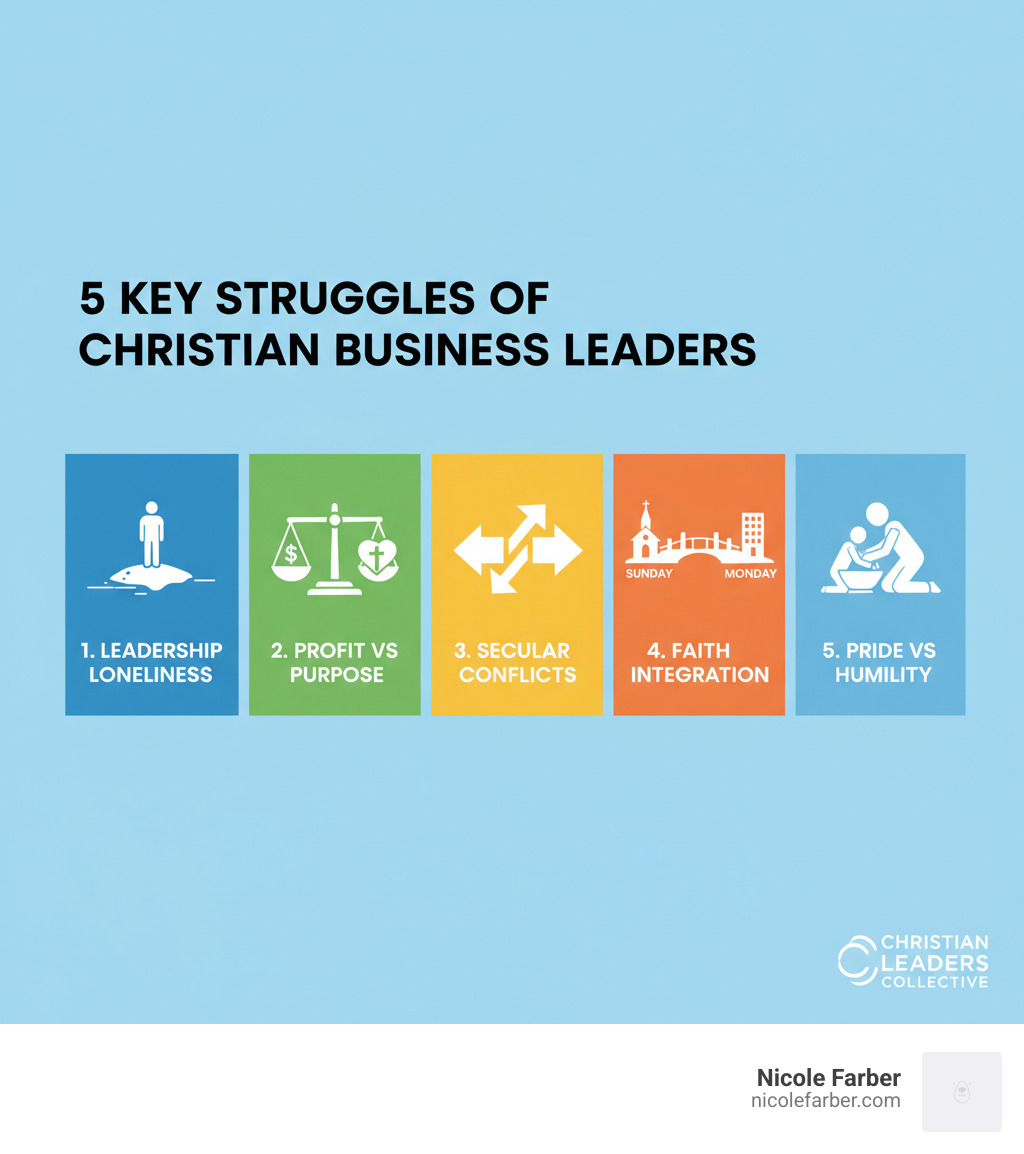
Quick Answer: The 5 Core Struggles of Christian Business Leaders
- Leadership Loneliness – The inability to confide in others about faith-driven decisions
- Profit vs. Purpose – Balancing financial success with biblical ethics
- Secular Marketplace Conflicts – Navigating opposition to faith-based values
- Faith Integration – Connecting Sunday worship to Monday work
- Pride vs. Humility – Maintaining servant leadership amid success
The numbers tell a compelling story. Over 1.5 million Christian-owned businesses operate in the United States, contributing to a faith-driven consumer market worth more than $2 trillion annually. Yet despite this, 68% of Christian business leaders report feeling unsure about how to practically integrate their faith into daily operations.
Behind the veneer of confidence, many successful executives struggle. As one CEO shared, “I feel in over my head” when facing difficult decisions about employee wages, ethical dilemmas, and spiritual integrity in a profit-driven world.
This isn’t just about running a business. It’s about answering a higher calling while meeting payroll and building something that matters beyond quarterly earnings.
I’m Nicole Farber, and I’ve spent over 15 years helping business leaders—including law firm partners across Philadelphia, Wilkes-Barre, and beyond—steer the intersection of faith, leadership, and growth. As a Christian business leader myself and a sought-after motivational speaker, I understand the unique pressures of leading with conviction in a secular marketplace while building a thriving enterprise that honors God.
This guide will walk you through the five most common struggles Christian business leaders face and provide practical, faith-based strategies to overcome them. Whether you’re leading a law firm in Luzerne County or expanding your business internationally, these principles will help you lead with integrity, purpose, and confidence.
Struggle #1: The Crushing Weight of Leadership Loneliness
There’s a particular loneliness that comes with sitting in the corner office. You make decisions that affect dozens of lives and carry burdens you can’t easily share. For a Christian business leader, that isolation cuts even deeper.
While everyone sees your confident exterior, they don’t see the sleepless nights wrestling with a decision that pits financial pressure against biblical principles. They don’t witness the quiet moments when you wonder if anyone truly understands the weight you’re carrying. As one CEO confessed, “I feel in over my head.” When revenue drops or an ethical dilemma lands on your desk, that feeling of being alone with impossible choices can be crushing.

Overcoming Isolation Through Community and Counsel
God never intended for you to lead alone. The isolation you feel isn’t a requirement of leadership—it’s a problem with a solution.
The first step is building a trusted network of fellow Christian business leaders who are navigating the same tension between faith and commerce. These are the people who won’t look at you strangely when you say you’re praying about a strategic decision.
Peer advisory groups can be transformative in breaking through isolation. They offer a safe space where you can be completely honest about your struggles. Seeking out local networks in the Philadelphia area or in Wilkes-Barre and Luzerne County can connect you with fellow believers who speak both the language of business and the language of faith.
Finding a mentor who has successfully integrated faith and business for years offers another layer of support. Their experience becomes your roadmap, saving you years of painful trial and error.
Never underestimate the power of prayer—both personal and with others. When you pray with fellow leaders who understand your challenges, you’re not just getting divine wisdom—you’re experiencing community in its truest form.
Accountability is a gift. Having trusted advisors who can ask you the hard questions—”Are you really honoring God in that decision?”—keeps you grounded and aligned with your values.
If you’re feeling overwhelmed by leadership loneliness, consider working with a Faith-Based Life Coach who understands both the business pressures you face and the biblical principles you’re trying to uphold. You don’t have to carry the weight alone. In fact, you weren’t meant to.
Struggle #2: Balancing the Scales of Profit and Principle
For Christian business leaders, decisions often feel like walking a tightrope between marketplace pressures and personal convictions. On one side, there’s the need for profit and shareholder expectations. On the other, a quiet voice asks, “Does this honor God?”
These aren’t hypothetical dilemmas. They show up in real decisions: Should we return more profit to shareholders or raise wages for struggling employees? Should we invest in higher-quality, ethical materials if it means lower margins? The tension is real, but research shows that 75% of Christian business leaders prioritize integrity in their decision-making. You’re not alone in this struggle.

How to Lead with Purpose and Profitability
Profit and principle don’t have to be enemies; a faith-driven lens can strengthen both.
Stewardship changes everything. When you realize your company belongs to God, the question shifts from “How can I maximize what’s mine?” to “How can I faithfully steward what’s been entrusted to me?” This frees you from the pressure of building your own kingdom and invites you into something much bigger.
Success needs a bigger definition. Financial health matters, but what if we also measured success by faithfulness, integrity, and the positive impact on our employees’ lives? This is the long-term vision that sets Christian business leaders apart—we’re building for eternity, not just the next quarter.
The Golden Rule isn’t just for Sunday school. “Treat others as you would want to be treated” is a powerful, practical framework for negotiating with suppliers, handling customer complaints, and structuring compensation.
Generosity is part of the business plan. For many Christian business owners, philanthropy is woven into their operations. Dave Thomas of Wendy’s founded the Dave Thomas Foundation for Adoption. The Walton family’s Walton Family Foundation issued over $749.5 million in grants in 2020 alone. And Dolly Parton‘s Dollywood Foundation has distributed millions of books to children worldwide.
These leaders prove that profitability and purpose can multiply each other’s impact. Whether you’re leading a law firm in Philadelphia or building a practice in Wilkes-Barre, leading with integrity and generosity creates a legacy that outlasts any quarterly report. If you’re wrestling with these principles, explore our resources on Faith-Based Business Leadership.
Struggle #3: Navigating Conflict in a Secular Marketplace
Operating as a Christian business leader can feel like you’re speaking a different language. Your faith-driven values don’t always align with the prevailing business culture, which can lead to misunderstanding and conflict.
Whether you’re leading a law firm in Philadelphia, building a practice in Wilkes-Barre, or expanding to places like Antigua Guatemala, you’ll encounter situations where your worldview clashes with the expectations of others. In culturally pluralistic cities like New Orleans, these tensions can be even more pronounced. Christian leaders should expect resistance simply because of their faith. The question isn’t if you’ll face opposition, but how you’ll respond.

A Guide for the Faithful Christian Business Leader in a Pluralistic World
Navigating conflict requires courage and wisdom. You must stand firm in your convictions while extending grace to those who see the world differently.
Vocational integrity is your foundation. As one respected leader puts it, credibility is defined by how you do your job. Before anyone will listen to your faith, they need to respect your competence. Delivering quality work and operating with integrity earns you the right to be heard, whether in Luzerne County or abroad.
Think of yourself as a “reverse missionary.” Your character speaks louder than any sermon. People recognize Christians “by their difference”—by the lack of gossip, vindictiveness, and office politics that can poison a workplace.
When working in diverse environments, finding common language is essential. Build bridges through universally accepted values like respect, truth, and responsibility. You don’t have to compromise your beliefs to find common ground.
Standing firm with humility is a challenging balance. Lead with conviction, but do so with grace. Be willing to listen to feedback and apologize for mistakes. Your goal is to reflect Christ, not to win arguments.
When you face direct opposition, here are three ways to respond with wisdom:
- Distinguish the source – Is this criticism about your skills (an opportunity for growth) or a challenge to your faith?
- Persevere and pray – Trust God through adversity. As the Bible reminds us, we Walk by Faith Not by Sight.
- Defend with grace – Be prepared to professionally defend your values without being confrontational. You can disagree without being disagreeable.
Your calling isn’t to conform to the world’s standards. It’s to be salt and light, demonstrating that biblical principles and business excellence are inseparable.
Struggle #4: Integrating Sunday Faith into Monday’s Work
Many Christian business leaders feel a disconnect between Sunday worship and Monday’s decisions—the “sacred-secular divide.” We leave church inspired, but by Monday morning, that clarity feels distant amid budget cuts and competitive pressures.
The challenge is that many of us lack a practical theology for our work. How do we apply God’s will to a marketing strategy or a performance review? When you’re running a law firm in Wilkes-Barre or managing a business in Luzerne County, these are daily realities.
Here’s the truth: our businesses aren’t separate from our faith; they’re an extension of it. We’re called to conduct business “for the glory of God,” which means our companies can become platforms to shape culture. Whether serving clients in Philadelphia or engaging in mission-driven work in Antigua Guatemala, your work itself can be a ministry.

Making Your Business a Place of Ministry
Bridging the Sunday-to-Monday gap means seeing your entire business through the lens of faith.
Connecting Sunday Faith to Monday Work starts with intentionally seeking God’s will for every aspect of your business—not just the big decisions, but the daily ones, too. Who you hire, how you price your services, the way you handle a customer complaint—all of it matters to God.
Creating a values-driven culture becomes natural when faith provides the framework. This isn’t about forcing religion on employees but building an environment that reflects biblical principles like respect, fairness, and generosity. These values should be reinforced in meetings, orientation, and daily interactions.
Servant leadership lies at the heart of Christian business leadership. Jesus used His power not to dominate but to serve and equip others. In practical terms, this means prioritizing your team’s well-being and development, not just your bottom line.
Daily spiritual disciplines are the fuel that keeps this integration alive. Prioritizing Bible reading, prayer, and fellowship are foundational practices. Starting and ending your day in prayer helps you stay aligned with God’s will and seek His wisdom in every decision.
When you stop viewing your business as separate from your faith and start seeing it as a ministry, everything changes. To help cultivate this integration, I invite you to explore our Ultimate Faith-Based Leadership Guide.
Struggle #5: The Battle Between Humility and Success
Success is something we work and pray for, but for Christian business leaders, it can also become a spiritual stumbling block. The temptation to take all the credit and believe we’ve earned it through our own brilliance is a real danger.
I’ve seen it happen. A business grows, and the leader who once prayed over every decision starts believing their own press. Pride creeps in. They micromanage every detail, leading to burnout and poor decisions. Research confirms that pridefulness stemming from success is a significant pitfall for Christian leaders. The fear of delegation often masks a deeper issue: we’ve forgotten who truly owns the business.

The Aspiring Christian Business Leader’s Path to Humble Strength
The most effective Christian business leaders master humble strength—leading with confidence while recognizing that every success ultimately comes from God.
Giving God the glory is where it starts. David Green, founder of Hobby Lobby, consistently attributes his business’s extraordinary growth to God’s guidance. When we remember that every good gift comes from Him, pride loses its foothold.
This naturally leads to servant leadership. Your title doesn’t make you better than your team; it makes you responsible to them. Whether you’re leading a law firm in Philadelphia or managing a practice in Wilkes-Barre, this principle remains the same.
The art of delegation flows from this servant mindset. When we trust our team members and delegate based on their strengths, we free ourselves to focus on our core gifting and empower others to grow. I’ve worked with countless leaders in Luzerne County and beyond who transformed their businesses the moment they began delegating effectively.
Employee development and empowerment should be a priority. We’re called to identify emerging talent and train the next generation of leaders, instilling godly ethics and resilient character along the way.
Finally, focus on your core gifts. Understand what you do best and delegate the rest. Operating in your “one thing” prevents burnout and ensures your energy goes where it matters most.
To help you develop these crucial qualities, we offer resources on How to Be a Good Leader and practical Business Leadership Strategies. Because leading with humble strength isn’t just good theology—it’s good business.
Frequently Asked Questions about Christian Leadership
How do Christian business leaders define success beyond financial metrics?
For Christian business leaders in Philadelphia, Wilkes-Barre, and beyond, success is defined by more than profit margins. While profitability is necessary, our definition runs much deeper.
- Spiritual Impact: Is our business making a lasting impact for God’s Kingdom? Are our actions strengthening our witness for Christ?
- Ethical Conduct: Integrity is non-negotiable. This means choosing the harder path when it’s the right one and being honest even when it costs us.
- Employee Well-being: We believe in putting employees first. A successful business is one where people flourish holistically, not just financially.
- Community Flourishing: We aim to positively impact our communities, whether in Luzerne County or New Orleans, by investing in social, economic, and spiritual capital.
- Faithfulness to Calling: Are we aligning our business with God’s will and fulfilling the unique purpose He has for our enterprise?
What are some examples of successful Christian business leaders?
The business world is full of inspiring leaders who integrated their faith and found remarkable success.
- Dave Thomas (Wendy’s) used his success to create the Dave Thomas Foundation for Adoption.
- James Cash Penney (J.C. Penney) built his retail empire on the Golden Rule, a legacy continued by the Penney Family Fund.
- Sam Walton (Walmart) created a legacy of giving through the Walton Family Foundation, which addresses major social and environmental issues.
- Dolly Parton‘s faith is the cornerstone of her philanthropy, including the Dollywood Foundation and its global book distribution program.
- David Green (Hobby Lobby) explicitly operates on biblical principles, closing on Sundays and giving roughly 50% of profits to Christian initiatives.
- Truett Cathy (Chick-fil-A) showed that unwavering commitment to principles—like closing on Sundays—can coexist with tremendous business success.
These leaders prove that Christian business leaders can achieve both commercial success and profound societal benefit. For more insights, explore our resources on Faith-Based Business Leadership.
What resources are available to support Christian business leaders?
You don’t have to figure this out alone. A growing community of resources exists to support Christian business leaders.
- Peer Advisory Groups: These groups offer a confidential space for sharing, mutual encouragement, and accountability with others who truly understand your challenges.
- Podcasts and Books: Resources for Christian leaders deliver regular inspiration and practical advice from experienced, faith-driven entrepreneurs and executives.
- Structured Learning: Our Leadership Development Seminars are designed to equip you with the tools for effective, faith-driven leadership.
- Local Networks: Faith-based business networks in areas like Philadelphia, Wilkes-Barre, and Luzerne County provide a vital sense of belonging and connect you with people who understand the challenges of leading in your region.
The journey of integrating faith and business is ongoing, but these resources, combined with personal spiritual disciplines, create a strong foundation for success.
Conclusion: Your Calling as a Christian Business Leader
The path of a Christian business leader is rarely easy. We’ve walked through the core struggles: leadership loneliness, the profit-principle tension, secular conflicts, the Sunday-to-Monday gap, and the battle with pride. These are the daily realities you face.
But your faith is not a liability in business—it’s your greatest asset. It’s the compass that guides you, the strength that sustains you, and the purpose that makes the hard work meaningful.
Your work matters. Whether you’re leading a law firm in Wilkes-Barre, building a practice in Philadelphia, or expanding to New Orleans, your business is more than an income source. It’s a ministry where you shape lives and demonstrate integrity.
These struggles are opportunities for growth. By embracing community, practicing stewardship, standing firm with grace, integrating your faith, and cultivating humility, you transform challenges into leadership strength.
As a single mother who built a business, I’ve lived these struggles. I know what it’s like to feel overwhelmed and question if faith and business can coexist. I can tell you with certainty: they can, and the sacrifices are worth it. You’re not just building a business—you’re building a legacy.
You don’t have to walk this path alone. Resources like Faith-Based Life Coaching and our Leadership Development Seminars exist to support you. Our Ultimate Faith-Based Leadership Guide is designed for leaders like you who refuse to compromise their values.
The marketplace needs Christian business leaders who will stand firm in their convictions while serving with excellence. Your community—whether in Luzerne County or beyond—needs your example.
This is your calling. If you’re ready to fully accept it and need guidance, I invite you to connect with us. Consider booking Nicole Farber as your leadership speaker in Wilkes-Barre for your next event. Together, we can open up your full potential as a Christian business leader who makes a lasting impact.