From Zero to Hero: How to Lead Any Team Building Activity Like a Pro
- Leadership
- In the News
- January 26, 2026
Why Mastering Team Building Leadership Transforms Your Practice

How to lead a team building activity starts with three essential steps: Plan with clear goals and inclusivity in mind, Facilitate by creating psychological safety and encouraging participation, and Follow Up through meaningful debriefs and measuring impact. When done right, team building transforms from awkward icebreakers into powerful catalysts for collaboration and growth.
Quick Guide to Leading a Team Building Activity:
- Define Your Purpose – Set specific goals (communication, trust, problem-solving)
- Choose the Right Activity – Match the exercise to your team’s needs and format
- Create a Safe Environment – Establish ground rules and explain the “why”
- Facilitate Actively – Observe dynamics, encourage participation, manage conflict
- Debrief Thoroughly – Connect lessons to daily work through powerful questions
- Measure Impact – Track behavioral changes and productivity shifts
The stakes are higher than you think. Businesses with agile teams are three times more likely to become top performers. Yet many leaders approach team building as an obligatory checkbox rather than a strategic investment. The result? Eye rolls, wasted time, and teams that remain siloed.
But it doesn’t have to be this way. The most successful team building isn’t about trust falls or forced fun—it’s about fostering genuine connection, improving communication, and building the collaborative muscle your team needs to thrive in today’s competitive landscape.
As Nicole Farber, CEO of ENX2 Legal Marketing with over 15 years of experience leading teams and speaking on leadership topics including at Merakey’s Annual Leadership Conference, I’ve seen how to lead a team building activity that genuinely transforms team dynamics and drives measurable results. My approach combines strategic planning with authentic facilitation, creating experiences that resonate long after the activity ends.
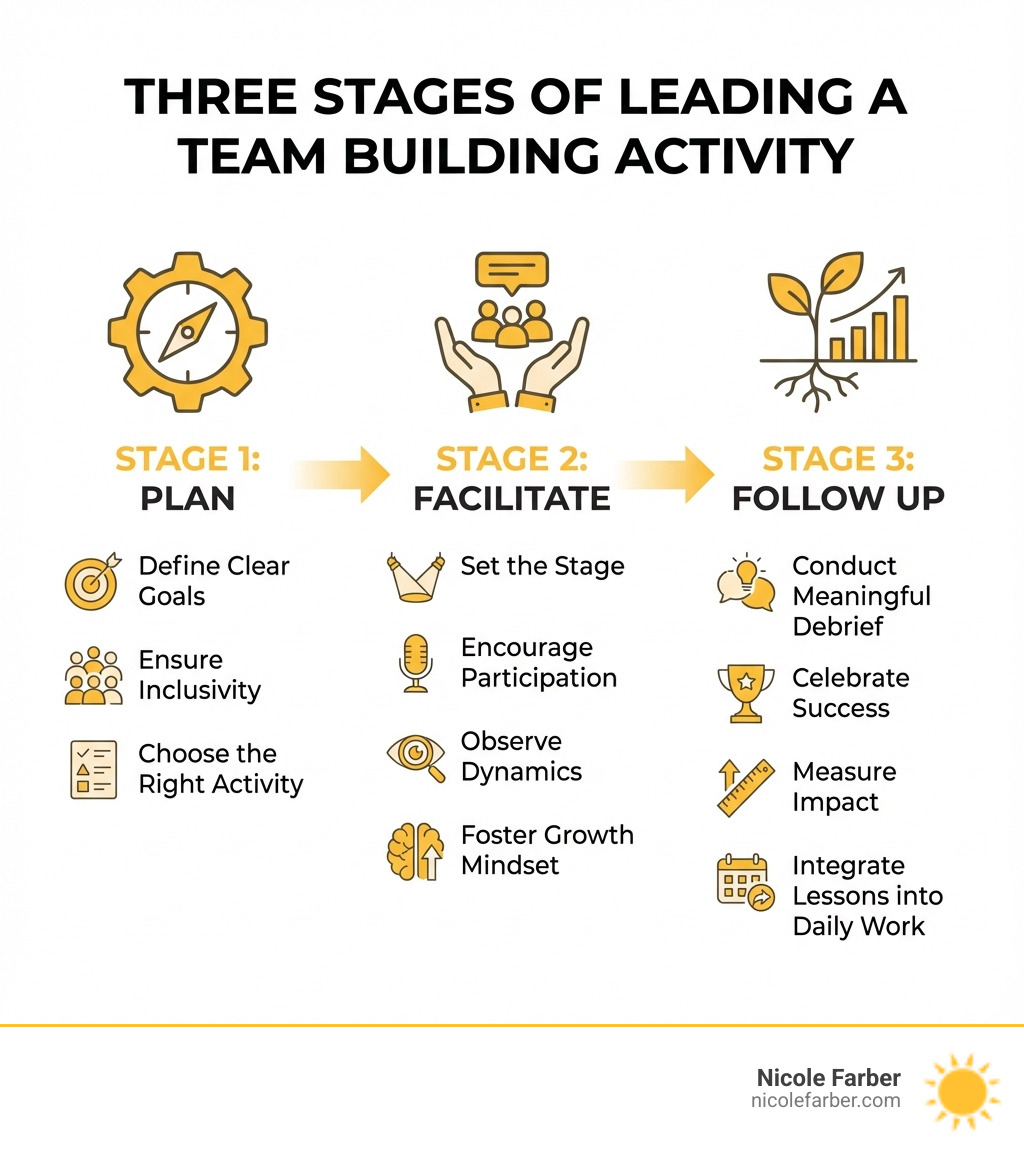
The Foundation: Strategic Planning for Meaningful Engagement

How to Lead a Team Building Activity by Starting with Why
Before we dive into the fun stuff, let’s talk purpose. The core component of any effective team building activity is a clear, well-defined “why.” Without it, even the most engaging activity can feel like a waste of time. As leaders, our most important task is to define the team’s purpose, especially when the team is losing motivation. This “why” should be short, powerful, easy to remember, and something everyone on the team can buy into and work towards as a collective unit.
When setting clear goals, consider what success looks like. Are we aiming to boost morale, improve specific communication channels, or foster creative problem-solving? Perhaps we want to focus on a specific area of development, like task allocation or time management. For instance, if our team in New Orleans is struggling with project handoffs, we might design an activity specifically to simulate and improve that process. Best practices suggest that these goals should establish what success looks like and build shared ownership. We should allow input from our team members when developing this purpose and review it regularly, perhaps quarterly or annually, to ensure alignment. This foundational step is crucial for anyone looking to Become a Good Leader: Your Team’s Guide.
Designing for Everyone: Inclusivity in Team Building
A truly successful team building activity accepts and celebrates the diversity within our teams. Inclusivity isn’t just a buzzword; it makes teams more efficient because it improves their productivity and performance. This means going beyond simply hiring diverse individuals and actively creating an accepting culture where everyone feels valued and heard. When planning, we must consider diverse perspectives, physical abilities, personality types (introverts and extroverts), and cultural backgrounds. For example, a physically demanding outdoor activity might exclude some, while a quiet, reflective exercise might not engage others.
For our remote or hybrid teams, adapting strategies is paramount. With 52% of workers believing company culture is as important in remote work as in the office, organizations are delving into virtual team building activities to tackle issues related to isolation. This could involve online escape rooms, virtual trivia, or shared digital creative projects. We also recognize the importance of hosting activities during working hours. Scheduling during lunch or with snacks significantly increases participation and shows respect for our employees’ personal time, indicating that their well-being is a priority. This approach is vital for leaders who are committed to Developing Female Leaders and all team members, ensuring everyone feels included and valued.
Choosing the Right Activity for Your Goal
Once we’ve defined our “why” and ensured inclusivity, the next step in how to lead a team building activity is selecting the perfect activity. The best choice directly aligns with our goals, whether they’re problem-solving, communication, creativity, or trust-building. Engaging in team building activities allows teams to forge connections and dig into one another’s working styles, strengths, weaknesses, likes, dislikes, thought processes, and problem-solving methodologies.
For example, if our goal is to improve problem-solving, a “Lost at Sea” exercise or an escape room challenge (like those popular in New Orleans) can be highly effective. These activities engage strategic planning, execution, and communication skills in a fun, energetic atmosphere. If we’re aiming to boost creativity, a “moonshot brainstorm” where teams develop seemingly impossible, radical solutions, or a “grab bag of creativity” using everyday items, can spark innovative thinking. To build trust, activities that require reliance on others, like a “Minefield” walk (where one person is blindfolded and guided by another), are excellent.
We also need to identify and leverage individual strengths within a team. A capability assessment can help us here, allowing us to assign work based on their strengths, which optimizes team performance and job satisfaction. We offer a variety of activity types, including:
- Communication Activities: Pantomime Chain, Drawing Communication, Icebreaker Trivia.
- Problem-Solving Activities: Lost at Sea, Escape Rooms, Marshmallow Challenge, Lego builds (like the Coriolis Effect activity).
- Creativity Boosters: Moonshot Brainstorm, Grab Bag of Creativity, Leadership Coat of Arms.
- Trust-Building Games: Minefield, Human Knot, Two Truths and a Lie.
These choices are fundamental to effective Business Leadership Strategies.
How to Lead a Team Building Activity: A Step-by-Step Facilitation Guide

Kicking Things Off: Setting the Stage for Success
The way we kick off a team building activity sets the tone for its success. Our primary goal is to create a safe space where everyone feels comfortable participating and expressing themselves. This involves clearly explaining the “why” behind the activity – how it connects to our team’s goals and overall development. For instance, if we’re doing a problem-solving exercise in Philadelphia, we’d explain how it sharpens our collective decision-making, a skill crucial for our daily projects.
Establishing clear ground rules is also vital. These might include active listening, respecting diverse opinions, and maintaining confidentiality. We encourage open communication by modeling it ourselves, being vocal about our thoughts, and listening attentively without interruption. Effective icebreakers can warm up the team and introduce new members, helping to build psychological safety from the start. Simple activities like “Two Truths and a Lie” or “Human Bingo” can quickly break down barriers, allowing team members to find commonalities and connect on a personal level. We might even use a “Staff Meeting Check-in” to start our regular meetings, asking lighthearted questions to foster connection. This approach aligns with being a Good Leader Workplace Guide.
During the Activity: How to Lead a Team Building Activity for Maximum Impact
Once the activity is underway, our role shifts to active facilitation. This means observing team dynamics closely, encouraging participation from all members, and subtly managing any conflicts that arise. We foster a growth mindset by framing challenges as learning opportunities and encouraging experimentation. For example, during a creative problem-solving workshop in Wilkes-Barre, we might remind our team that mistakes are part of the learning process, as long as we learn from them.
We continuously look for opportunities to identify and leverage individual strengths. A capability assessment can help us understand who excels in what area, allowing us to assign roles that play to these strengths. This not only optimizes performance but also boosts individual confidence and job satisfaction. We also encourage risk-taking and creativity. A recent Gallup study showed that only 29 percent of employees strongly believe they’re expected to be creative and try new things at work. To counter this, we create a judgment-free zone, allowing for “moonshot strategies” – radical solutions that take creative thinking to a new level. We reward effort and learning, not just successful outcomes, pushing employees out of their comfort zones by suggesting new skills or activities. This continuous support empowers our team members to take ownership and excel, truly helping us to Empower Your Team.
Adapting for Remote and Hybrid Teams
The shift to remote and hybrid work models has brought new challenges and opportunities for team building. Organizations are actively delving into virtual team building activities to tackle issues related to teams working in isolation. As leaders, we must adapt our strategies to ensure engagement and inclusion for all, whether they’re in our Philadelphia office or working remotely from Luzerne County.
Virtual facilitation tools and online collaboration platforms become our allies. We use video conferencing for interactive games, digital whiteboards for brainstorming, and shared documents for collaborative problem-solving. As 52% of workers think company culture is as important in remote work as in the office, creating a strong virtual presence is non-negotiable. This means ensuring our virtual activities are just as intentional and engaging as our in-person ones. Asynchronous activities, like a shared playlist or a virtual “kudos” board, can also foster connection without requiring everyone to be online simultaneously. The goal is to bridge the geographical gaps and ensure every team member feels connected, heard, and valued, regardless of their location. This adaptability is key to How to Become a Good Leader at Work.
From Activity to Action: Making the Impact Last
The Debrief: Integrating Feedback and Learning
The true magic of team building happens not during the activity itself, but in the debrief that follows. This is where we connect the dots, translating the fun and challenges into tangible lessons for daily work. Facilitating a post-activity discussion involves asking powerful questions: “What went well?”, “What was challenging?”, “How did we overcome obstacles?”, and most importantly, “How can we apply these lessons back in our roles?” For example, after an escape room challenge in New Orleans, we’d discuss how different communication styles impacted our progress and how we can improve that in our project meetings.
Creating a continuous feedback loop is essential. Team building is based on trust, which better enables communication, collaboration, and unity of purpose. We integrate feedback through one-on-one meetings, team forums, and even anonymous surveys to understand perspectives on existing processes and challenges. This allows us to review and innovate team processes, identifying bottlenecks and implementing improvements. The debrief is our chance to reinforce learning, ensuring the insights gained during the activity aren’t just fleeting moments but become ingrained behaviors that help us Develop Your Leadership.
Celebrating Success and Providing Recognition
Recognizing and celebrating successes is a powerful motivator and a critical component of effective team building. It’s not just about big wins; it’s about acknowledging contributions, rewarding teamwork, and celebrating milestones, big or small. This makes our team members feel seen, valued, and appreciated, fostering a positive and engaged environment.
How can we effectively incorporate rewards and recognition? We can host team dinners or cookouts, take the team out for coffee, or send personalized thank-you cards with small tokens of appreciation. For instance, after a successful project, we might gather our Wilkes-Barre team for a celebratory meal, or send “Kudos” with specific explanations of why we’re recognizing their efforts. We can also give certificates of recognition or plan monthly team-building events that double as celebrations. Making recognition personal and specific ensures it resonates deeply and reinforces the behaviors we want to encourage.
Measuring the ROI of Your Team Building
While team building activities might seem intangible, their impact can and should be measured. Practical ways to assess success include tracking key metrics, conducting employee surveys, and observing behavioral changes. Surveys, like those offered by tools such as Vantage Pulse, can gather feedback on how activities impacted team cohesion, understanding of colleagues’ working styles, and the addressing of team challenges. We can ask questions about perceived improvements in communication, collaboration, and problem-solving.
Beyond surveys, we look for shifts in team dynamics. Are communication channels more open? Are conflicts resolved more constructively? Is there increased cross-functional collaboration? We aim for productivity shifts. Businesses with agile teams are three times more likely to become top quartile performers. By consistently measuring the impact of our team building initiatives, we demonstrate their value and ensure they contribute to our Business Leadership Strategies Guide.
Real-World Examples and Common Pitfalls to Avoid
Inspiring Team Building Activities and Their Outcomes
Let’s look at how our teams have successfully implemented team building activities across various locations:
- Volunteer Day in Luzerne County: Our team recently participated in a community clean-up in Luzerne County. This activity fostered real intra-team relationships, built empathy, and gave everyone a shared sense of purpose beyond their daily tasks. The outcome was not only a cleaner community but a team with stronger bonds and a renewed sense of collective achievement.
- Scavenger Hunt in Historic Philadelphia: We organized a picture-based scavenger hunt through the historic streets of Philadelphia. This challenge required teamwork, communication, creative thinking, and trust. Teams had to prioritize, plan, and strategize to find clues and complete tasks, sharpening their problem-solving skills in a fun, competitive environment.
- Escape Room in New Orleans: Our New Orleans team tackled a complex escape room, requiring quick thinking and collaboration under pressure. This activity strengthened their problem-solving and communication skills, highlighting the importance of each team member’s unique contribution to the solution. Leaders even had a chance to practice following others, and those typically in the background found their voice.
- Creative Problem-Solving Workshop in Wilkes-Barre: In Wilkes-Barre, we conducted a “Moonshot Brainstorm” session. Teams were encouraged to develop radical solutions to a hypothetical business challenge, pushing the boundaries of conventional thinking. This exercise dramatically boosted creativity and encouraged a culture where innovative ideas, no matter how “foolish” they might initially seem, are welcomed and explored.
- Leadership Retreat in Antigua Guatemala: Our annual leadership retreat in Antigua Guatemala focused on a “Lost at Sea” exercise, where leaders had to prioritize survival items after a simulated shipwreck. This activity honed leadership, problem-solving, and decision-making skills under duress, reinforcing the importance of clear communication and collective strategy.
These examples illustrate the power of intentional team building, moving beyond just “fun” to achieve tangible outcomes. For more ideas and insights, check out our resources on Team building activities with Nicole Farber.
The Negative Impact of Poorly Executed Team Building
While the benefits of effective team building are clear, the potential negative impacts of poorly executed or absent activities can be significant. When team building activities fail, it’s usually because they’re a one-and-done event, or they lack clear purpose and follow-through. This can lead to decreased morale, wasted resources, and increased cynicism among team members who view it as forced fun or a distraction from real work.
Poorly planned activities can exacerbate existing team tensions, create awkward social situations, or even alienate certain individuals. If teams don’t see the relevance to their daily work, they might resist participation, leading to a negative perception of future initiatives. In the long run, absent or ineffective team building contributes to poor communication, a lack of collaboration, and ultimately, high employee turnover due to decreased engagement and morale. As leaders, we must understand that a poorly executed activity can be worse than no activity at all, as it wastes time, money, and erodes trust. This is a crucial lesson in our Good Leader Complete Guide.
Overcoming Common Challenges
Implementing team building activities isn’t always smooth sailing. We often encounter common challenges, but with thoughtful planning, we can overcome them:
- Employee Resistance: Some employees may perceive team building as unrelated or a distraction. Overcome this by clearly communicating the “why” and involving employees in the planning process. When they have a say, they have buy-in.
- Budget Constraints: Effective team building doesn’t have to break the bank. Many low-cost activities exist, such as peer-led workshops, virtual scavenger hunts, or simple creative exercises using office supplies.
- Time Limitations: Integrate shorter, impactful activities into regular meetings, like quick icebreakers or problem-solving challenges. A good cadence might be something light every month and a more structured activity once a quarter.
- Lack of Buy-in: This often stems from a lack of perceived value. Demonstrate the ROI by connecting activities directly to work goals and measuring their impact. Leaders must champion the initiative and model enthusiasm.
- Finding the Right Activity: This requires understanding your team’s specific needs, dynamics, and goals. Don’t force a square peg into a round hole. Use surveys and feedback to tailor activities to what your team genuinely needs and enjoys.
By anticipating these challenges and proactively addressing them, we can ensure our team building efforts are successful and contribute to our growth as leaders. This is a key aspect of How to Become an Effective Leader.
Frequently Asked Questions about Leading Team Building Activities
What are the core components of an effective team building activity?
The core components of an effective team building activity include a clear purpose, ensuring inclusivity for all team members, encouraging active participation, strong and empathetic facilitation, and a meaningful debrief that connects lessons learned to daily work. These elements ensure the activity is not just fun, but also productive and impactful.
How can I encourage creativity and risk-taking during an activity?
To encourage creativity and risk-taking, we must first create a judgment-free zone where all ideas are welcome. Reward effort and the willingness to try new things, not just successful outcomes. Model vulnerability as a leader, showing that it’s okay to make mistakes. Consider using exercises like a “moonshot strategy” to encourage radical thinking. Only 29% of employees feel they are expected to be creative at work, so actively fostering this environment is crucial.
What are some quick team building activities for a meeting?
For a quick boost of team cohesion during a meeting, we recommend:
- Two Truths and a Lie: Each person shares two true facts about themselves and one lie; others guess the lie.
- A Penny for Your Thoughts: Each person shares a significant event from the year etched on a coin they carry.
- Human Bingo: Create bingo cards with traits (e.g., “likes to cook,” “has traveled abroad”) and have team members find colleagues who match.
- Staff Meeting Check-ins: Start meetings with a quick, lighthearted question to foster connection.
These are excellent ways to warm up the team and can be found among other Icebreaker Activities with Nicole Farber.
Conclusion: Lead Your Team to Greatness
Mastering how to lead a team building activity is a powerful skill that transforms teams from disjointed individuals into cohesive, high-performing units. It’s a journey that encompasses careful planning, empathetic facilitation, and thoughtful follow-up, ensuring that every activity translates into lasting positive change.
As leaders, our commitment to fostering genuine connection, encouraging open communication, and nurturing a growth mindset is the critical ingredient. My personal journey as a single mother and business leader, rooted in faith-driven leadership and real-world experience, has taught me the profound impact of empowering teams through authentic engagement.
By embracing these strategies, we can move beyond the eye-rolls and truly lead our teams to greatness, building a culture of trust, collaboration, and continuous development.
Explore more leadership strategies and insights.